


 Download Free Sample
 Buy Now
Market Size
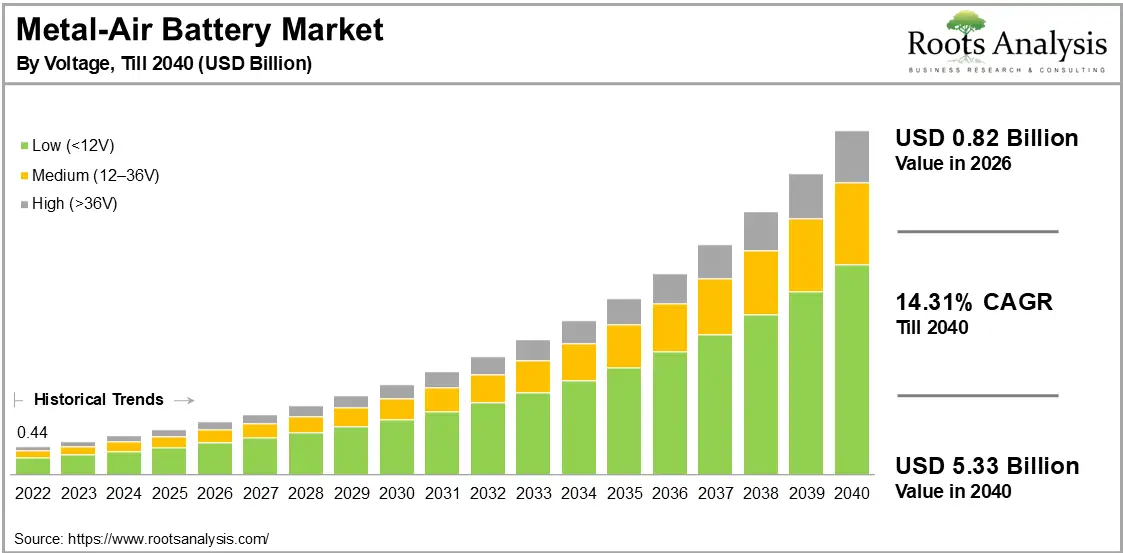
The global metal-air battery market, valued at USD 0.70 billion in 2025, is projected to reach USD 0.82 billion in 2026 and USD 5.33 billion by 2040, with a CAGR of 14.31% during the forecast period 2026 to 2040.
See What’s in the Full Report – Request Your Complimentary Insights!
Market Report: Key Takeaways
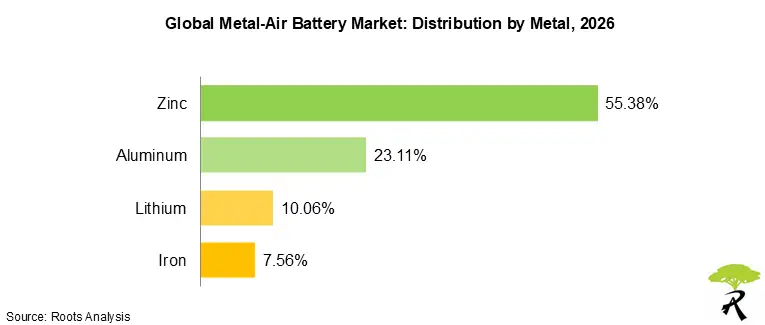
- In terms of metal, zinc secures 55.38% of the overall revenue share of the global market.
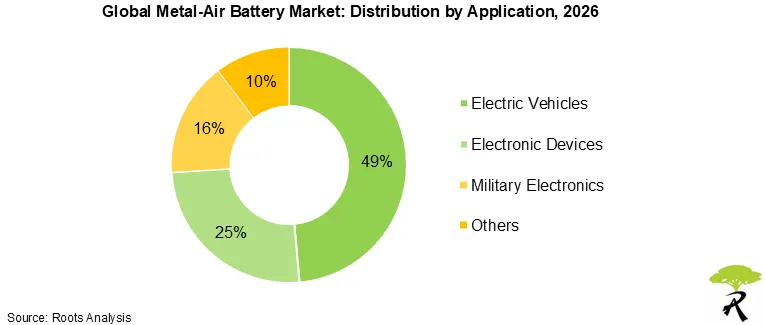
- In terms of application, electric vehicles hold the largest share (48.54%) of metal-air battery market.
- In terms of leading region Asia-Pacific holds the largest share with 53.74% share of the market.
- Growth of metal-air battery is driven by increasing demand for high density batteries and lightweight energy storage.
Market Overview
Metal-air batteries are advanced (primary or secondary) electrochemical cells that exploit the oxidation of a lightweight metal anode (such as zinc, lithium, or aluminum), paired with oxygen reduction from ambient air at a porous cathode, typically in an aqueous or non-aqueous electrolyte. This design draws oxygen directly from the atmosphere rather than storing it internally, enabling theoretical specific energies far surpassing those of conventional lithium-ion systems, often approaching the density of hydrocarbon fuels, while leveraging abundant metals for cost-effective scalability.
These batteries power diverse applications, from compact primary zinc-air cells in hearing aids and medical devices, where their high energy-to-weight ratio supports prolonged operation in miniature formats, to emerging rechargeable variants like lithium-air or iron-air systems targeted for electric vehicles and grid-scale storage metal-air technology.
In military contexts, their lightweight profile suits unmanned drones and portable power, while aluminum-air configurations show promise in underwater propulsion due to seawater compatibility; research highlights their role in bridging stationary renewables intermittency through long-duration discharge capabilities. This also fuels the aluminum-air battery market.
Market accelerates through relentless pursuit of catalysts that mitigate oxygen evolution / reduction reaction inefficiencies, alongside electrolyte innovations curbing metal anode corrosion and peroxide byproduct accumulation, persistent hurdles illuminated in electrochemical studies.
Sustainability imperatives amplify momentum, as these batteries repurpose earth-abundant metals, sidestepping cobalt or nickel scarcity, while global electrification mandates favor their intrinsic safety from aqueous chemistries that resist thermal runaway. Intensified R&D, highlighted by breakthroughs in bifunctional air electrodes and hybrid designs, establishes metal-air batteries as essential for decarbonizing transportation and enabling integration of metal-air batteries in renewable energy systems.
Pay Only for What You Need – The Best Way to Optimize
Recent Developments
- In July 2025, Ore Energy brought its first grid-connected iron-air battery online in the Netherlands.
- In April 2025, PacifiCorp, a Berkshire Hathaway Energy-owned utility, announced its plan to install 3,073MW of iron-air battery storage by 2045.
- In January 2025, SES AI signed a contract totaling up to $10 million to develop AI-enhanced Li-Metal and Li-ion batteries for EVs with two automotive OEM partners.
Market Share Insights
Zinc Metal to Lead the Metal-Air Battery Market
According to metal-air battery market report, Zinc dominates the metal-air battery segments, commanding over 55.38% share. They use proven, mature technology with ready supply chains that allow for easy, large-scale production of dependable batteries that work right out of the box.
Their water-based electrolyte makes them super safe, with no fire or explosion risks like those in lithium batteries, which is why they’re perfect for hearing aids, medical devices, and wearables where safety and reliability come first over the ability to recharge.
On top of that, zinc is cheap and widely available, non-toxic so it’s safe for people and the environment, easy to recycle at the end of life, and delivers steady voltage that matches everyday gadgets perfectly. This combo of low cost, high safety, and real-world readiness gives zinc-air battery market a huge edge over newer options like lithium-air or aluminum-air, which are still stuck in labs fixing issues like poor recharge cycles and instability.
Electric Vehicles to Shape the Future of Metal-Air Battery Industry
Electric vehicles represent the leading applications of metal-air batteries, capturing approximately 48.54% share and are projected for strong expansion through the forecast period. This dominance stems from surging worldwide EV demand as nations prioritize emissions cuts and sustainable transport, where electric vehicle metal-air batteries excel with superior energy density for extended range and better efficiency over conventional lithium-ion options.
Ongoing metal-air battery innovation and refined manufacturing further propel EV growth, with R&D targeting higher density, durability, and safety to better suit automotive needs. Government policies, including subsidies and mandates, amplify adoption by incentivizing EV fleets that leverage metal-air’s lightweight, high-capacity potential.
Regional Metal-air Battery Market Forecast Suggests Dominance of North America
Asia-Pacific dominates the metal-air battery market, capturing over 53.74% of revenue share. This supremacy arises from the region’s manufacturing powerhouse status in electronics and EVs, led by China, Japan, and South Korea, coupled with explosive demand for energy storage in renewables and booming EV fleets that prioritize high-density solutions like zinc-air and aluminum-air.
Government policies accelerating clean energy transitions, vast metal resources, and scaled production infrastructure further cement Asia-Pacific’s edge over North America’s R&D focus or Europe’s regulatory-driven growth.
Want Information on Specific Region / Segment?
Market Dynamics
Market Drivers
- Demand for High Energy Density Batteries and Lightweight Energy Storage: The use of metal-air battery technology for high energy density storage has outpaced lithium-ion counterparts. This positions them as prime next-generation energy storage solutions for electric vehicles, unmanned aerial vehicles, military applications, and consumer wearables where minimizing mass directly enhances range and endurance.
- Growth in Renewable Energy and Grid Storage Needs: Solar and wind power’s variability demands robust, extended-duration storage to stabilize grids, support peak shaving, and enable microgrids; metal-air technologies emerge as scalable frontrunners owing to their high energy-to-mass ratios and potential for stationary deployments like utility backup systems.
- Expanding R&D and Commercialization Investment: Robust funding from governments, defense agencies, and industry players for metal-air battery commercial adoption is accelerating breakthroughs in metal-air development, from advanced electrode materials and stable electrolytes to scalable production techniques that pave the way for pilot-scale deployments.
Market Challenges
- Overcoming Fundamental Materials and Chemistry Limits: Realizing extended cycle stability, rapid recharge rates, and practical deployment demands targeted innovations to resolve enduring challenges in air cathode durability, anode corrosion susceptibility, and electrolyte-metal interactions, as underscored in electrochemical research.
- Establishing Scalable, Cost-competitive Manufacturing: Crafting production pathways that yield high-purity metal anodes, resilient air electrodes, and integrated battery stacks at volume while curbing costs remains pivotal, necessitating breakthroughs in materials processing and assembly automation.
- Commercialization Timeline and Standardization Barriers: Transitioning from laboratory prototypes to market-ready, certified units entails protracted phases of rigorous validation, industry standardization, safety certification, and real-world piloting, which collectively prolong timelines for broad commercialization.
Your Business is Unique – Why Shouldn’t Your Report Be?
Key Market Insights
Competitive Landscape of Key Market Players
The metal-air battery competitive landscape features a mix of established battery giants and innovative specialists advancing zinc-air, aluminum-air, and lithium-air battery market technologies through targeted R&D in energy density and rechargeability.
NantEnergy leads with scalable zinc-air solutions for off-grid and renewable storage, leveraging modular designs for rapid deployment in emerging markets. Phinergy stands out for aluminum-air innovations tailored to electric vehicles and aviation, emphasizing swappable anodes for extended range without heavy onboard oxidizers. Arotech advances military-grade zinc-air power for drones and wearables, prioritizing ruggedness and high specific energy in compact formats.
Performance Comparison of Metal-Air vs. Lithium-Ion Batteries
Metal-air batteries can reach higher theoretical and often higher practical energy densities than lithium-ion, making them attractive where weight and runtime are critical (e.g., long-range EV concepts, some defense systems). They are typically safer and potentially cheaper at materials level since they use abundant metals and oxygen from air, but they suffer from poorer cycle life, lower round-trip efficiency, slower recharge, and more complex air / cathode management, so lithium-ion still dominates in mainstream EVs and consumer electronics.
Market Trends in Portable Electronic Devices Using Metal-Air Batteries
Portable and medical electronics (notably hearing aids and some wearable or backup devices) remain one of the most established commercial uses of zinc-air batteries. The trend is toward niche, high-energy primary cells where long replacement intervals and compact size matter more than rechargeability, while rechargeable lithium-based chemistries continue to rule smartphones, laptops, and high-drain portable devices.
Environmental Sustainability of Metal-Air Battery Recycling
- Metal-air batteries generally use abundant, non-toxic metals such as zinc or aluminum, which reduces raw-material environmental burden compared with cobalt- or nickel-rich systems.
- Their chemistries are, in principle, compatible with relatively straightforward material recovery and recycling loops, but large-scale, dedicated recycling infrastructure is still emerging and will need investment and regulation to match the maturity of lead-acid or lithium-ion recycling.
Market Segmentation
Metal-Air Battery Market: Scope of the Report
| Key Report Attributes | Details | |
| Historical Trend | Since 2020 | |
| Forecast Period | Till 2040 | |
| Market Size 2026 | USD 0.82 Billion | |
| Market Size 2040 | USD 5.33 Billion | |
| CAGR (Till 2040) | 14.31% | |
| Segments Covered |
|
|
| Key Players Profiled |
|
|
| PowerPoint Presentation (Complimentary) |
Available | |
| Customization Scope | 15% Free Customization | |
| Excel Data Packs (Complimentary) |
|
|
Market Segments
Based on research, we have segmented the metal-air battery market into metal, voltage, type of battery, electrolyte, application, geographical regions, and leading players.
By Metal
- Aluminum
- Iron
- Lithium
- Zinc
- Others
By Voltage
- Low (<12V)
- Medium (12-36V)
- High (>36V)
By Type of Battery
- Primary
- Secondary / Rechargeable
By Electrolyte
- Liquid-based
- Polymer-based
- Solid-based
By Application
- Electric Vehicles
- Electronic Devices
- Military Electronics
- Stationary Power
- Others
By Geographical Regions
- North America
- US
- Canada
- Mexico
- Rest of North America
- Europe
- Austria
- Belgium
- Denmark
- France
- Germany
- Ireland
- Italy
- Netherlands
- Norway
- Russia
- Spain
- Sweden
- Switzerland
- UK
- Rest of Europe
- Asia-Pacific
- Australia
- China
- India
- Japan
- New-Zealand
- Singapore
- South Korea
- Rest of Asia-Pacific
- Latin America
- Brazil
- Chile
- Colombia
- Venezuela
- Rest of Latin America
- Middle East and Africa (MEA)
- Egypt
- Iran
- Iraq
- Israel
- Kuwait
- Saudi Arabia
- UAE
- Rest of MEA
Have Questions? Let’s Get Them Answered.


