


 Download Free Sample
 Buy Now
Metalworking Fluids Market Overview
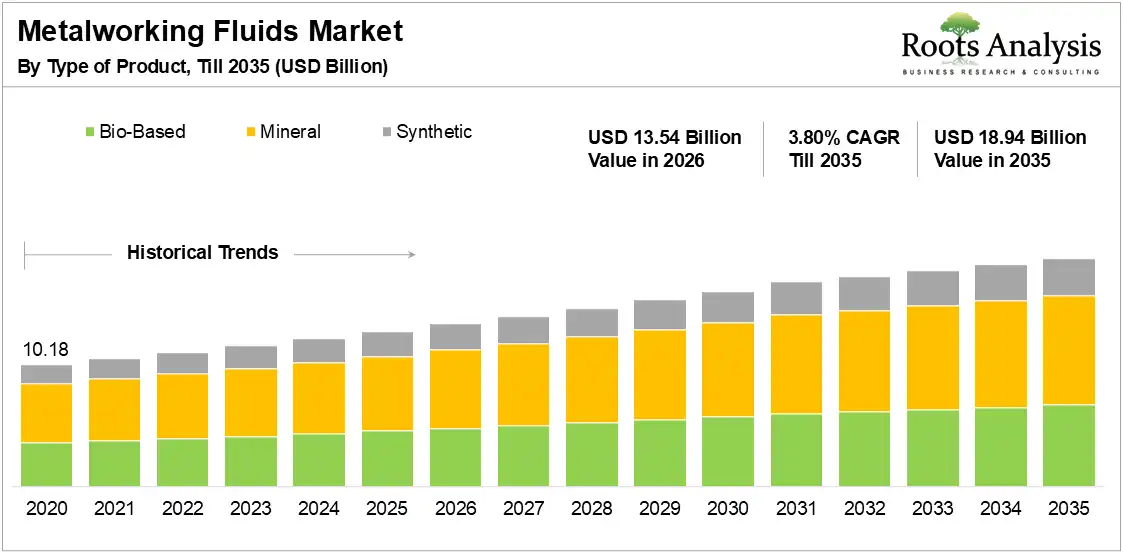
The global metalworking fluids market, valued at USD 13.54 billion in 2026, is projected to reach USD 16.27 billion by 2030 and USD 18.94 billion by 2035 with a CAGR of 3.80% during the forecast period 2026 to 2035.
See What’s in the Full Report–Request Your Complimentary Insights!
Market Report: Key Takeaways
- In terms of product, mineral accounts for the largest share (48.06%) of the market.
- With respect to application area, neat cutting oils dominate the market by holding 42% of the overall metalworking fluids market share.
- Based on the end use, machinery leads the market with 41.60% of the revenue share.
- On the other hand, transportation equipment is likely to grow at a CAGR of 5.40% during the forecast period. On the basis of vertical, automobile accounts for the largest share (42.36%) of the metalworking fluids market growth.
- According to geographical regions, Asia-Pacific leads the market by securing 42.84% of the market share.
Market Overview
Metalworking fluids refer to the specialized liquids that are used lubricate machines, cool tools, and prevent corrosion. These fluids enhance shelf life of the machines, improve surface finish and enhance productivity. Notably, metalworking fluids were widely used in industries, such as drilling, metal fabrication, milling, stamping, cutting, and grinding.
It is important to note here that the ongoing advancements in manufacturing technologies and focus on high precision machining of lightweight materials, such as aluminum and magnesium, are driving demand. Moreover, the rise of electric vehicles that require advanced lubricating and cooling are driving the metalworking fluids market growth.
Owing to its demand, several market players are encouraging partnerships and collaborations to strengthen product portfolio. For instance, in April 2025, Quaker Houghton and Idemitsu entered into a strategic partnership to offer Quaker Houghton’s water-soluble metalworking fluids to Japanese customers. These strategic partnerships and heightened demand across industrial players is likely to maintain long-term competitiveness in metalworking fluids market, offering comprehensive opportunities for innovations to industrial leaders.
Pay Only for What You Need – The Best Way to Optimize
Recent Industry Developments
- In November 2025, Americo Chemical Products acquired Fusion Chemical to expand its product portfolio, such as metalworking fluids, hybrid-cool products, and high performance next-generation lubricants and coolants across stamping and machining applications.
- In October 2025, Visual Components, QualiChem, and Master Fluid Solutions have joined the University Sheffield Advanced Manufacturing Research Center as the tier two partners. This partnership is aimed to strengthen collaborative industrial network and advanced simulation to cutting-edge fluid technologies.
- In October 2025, FUCHS acquired Swiss Partner ASEOL SUISSE to strengthen its marketplace in metalworking fluids and lubrication technology.
Market Share Insights
Mineral Products Dominate the Metalworking Fluids Market While Synthetic Products are Likely to Grow at a Higher CAGR
- Based on the metalworking fluids market report, mineral products dominates the market, accounting for over 48.06% of the market share. This highest share stems from the increasing consumption of mineral-based oils across wide range of industries, such as grinding, drilling, automotive, and milling.
- On the other hand, synthetic products will grow at a higher CAGR during the forecast period. This lucrative growth is estimated due to the ability of synthetic oil's ability to reduce friction between machine tools, parts, and extend sump life. Moreover, large scale manufacturers are increasing innovations in synthetic and semi-synthetic metalworking fluids.
Market Share by Application Area: Neat Cutting Oils Lead the Market
- According to the metalworking fluids market forecast, neat cutting oils lead the market by securing over more than 42% of the overall revenue share. The dominance can be attributed to the increasing demand for high-performance metalworking fluids in automotive sector, for engine component machining, gear manufacturing and heavy-duty forming.
- It is worth noting that the semi-synthetic oils will show robust growth during the forecast period. This highest CAGR can be ascribed to the increasing application of these fluids across various machining operations. It offer balancer balanced advantages, superior lubrication capabilities, and cooling characteristics are driving the driving across diverse industries, which further expected to drive semi-synthetic metalworking fluids market.
Have Questions? Let’s Get Them Answered.
Regional Market Growth: Asia-Pacific Dominates the Market
- The global metalworking fluids industry is distributed across North America, Europe, Asia-Pacific, Latin America, Middle East and Africa. Among these, Asia-Pacific leads the market by securing 42.84% of the overall metalworking fluids market share. The emerging electric vehicles market in Asian countries, such as India and China is increasing the demand for high-performance cutting fluids. In addition, the growing emphasis on the technological innovations, such as heat dissipation in metalworking fluids by industrial players established in this region has further fueled the growth of market in this region.
North America's Market Grows at Higher CAGR During the Forecast Period
North America is expected to witness a robust metalworking fluids market growth during the forecast period. This dynamic growth stems from the growing focus on regulatory compliance for metalworking fluid formulations and presence of well-established industrial players. It is worth mentioning that the market players are driving innovations in metalworking fluid technology to enhance its solubility, heat-dissipation capabilities, and lubrication capabilities.
Additionally, the increasing preferences for biodegradable metalworking fluids in the US and Canada are further contributing to the highest market share. Furthermore, the market players, such as Chevron, ExxonMobil, and Quaker Houghton are encouraging partnerships and investments, which strengthen the competitive edge in the region. For instance, in November 2025, Quker Houghton and Petrolube announced a strategic alliance to introduce Quaker Houghton's metalworking fluids into latter's portfolio. These initiatives are further expanding the metalworking fluids market size in this region.
Market Dynamics
Key Market Drivers
- Growth in Automotive and Heavy Machinery Manufacturing: It is important to note here that the heavy manufacturing machines require regular oiling to reduce wear / tear damage due to friction. Moreover, the metalworking fluids are useful in surface finishing to extend machine life and precision. With growing production of electric vehicles, construction machinery, airplanes and other automotives, there is a surge in the demand for metalworking fluids for precision machining and cutting operations.
- Increasing Focus on Manufacturing Efficiency and Productivity: Industrial players are widely emphasizing on improving efficiency and productivity of the machines, which further demand advanced metalworking fluids for corrosion prevention in industrial applications. These tools reduce downtime and improve chip handling for productivity optimization.
- Stringent Regulations on Environmental Impact: The increasing emphasis on regulatory compliance for metalworking fluid formulations to enhance worker safety, waste disposal, VOC emissions, and fluid toxicity are encouraging the adoption of low-emission, safer, and sustainable fluid formulas for machines.
Market Challenges
- Ensuring Compatibility with Next-gen Metals and Additive Manufacturing: The advancements in machine technology and materials composites, such as 3D-printed metals, and high strength alloys require advanced fluid chemistries. Therefore, ensuring compatibility of metalworking fluids with next-gen metals and additive manufacturing may create commercial hurdles and technical challenges.
- Balancing Performance, Sustainability, and Cost: It is worth mentioning that the industrial players are required to focus on biodegradable metalworking fluids to meet regulatory guidelines. These eco-friendly / bio-based metalworking fluids are expensive. Therefore, maintaining sustainability while balancing performance, and cost can be challenging for the market players.
- Implementation and Acceptance of Fluid Recycling Technologies: It is important to note here that recycling and disposal solutions for used metalworking fluids require high capital investment and require long payback period. Moreover, recycling often requires additional infrastructure, including dedicated piping, holding tanks, and space further increase the cost of fluid recycling technologies. Therefore, the implementation and acceptance of fluid recycling technologies can be a significant challenge for the market players.
Get an Instant Quote in 10 Minutes. Lowest Price Guaranteed
Key Market Insights
Metalworking Fluids Market Competitive Landscape
The market for metalworking fluids is highly competitive, featuring the presence of several small, mid-sized, and large industrial players. These industrial players are increasingly emphasizing the development of biodegradable metalworking fluids and recycling technologies. In order to strengthen the portfolio, several market players are forging partnerships and collaborations.
Several market players are greatly emphasizing on innovations in metalworking fluids and technologies, which is likely to maintain long-term competitiveness in the metalworking fluids market.
Market Trends in Eco-Friendly and Bio-Based Metalworking Fluids
The consistent focus on innovations in green chemistry for the development of bio-based and advanced synthetic fluids with low toxicity is favoring the future water-based metalworking fluids market growth. Considering the ongoing opportunities, several market players are focusing on the R&D activities to advance the development of bio-based and synthetic fluids while keeping sustainability goals on priority.
For instance, in May 2025, Clariant introduced its latest innovations in synthetic metalworking fluids at Inter Lubric 2025. The company has presented into advanced synthetic metalworking fluids under the slogan "Clariant fully synthetic metalworking fluids: Perform Hero, Wear Zero". The company has also highlighted three additions to its Hostagliss product line that deliver maximum efficiency and performance. These strategic innovations will address the ongoing demand for recycling and disposal solutions for used metalworking fluids.
Growth in Precision Engineering and Specialty Manufacturing
The future focus will be on the development of precision engineering and specialty manufacturing. This ongoing trend along with the adoption of advanced real-time monitoring equipment in manufacturing industry is creating the demand for specialty fluids that are tailored for micro-machining and unique cooling needs.
Market Segmentation
Metalworking Fluids Market: Scope of the Report
| Key Report Attributes | Details | |
| Historical Trend | Since 2020 | |
| Forecast Period | Till 2035 | |
| Market Size 2026 | $ 13.54 Billion | |
| Market Size 2035 | $ 18.94 Billion | |
| CAGR (Till 2035) | 3.80% | |
| Segments Covered |
|
|
| Key Players Profiled |
|
|
| PowerPoint Presentation (Complimentary) |
Available | |
| Customization Scope | 15% Free Customization | |
| Excel Data Packs (Complimentary) |
|
|
Market Segments
Based on research, we have segmented the metalworking fluids market into type of product, application area, end user, vertical, geographical regions, and key players.
By Product
- Bio-based
- Mineral
- Synthetic
By Application Area
- Corrosion Preventive Oils
- Neat Cutting Oils
- Soluble Cutting Oils
- Semi-Synthetic Cutting Oils
- Synthetic Cutting Oils
- Water Cutting Oils
- Others
By End Use
- Equipment
- Machinery
- Metal Fabrication
- Transportation
By Vertical
- Agriculture
- Automobile
- Aerospace
- Construction
- Electrical & Power
- Marine
- Rail
- Telecommunication
By Geographical Regions
- North America
- US
- Canada
- Mexico
- Rest of North America
- Europe
- Austria
- Belgium
- Denmark
- France
- Germany
- Ireland
- Italy
- Netherlands
- Norway
- Russia
- Spain
- Sweden
- Switzerland
- UK
- Rest of Europe
- Asia-Pacific
- Australia
- China
- India
- Japan
- New-Zealand
- Singapore
- South Korea
- Rest of Asia-Pacific
- Latin America
- Brazil
- Chile
- Colombia
- Venezuela
- Rest of Latin America
- Middle East and Africa (MEA)
- Egypt
- Iran
- Iraq
- Israel
- Kuwait
- Saudi Arabia
- UAE
- Rest of MEA
Pay Only for What You Need – The Best Way to Optimize


