Microplastic Fillers Market
Microplastic Fillers Market, Till 2035: Distribution by Type of Fillers (Polyethylene, Polypropylene, Polystyrene, Polyvinyl Chloride and Thermoplastic Elastomers), Type of Form (Granulation, Liquid, Pellets and Powder), Type of Application (Adhesives, Coating, Composites, Plastics and Rubber), Type of End Users (Automotive, Construction, Consumer Goods, Electronics and Healthcare) and Geographical Regions (North America, Europe, Asia, Latin America, and Middle East and North Africa and Rest of the World): Microplastic Fillers Industry Trends and Global Forecasts.
-
Lowest Price Guaranteed
-
Slides
171 -
Last Updated
February 2025 -
View Count
10473 -
Microplastic Fillers Market Overview
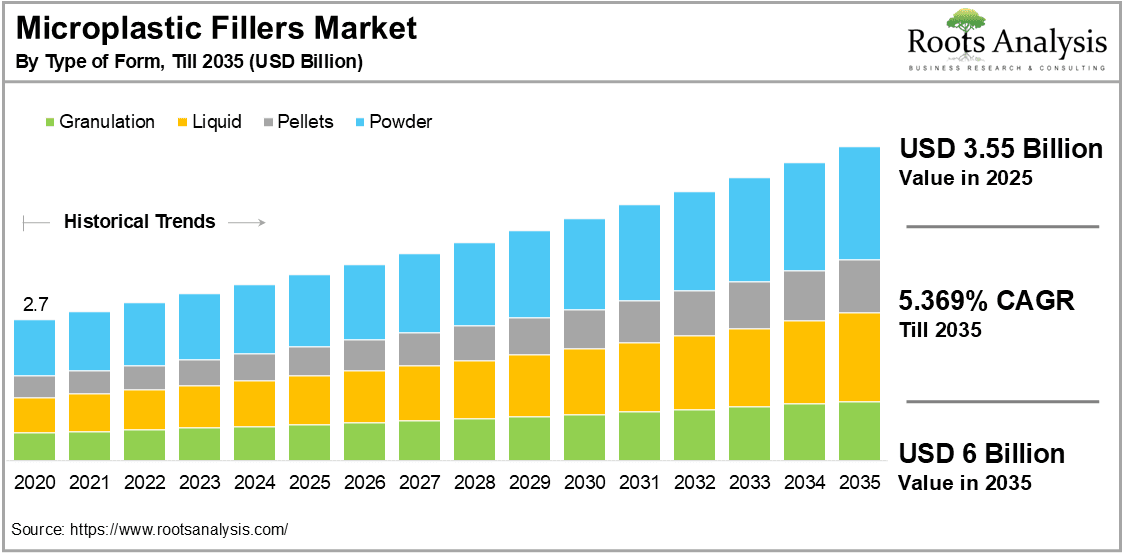
The global microplastic fillers market size is projected to grow from USD 3.55 billion in 2025 to USD 6 billion by 2035, representing a CAGR of 5.369%, during the forecast period till 2035.
 |
To learn more about this report, request a free sample copy
The new research study consists of microplastic fillers industry analysis, detailed market forecast analysis, and providing actionable strategic recommendations.
Tiny particles of plastic coupled with advanced functionalities such as improved moldability and stability, have played a pivotal role in the growth of the market. The polyethylene microplastic fillers are versatile that allows them to easily solute in any material. In addition, exceptionally light weight and low prices benefit weight and cost-reduction. It is worth highlighting that the stretching properties instead of breaking has contributed to adoption of plastic additive for durability. The polypropylene microplastic fillers can be effortlessly integrated with other composites, enhancing their suitability for engineering and injection molding. Further, microplastic fillers are favored for rheology modifiers in industrial applications that enhance texture and smoothness of the product, generally, surging usage of microbeads in cosmetics. These also features applications of lightweight material in construction due to the ability of providing strength and flexibility to used material that require withstanding physical stress and extreme weather. Notably, microplastic fillers market trends are fueled by rising demand for sustainable and biodegradable packaging solutions.
The global microplastic fillers demand is expected to grow significantly over the forecast period due to the rapid consumer growth in emerging economies like China and India. Additionally, microplastic fillers are used due to features such as abrasion-resistance and low maintenance that equips them with a long-life duration. One of the advancements in microplastic fillers technology includes the development of new biodegradable materials that break down into harmless sugar and amino acids after use, which allows for healthy environmental growth and improved sustainable solutions. This has become pivotal in the future of microplastic fillers in industries such as cosmetics, automotives and construction.
Microplastic Fillers Market Insights
The global microplastic fillers market research report presents an in-depth analysis of the various companies that are involved in offering microplastic fillers, across different segments, as defined in the table below:
Microplastic Fillers Market: Report Attributes / Market Segmentations
| Key Report Attributes | Details | |
| Historical Trend | Since 2020 | |
| Forecast Period | Till 2035 | |
| Market Size Value by 2025 | $ 3.55 Billion | |
| Market Size Value by 2035 | $ 6 Billion | |
| CAGR (Till 2035) | 5.369% | |
| Type of Fillers |
|
|
| Type of Form |
|
|
| Type of Application |
|
|
| Type of End Users |
|
|
| Geographical Regions |
|
|
| Leading Market Players | ||
| PowerPoint Presentation (Complimentary) |
Available | |
| Customization Scope | 15% Free Customization | |
| Excel Data Packs (Complimentary) |
|
|
Microplastic Fillers Market Segmentation
Market Share by Type of Fillers
Based on the type of fillers, the global microplastic fillers market is split into polyethylene, polypropylene, polystyrene, polyvinyl chloride, and thermoplastic elastomers. Currently, according to our analysis, polyethylene is augmenting the segment's growth with over 40% market share. This can be attributed to its easy availability, inexpensiveness and versatility that makes it moldable when heated. Further, low strength and hardness makes it favorable for application in packaging and consumer goods.
However, the polyvinyl chloride segment is also expected to grow with a relatively higher (6.57%) CAGR in the near future. This can be ascribed to its long-life span, low maintenance requirements and exceptional resistance to all inorganic chemicals.
Market Share by Type of Form
On the basis of the type of form, the microplastic fillers market is bifurcated into granulation, liquid, pellets and powder. The powder form is anticipated to dominate the segment with more than 40% of market share in 2025. This can be attributed to its manufacture-cost reducing approach, improved moldability and stability and reduction of thermal expansion, making it ideal for food, pharmaceutical and chemical industries.
On the other hand, the liquid segment is expected to witness a relatively faster (6.64%) market growth rate by 2035. This can be ascribed to rapidly growing microplastic fillers applications in cosmetics, automotive and construction due to its excellent dispersion and smooth texture.
Market Share by Type of Application
Based on the type of application, the microplastic fillers market is split into adhesives, coating, composites, plastics and rubber. Currently, according to our analysis plastics is augmenting the segment's growth with over 30% of the market share. Further, this is expected to grow with a relatively higher (6.74%) CAGR in the near future. This can be attributed to its ability to reduce cost and weight and resistance against heat. It is worth highlighting that these performance-enhancing fillers are favored for their capability of offering strength and durability despite being a light-weight material.
Market Share by End Users
On the basis of the end users, the microplastic fillers market is bifurcated into automotive, construction, consumer goods, electronics and healthcare. The consumer goods segment is anticipated to dominate the segment with more than 45% of market share in 2025. Additionally, this segment is expected to witness a relatively faster microplastic fillers market growth rate (7.01%) until 2035. This can be ascribed to its vast offering such as cosmetics, packaging, and appliances. Majorly, cosmetic formulations with microplastics to increase visuals of products and acquiring appealing texture has secured market opportunities in microplastic fillers.
Microplastic Fillers Market by Region
This segment highlights the distribution of microplastic fillers demand analysis across various geographical regions such as North America, Europe, Asia, Latin America, Middle East, North Africa, and the rest of the world. According to our market analysis of microplastic fillers, Asia exhibits dominance in the market with over 45% of the microplastic fillers market share in the global marketplace. This can be attributed to its high population that demands more consumer goods. Additionally, investments in development of sustainable microplastic fillers and microplastic fillers market research have led the microplastic fillers market in the region.
However, North America is also projected to grow with a relatively higher CAGR (6.94%) in the forecasted period. Primary reasons for this growth include the development of microplastic fillers for construction materials and application of polyvinyl chloride (PVC) fillers in chemicals and pipes. Further, surging demand for sustainable packaging solutions has played a pivotal role in growth of microplastic fillers in the region.
Microplastic Fillers Market Key Insights
The “Microplastic Fillers Market, Till-2035: Industry Trends and Global Forecasts" report features an extensive study of the current market landscape, market size and future opportunity within microplastic fillers market, during the given forecast period. The market report highlights the efforts of several stakeholders involved in this rapidly emerging segment of the service providers industry. Key takeaways of the global microplastic fillers market size report is briefly discussed below.
Key Drivers of Microplastic Fillers Market
An increasing demand for light-weight material that provides strength, and durability is majorly driving the microplastic fillers industry. Further, rising adoption of sustainable packaging and biodegradable microplastic fillers are one of the major key drivers of the domain. Moreover, services provided by microplastic fillers such as versatility, cost-reduction and improved moldability and stability are playing pivotal role in growth of the market. Notably, features including resistance to diluted acids, diluted alkalis and aliphatic hydrocarbons have further propelled market growth.
Microplastic Fillers Market Competitive Landscape
The global microplastic fillers market is experiencing intense competition and changing dynamics due to the presence of several small and large metamaterial companies. In terms of market share, large enterprises and multinational companies are dominating the market with over 70% of the market share. Prominent reason for this lead can be quality products and brand loyalty. While small metamaterial players are continuously improving their products to cater niche markets. These industry players are focusing on adopting competitive strategies, such as developing innovative metamaterial techniques, forming strategic alliances and partnerships to expand and global footprint.
Challenges in Microplastic Fillers Efficiency
Despite strong market growth projection, the microplastic fillers market faces numerous challenges. The most common challenge is regulatory challenge for microplastics as many countries and organizations have neglected the production of microplastic fillers. In addition, environmental issues, as these particles are highly difficult to detect due to their extremely small size. Further, posing a risk to human health and environmental impact of microplastics.
Regional Analysis: Asia is Expected to Dominate the Market with the Largest Microplastic Fillers Market Share
Asia currently holds a substantial share of approximately 45% in the microplastic fillers market opportunities. This dominance can be attributed to several factors, including growing adoption of sustainable and bio-degradable packaging solutions. Further, cost-reduction of manufacturing and versatile properties have played a vital role in growth of domain the region. It is worth highlighting that the presence of major players, including LG Chem and Mitsubishi Chemicals, enhances the region's market position through innovation and competition. Notably, substantial investments in research and development, leading to the creation of superior and eco-friendly materials is one of the major governing reasons for growth in the region. Additionally, the large prevalence of transportation has played a role in enhancement of microplastic fillers industry in the region.
Leading Microplastic Fillers Companies
Examples of key player involved in the microplastic filler market (which have also been captured in this market report, arranged in alphabetical order) include BASF, Clariant, Covestro, Dow Chemicals, Eastman, ExxonMobil Chemical, Goonvean Fibres, Honeywell, Huntsman, Kraton, LG Chem, Mitsubishi, POLYFILL, SABIC, Schiling, Solvay, Teijin and Tosoh. This market report includes an easily searchable excel database of all the companies who have adopted the microplastic fillers market.
Microplastic Fillers Market Report Coverage
The market report presents an in-depth analysis, highlighting the capabilities of various companies engaged in this domain, across different segments. Amongst other elements, the market report includes:
- A preface providing an introduction to the full report, microplastic fillers market, 2020-2024 (Historical Trends) and 2025-2035 (Forecasted Estimates).
- An outline of the systematic research methodology adopted to conduct the study on the microplastic fillers market, providing insights on the various assumptions, methodologies, and quality control measures employed to ensure the accuracy and reliability of our findings.
- An overview of economic factors that impact the overall microplastic fillers market, including historical global microplastic fillers market trends, currency fluctuation, foreign exchange impact, recession, and inflation measurement.
- An executive summary of the insights captured during our research. It offers a high-level view on the current state of the microplastic fillers market and their likely evolution in the mid-long term.
- A detailed assessment of the microplastic fillers market landscape, based on several relevant parameters, including years of experience, company size, location of headquarters, and ownership structure.
- Elaborate profiles of prominent players engaged in the microplastic fillers market, featuring information on their year of establishment, location of headquarters, company size, company mission, company footprint, management team, contact details, financial information, operating business segments, microplastic fillers portfolio, moat analysis, recent developments, and an informed future outlook.
- A qualitative assessment of the various megatrends ongoing in the microplastic fillers industry, including the increasing research and development focus on sustainable and biodegradable packaging solutions and the versatility and cost-reduction properties.
- An analysis highlighting the key unmet needs across microplastic fillers industry, featuring regulatory pressure and environmental degradation.
- An in-depth analysis of various patents that have been filed / granted related to microplastic fillers and its components, based on various parameters, such as type of patent, patent publication year, patent age and leading players
- A detailed analysis of recent developments in the microplastic fillers domain, based on relevant parameters such as year of initiative, type of initiative (partnerships and collaborations, expansions, funding and product launches), geographical distribution and most active players (in terms of number of recent developments).
- Key winning strategies framework that helps in analyzing the level of competition within an industry, by tracing the key market activities including partnership, funding, expansion of leading players
- A qualitative analysis, highlighting the five competitive forces prevalent in microplastic fillers industry, including threats for new entrants, bargaining power of suppliers, bargaining power of customers, threats of substitution and rivalry among existing competitors.
- A discussion on affiliated global microplastic fillers price trends, key drivers and challenges, under a SWOT framework, which are likely to impact the industry’s evolution, along with a Harvey ball analysis, highlighting the relative effect of each SWOT parameter on the overall microplastic fillers market.
- A value chain analysis featuring a discussion on various stakeholders involved in the development of the microplastic fillers market, from microplastic fillers suppliers to end-users.
- A detailed estimate of the current microplastic fillers market size and share of the future growth potential of the market over the next decade. Based on multiple parameters we have provided an informed estimate on the market evolution during the forecast period 2025-2035. The report also features the likely distribution of the current and forecasted opportunity within the microplastic fillers market. Further, in order to account for future uncertainties and to add robustness to our model, we have provided three forecast scenarios, namely conservative, base, and optimistic scenarios, representing different tracks of the industry’s growth.
- Detailed projections of the current and future market across various type of fillers such as polyethylene, polypropylene, polystyrene, polystyrene, polyvinyl chloride and thermoplastic elastomers.
- Detailed projections of the current and future market across various type of form such as granulation, liquid, pellets and powder.
- Detailed projections of the current and future market across various type of application such as adhesives, coating, liquid, pellets and powder.
- Detailed projections of the current and future market across various type of end users such as automotive, construction, consumers goods, electronics and healthcare.
- Detailed projections of the current and future microplastic fillers market across various geographical regions, such as North America (US, Canada, Mexico and other North American countries), Europe (Austria, Belgium, Denmark, France, Germany, Ireland, Italy, Netherlands, Norway, Russia, Spain, Sweden, Switzerland, UK and other European countries), Asia (China, India, Japan, Singapore, South Korea and other Asian countries), Middle East and North Africa (Egypt, Iran, Iraq, Israel, Kuwait, Saudi Arabia, UAE and other MENA countries), Latin America (Brazil, Chile, Colombia, Venezuela and other Latin American countries) and rest of the world (Australia, New Zealand and other countries).
Author: Ronit Sharma and Shivam Tiwari
Customization Opportunities
At Roots Analysis, we genuinely care about your success and understand that your business requirements are unique. While our market research reports provide valuable insights, we recognize that they might not cover every aspect you need to make well-informed strategic decisions. To account for that, we offer 15% free report customization tailored to your specific needs. Whether you require additional quantitative analysis, qualitative insights, or any other information related to the microplastic fillers market, reach out us today at: support@rootsanalysis.com