
Lowest Price Guaranteed
Slides
211
Last Updated
April 2025
View Count
16442
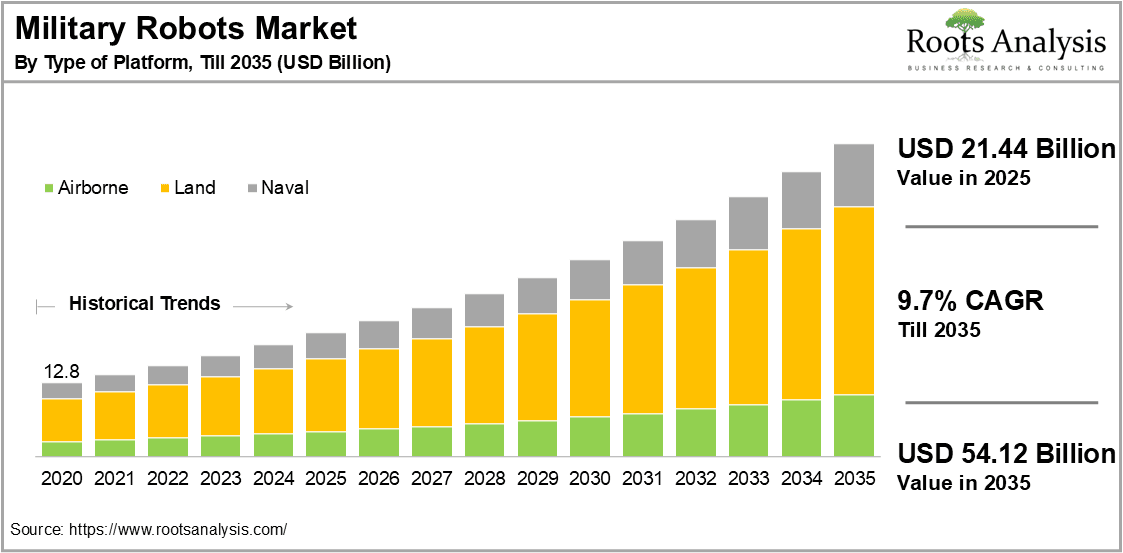
The military robots market size is projected to grow from USD 21.44 billion in 2025 to USD 54.12 billion by 2035, representing a CAGR of 9.7%, during the forecast period till 2035.
 |
To learn more about this report, request a free sample copy
The new research study consists of military robots industry analysis, detailed automotive military robots market analysis, mega trends, patent analysis, porter five forces, SWOT analysis, value chain analysis and other strategic frameworks.
In the last 5 year, conflicts have doubled across the globe. Notably there was a 25% YoY rise in political violence in 2024. These statistics emphasis on emergence of military robots. Military robots are autonomous or remotely controlled machines specifically designed for military applications. It is worth highlighting that these robots functions including combat, surveillance, transportation, and search and rescue operations. Few of the major advantages of military robots include increased situational awareness, the ability to conduct missions in hazardous conditions, and the potential for rapid decision-making in fast-paced combat scenarios.
The global military robots demand is expected to grow significantly over the forecast period due to the rising geopolitical tensions and public demand for reduced military casualties further propel the adoption of robotic solutions in modern warfare, reflecting a shift toward innovative military technologies.
The military robots market is emerging as a critical component in the global shift towards innovation and digital transformation in defense. Rising integration of artificial intelligence (AI), machine learning (ML), and advanced sensor technologies have enhanced the autonomy and efficiency of these systems, enabling them to perform complex tasks with minimal human intervention. Additionally, the emergence of swarm robotics and enhanced communication networks promises to revolutionize military strategies by allowing coordinated actions among multiple robotic units. Further, as technologies continue to evolve, military robots are expected to play an increasingly pivotal role in defense operations.
The military robots market research report presents an in-depth analysis of the various service providers that are involved in offering military robots market, across different segments, as defined in the table below:
| Key Report Attributes | Details | |
| Historical Trend | Since 2020 | |
| Forecast Period | Till 2035 | |
| Market Size Value in 2025 | $ 21.44 Billion | |
| Market Size Value by 2035 | $ 54.12 Billion | |
| CAGR (Till 2035) | 9.7% | |
| Type of Platform |
|
|
| Mode of Operation |
|
|
| Type of Propulsion |
|
|
| Type of Application |
|
|
| Geographical Regions |
|
|
| Leading Market Players |
|
|
| PowerPoint Presentation (Complimentary) |
Available | |
| Customization Scope | 15% Free Customization | |
| Excel Data Packs (Complimentary) |
|
|
Based on the type of platform, the global military robots market is split into airborne, land and naval. Among the categories, the land-based military robots segment is expected to gain nearly 55% of the current market share. Further, this segment is expected to expand with a relatively higher (10.35%) CAGR till 2035. This can be attributed to several factors, including its versatility and broad range of military robots applications, including reconnaissance, surveillance, logistics support, and explosive ordnance disposal robots.
The global military robots market is segmented into various modes of operation, such as autonomous and semi-autonomous. According to our analysis the semi-autonomous segment will augment the segment's growth with the largest military robots market share of around 65% by 2035. Prominent reason for this dominance include their effective blend of automation and human oversight, which enhances operational efficiency while mitigating risks.
However, autonomous military robots segment is expected to grow with the highest CAGR of 10.56% till 2035. This can be attributed to advancements in autonomous technologies, which enhance operational efficiency and effectiveness on the battlefield.
The global military robots market is segmented into various type of propulsion, such as electric, hybrid and mechanical. According to our analysis, the electric propulsion segment will augment the segment's growth with the largest military robots market share of around 55% by 2035. This can be ascribed to its numerous advantages, including lower operational costs, reduced noise levels, and enhanced maneuverability, which are crucial for stealth operations.
However, hybrid propulsion segment is expected to grow with the highest CAGR of 10.47% till 2035. This can be attributed to its unique ability to combine the strengths of both electric and conventional propulsion systems, resulting in enhanced operational flexibility and efficiency.
On the basis of the type of application, the military robots market is bifurcated into firing, image capturing and surveillance, metal/mine detections, pick and place, warfield operations and others. As per our research, the image capturing and surveillance segment is projected to hold the majority of the market shares, nearly 40%, and will drive the segment growth until 2035. This can be ascribed to the increasing need for real-time situational awareness in complex operational environments.
However, the warfield operations segment is expected to grow with the highest CAGR of 10.7% in the forecasted period. This can be attributed to advancements in technology, particularly in artificial intelligence and machine learning, which enhance the capabilities of autonomous systems on the battlefield.
This segment highlights the distribution of military robots across various geographical regions, such as North America, Europe, Asia, Latin America, Middle East and North Africa, and the rest of the world. According to our analysis, North America exhibits dominance in the market with the majority of the military robots market share, nearly 35% in the global marketplace. However, Asia is expected to grow with a relatively faster CAGR. This can be attributed to increased defense budgets in countries like China and India, driven by geopolitical tensions that demand enhanced surveillance and operational efficiency.
The “Military Robots Market, Till-2035: Industry Trends and Global Forecasts” report features an extensive study of the current market landscape, market size and future opportunity within their military robots market dynamics, during the given forecast period. The market report highlights the efforts of several stakeholders involved in this rapidly emerging segment of the service providers industry. Key takeaways of the military robots market report are briefly discussed below.
The military robots market is experiencing significant growth driven by several key factors, including increasing demand for automated systems that enhance operational efficiency and reduce human casualties. Some of other key governing factors are rising include substantial government military robotics investment trends, rapid technological advancements in robotics and artificial intelligence, rising geopolitical tensions, and the modernization of defense robotics market. Additionally, ongoing research and development initiatives are leading to innovative multi-purpose robotic systems, further enhance demand.
With the presence of several small and large military robot companies, the market is experiencing intense competition and changing market dynamics. From large multinational companies to local military robots players, companies are striving to enhance their competitive edge. In terms of market share, large enterprises and multinational companies are dominating the market. While small military robot players are continuously improving their products to cater to niche markets, or they are offering specialized services. These industry players are focusing on adopting competitive strategies, such as developing innovative military robots techniques, forming strategic alliances and partnerships to expand their portfolios and global footprint, investing in recent developments and new feature launches to enhance their military robots offerings.
Despite strong market growth projection, military robots market faces numerous challenges in military robots, including high initial costs and vulnerabilities to cybersecurity threats. Notably, technologically, challenges like communication issues for autonomous systems and high-power consumption also pose significant hurdles. Additionally, ethical concerns regarding the dual-use nature of robotics in military applications necessitate the development of adaptive regulatory frameworks. Addressing these mentioned challenges is essential for the expansion of the market in the near future.
With respect to regional military robots market insights, North America is likely to dominate the market for military robots with a 35% market share. Primarily, due to substantial investments from the U.S. Department of Defense and a robust defense infrastructure featuring major contractors like Boeing and Lockheed Martin. The region has significant government funding aimed at enhancing combat support robots, and a collaborative ecosystem that fosters innovation. Further, technological advancements, particularly in IoT and automation, are leading to the development of more efficient military robots systems.
Examples of key players involved in the military robots market (which have also been captured in this market report, arranged in alphabetical order) include AeroVironment, BAE Systems, Boston Dynamics, Clearpath Robotics, Cobham, Elbit Systems, Israel Aerospace Industries, Leonardo, Lockheed Martin, Northrop Grumman, QinetiQ, Raytheon Technologies, Textron Systems and Thales. This market report includes an easily searchable excel database of all the companies who are in military robots market.
The market report presents an in-depth analysis, highlighting the capabilities of various companies engaged in this domain, across different segments. Amongst other elements, the market report includes:
At Roots Analysis, we genuinely care about your success and understand that your business requirements are unique. While our market research reports provide valuable insights, we recognize that they might not cover every aspect you need to make well-informed strategic decisions. To account for that, we offer 15% free report customization tailored to your specific needs. Whether you require additional quantitative analysis, qualitative insights, or any other information related to the military robots market, reach out us today at: support@rootsanalysis.com