Modular Data Center Market by Component (Service (Consulting, Installation & Deployment, and Maintenance & Support) and Solution (All-in-one and Individual)), Build Type (Brownfield and Greenfield), Data Center Size (Large Size Data Center, Mid-Size Data Center, and Small Data Center), Application, End User Industry, Enterprise Size, Geographical Regions, and Key Players – Trends and Forecast 2026-2035
Market Size
The global modular data center market, valued at USD 38.10 billion in 2026, is projected to reach USD 72.96 billion in 2030 and USD 164.35 billion by 2035, with a 17.63% CAGR during the forecast period 2026 to 2035.

See What’s in the Full Report - Request Your Complimentary Insights!
Key Takeaways
- In terms of component, solution secures 74% of the overall revenue share of the global market.
- In terms of application, data center expansion holds the largest share (32.56%) of modular data center market.
- In terms of leading region, North America holds the largest share with 40% share of the market.
- Key market driver is the rapid growth in edge computing modular data centers and IoT deployment.
Market Overview
Modular data centers are self-contained, pre-engineered facilities designed to deliver integrated power, cooling, security, and modular IT infrastructure solutions within standardized modules. Unlike traditional data centers, these setups are manufactured off-site and delivered fully configured, enabling rapid deployment of modular data centers with minimal on-site setup and reduced planning complexity. Each module encompasses essential components, including environmental controls, cabling, fire safety, integrated wiring, and monitoring, ensuring efficiency, compatibility, and reliability that adhere to unified technical standards such as MDCS and sometimes ANSI / TIA-942 or ISO 22237 for modular solutions.
Modular data centers are widely deployed across diverse sectors, such as telecommunications, banking, healthcare, government, cloud service providers, edge computing, disaster recovery, and AI infrastructure. Their compact and portable design suits urban, remote, and temporary locations alike, coupled with modular colocation data center to make the adoption easier for enterprises. Modular units simplify IT expansion for businesses and public agencies, as organizations can quickly scale data center capacity by adding modules as needed, thereby matching real-time requirements without costly construction delays.
Market growth is driven by several factors, including surging demand for cloud, edge computing, and AI-driven workloads. Rapid digital transformation (across industries), energy efficiency mandates, need for secure, cost-effective, quickly deployable solutions, and evolving threat landscape demanding robust cybersecurity features are significant factors fueling the market growth.
Recent Developments
- In October 2025, Eagle Point closed $15.3 million financing with Integrated Modular Data Center, an advanced manufacturer of digital infrastructure that deploys its factory-built, large-scale data centers for public and private sector customers.
- In September 2025, Schneider Electric launched advanced EcoCare and prefab modular data center solutions offering enhanced maintenance and monitoring solutions.
- In September 2025, Compass Datacenters and Schneider Electric announced prefabricated white space module to accelerate data center delivery timelines.
- In July 2025, Hon Hai Technology Group (formerly known as Foxconn) and TECO announced strategic alliance targeting AI data center capabilities.
- In May 2025, Huawei outlined vision for AI-powered data centers to support Uzbekistan’s digital transformation.
Market Dynamics
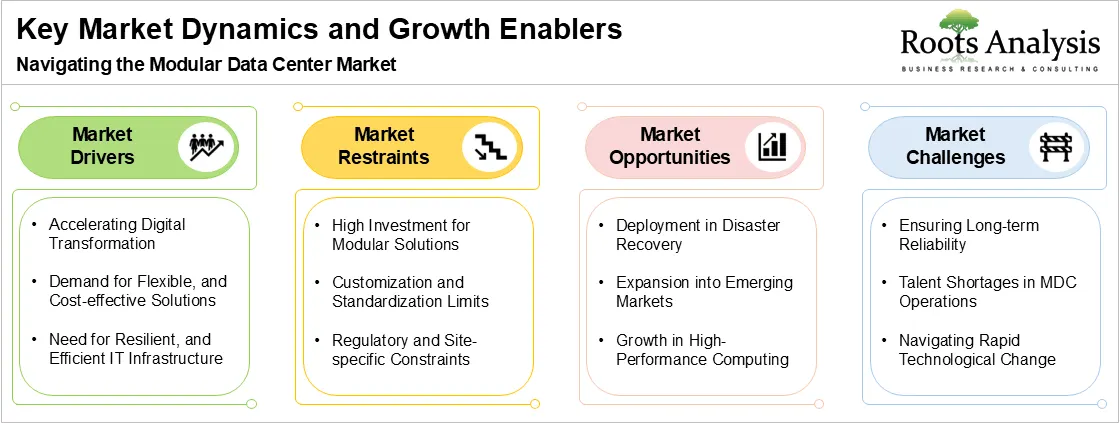
The industry is set to witness a lucrative growth phase, with the modular data center market shaped by a dynamic interplay of drivers, restraints, opportunities, and challenges that will influence its trajectory in the coming years.
Your Business is Unique – Why Shouldn’t Your Report Be?
Market Segmentation
The modular data center market report presents an in-depth analysis of the various companies that are involved in offering modular data center solutions and services, across different segments, as in the figure below:

Market Share Insights
Solution Segment to Dominate the Modular Data Center Market
As per our modular data center market analysis, the solution segment is expected to hold the largest share of 74% within the current global year.
The growth is attributed to its comprehensive and ready-to-deploy offerings, including prefabricated data center modules with integrated power, cooling, and IT infrastructure. These solutions provide businesses with a one-stop approach to quickly addressing their data center needs, eliminating the complexities of designing and assembling components from multiple vendors.
Further, the services segment is expected to witness the fastest CAGR (15.30%) during the forecast period. Services such as consulting, system integration, installation, and ongoing maintenance are critical to ensure that modular data centers function optimally and align with business objectives. The growing complexity of IT environments, coupled with advancements in modular technology, has heightened the need for specialized knowledge and tailored service offerings.
IT & Telecom Gains the Highest Market Share for End Use Industry
The modular data center market forecast suggest that the IT & telecom sub-segment is expected to hold the largest market share within the current global year.
This dominance is attributed to the reliance of IT sector on robust, scalable, and reliable infrastructure to support massive data processing and storage requirements. IT and telecom companies are at the forefront of digital transformation, managing vast networks, cloud services, and extensive data traffic. Modular data centers offer these organizations the flexibility to expand rapidly, deploy in diverse geographic locations, and maintain high operational efficiency.
Regional Forecast Estimates: Europe to Grow Significantly, Fueled by Region’ Emphasis on Sustainability
Our modular data center market report suggests that Europe is expected to grow at a steady CAGR throughout the forecast period. This growth is being driven by the region’s emphasis on sustainability, data sovereignty, and digital transformation. European Union’s stringent energy efficiency and carbon emission regulations have accelerated the adoption of energy-efficient modular data centers. Additionally, the growing use of hybrid cloud environments and the need for modular data centers for edge computing applications to support IoT and 5G deployments are key regional trends supporting the growth.
Want Information on Specific Region / Segment?
Which are the Top Companies in the Modular Data Center Industry?
Examples of leading companies (which have also been captured in this market report, arranged in alphabetical order) include ABB, BaseLayer Technology, Bladeroom, Cannon Technologies, Cisco Systems, Colt, CommScope, Dell Technologies (formerly known as Dell), Delta Electronics, Diversitec, Eaton, Hewlett Packard, Huawei Technologies, IBM, Instant Data Centers, Iron Mountain, Johnson Controls, PCX Holding, Rahi Systems, Rittal, Schneider Electric, Stulz, Vertiv, and ZTE.

What Strategies are the Companies Using to Gain Modular Data Center Market Share?
The competitive landscape is marked by a concentrated presence of industry leaders that offer comprehensive, technologically advanced, and scalable data center solutions and services. Dell Technologies leverages its deep enterprise relationships and broad IT portfolio to provide prefabricated modular data center solutions for rapid deployment, also simplifying procurement. Hewlett Packard Enterprise (HPE) complements its modular offerings with robust server and storage integration, focusing on flexibility and ease of expansion.
Huawei Technologies brings significant innovation in modular design and rapid manufacturing capabilities, especially catering to emerging markets and edge applications. Vertiv Group stands out for its expertise in power and thermal management, delivering highly efficient cooling and electrical solutions tailored for high-density computing environments. These key players combine technological leadership, global support networks, and extensive R&D investments to address the growing demand for agile, energy-efficient, and AI-ready modular data center infrastructures.
How is the Integration of Renewable Energy in Modular Data Centers Benefiting the Market?
Modular data centers benefit significantly from integration with renewable energy sources (such as solar and wind). This integration reduces overall carbon footprints and operational energy costs, aligning with global sustainability goals of the modular renewable energy data centers. MDCs’ flexibility and mobility allow them to be sited near renewable energy farms, reducing transmission losses and dependency on non-renewable grids.
Although variability in renewable energy poses challenges, predictive power management and workload migration mitigate risks. This results in more resilient, energy-efficient prefabricated infrastructure for data centers with lower embodied carbon and construction costs, supporting greener cloud and edge deployments.
What are the Modular Data Center Cooling Technologies and Innovations?
- Liquid cooling (direct-to-chip and immersion cooling) is increasingly adopted to manage high-density AI and HPC workloads.
- Use of free cooling and ambient air economizers reduces reliance on mechanical chillers, thereby lowering energy consumption.
- In-row and aisle containment modular data center cooling systems improve efficiency by directing airflow precisely and minimizing energy wastage.
- Intelligent cooling management with IoT sensors and AI-driven analytics enables dynamic adjustments based on real-time thermal loads.
What are the Scalability Trends in Containerized Data Center Modules?
Containerized data centers are designed for rapid scalability, allowing enterprises to deploy additional modules seamlessly as demand grows. These modular units support plug-and-play data center modules with standardized interfaces, enabling easy expansion with minimal downtime, leading to the growth of the containerized data center market.
Scalability trends include nested modular designs that integrate power and cooling components within containers, simplifying deployment. Edge computing growth further fuels demand for smaller, decentralized modules that scale horizontally across geographies. This flexibility supports adaptive workloads and varying client needs, accelerating time-to-market and operational efficiency.
What is the Regulatory Compliance in Modular Data Center Installations?
- Compliance with regional data protection laws such as GDPR in Europe and CCPA in California is mandatory for data storage and privacy.
- Adherence to construction and electrical safety standards, including certifications like UL 2755 and ISO 27001, ensures safe design and operation.
- Periodic cybersecurity audits, encrypted data storage, and defined data retention policies tailored to industry and geographic regulations are required.
- Compliance with recognized standards like ANSI / TIA-942 and Uptime Institute Tier certifications influence modular data center build and performance.

Modular Data Center Market: Scope of the Report
| Key Report Attributes | Details | |
| Historical Trend | Since 2020 | |
| Forecast Period | Till 2035 | |
| Market Size in 2026 | $ 38.10 Billion | |
| Market Size in 2035 | $ 164.35 Billion | |
| CAGR (Till 2035) | 17.63% | |
| Segments Covered |
|
|
Unlock Deeper Insights – Schedule Your Personalized Workshop Today!
Market Segments
Based on the research, we have segmented the modular data center market into component, build type, data center size, application, end user industry, enterprise size, geographical regions, and leading players.
By Component
- Service
- Consulting
- Installation & Deployment
- Maintenance & Support
- Solution
- All-in-one
- Individual
By Build Type
- Greenfield
- Brownfield
By Data Center Size
- Large Size Data Center
- Mid-Size Data Center
- Small Data Center
By Application
- Data Center Expansion
- Disaster Recovery
- Emergency Data Storage
- High Performance / Edge Computing
- Starter Data Centers
- Others
By End Use Industry
- BFSI
- Energy
- Government & Defense
- Healthcare
- IT & Telecom
- Industrial
- Manufacturing & Resources
- Media & Entertainment
- Retail & Consumer Goods
- Others
By Enterprise Size
- Large Enterprises
- Small And Medium Enterprises (SMEs)
By Geographical Regions
- North America
- US
- Canada
- Mexico
- Rest of North America
- Europe
- Austria
- Belgium
- Denmark
- France
- Germany
- Ireland
- Italy
- Netherlands
- Norway
- Russia
- Spain
- Sweden
- Switzerland
- UK
- Rest of Europe
- Asia-Pacific
- Australia
- China
- India
- Japan
- New-Zealand
- Singapore
- South Korea
- Rest of Asia-Pacific
- Latin America
- Brazil
- Chile
- Colombia
- Venezuela
- Rest of Latin America
- Middle East and Africa (MEA)
- Egypt
- Iran
- Iraq
- Israel
- Kuwait
- Saudi Arabia
- UAE
- Rest of MEA
Have Questions? Let’s Get Them Answered.


