
Lowest Price Guaranteed
Slides
226
Last Updated
September 2025
View Count
13035
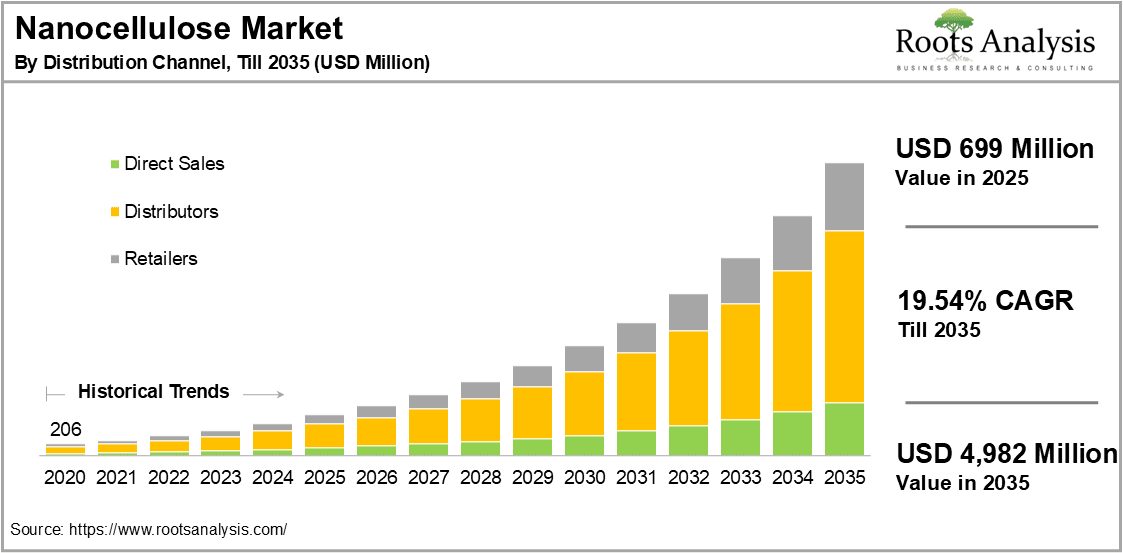
The nanocellulose market size is projected to grow from USD 699 million in 2025 to USD 4,982 million by 2035, representing a CAGR of 19.54%, during the forecast period till 2035.
 |
To learn more about this report, request a free sample copy
The new research study consists of nanocellulose industry analysis, detailed market forecast analysis and providing actionable strategic recommendations.
The nanocellulose is a renewable resource derived from plant cellulose, nanocellulose exhibits exceptional properties such as high strength-to-weight ratio, biodegradability, and large surface area, making it an ideal alternative to petroleum-based products. It is worth highlighting that nanocellulose improves barrier properties in packaging, acts as a biocompatible material for drug delivery systems in healthcare, and contributes to the development of lightweight and durable textiles.
The global nanocellulose market is expected to grow significantly over the forecast period due to the rapid industrialization in emerging economies like China and India. Additionally, some of the nanocellulose product innovations and advancements in manufacturing include microwave irradiation, enzymatic treatment, and cold plasma processing, have enhanced the efficiency and yield of nanocellulose production while lowering costs. Notably, a strong focus on sustainability is promoting the development of eco-friendly applications, further encouraging the adoption of nanocellulose as a greener alternative to traditional materials. Additionally, key players are investing in research and development to explore innovative uses, unlocking new opportunities for growth in this dynamic sector.
Recently, in January 2024, Smart Reactors secured €3 million in European funding to develop nanocellulose material for artificial lung devices, aiming to assist patients awaiting lung transplants. While informing about the funding Brian Haddigan, CEO of Smart Reactors mentioned-The creation of an artificial lung could greatly benefit patients with reduced lung function who are waiting for a lung transplant, assisting them in breathing when their own lungs are unable to perform this vital function.
The nanocellulose market research report presents an in-depth analysis of the various companies that are involved in offering nanocellulose , across different segments, as defined in the table below:
| Key Report Attributes | Details | |
| Historical Trend | Since 2020 | |
| Forecast Period | Till 2035 | |
| Current Market Size | $ 699 Million | |
| Market Size Value by 2035 | $ 4,982 Million | |
| CAGR (Till 2035) | 19.54% | |
| Type of Nanocellulose |
|
|
| Type of Application |
|
|
| Type of Distribution Channel |
|
|
| Geographical Regions |
|
|
| Leading Market Players |
|
|
| PowerPoint Presentation (Complimentary) |
Available | |
| Customization Scope | 15% Free Customization | |
| Excel Data Packs (Complimentary) |
|
|
Based on the type of nanocellulose, the global nanocellulose market is split into bacterial cellulose, cellulose nanocrystals, cellulose nanofibrils, microfibrillated cellulose and others. According to our analysis the cellulose nanofibrils segment will augment the segment's growth with over 40% of nanocellulose market share during this nanocellulose market forecast period. This can be ascribed to their exceptional mechanical properties, high surface area, and versatility in various applications. However, this segment is expected to grow with a relatively higher (21.34%) CAGR in the near future. This can be attributed to increasing demand across various industries, particularly in food processing and cosmetics, where they serve as effective binding and texturizing agents.
On the basis of the type of application, the nanocellulose market is bifurcated into cement & composite materials, cosmetics & toiletries, filter materials, food products, paper & packaging, textiles & nonwovens and others. The paper & packaging segment is anticipated to dominate the segment with more than 35% of nanocellulose market size in 2025. Further, this segment is expected to witness a relatively faster nanocellulose market growth rate of (20.87%) until 2035. This can be attributed to its exceptional mechanical properties, such as high tensile strength and stiffness, which enhance the durability of paper products. Its biodegradable and renewable nature meets the increasing demand for nanocellulose in packaging solutions, as industries aim to reduce reliance on petroleum-based materials.
On the basis of the type of distribution channel, the nanocellulose market is bifurcated into direct sales, distributors and retailers. The distributors segment is anticipated to dominate the segment with more than 60% of market share in 2025. Additionally, this segment is expected to witness a relatively faster nanocellulose market growth rate until 2035. This can be ascribed to their ability to handle large volumes of nanocellulose and provide extensive reach across various markets and increasing industrial global nanocellulose demand for efficient supply chain solutions.
This segment highlights the distribution of the nanocellulose market across various geographical regions such as North America, Europe, Asia, Latin America, Middle East, North Africa, and the rest of the world. According to our nanocellulose market analysis, North America exhibits dominance in the market with over 40% of the nanocellulose market share in the global marketplace. However, Asia is also projected to grow with a relatively higher CAGR in the forecasted period. Primary reasons for this dominance include the combination of rapid industrialization, urbanization, rising focus on sustainable and bio-based materials, aligning with global environmental trends. Notably, due to its major manufacturing hubs, such as China, Japan, and South Korea, which are increasingly adopting nanocellulose in industries like electronics, automotive, and textiles is a major governing factor.
The “Nanocellulose Market, Till-2035: Industry Trends and Global Forecasts” report features an extensive study of the current market landscape, market size and future opportunity within nanocellulose market, during the given forecast period. The market report highlights the efforts of several stakeholders involved in this rapidly emerging segment of the service providers industry. Key takeaways of the global nanocellulose market report are briefly discussed below.
An increasing emphasis on environmental sustainability and regulatory compliance is majorly driving the nanocellulose industry. The rise in consumer preferences for environmentally friendly options is influencing manufacturers to innovate and expand their offerings. Further, its exceptional mechanical strength and versatility enable diverse applications across industries such as applications of nanocellulose in healthcare, packaging, and electronics. Moreover, supportive government regulations and rising consumer awareness of eco-friendly products further bolster the market. Additionally, advancements in nanocellulose technology and rising disposable incomes in developing economies, such as India, China and Japan have further propelled market growth.
With the presence of several small and large nanocellulose manufacturers companies, the market is experiencing intense competition and changing dynamics. From large multinational companies to nanocellulose manufacturers players, companies are striving to enhance their competitive edge. In terms of market share, large enterprises and multinational companies are dominating the market. While small nanocellulose manufacturers players are continuously improving their products to cater to niche markets, or they are offering specialized services. These industry players are focusing on adopting competitive strategies, such as developing innovative solution techniques, forming strategic alliances and partnerships to expand their portfolios and global footprint, investing in recent developments and new feature launches to enhance their nanocellulose offerings.
Despite strong market growth projection, the nanocellulose market faces numerous challenges. The most common challenge is high production costs and limited scalability, which make it difficult for nanocellulose to compete with conventional materials. The complex regulatory landscape and safety concerns create uncertainties that slow innovation and market entry. The lack of standardized testing methodologies leads to variability in product quality, complicating compliance and consumer confidence. Further, nanocellulose supply chain dynamics disruptions, exacerbated by geopolitical events and the COVID-19 pandemic, have led to inconsistent product availability.
North America currently holds a substantial share of approximately 35% in the nanocellulose market opportunities. This dominance can be attributed to its strong research and development infrastructure, diverse industrial applications, and significant government support. Further, the ongoing growth of end-use industries such as pharmaceuticals, packaging, and construction, coupled with a focus on innovation and sustainability, further enhances the region's market position. Notably, substantial investments in research and development, leading to the creation of superior nanocellulose, is one of the major governing reasons for growth in this region.
Examples of key player involved in the nanocellulose market (which have also been captured in this market report, arranged in alphabetical order) include American Process, Axcelon Biopolymers, Blue Goose Biorefineries, CelluComp, CelluForce, Daio Paper, FiberLean Technologies, GranBio Investimentos, Kruger, Melodea, NAVITAS, Nippon Paper Group, Oji Holdings, Sappi and Stora Enso. This market report includes an easily searchable excel database of all the companies who have adopted the nanocellulose market.
The market report presents an in-depth analysis, highlighting the capabilities of various companies engaged in this domain, across different segments. Amongst other elements, the market report includes:
At Roots Analysis, we genuinely care about your success and understand that your business requirements are unique. While our market research reports provide valuable insights, we recognize that they might not cover every aspect you need to make well-informed strategic decisions. To account for that, we offer 15% free report customization tailored to your specific needs. Whether you require additional quantitative analysis, qualitative insights, or any other information related to the nanocellulose market, reach out us today at: support@rootsanalysis.com