


 Download Free Sample
 Buy Now
Market Size
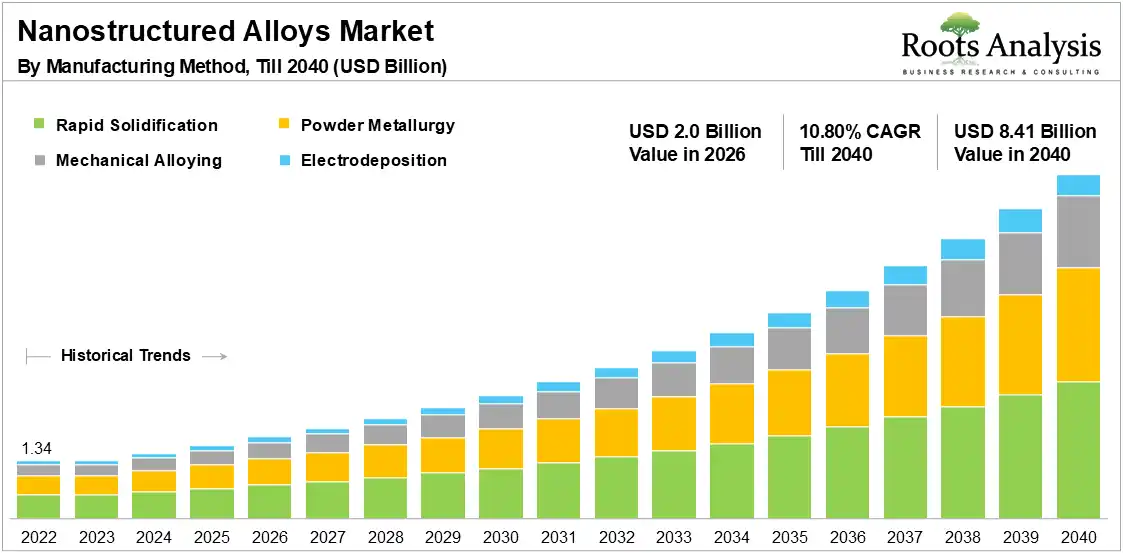
The nanostructured alloys market is projected to reach USD 2.0 billion in 2026 and USD 8.41 billion by 2040, representing a CAGR of 10.80% during the forecast period 2026 to 2040.
See What’s in the Full Report - Request Your Complimentary Insights!
Market Overview
The nanostructured alloys encompass materials specifically engineered to possess a microstructure where grain size is controlled at the nanoscale (typically below 100 nanometers). The scope includes bulk nanostructured metals, thin film coatings, and composite materials, often manufactured using advanced techniques, such as severe plastic deformation, powder metallurgy, and additive manufacturing. Value creation is primarily driven by the ability of these materials to offer significantly enhanced performance metrics that include high strength-to-weight ratio, superior hardness, and improved corrosion resistance in high-stress environments where conventional metallic alloys are inadequate.
Market expansion is primarily fueled by increasing demand for high-performance materials in critical end-use sectors, including nanostructured alloys applications in aerospace and defense for lightweight structural components, medical devices requiring enhanced biocompatibility and durability, and automotive applications focused on structural safety and efficiency in electric vehicles. The ongoing transition to new-generation vehicle platforms necessitates materials that can withstand high temperatures and severe mechanical stress. This momentum is evidenced by recent investments in developing nanostructured steel alloys specifically for next-generation electric vehicle battery enclosures to improve crash resistance and thermal management.
Innovation trends are focused on integrating nanostructured materials with advanced manufacturing processes, particularly additive manufacturing (AM), to produce complex geometries with consistent material properties. Further R&D efforts are concentrated on high-entropy alloys (HEAs) and bulk metallic glasses (BMGs) to develop materials with unprecedented strength-to-ductility ratios. Looking forward, strategic initiatives by major materials science firms to develop nanostructured alloys for next-generation nuclear reactors highlight the market’s direction toward extreme environment applications. The overall market outlook remains positive, driven by sustained R&D investments and increasing industrial adoption.
Market Report: Key Takeaways
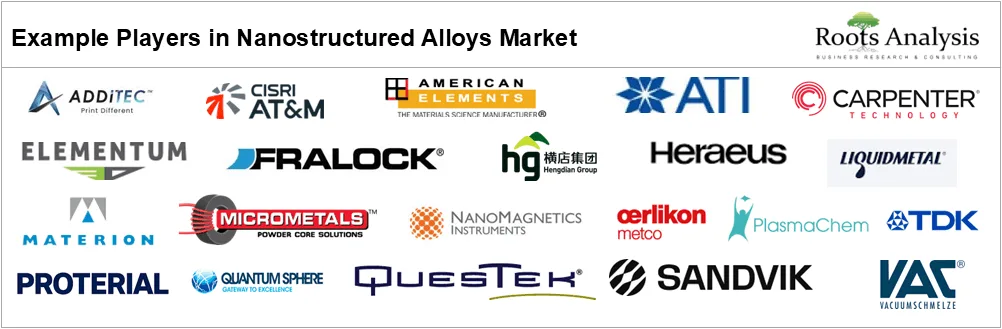
- Leading Players Competitive Footprint: Dominant players like ADDiTEC, Advanced Technology & Materials, American Elements, ATI, Carpenter Technology, Elementum 3D, Fralock, Hengdian Group Magnetics, Heraeus Group, Liquidmetal, Materion, Micrometals, Nano Magnetics Instruments, Oerlikon Metco, PlasmaChem, Proterial, Quantum Sphere, QuesTek Innovations, Sandvik, TDK, Vacuumschmelze hold strong market positions with extensive geographic presence in various regions.
- Startup Ecosystem and Innovation Hotspots: Early-stage companies are focusing on catering to the increasing demand for energy-efficient and low-power nanostructured alloys used in electric vehicles, renewable energy systems, and advanced semiconductors. These startups leverage nanoscale engineering to enhance magnetic properties, thermal stability, and mechanical strength, targeting applications in power electronics and energy storage.
- Regional Penetration and Adoption Trend: Rapid industrialization, surging semiconductor production, and expanding applications in energy storage and power electronics drive regional growth of nanostructured alloys in Asia-Pacific. Notably, China leads demand through EV battery alloys and 5G infrastructure, accounting for over 40% of global shipments in 2025.
- Rapid Solidification Technology Holds Highest Market Segment: In the type of manufacturing method, rapid solidification technology holds the maximum market share 41.47% due to its ability to produce ultra-fine grain additive manufacturing nanostructured alloys with superior magnetic properties, mechanical strength, and uniformity at scale.
- Opportunities and Unmet Market Needs: Industry leaders can capitalize on surging demand for high-entropy nano-structured alloys, boosting solid-state battery energy density by 50% and enabling 5G services for semiconductor breakthroughs via additive manufacturing for EV and aerospace leadership. Strategic collaborations with leaders like VACUUMSCHMELZE and green recycling innovations address key scalable production gaps beyond rapid solidification and fatigue testing needs, securing unmatched market dominance.
- Funding and Investment Momentum: The tiny machine learning industry attracts steady investment as AI-driven tools enhance materials design and predictive modeling in the nanostructured alloys market, accelerating discovery and optimization.
Recent Industry Developments
- December 2025: REalloys entered a historic strategic partnership with the Saskatchewan Research Council (SRC) to establish North America's first fully integrated rare earth supply chain. This agreement includes a US$21 million investment to expand midstream refining, securing high-purity rare earth oxides necessary for the production of next-generation nanostructured magnets and aerospace alloys.
- August 2025: USC Viterbi School of Engineering reported significant breakthroughs in laser additive manufacturing for nanostructured alloys. The research, led by Prof. Wen Chen, showcased 3D-printed alloys reaching yield strengths of 1.3 GPa while overcoming the traditional trade-off between strength and ductility, targeting weight reduction in aerospace and automotive structures.
- March 2025: The US Army Research Laboratory and Lehigh University announced a revolutionary nanostructured Cu-Ta-Li alloy in the journal Science. Patented under US 11,975,385 B2, the alloy utilizes tantalum-rich bilayers to stabilize its nanocrystalline structure, allowing it to rival nickel superalloys in high-temperature strength while maintaining the superior conductivity of copper for use in hypersonic vehicles and heat exchangers.
Pay Only for What You Need – The Best Way to Optimize
Market Dynamics
Nanostructured Alloys Market Drivers
- Aerospace Lightweighting and Performance Enhancement: The aerospace industry's shift towards higher fuel efficiency and advanced performance requires materials with exceptional strength-to-weight ratios and high-temperature resistance. Nanostructured alloys offer superior specific strength over traditional alloys, enabling the design of lighter airframes and more robust engine components, crucial for next-generation aircraft and spacecraft programs.
- Growing Demand for Advanced Medical Implants: The increasing lifespan of populations and advancements in surgical techniques are driving demand for durable medical implants. Titanium-based nanostructured alloys for medical implants provide superior biocompatibility, osteointegration, and fatigue resistance, making them ideal for high-stress orthopedic and dental applications.
- Harsh Environment Resistance in High-Performance Industries: Nanostructured alloys enhance creep and corrosion resistance that increase component durability and strengthen infrastructure safety under harsh operating conditions.
Market Restraints
- High Capital Investment and Production Costs: Advanced alloy production methods such as severe plastic deformation and powder metallurgy require high upfront investment, as reflected in nanomaterials industry data. These fixed costs increase per-unit pricing compared to traditional alloys, creating entry barriers for new players and limiting adoption in cost-sensitive industries.
- Concerns over Long-Term Thermal Stability and Material Degradation: Thermal instability in nanostructured alloys at high temperatures can lead to grain growth and reduced mechanical strength. This limits deployment of gas turbines and engines, where maintaining long-term material reliability under extreme heat is critical.
- Limited Intellectual Property Access and Proprietary Technology: The concentration of intellectual property creates barriers for wider market entry. This makes it difficult for manufacturers to license nanostructured alloy technologies for commercial production without major investment or new research partnerships, slowing scale and adoption across the materials value chain.
Market Share Insights
Market Share by Type of Alloys: Nanocrystalline Alloys Hold the Largest Market Share
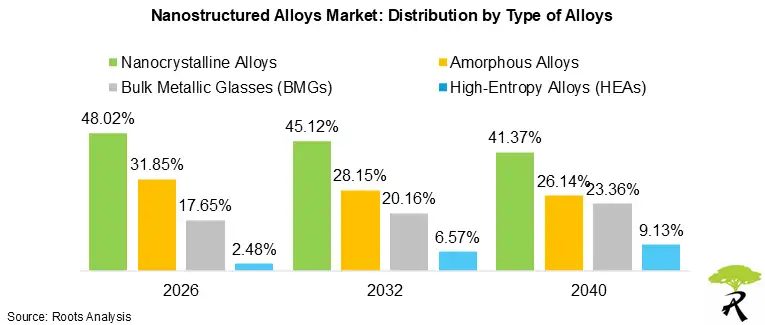
- According to our nanostructured alloys market analysis, nanocrystalline alloys hold the largest market share of 48.02% in 2026. This dominance is driven by their ultra-low core loss, allowing them to outperform traditional silicon steel by up to 80% in efficiency across high-frequency electric vehicle (EV) and renewable energy applications.
- The segment's rapid growth relies heavily on overcoming global supply bottlenecks, as only select Tier-1 mills can consistently manufacture the critical 18-25-micron thick ribbons required for these efficiency gains. Validating this expansion, Vacuumschmelze formed a November 2025 strategic alliance with Ucore Rare Metals to localize the North American supply chain. This targeted intervention directly accelerates the mass production of magnetic cores for extreme-duty e-mobility sectors.
- Ultimately, transitioning to these ultra-efficient materials addresses critical unmet needs regarding thermal management and component miniaturization. By prioritizing these dominant alloys, technical strategists can maximize power densities and system payloads, empowering informed decision-making when designing high-performance architectures for the broader electrification transition.
Market Share by Geographical Regions: Asia-Pacific to Dominate the Industry and Grow with High Through 2040
- The regional analysis suggests that Asia-Pacific is expected to hold the largest nanostructured alloys market share of 47.87% and is anticipated to witness the fastest CAGR during the forecast period. This leadership is sustained by the region’s established manufacturing ecosystems for bulk metallic glasses and high-performance nanocrystalline ribbons, significantly outpacing mature Western markets.
- Driven by 11.5% CAGR, the region’s expansion is fueled by large-scale grid modernization and 5G telecommunications infrastructure. China and Japan remain pivotal, leveraging supply chain maturity to integrate nanostructured materials into high-efficiency EV powertrains and renewable energy storage systems.
- The APAC market is characterized by rapid penetration in soft magnetic materials. By narrowing the cost-to-performance gap through advanced casting techniques, regional players are accelerating the transition from conventional silicon steel to ultra-low-loss nanostructured alloys in industrial-grade power electronics.
Want Information on Specific Region / Segment?
Market Ecosystem Insights
Leading Players Competitive Footprint
The nanostructured alloys market is led by specialized material science firms, including ATI, Carpenter Technology, Proterial, and Sandvik. These entities maintain authority by leveraging Integrated Computational Materials Engineering (ICME) to bypass trial-and-error metallurgy, solving historical brittleness constraints in industrial-scale deployments. The below outlined recent strategic moves highlight this shift:
- MedTech Application: Liquidmetal Technologies partnered with Amorphology to commercialize Bulk Metallic Glass (BMG). Together, they produce highly elastic, biocompatible surgical tools and consumer wearables.
- Defense & Aerospace Applications: QuesTek Innovations and the US Navy are using the ICMD® platform to certify ultra-high-strength nanostructured steels, ensuring extreme survivability for mission-critical naval components.
For CTOs and investors, these targeted innovations address immediate unmet needs, paving the way for informed decision-making in next-generation infrastructure.
Startup Activity and Innovation Hotspots
The nanostructured alloys sector is increasingly driven by early-stage and specialized innovators addressing critical unmet needs in electrification and lightweighting. Moving beyond basic formulations, these companies focus on grain boundary engineering and nanocrystalline phase control to produce sustainable, high-performance materials. The below outlined are recent strategic moves highlight a practical shift toward industrial scaling:
- Thermal Management-related Initiatives: Specialized material firms like Fralock are advancing nanocrystalline alloy processing, targeting extreme thermal environments in mission-critical aerospace and defense applications.
- Additive Manufacturing-related Initiatives: Following its late-2024 expansion, Elementum 3D is scaling nanostructured aluminum alloys for laser powder bed fusion (L-PBF). This overcomes traditional printing constraints, enabling structural lightweighting.
For investors and technical leadership, these material breakthroughs transition nanostructured alloys from niche R&D into scalable commercial realities. By resolving historical manufacturing bottlenecks, such as thermal degradation in extreme environments and printability constraints in additive manufacturing, these innovations directly de-risk capital deployment. Ultimately, they empower informed decision-making for stakeholders tasked with scaling next-generation EV powertrains, advanced aerospace platforms, and energy-efficient grid infrastructure, seamlessly bridging technical viability with long-term commercial ROI.
Funding and Investment Momentum
The nanostructured and amorphous alloys market is experiencing robust investment momentum, driven by a convergence of venture capital and government mandates. Capital flows are heavily focused on scaling production for extreme-duty sectors like electrification and advanced aerospace. Recent financial milestones driving this momentum include:
- Regulatory-Driven Capital Investments: The US Department of Energy (DOE) enacted an April 2024 rule mandating energy-efficient amorphous steel cores in distribution transformers. This exact legislative push has triggered massive private equity and public funding into grid modernization supply chains.
- Venture Scaling: Innovators like Elementum 3D are securing late-stage capital rounds to scale nanostructured additive manufacturing, while Liquidmetal’s funded commercial agreements with Amorphology accelerate high-volume production for industrial applications.
For technical leadership and capital allocators, these developments signal a fundamentally de-risked financial landscape. By aligning venture funding with strict government energy mandates, these investments guarantee long-term industrial demand. Ultimately, this capital convergence empowers informed decision-making, ensuring scalable production and robust commercial ROI in next-generation infrastructure.
Your Business is Unique – Why Shouldn’t Your Report Be?
Nanostructured Alloys Market: Scope of the Report
| Key Report Attributes | Details | |
| Historical Trend | Since 2022 | |
| Forecast Period | Till 2040 | |
| Market Size 2026 | $ 2.0 Billion | |
| Market Size 2040 | $ 8.41 Billion | |
| CAGR (Till 2040) | 10.80% | |
| Segments Covered |
|
|
Market Segmentation
Based on research, we have segmented the nanostructured alloys market into type of alloys, manufacturing method, application, geographical regions, and key players.
Market Share by Type of Alloys
- Amorphous Alloys
- Bulk Metallic Glasses (BMGs)
- High-Entropy Alloys (HEAs)
- Nanocrystalline Alloys
Market Share by Manufacturing Method
- Electrodeposition
- Mechanical Alloying
- Powder Metallurgy
- Rapid Solidification Technology
Market Share by Application
- Aerospace & Defense
- Automotive
- Electronics
- Energy & Power
- Industrial Manufacturing
- Medical Devices
Market Share by Geographical Regions
- North America
- US
- Canada
- Mexico
- Rest of North America
- Europe
- Austria
- Belgium
- Denmark
- France
- Germany
- Ireland
- Italy
- Netherlands
- Norway
- Russia
- Spain
- Sweden
- Switzerland
- UK
- Rest of Europe
- Asia-Pacific
- Australia
- China
- India
- Japan
- New-Zeeland
- Singapore
- South Korea
- Rest of Asia-Pacific
- Latin America
- Brazil
- Chile
- Colombia
- Venezuela
- Rest of Latin America
- Middle East and Africa (MEA)
- Egypt
- Iran
- Iraq
- Israel
- Kuwait
- Saudi Arabia
- UAE
- Rest of MEA


