
Lowest Price Guaranteed
Slides
218
Last Updated
June 2026
View Count
13908
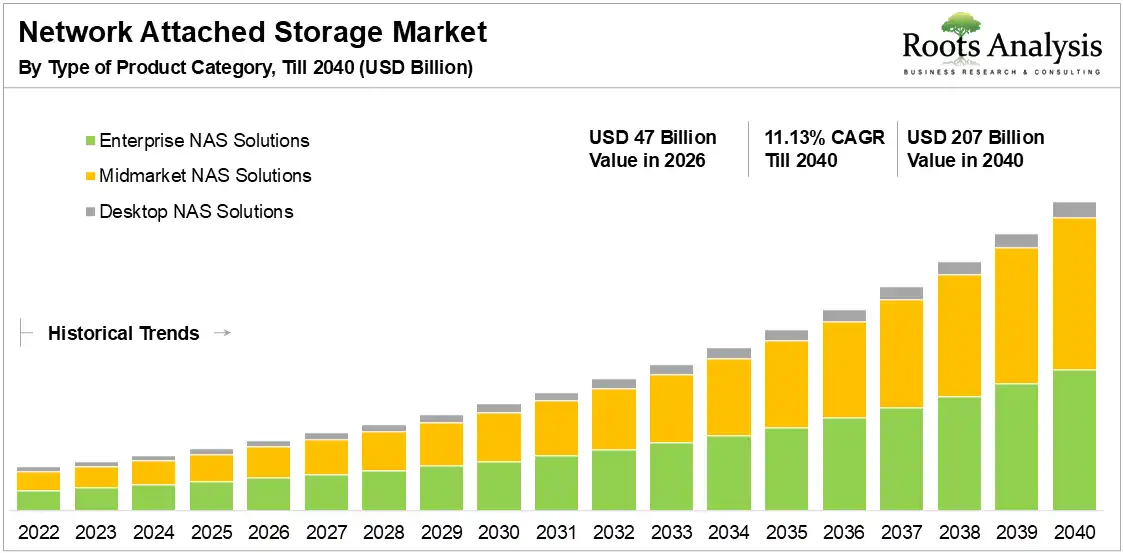
The global network attached storage (NAS) market size is projected to grow from USD 47 billion in 2026 to USD 207 billion by 2040, representing a CAGR of 11.13%, during the forecast period, 2026-2040.
To learn more about this report, request a free sample copy
The new research study consists of global NAS industry trends, detailed market analysis of leading NAS devices manufacturers, Porter’s five forces analysis, megatrends analysis and market impact analysis. The report includes network attached storage market forecast and opportunity analysis.
Network attached storage (NAS) systems are centralized units that enable multiple users and different devices to access data stored on disks through a common network. The users operating on a local area network (LAN) can access this storage through a standard ethernet connection. NAS devices are typically configured / managed using a browser. NAS systems are configured to provide the LAN user with ease of access to the shared storage, moreover, these devices offer an expandable storage capacity, enabling organizations to consolidate large amounts of data in a centralized location. Compared to conventional storage systems, NAS storage solutions are more cost effective, making them an attractive data storage option for various organizations. Further, along with the capability of providing local data storage, various network attached storage devices can also integrate cloud servers to accommodate more users and regular data backups. This enables the user to enjoy stress free data storage with multi-level data sharing options. Based on the type of organization managed, network attached storage systems are categorized into three broad categories namely, enterprise NAS, midmarket NAS and low end or desktop NAS. Enterprise NAS systems are equipped with multiple bays in order to aid in storing large amounts of data and ease of access on a larger scale. On the other hand, midmarket and desktop NAS devices generally feature a single bay system, dedicated to the storage of small amounts of data, which does not require frequent access.
Prior to the introduction of network attached storage devices, organizations had to constantly manage multiple servers for data consolidation, however, modern NAS systems are equipped with multiple disks, which enables the user to store vast amounts of data, with the ease of remote access, while minimizing latency.
The network attached storage market research report presents an in-depth analysis of various leading players involved in manufacturing innovative NAS storage devices, across different segments, as defined in the table below:
| Key Report Attributes | Details | |
| Historical Trend | Since 2022 | |
| Base Year | 2025 | |
| Forecast Period | Till 2040 | |
| Market Size 2026 | $ 47 Billion | |
| Market Size 2040 | $ 207 Billion | |
| Growth Rate | CAGR of 11.13% | |
| Design |
|
|
| Product Category |
|
|
| Application Area |
|
|
| Storage Solution |
|
|
| Mode of Deployment |
|
|
| End-User |
|
|
| Geography |
|
|
| Key Companies Profiled in the Network Attached Storage Market |
|
|
| PowerPoint Presentation (Complimentary) |
Available | |
| Customization Scope | 15% Free Customization | |
| Excel Data Packs (Complimentary) |
|
|
The global network attached storage market is segmented into different designs in terms of number of bays used, namely 1 to 8 bays, 8 to 12 bays, 12 to 20 bays and more than 20 bays. Currently, NAS devices with 1 to 8 bays are expected to capture the highest share in the market and this trend is likely to remain unchanged during the forecast period. This can be attributed to the high adoption for single bay NAS systems for personal / small scale uses, for instance, backup for gaming files and home surveillance camera.
The global network attached storage market is segmented into different product categories, such as enterprise NAS solutions, midmarket NAS solutions and desktop NAS solutions. Presently, midmarket NAS systems capture the highest market share. However, driven by the increasing demand for remotely accessible data storage solutions in small businesses, the market for desktop NAS solutions is expected to grow at a higher CAGR during the forecast period.
The global network attached storage industry is segmented into two different solutions, namely scale-up NAS and scale-out NAS. Currently, scale-out NAS devices are expected to capture the highest share in the network attached storage market and this trend is likely to remain unchanged during the forecast period. This can be attributed to the fact that scale-out systems provide users the flexibility to add redundant arrays of independent disks (RAID) in order to expand the storage capacity without compromising on the speed.
The global network attached storage industry is segmented into different modes of deployment, namely on-premise deployment, cloud-based deployment and hybrid deployment. Presently, NAS devices which can be deployed on-premise are expected to capture the highest share of the market. However, driven by the increasing demand for contactless installation of storage solutions post the COVID-19 pandemic, the market for cloud-based NAS solutions is expected to grow at a higher CAGR during the forecast period.
The global network attached storage market is segmented into different end-users, namely banking, financial services and insurance (BFSI), consumer goods and retail, telecommunication, healthcare, government, and others. Currently, the telecommunication industry is expected to capture the highest share of the market. However, driven by the increasing adoption for single NAS systems in personal / small scale uses, the market for consumer goods and retail is expected to grow at a higher CAGR during the forecast period.
This segment highlights the distribution of the global network attached storage market across various geographies, such as North America, Europe, and Asia-Pacific, Latin America, and the Middle East and Africa. According to our projections, presently, North America captures the majority share of the market opportunity. It is worth highlighting that the market in Asia-Pacific is expected to grow at a relatively higher CAGR, during the forecast period, 2026-2040.
The global network attached storage market size growth is primarily driven by rise in the demand for consumer electronics, including personal computers, smartphones, laptops, tablets and smart wearable devices. The use of single bay NAS devices for personal purposes provides an attractive option for users who are looking for an effective, low-cost data storage option. Further, the increasing number of small businesses worldwide are also expected to adopt NAS devices for data consolidation and remote access which is anticipated to propel the market ahead.
Presently, the majority of the market share is captured by North America. However, the market for these devices in the Asia-Pacific is expected to grow at a relatively higher CAGR during the forecast period. According to the Asian Development Bank (ADB), micro, small and medium-sized enterprises (MSMEs) make up the majority of the organizations in the region, further, this trend is likely to increase over the foreseeable future driving the overall market growth.
Examples of key companies involved in the global network attached storage market (which have also been captured in this market report, arranged in alphabetical order) include ASUSTOR, Buffalo Americas, Cisco Systems, Dell Technologies, D-Link, Drobo, Hewlett Packard Enterprise, Hitachi, Huawei Technologies and IBM. This market report includes an easily searchable excel database for the leading companies manufacturing NAS devices along with information on their product portfolios.
Several recent developments have taken place in the market, some of which have been outlined below.