


 Download Free Sample
 Buy Now
Market Outlook
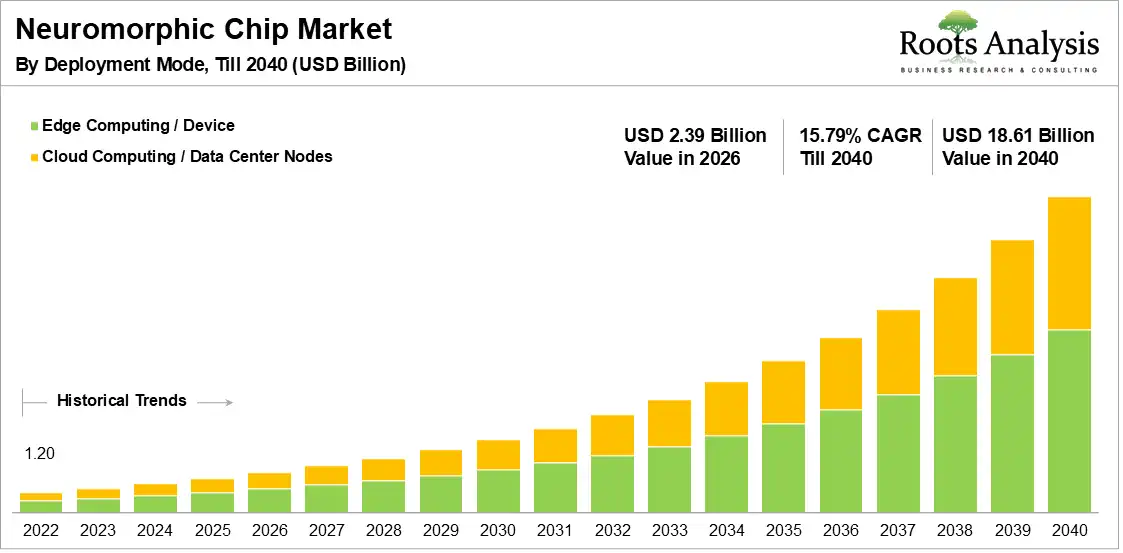
The global neuromorphic chip market is projected to reach USD 2.39 billion in 2026 and USD 18.61 billion by 2040, representing a CAGR of 15.79% during the forecast period 2026 to 2040.
See What’s in the Full Report – Request Your Complimentary Insights!
Neuromorphic chips represent a paradigm shift in silicon architecture, moving beyond the 'von Neumann bottleneck' to mimic the brain's parallel processing efficiency. By integrating computation and storage within artificial neurons and synapses, these processors enable event-driven execution that reduces power consumption by orders of magnitude compared to legacy GPUs and CPUs.
As of 2026, as traditional architecture hit the physical and economic limits of Moore's Law, neuromorphic systems have transitioned from research labs to commercial roadmaps. This transition is catalyzed by a doubling in global artificial intelligence (AI) energy demand, creating a critical market for high-performance inference that does not jeopardize power grid stability. With key innovations in memristor-based synapses and hybrid analog-digital designs, neuromorphic chips are moving from niche applications in robotics and defense toward the core of the sustainable Edge AI ecosystem.
Trends emphasize reduced power usage for sustainable AI and integration with edge AI frameworks to handle dynamic environments. For instance, ongoing research into memristor-based synapses promises further performance gains. Overall, the neuromorphic chip market continues to evolve, positioning neuromorphic chips as a cornerstone for next-generation intelligent systems.
Market Report: Key Takeaways
- Leading Players in the Market: Top market players, such as IBM, Intel, Samsung Electronics, and Brainchip Holdings are increasingly undertaking initiatives, such as product launch, and partnerships to strengthen market position.
- Startup Activity: Startup tier 2 company, Innatera has commercialized / launched Pulsar (a neuromorphic microcontroller) at Computex 2025. Moreover, this company has also received USD 21 million in Series A funding round and is manufacturing Pulsar-integrated products with Joya and ecosystem partners.
- Major Market Pulls: The neuromorphic chip market attracts distinct buyer cohorts, each with differentiated value drivers. One of the significant pulls includes defense & aerospace sector, where military R&D directors are deploying signal intelligence (SIGINT) processing and autonomous system integrators for threat detection. Moreover, the recent DAP funding (USD 50+ million through SyNAPSE program) validates demand for neuromorphic chips and production-focused contracts accelerate 2026-2028.
- Fundings and Investments: The global neuromorphic chip industry is backed by robust investments and fundings. Companies like Unconventional AI emerged in December 2025 with USD 475 million seed funding (led by Jeff Bezos's investment vehicles), demonstrating venture market appetite for next-generation neuromorphic solutions.
- Tariffs and Trade Impact: The global market for neuromorphic chips is heavily influenced by the shifting tides of international trade policy. For instance, in 2025, the US administration proposed 100% tariffs on semiconductor imports, with exemptions for firms building domestic capacity. For the neuromorphic market, this has been a double-edged sword. It has accelerated the “reshoring” of manufacturing to fabs like Intel’s in Arizona and SkyWater’s in Minnesota.
- Future Trends: The shift towards hybrid architecture is likely to open gateways for significant investments. Prominent market players, such as Intel and Innatera are developing heterogeneous chips that combine spiking neurons with traditional RISC-V cores.
Recent Industry Developments
- In December 2025, BrainChip raised USD 25 million to scale Akida neuromorphic AI chips and on-device GenAI development. With this massive investment, the company is aiming to expand its product portfolio to establish a robust position in the neuromorphic computing market.
- In December 2025, Innatera announced to showcase award-winning Pulsar neuromorphic microcontroller at CES 2026, debuting in real-world neuromorphic edge AI.
- In November 2025, Xiamen Joyatech (Joya) and Innatera signed a collaboration agreement and become Innatera’s first Original Design Manufacturer (ODM) customer. The prime focus of this agreement with be on the mass production integration of Pulsar neuromorphic microcontroller into customer / IoT devices specifically targeting lifestyle devices, IoT sensors, and smart homes. Joya's manufacturing scale enables neuromorphic chips to reach 10M+ unit volumes by 2027.
- In October 2025, BrainChip collaborated with PreAct Technologies for the Akida (next-generation ultra-efficient edge AI processor) integration with LiDAR perception for autonomous systems particularly for applications, such as robotics, autonomous vehicles, and smart sensing. This collaboration will extend Akida’s application scope beyond vision-based sensing.
Pay Only for What You Need – The Best Way to Optimize
Market Dynamics
Key Market Drivers
- Rising AI Demand: The growing need for efficient artificial intelligence processing is driving adoption of neuromorphic chips that replicate brain-like operations, enabling real-time decision-making in edge devices such as smart cameras without relying on external cloud infrastructure.
- Defense and Robotics Push: Expanding military and robotics applications are fueling the demand for adaptive intelligence, as neuromorphic hardware enhances machine responsiveness in dynamic environments, leading to increased government investments in neuromorphic technologies for autonomous drones and robotic systems.
- Energy Savings in Data Centers: Rising data center energy consumption is accelerating interest in neuromorphic chips, that consume significantly less power than conventional processors, allowing enterprises to achieve large-scale cost reductions while improving computational efficiency across high-performance workloads.
- Advancements in Brain Research: Rapid progress in neuroscience is strengthening the design foundation of neuromorphic chips, as new insights into neural functioning help researchers and companies transform laboratory innovations into commercially viable products with advanced cognitive processing capabilities.
- Growth of IoT Devices: The accelerating proliferation of interconnected smart devices is increasing demand for energy-efficient computing. Neuromorphic chip architecture enables continuous, low-latency processing in IoT sensors, supporting always-on intelligence while extending device lifespan and minimizing maintenance frequency.
- Boom in Autonomous Vehicles: Rising deployment of self-driving vehicles is propelling neuromorphic chip adoption, as their brain-inspired architecture enhances vehicle perception and real-time decision-making, enabling faster sensor data processing and safer navigation across diverse driving conditions.
Market Restraints
- High Development Costs: Significant research and development expenditures required to design brain-inspired microcontrollers constrain broader market participation, allowing only major corporations to compete effectively while smaller firms face scalability barriers in product commercialization.
- Immature Manufacturing Tech: Existing semiconductor fabrication infrastructure is not optimized for neuromorphic architectures, leading to low yields and production inefficiencies that delay large-scale deployment and hinder overall market growth potential.
- Limited Software Ecosystem: A shortage of skilled developers capable of programming spiking neural networks restricts software availability and compatibility, slowing adoption as many developers continue to rely on established AI frameworks supported by GPUs.
- Lack of Industry Standards: The absence of standardized protocols for neuromorphic chip development results in interoperability challenges, creating uncertainty among buyers and impeding integration within existing supply chains and system architectures.
- Small Market Size: The comparatively narrow scale of neuromorphic chip sales relative to the broader semiconductor market limits economies of scale, consequently raising production costs and slowing reduction in unit pricing across the industry.
Market Share Insights
Hardware Holds the Highest Share of Neuromorphic Chip Market
- Based on the next-generation brain-inspired computing market research, hardware holds the largest share (52%) of the market and is poised to maintain the dominance as specialized processors and sensors move into mass production. Hardware such as neuromorphic processors are the most essential, valued for their ability to replicate neural structures directly on silicon.
- On the other hand, software is projected to show robust growth, anticipated to show higher CAGR. This unprecedented growth stems due to the industrial shifts toward standardizing simulation, algorithm development, and cloud-based neuromorphic platforms.
North America vs. Asia-Pacific Neuromorphic Chip Market Analysis
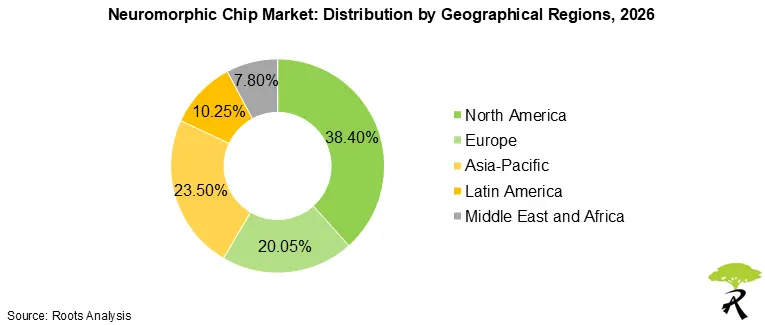
- North America is currently the largest regional market for neuromorphic chips, holding 38.4% of the market share. This dominance is primarily driven by the robust R&D environment, early adoption by the US Department of Defense (DARPA-funded projects), and the presence of industry giants like Intel and IBM.
- Based on the global neuromorphic chip market forecast, Asia-Pacific region is likely to show fastest growth at an estimated CAGR of 28.6%. This unprecedented growth is fueled by massive consumption of smart electronic equipment and government funding in China, South Korea, and Japan aimed at securing semiconductor independence and leading the “post-Moore” era.
Want Information on Specific Region / Segment?
Market Ecosystem Insights
Neuromorphic Hardware Market Trends and Opportunities
- Edge AI Expansion: As 5G rolls out, neuromorphic chips can power smart cities' traffic cams and wearables, capturing a slice of the $100B+ edge computing boom.
- Neuro-inspired Microcontrollers for Wearables: Brain-like chips enable always-on brainwave monitoring in fitness bands, opening doors to personalized health tech for aging populations.
- Quantum-Hybrid Potential: Pairing neuromorphic with quantum tech could solve complex simulations for drug discovery, attracting pharma giants seeking faster R&D.
- Asia-Pacific Manufacturing Surge: Taiwan and China's fab investments offer cheap scaling for neuromorphic production, undercutting US costs and boosting global exports.
Neuromorphic Chip Competitive Landscape and Benchmarking
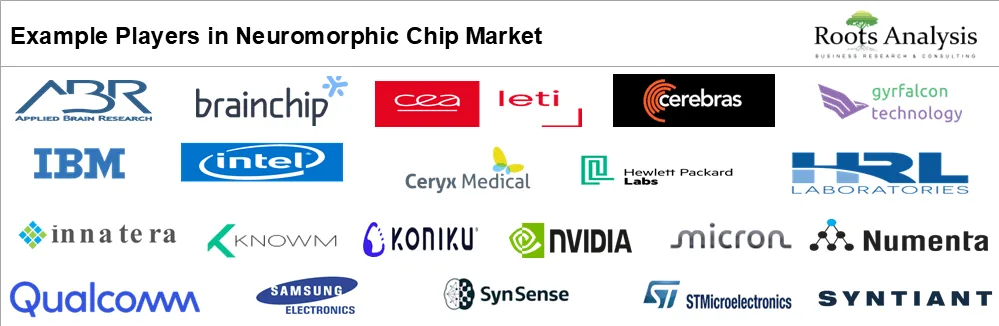
The neuromorphic chips market exhibits a bifurcated leadership structure, witnessing the presence of established semiconductor giants driving foundational research and commercial startups accelerating production-ready deployment. These market players are widely leveraging technological innovations, fundings, investments, and collaborations to strengthen product portfolio and expand market share. Some of the major initiatives by the top companies (active in the neuromorphic chips industry) are listed below:
- Intel unveiled Hala Point (in April 2025), the world’s largest neuromorphic system using Loihi 2 processors, deployed at Sandia Labs. It offers 10x more neuron capacity and 12x performance over Pohoiki Springs to advance efficient, sustainable brain-inspired AI research.
- IBM bifurcates its neuromorphic roadmap with TrueNorth enabling ultra low power sensory processing at 70 milliwatts for 1 billion neurons, while NorthPole accelerates LLM inference with 46.9x faster token generation and 72.7x energy efficiency over GPUs. Backed by DARPA, this research advances toward commercial 5nm tape out in 2026.
Strategic Regional Analysis: Growth Catalysts in Europe, MEA, and Latin America
In the evolving landscape of the neuromorphic chip market, Europe maintains a prominent presence with a 20.3% market share, primarily driven by a heavy focus on the “Industrial & Automotive” sectors. The region's growth is further anchored by “Vision-zero” autonomous vehicle mandates and the strategic integration of Industry 4.0 by giants like BMW and Siemens, who are leveraging neuromorphic architectures for real-time Industrial IoT (IIoT) efficiency.
Meanwhile, the Middle East and Africa are positioning themselves as a significant “Infrastructure Play,” capturing a 10.70% share. This growth is fueled by ambitious smart city megaprojects like Saudi Arabia’s NEOM and UAE’s urban initiatives, that utilize these chips for grid optimization and advanced surveillance to meet sustainability goals.
In contrast, Latin America, though currently holding a smaller share, is emerging as a critical data hub with an 18.5% CAGR. This region is prioritizing Logistics and Agritech, utilizing the ultra-low-power capabilities of neuromorphic processors for trade optimization and smart agricultural monitoring in remote environments.
Have Questions? Let’s Get Them Answered.
Neuromorphic Chip Market: Scope of the Report
| Key Report Attributes | Details | |
| Historical Trend | Since 2022 | |
| Forecast Period | Till 2040 | |
| Market Size 2026 | $ 2.39 Billion | |
| Market Size 2040 | $ 18.61 Billion | |
| CAGR (Till 2040) | 15.79% | |
| Segments Covered |
|
|
Market Segmentation
Based on the research, we have segmented the neuromorphic chip market into components, type of architecture, type of plasticity mechanism, type of integration, type of single domain architecture, deployment mode, application area, end use industry, geographical regions, and key players.
Market Share by Component
- Hardware
- Processors
- Memory
- Sensors
- Software
- Development Frameworks & SDKs
- Mapping & Simulation Tools
- Algorithms & Libraries
- Services
- Consulting & Integration
- Support & Maintenance
Market Share by Type of Neuromorphic Chips
- Analog Neuromorphic Chips
- Digital Neuromorphic Chips
- Mixed-Signal Neuromorphic Chips
Market Share by Type of Architecture
- ASIC-based Neuromorphic Chips
- Deep Neural Networks (DNN) Accelerators
- FPGA-based Neuromorphic Chips
- Memristor-based Chips
- Spiking Neural Networks (SNN)
Market Share by Deployment Mode
- Edge Computing / Devices
- Cloud Computing / Data Center Nodes
Market Share by Type of Plasticity Mechanism
- Inference-Only Chips
- On-Chip Learning / Adaptive Chips
Market Share by Type of Integration
- Embedded Neuromorphic IP Cores
- Neuromorphic Sensing Units
- Standalone Neuromorphic Accelerators
Market Share by Type of Single Domain Architecture
- Hybrid Mixed-Signal
- Pure Digital (SNN)
- Sub-Threshold Analog
Market Share by Application Area
- Audio & Signal Processing
- Cybersecurity & Pattern Recognition
- Data Mining & Analytics
- Edge AI and IoT Devices
- Healthcare & Wearable
- Image & Video Processing
- Natural Language Processing (NLP)
- Object Detection & Recognition
- Sensor Fusion
Market Share by End Use Industry
- Automotive
- Aerospace & Defense
- Consumer Electronics
- Healthcare
- Industrial Automation
- IT & Telecommunications
Market Share by Geographical Regions
- North America
- US
- Canada
- Mexico
- Rest of North America
- Europe
- Austria
- Belgium
- Denmark
- France
- Germany
- Ireland
- Italy
- Netherlands
- Norway
- Russia
- Spain
- Sweden
- Switzerland
- UK
- Rest of Europe
- Asia-Pacific
- Australia
- China
- India
- Japan
- New-Zealand
- Singapore
- South Korea
- Rest of Asia-Pacific
- Latin America
- Brazil
- Chile
- Colombia
- Venezuela
- Rest of Latin America
- Middle East and Africa (MEA)
- Egypt
- Iran
- Iraq
- Israel
- Kuwait
- Saudi Arabia
- UAE
- Rest of MEA


