


 Download Free Sample
 Buy Now
Market Size
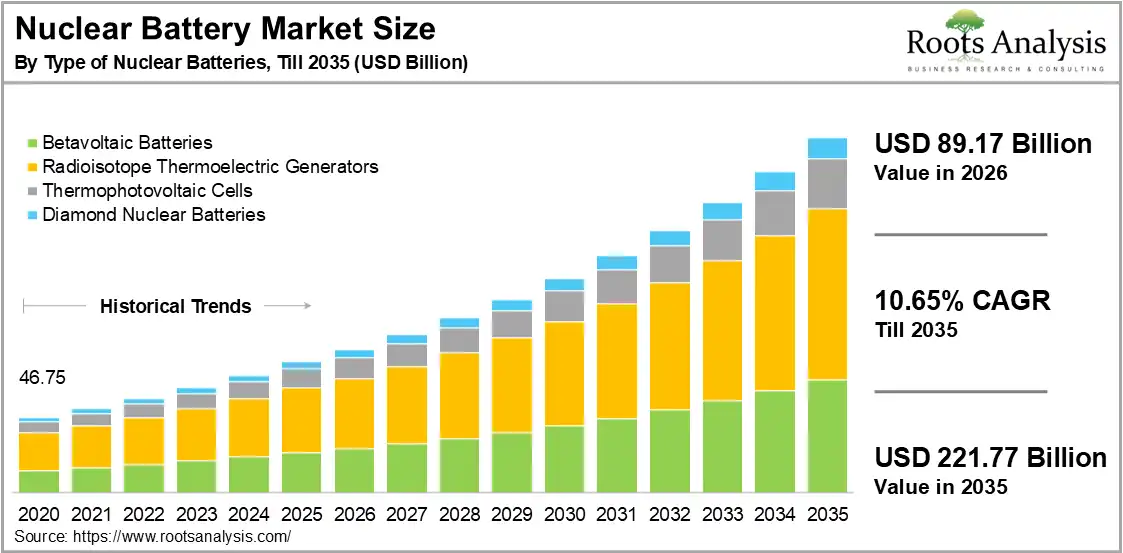
The global nuclear battery market, valued at USD 89.17 billion in 2026, is projected to reach USD 147.92 billion in 2030 and USD 221.77 billion by 2035, representing a CAGR of 10.65% during the forecast period.
See What’s in the Full Report – Request Your Complimentary Insights!
Market Overview
A nuclear battery, also known as an atomic battery or radioisotope generator, is a device that generates electricity by harnessing the energy released from the decay of radioactive isotopes. Unlike conventional electrochemical batteries, nuclear batteries do not rely on chemical reactions and cannot be recharged; instead, they convert the energy from emitted alpha, beta, or gamma particles directly into electrical current, often through thermal or non-thermal conversion mechanisms.
This technology enables the production of compact, long-life power sources capable of operating for years or even decades without maintenance, making them invaluable for applications where reliability and longevity are paramount.
What sets the nuclear battery market apart is its unique intersection of advanced materials science, energy innovation, and mission-critical applications. As Dr. Vladimir Kucherov, a leading researcher in radioisotope power systems, stated the ability of nuclear batteries to deliver consistent, maintenance-free power in extreme environments is unmatched by any other current technology.
These batteries have powered deep-space missions, such as NASA’s Cassini-Huygens and Curiosity Rover. Recent advances in nano-engineering and wide-bandgap semiconductors are opening new frontiers for the nuclear battery market, enabling miniaturization and improved efficiency.
Recent Industry Developments
-
In March 2025, Japan developed the world’s first uranium rechargeable battery while researchers in South Korea developed a prototype Betavoltaic battery powered by the carbon-14 isotope.
Pay Only for What You Need – The Best Way to Optimize
Market Share Insights
Which Type of Nuclear Battery Will Dominate the Market?
The radioisotope thermoelectric generators (RTGs) segment is set to take the lead, holding a significant share of 36.21% of the market.
The radioisotope thermoelectric generator market growth is largely due to the high usage of RTGs as the primary power source for deep space missions, remote monitoring stations, and military applications. This wide usage is due to their properties including reliability, longevity, and ability to deliver steady power for decades without maintenance.
However, the betavoltaic battery market is likely to witness the fastest CAGR (9.84%) during the forecasted period.
Which Conversion Type Will have the Fastest CAGR?
Non-thermal conversion segment is set to witness the fastest CAGR (10.62%) during the forecasted period.
This is driven by advancements in nuclear battery miniaturization, materials science, and efficiency, which are expanding their use in medical implants, microelectronics, IoT sensors, and other emerging applications that require compact, long-lasting power sources.
On the other hand, the thermal conversion batteries segment is likely to hold the largest market share of 72.83% during the forecasted period.
Which Technology Innovation Will Dominate the Nuclear Battery Market?
According to our nuclear battery industry analysis, the conventional thermal segment is set to have the highest market share of about 76% during the forecasted period.
Conventional thermal batteries, such as radioisotope thermoelectric generators (RTGs) have been the mainstay of the nuclear battery market for decades. Their reliability, proven safety, and established use in critical applications like space mission power supply, remote monitoring, and defense ensure their continued dominance in terms of overall market share.
On the other hand, it is worth highlighting that the advanced nuclear batteries segment is likely to witness the fastest CAGR (9.83%) during the forecast period.
Which Power Output Will Dominate the Nuclear Battery Market?
According to our nuclear battery industry analysis, the low-power segment is set to have the highest market share of about 35% during the forecasted period.
This growth is driven by the rapid expansion of wearables, medical devices, and autonomous sensors, all of which benefit from the long lifespan and reliability of low-power nuclear batteries. Innovations in materials and miniaturization are further accelerating adoption in these emerging markets.
Which Areas of Application Will have the Fastest CAGR?
When it comes to the nuclear battery applications, the medical devices segment is set to witness the fastest CAGR (9.93%) during the forecasted period.
This is because nuclear batteries are getting smaller and safer, using materials like tritium and radiocarbon. These improvements make them suitable for use in pacemakers, implants, and other medical devices that need to work reliably for many years without being replaced. As healthcare technology advances and the need for long-lasting, maintenance-free power sources increases, especially for an aging population, the demand for nuclear batteries in medical devices is rising quickly.
On the other hand, space missions’ segment is likely to hold the largest market share of 36.8% during the forecast period.
How is the Residential Segment Dominating End Use Industries?
Among the end use industries, the aerospace & defense segment really stands out as the leading segment holding a market share of 64% as well as the one with the fastest CAGR (10.16%).
This rapid growth is fueled by increasing investments in space exploration, satellite launches, military modernization, and the demand for autonomous, resilient power sources that can operate in extreme conditions. The expansion of satellite constellations and interplanetary missions, as well as the modernization of defense platforms, are key drivers accelerating adoption in this industry.
Which Regions or Countries Offer the Highest Growth Potential for Nuclear Battery?
According to our nuclear battery regional analysis, the North American nuclear battery market exhibits dominance by capturing 49.86% of the overall current market share. This is mainly due to the increasing automotive sector in the region.
This dominance is driven by the region’s established technological infrastructure, significant investments in defense and aerospace sectors, and a supportive regulatory environment that encourages innovation and ensures safety.
The United States, in particular, has a robust nuclear industry, extensive research facilities, and strong government support for both military and space applications, all of which contribute to high demand and advanced development of nuclear battery technologies.
Want Information on Specific Region / Segment?
Key Market Insights
Key Market Drivers
- Demand for Long-Lasting, Reliable Power: Nuclear batteries offer continuous power for years or decades, making them ideal for remote, inaccessible, or harsh environments such as space missions, deep-sea sensors, remote monitoring, and implantable medical devices.
- Advancements in Miniaturization and Efficiency: Progress in nanotechnology and materials science is enabling smaller, more efficient nuclear batteries suitable for IoT, microelectronics, and medical implants.
- Rising Space and Defense Applications: Space agencies and defense sectors require uninterrupted, maintenance-free power sources for satellites, deep-space probes, unmanned vehicles, and surveillance equipment.
- Growing Automotive and Industrial Demand: Automotive applications, especially in Asia-Pacific, and industrial automation in remote locations are driving adoption.
- Government and R&D Support: Increased funding and supportive policies from governments and agencies (NASA, DOE, Rosatom, ESA and others) are accelerating research, development, and commercialization of nuclear battery technologies.
- Environmental and Sustainability Benefits: Nuclear batteries produce minimal emissions and align with global efforts to reduce reliance on fossil fuels and lower carbon footprints.
What are the Advancements in Miniaturized Nuclear Batteries for Medical Implants?
Recent breakthroughs in medical implant batteries include betavoltaic batteries which use tritium or carbon-14. These batteries emit low-energy beta particles safely contained within shielding, enabling decades-long operation in pacemakers and implants. Innovations like diamond semiconductors and optimized radiocarbon emitters improve efficiency and safety.
What are the Regulatory Hurdles for Nuclear Battery Commercialization?
Strict safety standards and public skepticism about radiation risks slow adoption, despite advances in benign isotopes like tritium. Regulatory frameworks, such as the US NRC’s Part 53 rulemaking, aim to streamline licensing but require clearer guidelines for small-scale nuclear devices.
What is the Role of Nuclear Batteries in Remote and Harsh Environments?
They provide maintenance-free power for decades in extreme conditions, such as space missions (e.g., RTGs in rovers), deep-sea sensors, or Arctic monitoring systems. Their reliability surpasses solar or chemical alternatives in inaccessible locations.
What is the Comparison b/w Nuclear Batteries vs. Traditional Electrochemical Batteries?
Nuclear batteries offer decades-long lifespans without recharging and stability in extreme temperatures but have lower efficiency (2-3%) and higher upfront costs. Traditional electrochemical batteries are cheaper and more efficient (~90%) but degrade over time and require frequent replacement.
What are the Key Strategies Used by Companies to Gain Nuclear Battery Market Share?
Nuclear battery companies are using smart strategies to stay ahead. Big players are focusing on nuclear battery market opportunities in emerging economies, partnerships, acquisitions, joint ventures, and innovations to strengthen their position in the nuclear battery competitive landscape while also investing in R&D to bring innovative and novel products to the market.
Market Challenges
- High Initial Development and Production Costs: The cost of radioactive isotopes, precision engineering, and compliance with strict safety standards make nuclear batteries expensive to develop and manufacture.
- Safety and Public Perception: Concerns about radioactive materials, past nuclear accidents, and waste management contribute to public skepticism and slow adoption.
- Stringent Regulatory Requirements: Complex and region-specific regulations governing the use, transport, and disposal of radioactive materials create barriers to commercialization and market entry.
- Limited Isotope Availability: Sourcing suitable isotopes (e.g., plutonium-238, tritium) at reasonable prices is challenging and can constrain production capacity.
- Competition from Alternative Technologies: Advances in lithium-ion, solid-state, and other battery technologies may limit nuclear battery adoption in some sectors.
Your Business is Unique – Why Shouldn’t Your Report Be?
Nuclear Battery Market: Scope of the Report
| Key Report Attributes | Details | |
| Historical Trend | Since 2020 | |
| Forecast Period | Till 2035 | |
| Market Size 2026 | $ 89.17 Billion | |
| Market Size 2035 | $ 221.77 Billion | |
| CAGR till 2035 | 10.65% | |
| Type of Nuclear Batteries |
|
|
| Type of Conversion |
|
|
| Technology Innovation |
|
|
| Power Output |
|
|
| Area of Application |
|
|
| Type of Enterprise |
|
|
| End Use Industry |
|
|
| Geographical Regions |
|
|
| Key Players Profiled |
|
|
| PowerPoint Presentation (Complimentary) |
Available | |
| Customization Scope | 15% Free Customization | |
| Excel Data Packs (Complimentary) |
|
|


