
Lowest Price Guaranteed
Slides
178
Last Updated
September 2025
View Count
13128
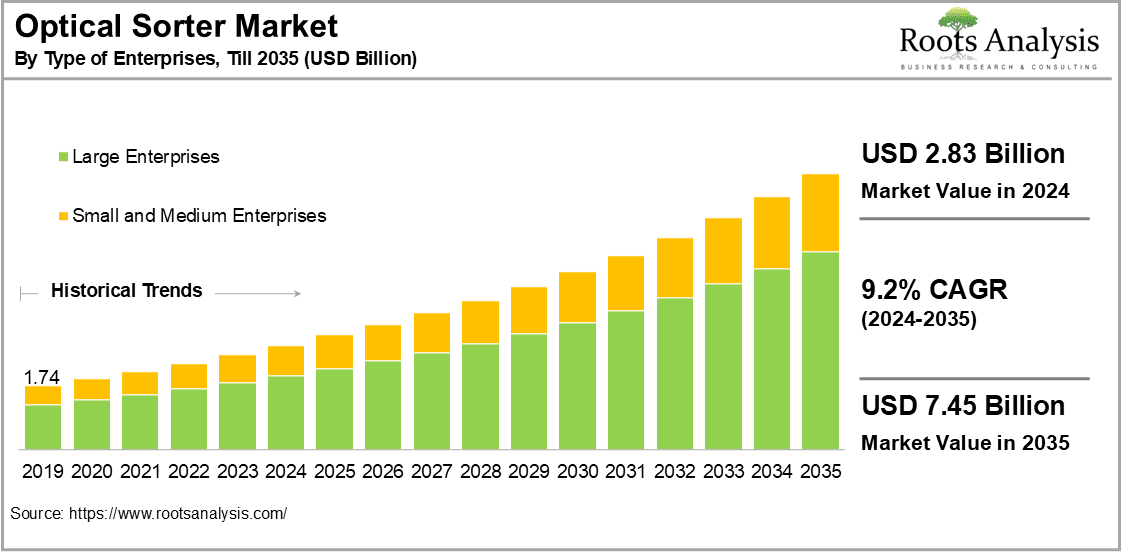
The optical sorter market size is projected to grow from USD 2.83 billion in 2024 to USD 7.45 billion by 2035, representing a CAGR of 9.2%, during the forecast period 2024-2035.
To learn more about this report, request a free sample copy
The new research study consists of optical sorter market trends analysis, detailed global optical sorter market forecast analysis, and providing actionable strategic recommendations.
An optical sorter, also known as a visual sorter machine, is a device used in various industries to automatically sort objects based on their optical properties including color, shape, size, and texture. Advanced imaging technologies in the form of cameras and sensors are used to analyze the characteristics of objects as they pass through the conveyor belts of the optical sorters. These sorters have recently acquired brand new features, enabling them to maximize yield and better comprehend the crucial elements of processing processes. This is widely led by the advancements in intelligent software and detecting technology.
The global optical sorter market is expected to witness an exponential growth driven by the increasing demand for industrial automation, such as food and beverages, pharmaceuticals, recycling and mining and others. The ongoing advancements in optical sorting technology are leading to improved accuracy, efficiency, and speed of sorting processes. These advancements include high-resolution cameras, advanced sensors, and sophisticated sorting algorithms. Additionally, the market growth is also expected to be driven by the rising desire to reduce delivery and processing times. In comparison with manual sorting, which is mainly subjective and unreliable, optical sorters tend to improve product quality, maximize throughput, and increase yields while also reducing labor costs.
The optical sorter market report presents an in-depth analysis of the various companies that are involved in offering optical sorter systems, across different segments, as defined in the table below:
| Key Report Attributes | Details | |
| Historical Trend | Since 2019 | |
| Forecast Period | 2024-2035 | |
| Market Size Value in 2024 | $ 2.83 Billion | |
| Market Size Value by 2035 | $ 7.45 Billion | |
| CAGR (Till 2035) | 9.2% | |
| Type of Optical Sorter |
|
|
| Type of Platform |
|
|
| Areas of Application |
|
|
| Type of End-Users |
|
|
| Company Size |
|
|
| Geographical Regions |
|
|
| Leading Market Players |
|
|
| PowerPoint Presentation (Complimentary) |
Available | |
| Customization Scope | 15% Free Customization | |
| Excel Data Packs (Complimentary) |
|
|
Based on the type of optical sorters, the global optical sorter market is split into cameras sorters, hyperspectral cameras & combined sorters, lasers sorter, near infrared (NIR) sorter, and others. Among these categories, the hyperspectral cameras & combined sorters segment is expected to dominate the market comprising over 35% of the current market. This can be attributed to the rising adoption of these machines across the food processing industries. This rising adoption is driven by the ability of these machines to detect defective pieces highly accurately in food grains, coffee beans, corn, peanuts, dry fruits and others, without generating waste. On the other hand, the near infrared (NIR) sorter segment is expected to witness the relatively CAGR of 11.23%. The prominent reason for this growth is the rising demand for advanced technology-based sorters for recycling and food processing units.
The global optical sorter market is segmented into various types of platforms, such as belt platform, freefall platform, hybrid platform, and lane platform. According to our optical sorter industry analysis, the belt segment will augment the segment's growth with the 38% market share by next decade. This can be attributed to the major benefit of belt optical sorters to process various material types such as recyclables, agricultural products and minerals. On the other hand, the hybrid platform segment is expected to witness the fastest CAGR as they are largely becoming popular by merging various sorting methods like belt, freefall and lane systems into one unit, providing increased flexibility and efficiency.
The global optical sorter market is segmented into various areas of application, such as chemical composition sorting, color sorting, contaminant removal, foreign material removal, product inspection, shape sorting, size grading, structural property sorting. According to our analysis, the foreign material removal segment will dominate the optical sorter market along with obtaining the fastest CAGR during the forecasted period. This can be attributed to the increasing demand of optical sorters in the food industry where removing contaminants from food products is one of the major areas of application where optical sorters can be highly beneficial.
The global optical sorter market is fragmented into various types of end-users such as food processing industry, mining industry, recycling industry, and others. The food processing industry is dominating the market with over 33% market share during the forecasted period. This can be attributed to the advancements in food grain sorting technologies. The rise in population has led to the ever-growing demand for cereal and grain production which is further leading to an exponential rise in the demand for food processing optical sorter machines. These machines are utilized to remove unwanted cereal grains and avoid contamination. On the other hand, the recycling industry is expected to witness the fastest CAGR of 13.12% in the forecasted period. This growth is driven by the increasing global focus on sustainability and effective waste material management. The recycling industries are commonly using optical sorters to segregate various materials like plastics, metals and paper, making the recycling process more efficient.
The global optical sorter market is fragmented into multiple types of enterprise namely large and small and medium enterprise. The large enterprise segment is anticipated to dominate the segment with the highest market share over this forecast period. However, small and medium enterprise segments are expected to witness the fastest growth rate until 2035. This is ascribable to their agility, innovation, focus on niche markets, and ability to adapt to changing customer preferences and market conditions.
This segment highlights the distribution of optical sorter across various geographical regions, such as North America, Europe, Asia, Latin America, Middle East and North Africa, and the rest of the world. According to our optical sorter regional outlook, North America exhibits dominance in the market due to the increased demand for automated sorting systems and advanced sorting technologies across various industries. Being a region of rapidly expanding industries, the need for advanced optical sorting solutions to enhance productivity, quality control, and product consistency is increasing. As the region’s population growth is expanding day by day, there is a growing demand for processed food and beverages. This has further led to the increasing adoption of optical sorters in the industry as they help in ensuring food safety, quality assurance, and compliance with regulatory standards.
The “Optical Sorter Market, Till-2035: Industry Trends and Global Forecasts” report features an extensive study of the current market landscape, market size and future opportunity within optical sorter market, during the given forecast period. The market report highlights the efforts of several stakeholders involved in this rapidly emerging segment of the service providers industry. Key takeaways of the optical sorter market report are briefly discussed below.
The optical sorter industry is booming due to its widespread usage in the food sector, especially in the harvested food processing. High-speed optical sorting systems are widely used to detect and remove discolored and foreign materials to help maintain the food quality. Furthermore, quality and automation are a few of the most prominent optical sorter market drivers. The precise sorting mechanisms of optical sorters i.e. sorting through changing color, unchanged size, broken defect, foreign material, and digital mechanism, helps these machines to sort products sensitively. Moreover, due to the rise of automation globally, the market for optical sorters is experiencing exponential growth.
With the presence of several small and large optical sorter solutions manufacturing companies, the market is experiencing intense competition and changing market dynamics. From large multinational companies to local optical sorter manufacturing players, companies are striving to enhance their competitive edge. In terms of market share, large enterprises and multinational companies are dominating the market. While small optical sorter manufacturing players are continuously improving their products to cater to niche markets, or they are offering specialized services. These industry players are focusing on adopting competitive strategies, such as developing innovative optical sorter solution techniques, forming strategic alliances and partnerships to expand their portfolios and global footprint, investing in recent developments and new feature launches to enhance their optical sorter solution offerings. For instance, in May 2024, Tolsma-Grisnich and the Invaro Group collaborated in the field of optical sorting and are handling all the commercial and service activities of the Schouten Optica Q and Optica CS globally.
Despite strong market growth projection, the optical sorter market faces numerous challenges. The optical sorter market is largely being affected by the huge initial capital investment that is required for the integration of sorting systems in the industry. This is due to advanced sensors, cameras and algorithms being the base of optical sorting technology, which further require considerable amount of money. Along with this, the regular maintenance and calibration to ensure consistent performance also adds to the cost of optical sorters, further increasing the investment in the product.
With respect to regional optical sorter market insights, North America is likely to dominate the market capturing over 25% market share by 2035. The dominance of this region can be attributed to the rising demand for sophisticated sorting machinery in regions like the US and Canada particularly. Additionally, the region is also witnessing a pronounced tendency for innovation caused by the huge R&D investments and an already established industrial base.
Examples of key optical sorter device manufacturers involved in the optical sorter market (which have also been captured in this market report, arranged in alphabetical order) include Advanced Sorting Machines, Allgaier Werke, Binder+Co, Bühler, CP Manufacturing, Cimbria, Daewon GSI, Eagle Vision, GREEFA, Hefei Meyer Optoelectronic, Hitachi Zosen, Key Technology, Körber AG, Machinex, Meyer Optoelectronic Technology, National Recovery Technologies, NEWTEC, Pellenc ST, Raytec Vision, SATAKE, Sesotec, STEINERT, TAIHO, TOMRA, and Unitec. This market report includes an easily searchable excel database of all the companies who have adopted optical sorter market.
At Roots Analysis, we genuinely care about your success and understand that your business requirements are unique. While our optical sorter market research reports provide valuable insights, we recognize that they might not cover every aspect you need to make well-informed strategic decisions. To account for that, we offer 15% free report customization tailored to your specific needs. Whether you require additional quantitative analysis, qualitative insights, or any other information related to the optical sorter market, reach out us today at: support@rootsanalysis.com