


 Download Free Sample
 Buy Now
Market Outlook
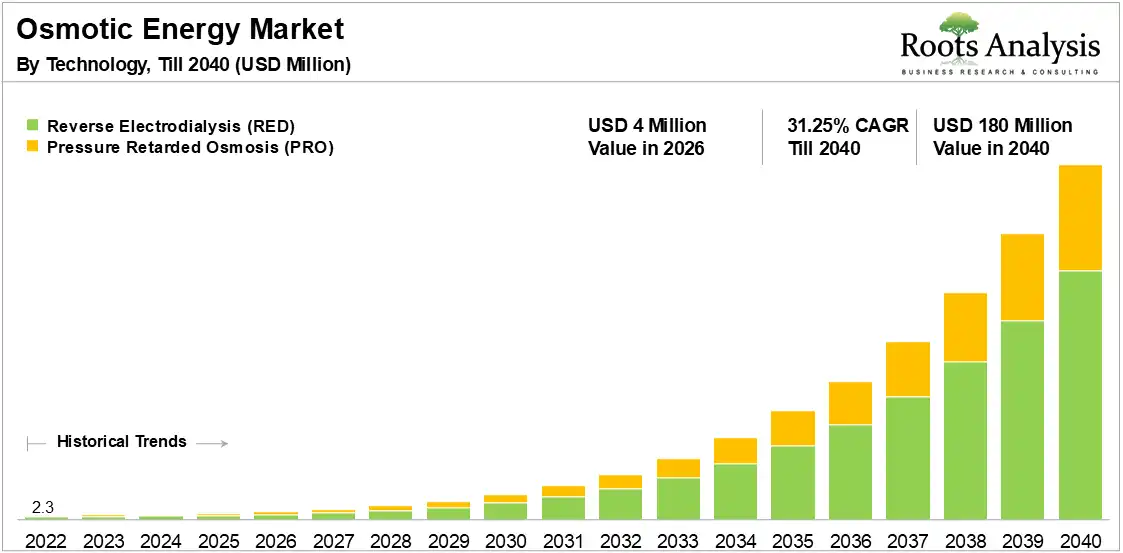
The osmotic energy market, valued at USD 4 million in 2026, is forecasted to reach USD 180 million by 2040, with 31.25% compounded annual growth rate (CAGR) during the forecast period 2026 to 2040.
See What’s in the Full Report - Request Your Complimentary Insights!
The osmotic energy market covers technologies and related services that generate electricity by converting chemical potential energy created by salinity gradients. Often described as blue energy, this approach exploits the natural difference between saltwater and freshwater using pressure retarded osmosis (PRO) technology and reverse electrodialysis (RED) systems.
Market growth is primarily supported by the rising need for stable, non-intermittent renewable energy and by growing interest in recovering energy from industrial water streams. Unlike variable renewables, osmotic energy delivers continuous output strengthening its role as a complement to solar and wind in modern energy systems. End-use cases include power generation in coastal estuaries and the integration of osmotic energy technologies into water treatment infrastructure to recover energy from brine wastewater. Recent pilot initiatives focus on deploying these systems in desalination plants to lower energy consumption by leveraging brine discharge.
Innovation across the osmotic energy industry is concentrated on enhancing membrane selectivity and lowering capital costs to improve efficiency and commercial readiness. The market is moving toward modular, hybrid systems that integrate with existing water treatment processes. Ongoing development focuses on next generation membranes to achieve cost parity, which is critical for large-scale adoption. Overall market potential depends on technological advances and the ability to deliver economically viable solutions.
Key Takeaways
- Leading Players Competitive Footprint: Top key players like Aqua Battery, Aquastill, DuPont, Eco Wave Power, Gradiant, Minesto, Ocean Grazer, Pani, REDstack, REGENERATE, Renergen, Salinity Solutions, SaltPower, Sea6 Energy, Statkraft, SUEZ, Sweetch Energy hold strong market positions with extensive geographic presence in various regions.
- Startup Ecosystem and Innovation Hotspots: Early-stage companies are focusing on catering to the increasing demand through advanced membrane innovations, modular scalability, and strategic pilots targeting baseload renewable power from salinity gradients. Companies are making advancements in areas, for instance Sweetch Energy deploy ionic nano osmotic diffusion (INOD) nanotechnology for high-efficiency (20-25 W/m2) osmotic power, using bio sourced nano-membranes to cut costs by 90%.
- Regional Penetration and Adoption Trend: Rapid industrialization, rising infrastructure investments, and expanding desalination projects drive osmotic energy adoption in Europe. Notably pilot scale deployments in the Netherlands, and France are driving regional growth. Demand is driven by EU subsidies and membrane R&D supporting baseload power generation.
- Industrial holds Highest Market Segment: In the end user, the industrial segment (utilities) holds the maximum market share of 70% in 2026. The market has been expanding, supported by pilot integrations at treatment plants and growing smart grid stability requirements, where continuous baseload power provides added value.
- Opportunities in the Osmotic Energy Market is shaped by hybrid integration with water treatment infrastructure, growing demand from remote coastal and island markets, and increased partnership activity with established industrial players. For instance, REDstack announced a collaboration with Oasen to use reverse electrodialysis (RED) technology to generate energy from residual flows during drinking water production in the Netherlands.
- Funding and Investment Momentum: The osmotic energy industry sees growing investment momentum targeting membrane technology advancements, pilot scaling, and desalination integration, sourced from private equity, venture capital, and government grants directed toward sustainable innovation.
Recent Industry Developments
- December 2025: The European Commission highlighted the progress of the EU funded project, which aims to develop and demonstrate high-performance reverse electrodialysis (RED) stacks for industrial applications, supporting the transition to a circular economy.
- August 2025: Japan inaugurated the world’s second osmotic power plant, generating power from salinity gradients, and building on prior pilots.
- June 2025: LG Chem finalized the sale of its water filter business to produce reverse osmosis membranes to Seoul-based private equity firm Glenwood Private Equity for $1 billion.
- April 2025: Kurita announced a merger with Avista Technologies, a specialist in membrane treatment solutions for reverse osmosis systems.
Pay Only for What You Need – The Best Way to Optimize
Market Dynamics
Key Market Drivers
- Baseload Power Source for Grid Stability: Osmotic energy delivers highly predictable, continuous power by harnessing stable salinity gradients, avoiding the intermittency inherent in solar and wind generation. This reliability positions it as a strategic option for grid stabilization and round the clock baseload supply, directly addressing a structural gap in variable renewable portfolios on across the Asia-Pacific.
- Growing Demand for Industrial Carbon-Free Power: Energy intensive industrial users, including data center power operations and hydrogen production facilities, increasingly require uninterrupted, high-capacity, carbon-free electricity to meet stringent environmental, social, and governance (ESG) commitments. Osmotic energy installations near coastal industrial hubs offer a localized, stable, and low-emission power source aligned with these operational and sustainability requirements.
- Advancements in Membrane Technology and Cost Reduction: In the osmotic energy membrane market progress in high-performance membranes including (graphene oxide and advanced polymer composites) is enhancing power density while reducing spatial requirements. These advancements help offset the high capital intensity of early osmotic systems strengthening the pathway toward commercial viability in priority development regions.
Market Restraints
- High Levelized Cost of Energy (LCOE) and Capital Expenditure: Osmotic energy remains cost disadvantaged relative to mature solar and wind technologies, largely due to high capital costs associated with specialized membranes and extensive civil works. Current power density limitations necessitate significant upfront investment for modest output, resulting in elevated LCOE and constrained adoption without financial support mechanisms.
- Operational Challenges of Membrane Fouling and Scaling: Membrane fouling caused by biological growth and mineral scaling continues to impact real-world system performance. Within clean energy storage solutions these challenges increase maintenance requirements, reduce efficiency over time, and elevate operating costs, undermining the long-term reliability and economic viability of both PRO and RED technologies.
- Immature Supply Chain and Component Standardization: The sector lacks a standardized supply ecosystem for critical components particularly (industrial-scale membranes and specialized salinity management equipment). In the context of global renewable energy market trends resulting in higher procurement costs, longer lead times, and increased project execution risk compared with more established renewable technologies.
Market Share Insights
Market Share by Application: Power Generation Hold the Largest Market Share
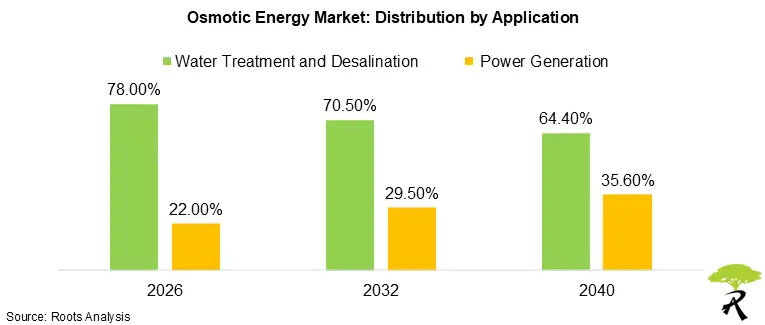
- According to our osmotic energy market analysis, power generation holds the largest market share of 78% in 2026. Growth is driven by deployed and planned projects that are primarily designed to convert salinity gradients directly into electricity, making this the core revenue-generating application.
- There is a growing industrial demand for power generation by regulatory alignment, the global expansion of desalination capacity, and pilot projects demonstrating the efficiency gains achievable through hybrid energy recovery configurations.
- The osmotic energy market forecast suggests that the need for non-intermittent (baseload) renewables, the valorization of industrial waste (brine), and the recent arrival of high-efficiency nanomaterial membranes leads to consistent demand in the power generation segment.
- Applications such as power generation have driven technological advancements among key players. For example, Aquapotable, in partnership with other organizations, completed a pilot project demonstrating the use of PRO technology for power generation from specific waste brine streams in industrial settings.
Market Share by Geographical Regions: Europe to Dominate the Industry While Asia-Pacific Growing Rapidly through 2040
- The regional analysis suggests that Europe is expected to hold the largest osmotic energy market share of 45.00% while Asia-Pacific is also expected to witness the fastest CAGR.
- The Europe dominance is due to its underpinned concentrated R&D activity, sustained public funding, and a higher density of operational pilots in countries such as the Netherlands and France.
- In the Asia-Pacific, the osmotic energy market is growing fastest with 31.78% CAGR supported by extensive coastlines and river deltas, rising industrial energy demand, policy shifts toward renewable energy, and strong desalination linkages. While Europe benefits from first mover advantages and a mature innovation ecosystem, Asia-Pacific’s growth outlook reflects accelerating investment momentum and a larger long-term deployment base.
Want Information on Specific Region / Segment?
Market Ecosystem Insights
Leading Players Competitive Footprint
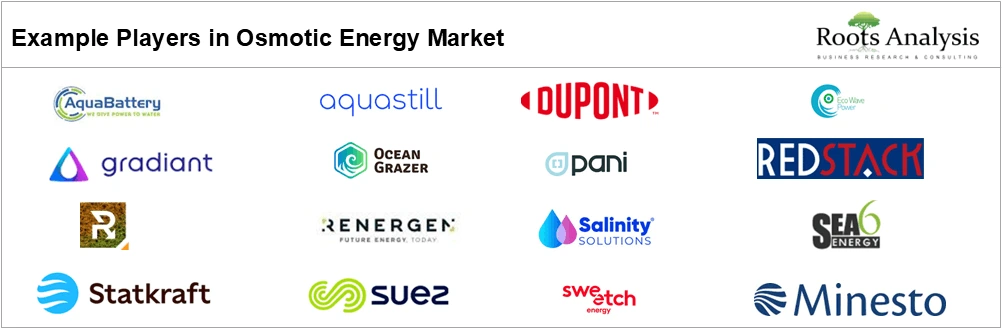
Competitive landscape of osmotic energy key players include Aqua Battery, Aquastill, DuPont, Eco Wave Power, Gradiant, Minesto, Ocean Grazer, Pani, REDstack, REGENERATE, Renergen, Salinity Solutions, SaltPower, Sea6 Energy, Statkraft, SUEZ, Sweetch Energy which hold strong market positions through their extensive product portfolios and global reach.
Collaborations and expansions remain key growth strategies, with players accelerating innovation, market penetration, and scalability. For instance, Aquastill announced collaboration on a project focusing on sustainable water treatment and energy generation using membrane technologies.
Similarly, Salt Power secured a grant from innovation fund Denmark to further develop and scale its pressure retarded osmosis (PRO) technology for industrial applications. This expansion is intended to primarily accelerate the commercial scalability of the technology and its integration into multi-purpose resource platforms.
Startup Activity and Innovation Hotspots
The startup activity within the osmotic energy industry is rapidly evolving with early-stage companies pioneering disruptive applications, primarily focused on acceleration of hybrid industrial platforms and grid integration and baseload reliability. Innovators are shifting toward high-efficiency nanomaterials and the integration of osmotic units into existing water infrastructure like desalination plants.
Recent launches in osmotic energy are focusing on market-ready products supported by strategic partnerships, standardized components, and pilot projects that showcase operational benefits in real-world environments. For instance, Osmo Pro, in partnership with academic institutions, recently launched a field test project focusing on integrating PRO technology into existing industrial processes to recover energy from waste heat and brine.
Additionally, there are other startups such as those providing technological advancements and innovations as the EU-funded E-Motive consortium announced progress in developing a membrane-based system for generating osmotic energy directly within wastewater treatment plants, leveraging existing infrastructure.
Funding and Investment Momentum
The osmotic energy market has shifted from a high-risk academic niche to a strategic growth sector attracting massive capital from venture capitalists, utility giants, and sovereign wealth funds.
These funds are no longer just focused on proving science, but they are now accelerating the industrial-scale deployment of Blue Energy as a critical baseload solution for the global energy transition. Fundings include the European commission providing funds for the Blue Energy project, specifically targeting the development of innovative membrane systems and designs to increase the efficiency of osmotic energy generation.
In addition, government initiatives and grants predominantly support sustainability-focused innovations by companies. For instance, DuPont water solutions presented advancements in membrane technology specifically tailored for high-efficiency osmotic power generation applications at a relevant industry conference.
Your Business is Unique – Why Shouldn’t Your Report Be?
Osmotic Energy Market: Scope of the Report
| Key Report Attributes | Details | |
| Historical Trend | Since 2022 | |
| Forecast Period | Till 2040 | |
| Market Size 2026 | $ 4 Million | |
| Market Size 2040 | $ 180 Million | |
| CAGR (Till 2040) | 31.25% | |
| Segments Covered |
|
|
Market Segmentation
Based on the research, we have segmented the osmotic energy market into technology, application, end user, geographical regions, and key players.
Market Share by Technology
- Pressure Retarded Osmosis (PRO)
- Reverse Electrodialysis (RED)
Market Share by Application
- Power Generation
- Water Treatment and Desalination
Market Share by End User
- Commercial
- Industrial
- Residential
Market Share by Geographical Regions
- North America
- US
- Canada
- Mexico
- Rest of North America
- Europe
- Austria
- Belgium
- Denmark
- France
- Germany
- Ireland
- Italy
- Netherlands
- Norway
- Russia
- Spain
- Sweden
- Switzerland
- UK
- Rest of Europe
- Asia-Pacific
- Australia
- China
- India
- Japan
- New-Zealand
- Singapore
- South Korea
- Rest of Asia-Pacific
- Latin America
- Brazil
- Chile
- Colombia
- Venezuela
- Rest of Latin America
- Middle East and Africa (MEA)
- Egypt
- Iran
- Iraq
- Israel
- Kuwait
- Saudi Arabia
- UAE
- Rest of MEA


