
Lowest Price Guaranteed
Slides
182
Last Updated
July 2026
View Count
18956
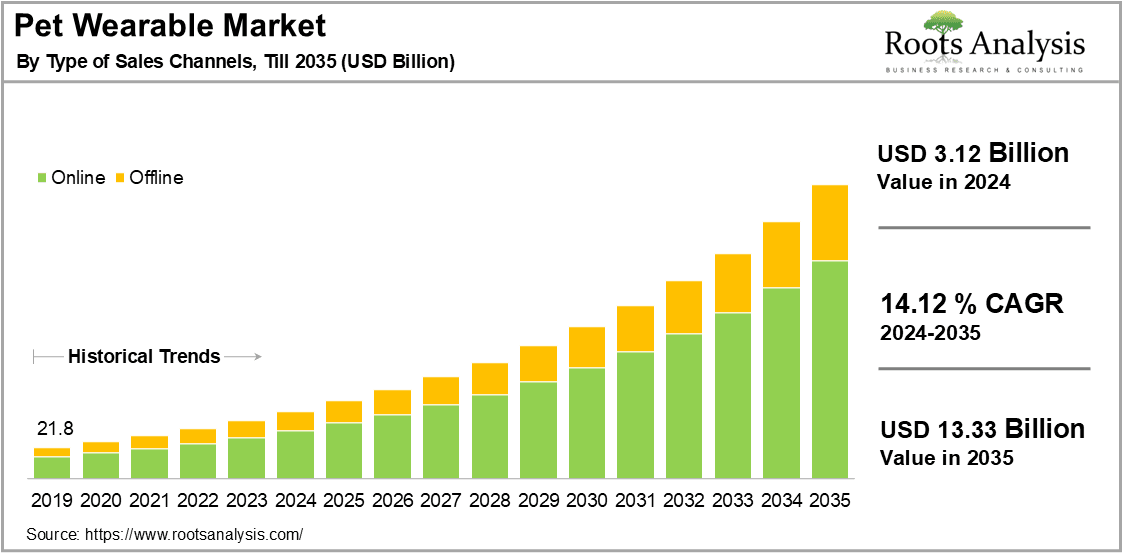
The pet wearable market size is projected to grow from USD 3.12 billion in 2024 to USD 13.33 billion by 2035, representing a CAGR of 14.12%, during the forecast period 2024-2035.
 |
To learn more about this report, request a free sample copy
The new research study consists of industry trends, detailed market analysis, key market trends of pet wearable market, SWOT analysis and value chain analysis.
In the wake of pet parents’ rising spending capacity, the pet wearable market has grown exponentially. The need to monitor the activity levels, heart rates, sleep habits, and caloric expenditure of their pooches has led to the increase in demand for advanced devices. This market is proving to be an evolving sector backed up by scientific advancements that have paved the way for the initiation of advanced devices. Further, being scientifically advanced, these devices can help with disease detection and behavioral difficulties. The collected data can also help pet owners to gather information about their pets’ stress levels or medical concerns, if any.
Over the years, a significant number of pet tech startups have emerged and are actively contributing to the product utilization over the forecasted time. These devices are also increasingly being utilized to aid veterinary treatment by giving vets access to monitored extensive data and insights on the pet’s health. The prominent factors to be deriving a solid growth in this market are the increase in awareness about pet’s mental as well as physical health, the rising adoption of IoT, a growth in demand for pet monitoring, and technological advancements. It is worth mentioning that these pet wearables are equipped with remote monitoring features, thereby enabling pet owners to ensure the safety and security of their pets even when left unattended for longer than usual. Apart from this, the geofencing features help in alerting the owners in case their pet wanders outside the predefined safe zones, eliminating the risk of loss / injury. Such product innovations are bound to drive the market growth significantly.
The market report presents an in-depth analysis of the various companies that are involved in offering pet wearable, across different segments, as defined in the table below:
| Key Report Attributes | Details | |
| Historical Trend | 2019-2023 | |
| Base Year | 2023 | |
| Forecast Period | 2024-2035 | |
| Market Size Value in 2024 | $ 3.12 Billion | |
| Market Size Value by 2035 | $ 13.33 Billion | |
| Growth Rate | CAGR of 14.12% from 2024 to 2035 | |
| Type of Technology |
|
|
| Type of Product |
|
|
| Type of Component |
|
|
| Type of Animal |
|
|
| Type of Battery |
|
|
| Type of Material Composition |
|
|
| Type of Sales Channels |
|
|
| Area of Application |
|
|
| Type of End User |
|
|
| Company Size |
|
|
| Business Model |
|
|
| Geographical Regions |
|
|
| Leading Market Players |
|
|
| PowerPoint Presentation (Complimentary) |
|
|
| Customization Scope |
|
|
| Excel Data Packs (Complimentary) |
|
|
This segment highlights different types of technologies developed by key players of the pet wearable market, such as GPS, RFID and sensors. According to our market study, the RFID segment accounts for the highest share in the current year and the trend of growth is likely to remain unchanged during the forecast period. This can be attributed to the two main features - reliability and accuracy. These trackers monitor parameters that concern the heath segments like the variability in heart rate, calorie intake, body temperature, and pulse. These benefits are the key contributors in fuelling the growth of this segment. However, it is worth highlighting here that the GPS enabled devices segment is expected to grow at a higher CAGR during the forecast period. This is likely to be the result of the growing demand to monitor pet activities while ensuring their security.
This segment highlights different types of products developed by key players of the pet wearable market, such as smart camera, smart collar, smart harness, smart vest, and others. According to our market study, smart collars account for the highest share in the current year and the trend of growth is likely to remain unchanged during the forecast period. This can be attributed to the rise in need for pet monitoring among the working class. As the schedules get hectic and the working hours seem unending, the pet owners demand smart collars that can allow them to stay connected with their pets from their offices. The growing trend of the IoT is increasing the advancement in pet wearable which is further being utilized by medical device companies to provide valuable health related data. This has also caused a massive surge in the smart collars market growth. However, it is worth highlighting here that the smart camera segment is expected to grow at a high CAGR during the forecast period. This is likely to be the result of key companies launching and updating new features in cameras with advanced technologies.
This segment highlights different types of components developed by key players of the pet wearable market, such as batteries, Bluetooth chips, cellular, displays, GPS chips, memory, processors, RFID chips, sensors and Wi-Fi. According to our market study, the GPS chips segment accounts for the highest share in the current year and the trend of growth is likely to remain unchanged during the forecast period. This can be attributed to the synergy between GPS chips and other wearables, which further enhances the overall functionality and utility of pet tracking devices. With a proactive approach to monitoring, GPS chips are enhancing the safety and security of pets, resulting in a boost to the pet wearable market.
This segment highlights different types of animals for which companies are offering wearables, such as cats, dogs, horses and others. According to our market study, the cat segment accounts for the highest share in the current year and the trend of growth is likely to remain unchanged during the forecast period. This can be ascribed to the increasing awareness among cat owners regarding the importance of monitoring their pets’ health and behavior. In addition to this, cat owners are increasingly concerned about the safety and security of their pets, particularly if they let them roam outdoors. This is further driving the growth of pet wearables, specifically the GPS-enabled market. However, it is worth highlighting here that the dog segment is expected to grow at a higher CAGR during the forecast period. This is likely to be the result of the advancement in technology, resulting in the development of light weight and durable wearable devices for dogs.
This segment highlights different types of battery developed by key players of the pet wearable market; these include non-rechargeable, rechargeable and solar-powered. According to our market study, rechargeable batteries account for the highest share in the current year and the trend of growth is likely to remain unchanged during the forecast period. This can be attributed to their ability to be recharged and incorporate advanced technologies like wireless networks, GPS, sensors, cameras, etc. which require significant power consumption. These features further enable pet wearables to provide valuable data to pet owners on the health, activity levels and location of their pets.
This segment highlights different types of material compositions developed by key players of the pet wearable market, such as eco-friendly, metal and plastic. According to our market study, presently plastics, particularly silicone-based materials, account for the highest share and the trend of growth is likely to remain unchanged during the forecast period. This can be attributed to the flexibility and comfort offered by silicone plastics, making the products more comfortable for pets. Silicone based products are also highly durable, allowing them to withstand frequent use.
This segment highlights different types of sales channels developed by key players of the pet wearable market, such as offline and online. According to our market study, the online segment accounts for the highest share in the current year and the trend of growth is likely to remain unchanged during the forecast period. Additionally, it is worth highlighting here that the online segment is expected to grow at a higher CAGR during the forecast period. This can be attributed to the easier accessibility of pet wearable online. The online stores offer a vast collection of products that can be browsed from the comfort of your home, allowing easier price comparisons. Further, shopping online also enables pet owners to make an informed decision while buying a product for their pets.
This segment highlights different areas of application developed by key players of the pet wearable market, such as identification and tracking, medical diagnosis and treatment, and others. According to our market study, identification and tracking pet wearable devices account for the highest share in the current year and the trend of growth is likely to remain unchanged during the forecast period. This can be attributed to features like access to location history and weight & dimensions offered by these devices. They further provide the pet owners an easy way to monitor their pet’s activity. Furthermore, it is worth highlighting here that the demand for pet wearable for medical diagnosis and treatment is expected to grow at a higher CAGR during the forecast period. This is likely to be the result of the increasing expenditure on pet health diagnostics.
This segment highlights different types of end users developed by key players of the pet wearable market, such as pet businesses, pet care professionals and pet owners. According to our market study, pet owners account for the highest share currently and the trend of growth is likely to remain unchanged during the forecast period. This can be attributed to the growing trend of treating pets as family members which has heightened the demand for health tracking pet wearable. However, it should be noted that the pet care professionals’ segment is also set to witness a higher CAGR growth opportunity as veterinary practices are increasingly adopting telehealth services and data-driven approaches. This will further help the pet wearable market to grow as the demand for comprehensive health data providing wearables increases.
The market for pet wearable is segmented by company size, reflecting different market shares and adoption patterns based on organizational scale. It is further segmented into large size companies and small and mid-size (SMEs) companies. Large companies have the resources and capabilities to invest heavily in research and development, manufacturing infrastructure, and marketing, enabling them to produce pet wearable at a lower cost per unit compared to smaller competitors. Furthermore, pet wearable developed by medium and small companies are affordable alternatives available in a good quality. This segment is expected to size up by 2035 owing to increasing demand and availability of better pet wearable in market.
The “Pet Wearable Market, till 2035: Distribution by Type of Technology (GPS, RFID, and Sensors), by Type of Product (Smart Camera, Smart Collar, Smart Harness, Smart Vest, and Others), by Type of Components (Batteries, Bluetooth Chips, Cellular, Displays, GPS Chips, Memory, Processors, RFID Chips, Sensors, and Wi-Fi) by Type of Animal (Dogs, Cats, Horses, and Others), by Type of Battery (Non-Rechargeable, Rechargeable, and Solar Powered), by Type of Material Composition (Eco-Friendly Materials, Metal, Plastic, and Silicone), by Type of Sales Channel (Online and Offline), by Area of Application (Identification & Tracking, Medical Diagnosis & Treatment, and Other), by Type of End Users (Pet Businesses, Pet Care Professionals, and Pet Owners) by Type of Company Size (Large Enterprises, Small and Medium Enterprises (SMEs)), and Key Geographical Regions (North America, Europe, Asia, Latin America, and Middle East and North Africa and Rest of the World): Industry Trends and Global Forecasts: Industry Trends and Global Forecasts” report features an extensive study of the current market landscape, market size and future opportunity within the pet wearable market, during the given forecast period. The market report highlights the efforts of several stakeholders involved in this rapidly emerging segment of the service providers industry. Key takeaways of the pet wearable market report are briefly discussed below.
The global pet wearable market is propelled by the increased need for understanding of pets’ physical and mental health, expanding IoT adoption, increased demand for pet monitoring and technological advancements. It is worth noting here that electronic devices, including wearables, depend on technology. Thus, any kind of development in the above areas will drive the demand and growth of this market. To fulfill the growing demand, new businesses like Xiaomi have combined their pedometers to aid people with pet trackers with more fitness and analytics information. For pet monitoring, communication protocols with NB-IoT are being developed.
The pet wearable market is highly competitive, featuring numerous service providers delivering a diverse array of solutions tailored to various end users. Key players are focusing on developing pet wearable for sectors such as identification, tracking, medical diagnosis and treatment. Prominent providers include Whistle, a significant player which incorporates cutting-edge sensor technology into wearables for pets, allowing the owners to monitor a range of health indicators.
Despite growing demand, the pet wearable market is witnessing several challenges that need to be addressed. Some of the potential challenges include the high cost associated with pet wearables and the lack of public awareness regarding their availability. It is worth highlighting that the initial purchasing or installation cost of a pet wearable product is quite high due to its smart features and technologies involved. In addition to the high initial cost, the lack of public awareness for pet wearable benefits may affect the adoption rate, which impedes market growth.
North America holds the largest pet wearable market share due to a growing adoption of companion animals, high disposable income and increasing per capita animal health care expenditure. Additionally, a rise in pet health awareness and increase in adoption of innovative pet care products by rising tech savvy owners, are a few of the other prominent factors fueling the growth of North America pet wearable market.
Examples of key service providers involved in the pet wearable industry (which have also been captured in this market report, arranged in alphabetical order) include Allflex, Byte Tag, Crumb, Dogtra, Felcana, Garmin Ltd., HeyBuddy Club, IceRobotics, Invisible Fence (Radio Systems Corporation), Link My Pet, Motorola, Nedap, PetCube, Qalo, Ring, Silent Herdsman, Tag, Trovan, Voyce, Whistle, and others. This market report includes an easily searchable Excel database of the companies who are engaged in offering pet wearable services, along with information on several relevant parameters.
The market report presents an in-depth analysis, highlighting the capabilities of various companies engaged in this domain, across different segments. Amongst other elements, the market report includes:
At Roots Analysis, we genuinely care about your success and understand that your business requirements are unique. While our market research reports provide valuable insights, we recognize that they might not cover every aspect you need to make well-informed strategic decisions. To account for that, we offer 15% free report customization tailored to your specific needs. Whether you require additional quantitative analysis, qualitative insights, or any other information related to the pet wearable market, reach out us today at: support@rootsanalysis.com