
Lowest Price Guaranteed
Slides
171
Last Updated
November 2024
View Count
12874
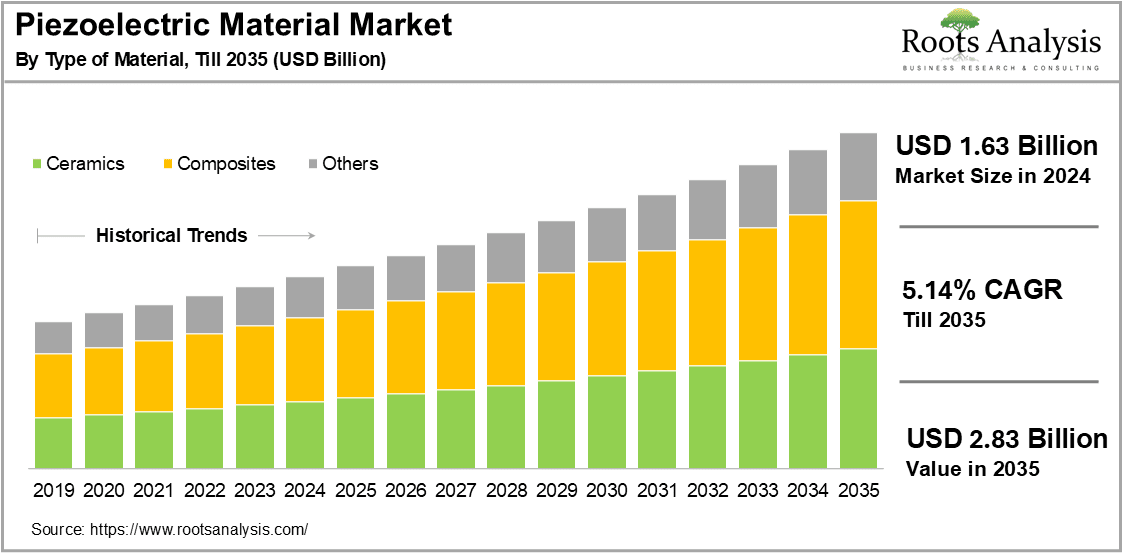
The piezoelectric materials market size is projected to grow from USD 1.63 billion in 2024 to USD 2.83 billion by 2035, representing a CAGR of 5.14%, during the forecast period till 2035.
 |
To learn more about this report, request a free sample copy
The new research study consists of piezoelectric materials and trends analysis, detailed market forecast analysis, and provide actionable strategic recommendations.
Piezoelectric materials are type of advanced materials that generate electric charge in response to mechanical pressure or stress. The term piezoelectric is derived from piezoelectricity in which piezo stands for pressure or stress. Thus, piezoelectric materials have unique properties that are known as the piezoelectric effect to generate an electric charge in reaction to applied mechanical pressure. Historically, in 1880s, the first piezoelectric effect was seen and initiated by two brothers, Pierre and Jacques Curie. Also, the first practical application for piezoelectric devices was the sonar device which was introduced during World War I.
Over time, with the advancements in technologies, the range of both natural and man-made materials has been increased which showed piezoelectric effects. Natural materials incorporate berlinite, quartz, topaz tourmaline, and many others. While barium titanate and lead zirconate titanate (PZT) are man-made piezoelectric materials and have exceptional properties that make them most suitable materials for applications like transducers, ultrasonic devices, and vibration sensors. The versatility of such ferroelectric materials enhances their significance across numerous industries. The unique properties of piezoelectric material make it the most demanding material across various applications that incorporate the production of detection of sound, generation of high voltages, microbalances, and electronic frequency generation. Due to this, applications of piezoelectric materials in industries, such as automotive, aerospace, and consumer electronics continued to expand. Additionally, the importance of piezoelectric actuators which are vital components in converting electrical energy into mechanical motion that allows precision control in automotive, robotics, and many other applications, continues to fuel the demand for materials in the market. Consequently, the market is expected to flourish due to such emerging trends and key factors during this forecast period.
The piezoelectric materials market report presents an in-depth analysis of the various companies that are involved in manufacturing piezoelectric material, across different segments, as defined in the table below:
| Key Report Attributes | Details | |
| Historical Trend | Since 2019 | |
| Forecast Period | Till 2035 | |
| Current Market Size | $ 1.63 Billion | |
| Market Size Value by 2035 | $ 2.83 Billion | |
| CAGR (Till 2035) | 5.14% | |
| Type of Material |
|
|
| Type of Application |
|
|
| Type of End User |
|
|
| Geographical Regions |
|
|
| Leading Market Players |
|
|
| PowerPoint Presentation (Complimentary) |
Available | |
| Customization Scope | 15% Free Customization | |
| Excel Data Packs (Complimentary) |
|
|
This piezoelectric materials market segmentation comprises a range of materials such as ceramics, composites, polymers, and others. According to our global piezoelectric materials report analysis, the ceramic segment is poised to drive the market with around 35% market share in 2024. This is driven by the high performance of lead zirconate titanate (PZT) and the versatility that is commonly utilized in sensors, fuel injectors, ultrasound imaging, and various other industrial automation and energy harvesting technologies. Additionally, the composites segment is likely to expand at a relatively higher CAGR of 5.68% till 2035. This growth can be ascribed to the increasing demand for lightweight piezoelectric materials in the aerospace industry. Also, its greater properties of composites, such as corrosion resistance and low maintenance raise the demand for composite materials.
Based on the type of application, the global piezoelectric materials market is bifurcated into acoustic devices, actuators, generators, sensors, sonar, and transducers. As per our piezoelectric materials market research, the actuators segment holds the maximum share of the market and is projected to lead the market throughout the forecast period. Owing to the widespread use of actuators for precision control and movements in applications such as robotics, aerospace, and industrial automation, augments the market piezoelectric materials market growth. However, the sensor segment is expected to expand at the fastest CAGR in the coming years due to its wide usage in numerous industries, rising advancements in wearable and IoT devices, as well as in medical imaging applications.
This segment of the piezoelectric materials market forecast report describes the type of end users in the market including aerospace & defense, automotive, consumer goods, healthcare, information & telecom, and others. Based on end users, the automotive sector is anticipated to propel the market growth with the major market share and will likely dominate the segment till 2035. Majorly, due to the extensive use of sensors in fuel injectors, knock sensors, airbag deployment systems, and tire pressure monitoring sensors, reinforce the market development. Additionally, a growing shift toward electric vehicles and autonomous driving technologies has uplifted the demand for precision sensors, actuators, and other piezoelectric components to control and optimize automobile systems. On the other hand, healthcare and consumer electronics industries are equally escalating the market progress with higher demand for piezoelectric material in the production of their application components.
This segment highlights the distribution of piezoelectric materials across various geographical regions, such as North America, Europe, Asia, Latin America, Middle East and North Africa, and the rest of the world. According to a previous years’ statistics, North America accounts for the maximum piezoelectric materials market share and is estimated to continue to lead the global market for piezoelectric materials. Moreover, Asa is projected to grow at an outstanding CAGR during this projection primarily, due to being a manufacturing hub, high demand for consumer electronics, and enlargement of the automotive sector.
The “Piezoelectric Materials Market, Till-2035: Industry Trends and Global Forecasts “report features an extensive study of the current market landscape, market size and future opportunity within piezoelectric materials market, during the given forecast period. The market report highlights the efforts of several stakeholders involved in this rapidly emerging segment of the service providers industry. Key takeaways of the piezoelectric materials market report are briefly discussed below.
In recent years, the market has been expanding owing to significant key drivers along with growing trends in the market. Mainly, the mounting demand for sensors and actuators is elevating the market demand due to the extensive use of piezoelectric material in sensors and actuators which are essential components of various sensing devices and motion control systems. Further, the rapid expansion of IoT and soaring need for energy-efficient, self-powered devices have spiked the materials’ demand, contributing to accelerating the rise in the piezoelectric materials growth rate. Apart from these factors, higher demand from the automotive industry, and increased advancements in healthcare sectors coupled with advances in robotics and automation are anticipated to develop opportunities for market evolution over this projection timeframe.
Numerous small and large-sized companies, whether global or regional, are explained in this comprehensive report of piezoelectric materials which further describe the competitive landscape of the market. Established multinational corporations, specialized manufacturers, new entrants, and startups are collectively booting the market dynamics. In addition, companies like TDK, Murata Manufacturing, CeremTec and others are the major piezoelectric materials key players who stimulate market growth with their wide range of product portfolios, vast distribution networks, and continuous endeavor in the development of innovative materials. Also, these companies strive to secure substantial market share across different sectors by following market trends in piezoelectric materials, merger & acquisition, partnership and collaboration strategies.
Despite the noteworthy growth of the market, some piezoelectric material market challenges such as high production costs of materials, particularly, high-performance ceramics such as lead zirconate titanate (PZT) can be expensive to manufacture. Also, the high cost of raw materials with their complex production process makes it challenging for budget-constrained manufacturers which can also impact the adoption of the materials. As well as the negative environmental impact of the use of lead in PZT can lead to regulatory concerns. Therefore, these factors collectively can impede the expansion of the market during the forecast period.
With respect to regional piezoelectric materials market insights, North America predominantly fosters the global market for piezoelectric materials owing to its robust automotive and aerospace industries. The major automotive manufacturers and suppliers such as Ford, General Motors, and Tesla amplify the adoption of piezoelectric sensors and actuators, fortifying the market demand in the region. Apart from this, modern healthcare and medical technologies coupled with a growing emphasis on energy harvesting technology where piezoelectric materials are widely used to gain energy from mechanical movements in renewable energy projects and smart grids strengthen the market demand in North America.
Examples of key piezoelectric materials manufacturers involved in the piezoelectric materials market(which have also been captured in this market report, arranged in alphabetical order) include APC International (US), Arkema (France), CeramTec (Germany), CTS (US), Harris Corporation (US), Hong Kong Piezo (China), Johnson Matthey (UK), Mad City Labs (US), Meggitt (UK), Milde Technology (Germany), Morgan Advanced Materials (UK), Murata Manufacturing (Japan), Noliac (Denmark), PI Ceramics (Germany), Piezo Kinetics (US), Piezomechanik (Germany), Piezosystem Jena (Germany), Solvay (Belgium), Sparkler Ceramics (India), TDK (Japan). This market report includes an easily searchable excel database of all the companies who have adopted the piezoelectric materials market.
The market report presents an in-depth analysis, highlighting the capabilities of various companies engaged in this domain, across different segments. Amongst other elements, the market report includes:
At Roots Analysis, we genuinely care about your success and understand that your business requirements are unique. While our market research reports provide valuable insights, we recognize that they might not cover every aspect you need to make well-informed strategic decisions. To account for that, we offer 15% free report customization tailored to your specific needs. Whether you require additional quantitative analysis, qualitative insights, or any other information related to the Piezoelectric Materials Market, reach out us today at: support@rootsanalysis.com