


 Download Free Sample
 Buy Now
Market Size
The global polyols market is projected to reach USD 38.75 billion in 2026 and USD 77.66 billion by 2040, representing a compounded annual growth rate (CAGR) of 5.09% during the forecast period 2026 to 2040.
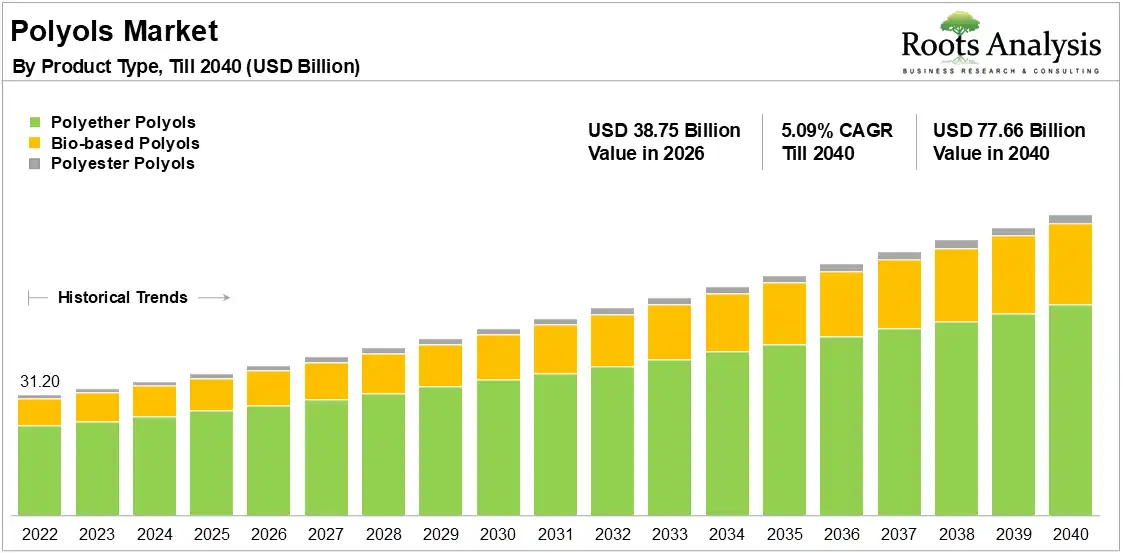
See What’s in the Full Report–Request Your Complimentary Insights!
Market Overview
Polyols define a core chemical market spanning polyester and polyether chemistries that react with isocyanates to form polyurethanes, setting clear boundaries for market size and scope. The resulting materials underpin foams, coatings, adhesives, sealants, and elastomers, prized for durability, flexibility, and energy absorption. Demand for polyols concentrates on construction insulation, furniture cushioning, and protective packaging, reflecting broad operational adoption and established end-use value chains.
The growth momentum is anchored in construction and automotive expansion, where polyol-based polyurethane foams support energy-efficient buildings and vehicle weight reduction amid urbanization and tightening emissions rules. Key use cases include rigid foams for building panels, flexible foams for seating, and protective industrial coatings, serving building and construction, transportation, and furniture markets. A concrete sustainability signal emerged in August 2024, when Cargill launched three 100% bio-based polyols at FEICA 2024 to advance adhesives & sealants, and polyurethane formulations. This activity reflects current market trends and investment interest across scalable polyurethane applications.
Innovation is increasingly shaped by renewable inputs and regulatory alignment, with biopolymers gaining ground under frameworks such as the EU's circular economy action plan while maintaining performance parity in established uses. Looking ahead, Dow's 2025 introduction of VORANOL WK5750 polyol highlights efficiency gains in flexible foams for automotive and furniture, signaling a measured but steady industry outlook.
Market Report: Key Takeaways
- Leading Players Competitive Footprint: Dominant players like Archer Daniels Midland, Arkema, BASF, Cargill, Coim, Covestro, Dow, Evonik, Huntsman, LANXESS, LyondellBasell, Manali Petrochemicals, Mitsui Chemicals, PCC, Repsol, Sabic, Shell, Stepan, Wanhua, Huafon hold strong market positions with extensive geographic presence in various regions.
- Regional Penetration and Adoption Trend: Rapid industrialization, rising number of infrastructure projects, and expanding applications across various end-use sectors is leading the regional growth of polyols market in Asia-Pacific. Notably, the US drives demand through strong industrial and construction activity, accounting for a substantial share of insulation material consumption.
- Building & Construction holds Highest Market Segment: In terms of end use industry, the building & construction sector holds the maximum market share. This is due to extensive use of polyols in rigid polyurethane foams for building insulation, spray foams, roofing systems, sealants, and construction adhesives, which are further supported by energy-efficiency regulations and insulation standards in many regions.
- Opportunities in the Polyols Market: Expanding investment in vegetable oil and bio-waste–based production technologies is opening growth avenues across construction and automotive applications, supported by green building incentives and strong projected market expansion through 2029. Further, polyols derived from captured CO2 present a differentiated revenue opportunity in energy-efficient insulation and related applications, reinforced by supportive policy signals and ongoing industrial partnerships aligned with net-zero manufacturing goals.
- Funding and Investment Momentum: The polyols industry sees steady investment from targeting model optimization and compiler ecosystems within private equity firms, government grants, and largely directed towards sustainable product innovation.
Pay Only for What You Need – The Best Way to Optimize
Recent Industry Developments
- September 2025: EPA amended the national emission standards for hazardous air pollutants (NESHAP) for polyether polyols production, finalizing the removal of affirmative defense provisions for violations due to malfunctions.
- September 2025: Dow and Hisense Home Appliance Group signed a memorandum of understanding at the Shanghai Dow Center. The partnership includes the launch of a joint laboratory dedicated to developing high-performance, sustainable polyurethane materials for home appliance insulation and cooling efficiency.
- August 2025: Wanhua Chemical advanced the commercialization of its next-generation MDI and polyols portfolio, notably commissioning a 50,000-ton-per-year optical-grade MS resin project in the same month.
- May 2025: BASF highlighted the expansion of its Sovermol bio-based polyol line derived from rapeseed, soybean, and castor oil. Concurrently, the company showcased the line’s latest applications in sustainable VOC-free coatings and adhesives, aligning with the brand’s recent regional production scaling in Asia to meet demand for New Energy Vehicles (NEV) and green construction.
Market Dynamics
Polyols Market Drivers
- Booming Construction Insulation Demand: Rigid polyols are used to produce high-performance polyurethane foams for building insulation, with demand driven by global energy-efficiency standards and renewable energy adoption in buildings, along with rapid urbanization across the Asia-Pacific.
- Automotive Lightweighting Push: Flexible polyether polyols play a critical role in reducing vehicle weight in seating and interior systems, directly supporting electrification strategies and fuel-efficiency regulations, with automotive manufacturers in North America increasing polyurethane integration in newer platforms.
- Rise of Bio-Based Alternatives: The gradual transition from petrochemical inputs toward vegetable oil–derived polyols is gaining momentum as manufacturers respond to regulatory preferences in Europe and the United States for low-VOC, lower-carbon materials across foam and coating applications.
- Expanding CASE Applications: Polyols are increasingly valued in CASE (coatings, adhesives, sealants, and elastomers) for their durability and performance benefits, with rising demand alongside industrial growth and the need for materials that perform reliably in high-humidity and challenging operating environments.
Market Restraints
- Petrochemical Feedstock Volatility: Price instability in key inputs such as propylene oxide and ethylene oxide, closely linked to crude oil market disruptions that continue to compress margins for polyether polyol producers, particularly amid ongoing supply chain pressures.
- Stringent Emission Regulations: Tightening environmental standards in Europe and North America, governing VOC emissions and polyurethane manufacturing processes, require significant capital investment in compliance upgrades, slowing adoption at facilities that lack modernization readiness.
- High Bio-Polyol Production Costs: The use of renewable feedstocks (including sugars and bio-based inputs) results in materially higher production costs compared with synthetic alternatives constraining scalability despite increasing sustainability mandates.
- Supply Chain Disruptions: Geopolitical uncertainty and regional raw material shortages have periodically disrupted supply flows exposing Asia-Pacific manufacturers, especially those dependent on imports for pricing volatility and production interruptions.
Unlock Deeper Insights – Schedule Your Personalized Workshop Today!
Market Share Insights
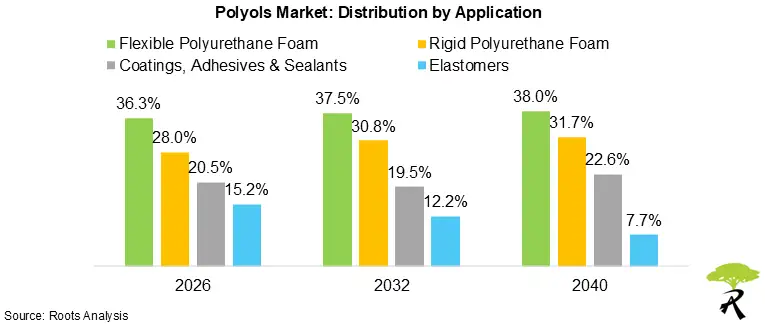
Market Share by Application: Flexible Polyurethane Foam Hold the Largest Market Share
- According to our polyols market analysis, flexible polyurethane foam holds the largest market share of 36.3% in 2026. The growth is driven by extensive use in mattresses, upholstered furniture, bedding, and automotive seating where comfort, durability, and cost efficiency converge to sustain high-volume consumption.
- The coatings segment is expected to be the fastest-growing application, with an estimated CAGR of 7.5% through 2040, supported by rising demand for durable, abrasion-resistant, and chemically robust polyurethane coatings in industrial, infrastructure, and transportation settings. Growth is further reinforced by increased maintenance and retrofit activity, as well as the integration of green and bio-based polyols into coatings formulations.
- While rigid polyurethane foam continues to benefit from insulation-driven demand in construction, its growth remains more closely tied to building cycles and regulatory timelines, giving coatings a structural advantage in long-term growth momentum.
Market Share by Geographical Regions: Asia-Pacific to Dominate the Current Polyols Industry and Grow Rapidly Through 2040
The regional analysis suggests that Asia-Pacific region holds the largest polyols market share of 45.00% in 2026 and is also expected to witness the fastest CAGR during the forecast period till 2040.
- The Asia-Pacific region’s dominance is driven by rapid industrialization, urbanization, and strong demand from construction, automotive, and furnishing industries in China, India, and other emerging economies.
- The Asia-Pacific’s polyols market is anticipated to grow at a faster CAGR of 6.8% through 2040, supported by accelerating adoption of sustainable materials, expanding regional production capacity, and the migration of downstream manufacturing to cost-competitive markets. Compared with North America and Europe, where construction and automotive markets are more mature, Asia-Pacific benefits from both higher baseline growth and stronger incremental demand for green and bio-based polyols.
Want Information on Specific Region / Segment?
Market Ecosystem Insights
Leading Players Competitive Footprint
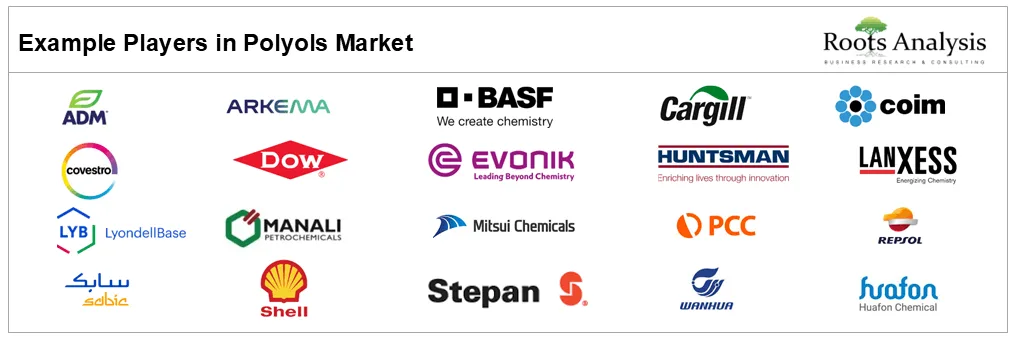
Leading players in the polyols industry include such as Archer Daniels Midland, Arkema, BASF, Cargill, Coim, Covestro, Dow, Evonik, Huntsman, LANXESS, LyondellBasell, Manali Petrochemicals, Mitsui Chemicals, PCC, Repsol, Sabic, Shell, Stepan, Wanhua, Huafon which hold strong market positions through their extensive product portfolios and global reach.
Collaborations and expansions remain key growth strategies, with players accelerating innovation, market penetration, and scalability. For instance, Covestro received a takeover offer from ADNOC to support its sustainable growth strategy in polyols and polyurethanes. With this collaboration the companies are expecting to be in top 5 global chemical players.
Similarly, Wanhua Chemical Group has announced a significant polyether polyols capacity expansion of 850 ktpa (thousand tons per annum) at its Yantai industrial site as part of its broader strategy to strengthen its position in the global polyurethane value chain. This expansion is intended to support rising downstream demand for polyurethane materials and complements the company’s upstream isocyanate capacity growth methylene diphenyl diisocyanate and toluene diisocyanate (MDI/TDI) at the same site.
Startup Activity and Innovation Hotspots
Startup activity within the global polyol market is intensifying as early-stage innovators move from pilot phases to commercial-scale disruptive applications. These companies are primarily focused on high-performance, low-emission formulations that align with the automotive and construction industries' shift toward carbon neutrality.
A defining trend is the commercialization of carbon-capture utilization (CCU); for instance, the partnership between Econic Technologies and Sanyo Chemical has now reached a critical deployment phase, successfully integrating CO2-based polyols into sustainable polyurethane (PU) foams. This technology effectively replaces a significant portion of fossil-based feedstocks with captured carbon.
Beyond CCU, innovation hotspots are emerging in the chemical upcycling sector. Newer startups are developing proprietary catalysts to break down post-consumer PU waste into high-purity recycled polyols, directly supporting the circular economy. These advancements are most prominent in the US Gulf Coast and European industrial clusters, where government incentives for green chemistry have accelerated the adoption of functionalized bio-based polyols for electronics and high-end furniture applications.
Funding and Investment Momentum
The polyols market is experiencing a surge in capital inflows from venture capital, private equity, and strategic corporate investments. This momentum is fueled by the escalating demand for sustainable materials in the electric vehicle (EV) and green building sectors. A landmark event in this space is the pending 14.7 billion acquisition of Covestro by ADNOC, which was conditionally approved by the European Commission in late 2025. As part of this strategic deal, ADNOC committed a 1.17 billion capital injection specifically to accelerate Covestro’s “Sustainable Future” strategy, which includes a heavy focus on circular polyol production.
Government backing remains a critical catalyst for growth. In May 2025, COIM USA acquired a strategic 20-acre site in New Boston, Texas, to expand its renewable polyol capacity, specifically focusing on materials derived from Cashew Nutshell Liquid (CNSL). This move aligns with broader federal and state-level incentives in the US aimed at reducing dependence on petroleum-based chemicals. Simultaneously, the European Union’s Ecodesign for Sustainable Products Regulation (ESPR) and India’s burgeoning green chemical grants are providing the financial runway for companies to scale production of propylene oxide (PO) and ethylene oxide (EO) through lower-carbon, bio-integrated routes.
Your Business is Unique – Why Shouldn’t Your Report Be?
Polyols Market: Scope of the Report
| Key Report Attributes | Details | |
| Historical Trend | Since 2022 | |
| Forecast Period | Till 2040 | |
| Market Size 2026 | $ 38.75 Billion | |
| Market Size 2040 | $ 77.66 Billion | |
| CAGR (Till 2040) | 5.09% | |
| Segments Covered |
|
|
Market Segmentation
Based on research, we have segmented the polyols market into product type, application, end use industry, geographical regions, and key players.
Market Share by Product Type
- Bio-based Polyols
- Polyester Polyols
- Polyether Polyols
Market Share by Application
- Coatings, Adhesives & Sealants
- Elastomers
- Flexible Polyurethane Foam
- Rigid Polyurethane Foam
Market Share by End Use Industry
- Automotive & Transportation
- Building & Construction
- Electronics & Electricals
- Furniture & Bedding
- Packaging
Market Share by Geographical Regions
- North America
- US
- Canada
- Mexico
- Rest of North America
- Europe
- Austria
- Belgium
- Denmark
- France
- Germany
- Ireland
- Italy
- Netherlands
- Norway
- Russia
- Spain
- Sweden
- Switzerland
- UK
- Rest of Europe
- Asia-Pacific
- Australia
- China
- India
- Japan
- New-Zeeland
- Singapore
- South Korea
- Rest of Asia-Pacific
- Latin America
- Brazil
- Chile
- Colombia
- Venezuela
- Rest of Latin America
- Middle East and Africa (MEA)
- Egypt
- Iran
- Iraq
- Israel
- Kuwait
- Saudi Arabia
- UAE
- Rest of MEA


