


 Download Free Sample
 Buy Now
Power Distribution Unit (PDU) Market Size
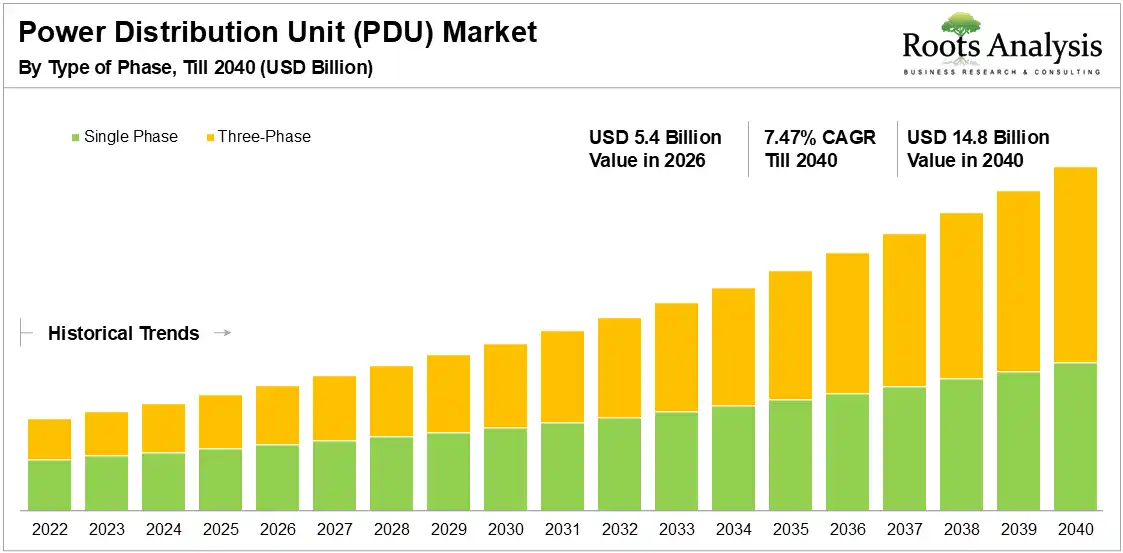
The global power distribution unit (PDU) market reached USD 5.4 billion in 2026 and will grow to USD 14.8 billion by 2040, registering a CAGR of 7.47% over the forecast period 2026 to 2040, driven by hyperscale AI data center expansion and rising intelligent power management demand.
See What’s in the Full Report – Request Your Complimentary Insights!
Market Report: Key Takeaways
- Based on Type, Basic PDU captures 24.0% market share in 2026, whereas Intelligent PDU registers a 10.2% CAGR through 2040, driven by AI-focused monitoring requirements.
- Based on Phase, Single-Phase captures 58.0% market share in 2026, whereas Three-Phase registers a 9.2% CAGR through 2040, driven by high-density rack deployments.
- With respect to Application, Colocation Data Centers captures 31.0% market share in 2026, whereas Hyperscale Data Centers registers a 10.0% CAGR through 2040, driven by cloud AI infrastructure scaling.
- On the basis of End User, Data Centers is both the dominant and fastest-growing category, holding 39.0% share in 2026 and expanding at 9.48% CAGR through 2040, driven by AI compute expansion.
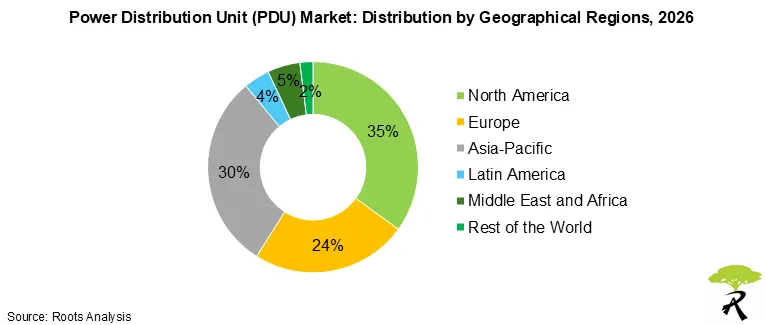
- Based on Geography, North America captures 35.0% market share in 2026, whereas Asia-Pacific registers a 9.34% CAGR through 2040, driven by hyperscale infrastructure investments.
Power Distribution Unit (PDU) Market Outlook
The power distribution unit market has shifted from basic rack power hardware to intelligent, software-aware infrastructure. Hyperscale AI clusters now force buyers to prioritize remote switching, real-time monitoring, and higher-density power paths. That shift is pulling demand away from low-cost basic units and toward monitored, switched, and intelligent PDUs across colocation and enterprise environments.
Growth is being driven by AI-ready data center builds, rising rack densities, and energy optimization mandates inside large facilities. Sustainability pressure is also pushing operators to reduce waste, improve load balancing, and track energy use at the rack level. In March 2026, Schneider Electric promoted its APC NetShelter Rack PDU Advanced platform for higher-density AI workloads and simplified rack power deployment.
Through 2040, the market will stay high-growth because AI training, HPC, and edge expansion all require tighter power control and modular deployment models. Three-phase and rack-mounted systems will gain share as racks exceed 25 kW and operators standardize on intelligent monitoring. In January 2026, Legrand linked UPS, switchgear, busway, and rack PDUs into integrated electrical ecosystems for AI-ready data centers. The outlook remains constructive, with intelligent PDUs capturing the clearest upside.
Power Distribution Unit (PDU) Market Size Estimation Methodology
- As a starting point, the forecast anchors on the 2026 global market size of USD 5.4 billion and the historical progression from USD 3.7 billion in 2022. The baseline is cross-checked against hyperscaler capex disclosures, colocation leasing rates, and data center buildout intensity in North America, Europe, and Asia-Pacific. That combination keeps the Power Distribution Unit market tied to real deployment momentum rather than abstract sentiment.
- Moving forward, we mapped end-user demand using server shipment data, rack density trends, and AI infrastructure expansion signals. Hyperscale, colocation, and edge facilities were separated because each uses different power ratings, mounting formats, and monitoring requirements. This step matters because basic PDUs and intelligent PDUs do not scale at the same pace.
- Building on this, we adjusted the model by segment shares across type, phase, mounting type, end user, power rating, application, and geography. The share shifts toward intelligent PDU, three-phase systems, rack-mounted units, and hyperscale data centers define the forward curve. The model also reflects the market’s geographic tilt toward Asia-Pacific growth and North American leadership.
- Drawing upon these, we used utility billing data, construction cost indices, and facility expansion announcements to validate adoption speed. Energy optimization needs and higher rack power draw make these inputs especially relevant for AI-ready and HPC installations. They also help separate genuine demand from one-time procurement spikes.
- The projected value was then reconciled against the segment outlook, which shows intelligent PDUs growing fastest and above 50 kW systems gaining share. We aligned the long-range forecast with the 2026 to 2040 trajectory, where the market rises from USD 5.4 billion to USD 14.8 billion. This step ties the macro forecast to the commercial reality of higher-density power infrastructure.
- Finally, sensitivity checks tested adoption timing for AI clusters, enterprise refresh cycles, and regional rollout differences. The forecast remains most sensitive to hyperscale capex, rack density, and the speed of three-phase intelligent PDU adoption. That makes the model conservative on legacy retrofit demand and stronger on new-build digital infrastructure.
Power Distribution Unit (PDU) Market Share Insights
Market Share by Application
Based on our analysis, colocation data centers secure 31% of the overall revenue share in 2026. Colocation data centers lead because enterprises increasingly outsource infrastructure management and seek scalable deployment flexibility. Colocation operators maintain strong capital access and extensive interconnection ecosystems across major digital hubs. In April 2025, Vertiv partnered with Maxcom to expand modular data center infrastructure across the Maldives.
Conversely, hyperscale data centers will show robust growth, expanding at a CAGR of 10.0% during the forecast period 2026-2040. Hyperscale data centers will grow fast because AI model training and cloud-native applications require massive compute scalability. Operators increasingly deploy ultra-high-density racks requiring intelligent and remotely managed PDUs. In October 2025, Vertiv launched AI-focused modular rack ecosystems supporting hyperscale infrastructure expansion.
Market Share by Geographical Regions
Based on our geographical analysis, North America leads the market, accounting for 35% of the overall revenue share in 2026. North America leads because the region hosts the largest hyperscale cloud ecosystem and mature colocation infrastructure base. Strong capital availability and AI infrastructure spending continue supporting rapid intelligent PDU deployments. In March 2025, Schneider Electric committed over USD 700 million toward expanding United States operations supporting AI data centers.
On the other hand, Asia-Pacific is likely to grow at a CAGR of 9.3% during the forecast period 2026-2040. Asia-Pacific will expand fastest because regional governments are aggressively supporting domestic cloud and AI infrastructure investments. Rapid digitalization and enterprise cloud adoption are increasing demand for scalable rack power management systems. In March 2025, Schneider Electric announced new AI infrastructure solutions supporting accelerated computing deployments globally.
Want Information on Specific Region / Segment?
Market Ecosystem Analysis
Power Distribution Unit (PDU) Market Competitive Landscape
The PDU market is moderately consolidated. The top five players, Schneider Electric, Vertiv, Eaton, Legrand, and ABB are focused on technology innovation. Competition is intensifying on multiple fronts. Asian challengers like Delta Electronics and Huawei leverage vertically integrated components to price aggressively in Southeast Asia and Latin America. This pressures Western incumbents to bundle service agreements and firmware roadmaps to defend margins.
Niche players such as nVent Enlogic, Starline, and Server Technology are attacking whitespace in modular busway and software-defined PDU segments. US-China tariffs in 2025–2026 raised production costs by 10–20%, adding further competitive pressure on pricing and supply chains. The race to serve AI data centers is the primary competitive battleground today.
Top 5 Companies and Their Key Initiatives
- Schneider Electric updated its NetShelter Rack PDU for high-current AI servers and integrated into NVIDIA's HGX and MGX ecosystems, the first PDU vendor to do so.
- Vertiv launched its PowerIT rack PDU in 2025, targeting AI and HPC workloads, and acquired a custom rack solutions firm in July 2025.
- Eaton agreed to acquire Boyd Thermal for $9.5 billion in November 2025, strengthening its thermal management for liquid-cooled racks.
- ABB launched the AI-ready MegaFlex UL 415V UPS in June 2025 for large-scale data centers. Legrand integrated Server Technology firmware into its CloudRail platform in November 2025, enabling over-the-air updates for 20,000 PDU units across Digital Realty sites.
Startup Companies and Their Key Initiatives
Startups are targeting AI-driven power software and next-generation DC architecture. Companies integrating IoT capabilities, AI-driven predictive maintenance, and modular PDU designs are well-positioned to capture demand. The bigger structural shift is NVIDIA's 800 VDC architecture. It centralizes AC-to-DC conversion at facility level and eliminates the need for traditional rack-level PDUs and AC switchgear. This threatens legacy AC-PDU vendors long term. The intelligent PDU segment alone is forecast to grow from $2.35 billion in 2025 to $4.30 billion by 2032 at a CAGR of 9%. The highest investor opportunity lies in intelligent power software and liquid-cooling integration.
Power Distribution Unit (PDU) Market Trends
- AI Workload Density Reshaping Rack Power Procurement: AI training clusters are forcing rack power buyers to move beyond simple distribution hardware. Vertiv’s September 2025 PowerIT expansion for high-density AI and HPC deployments shows how vendor roadmaps are now built around higher rack loads. The commercial implication is clear, suppliers that cannot serve dense racks will lose specification influence.
- Hyperscale facilities are Standardizing on Stronger Monitoring and Remote Management: Schneider Electric’s March 2026 APC NetShelter Rack PDU Advanced push reflects that shift toward deployment and cleaner rack-level control. The competitive implication is higher attach rates for intelligent PDU platforms.
- Integrated Electrical Ecosystems are Compressing Vendor Boundaries: Data center buyers increasingly want bundled power stacks instead of standalone PDU purchases. Legrand’s January 2026 initiative combined UPS, switchgear, busway, and rack PDUs into one AI-ready electrical ecosystem. The commercial implication is that integrated solution providers can lock in broader account control.
- Platform-Level Integration is also Raising Switching Costs for Operators: Vertiv’s October 2025 OCP-compliant ecosystem launch tied power, cooling, and rack technologies together for high-density sites. The competitive implication is stronger bundling power for incumbents with multi-product portfolios.
- Rising Power Ratings are Shifting Value Toward Intelligent and Three-Phase Units: Rack loads above 25 kW are changing PDU selection criteria. Vertiv’s 2025 PowerIT launches supported up to 57.6 kW, which shows where the market is heading on density ceilings. The commercial implication is a faster replacement cycle for low-spec units.
Your Business is Unique – Why Shouldn’t Your Report Be?
Market Access Considerations
High-Density Data Center Qualification
Entry depends on proving performance in dense AI and HPC environments, not just standard enterprise rooms. Buyers increasingly expect rack PDUs to handle higher power ratings, remote control, and continuous monitoring under OCP-style ecosystem requirements. Vertiv’s October 2025 AI infrastructure launch shows how vendor qualification now depends on ecosystem compatibility, which raises commercialization costs but strengthens incumbents with validated portfolios and field-tested references.
Global Deployment Flexibility
Operators want products that can be rolled out across North America, EMEA, and Asia-Pacific without redesigning the electrical stack. Legrand’s February 2025 Universal Input support for PRO4X and PX4 intelligent rack PDUs simplified global deployments and reduced localized rework. The market reward goes to suppliers that can shorten deployment time and lower integration friction across regions, especially where procurement cycles are compressed.
AI-Ready Product and Lab Validation
Market access increasingly depends on formal product validation for AI power systems. Schneider Electric opened a dedicated PDU testing laboratory in Massachusetts in February 2025, which signals how test infrastructure now supports commercialization credibility. Vendors without similar validation capacity face slower procurement approval and weaker differentiation, especially in large data center bids.
Distributed Channel and Ecosystem Reach
The winning access model is increasingly ecosystem-led, not transaction-led. Schneider Electric, Vertiv, and Legrand all use broader data center power programs to reach buyers through integrated infrastructure conversations. That structure favors companies with channel depth, engineering support, and field-service coverage, because rack PDU sales now follow larger power architecture decisions and account-level standardization.
How Stakeholders Benefit from the Key Focus Areas of Our Power Distribution Unit (PDU) Market Report
AI-led data center expansion has made rack power a commercial priority, not a back-end utility purchase. The report helps teams separate legacy PDU demand from the faster-growing intelligent and high-density segments. It supports pricing, partner, and investment decisions where rack density, energy control, and deployment speed now determine competitiveness.
- Unmet Needs and Market Gaps in Power Distribution Unit Market: The report identifies where basic and metered products still dominate and where intelligent monitoring remains underpenetrated. That matters for product teams deciding whether to target retrofit sites, hyperscale new builds, or edge deployments. It gives a clear basis for deciding which gaps justify new SKUs, service bundles, or region-specific offerings.
- Funding and Venture Investment Opportunities in Power Distribution Unit Market: The report highlights where growth is concentrated, especially intelligent PDU, three-phase systems, and above 50 kW power ratings. That is useful for capital allocators deciding whether the market supports expansion into high-density power platforms and adjacent infrastructure layers. It also helps investors separate durable AI infrastructure demand from short-lived procurement cycles.
- Technology Innovation and Adoption Trends: The report shows how AI workloads, remote power management, and integrated electrical ecosystems are changing adoption curves. That helps product and engineering leaders decide whether to prioritize monitoring, switching, universal input support, or bundled ecosystem functionality. It also clarifies which technologies are gaining specification power inside AI-ready facilities.
- Power Distribution Unit Market Competitive Landscape and Industry Analysis: The report maps Tier 1, Tier 2, and emerging providers across rack PDU, intelligent power, and integrated infrastructure categories. That gives commercial teams a practical view of who sets the spec, who competes on deployment speed, and who leads on ecosystem breadth. It supports account planning, channel strategy, and competitor positioning.
- Mapping Strategic Partnerships and Ecosystem Synergies: The report explains how partnerships now span UPS, switchgear, busway, cooling, and rack power. That matters for business development teams deciding where bundle economics can improve win rates. It also shows which combinations can reduce customer friction and lock in larger infrastructure deals.
- Power Distribution Unit Market CAGR and Growth Trends: The report quantifies which segments grow fastest through 2040, including intelligent PDUs, three-phase units, rack-mounted systems, and hyperscale applications. That is the key input for forecast-driven planning, portfolio prioritization, and capex timing. It gives leadership a defensible view of where the market is expanding and where share is being lost.
Power Distribution Unit (PDU) Market: Scope of the Report
| Key Report Attributes | Details | |
| Forecast Period | Till 2040 | |
| Market Size 2026 | USD 5.4 Billion | |
| Market Size 2040 | USD 14.8 Billion | |
| CAGR (Till 2040) | 7.47% | |
| Segments Covered |
|
|
| Geographical Regions Covered |
|
|
| Key Sections Covered |
|
|
Source: Roots Analysis
Market Segmentation
The power distribution unit (PDU) market report presents an in-depth analysis, highlighting the capabilities of various stakeholders, based on different segments such as type, phase, mounting type, power rating, application, end-user, geographical regions, and leading players.
By Type
- Basic PDU
- Metered PDU
- Monitored PDU
- Switched PDU
- Intelligent PDU
- Others
By Phase
- Single-Phase
- Three-Phase
By Mounting Type
- Rack-Mounted
- Floor-Mounted
- Cabinet-Mounted
By Power Rating
- Up to 10 kW
- 10-25 kW
- 25-50 kW
- Above 50 kW
By Application
- Colocation Data Centers
- Enterprise Data Centers
- Hyperscale Data Centers
- Edge Data Centers
- High-Performance Computing Facilities
By End User
- Data Centers
- Telecom and IT
- Industrial Manufacturing
- Healthcare
- BFSI
- Government and Defense
- Energy and Utilities
- Others
By Geographical Regions
- North America
- US
- Canada
- Mexico
- Rest of North America
- Europe
- Austria
- Belgium
- Denmark
- France
- Germany
- Ireland
- Italy
- Netherlands
- Norway
- Russia
- Spain
- Sweden
- Switzerland
- UK
- Rest of Europe
- Asia-Pacific
- Australia
- China
- India
- Japan
- New-Zealand
- Singapore
- South Korea
- Rest of Asia-Pacific
- Latin America
- Argentina
- Brazil
- Chile
- Colombia
- Venezuela
- Rest of Latin America
- Middle East and North Africa (MENA)
- Egypt
- Iran
- Iraq
- Israel
- Kuwait
- Saudi Arabia
- UAE
- Rest of MENA
- Rest of the World


