Privacy-Enhancing Computation Market by Technology (Differential Privacy, Homomorphic Encryption, Multi-party Computation, Personal Data Stores, and Trusted Execution Environments), Deployment Mode (Cloud and On-Premises), End Use Vertical, Geographical Region, and Key Players – Trends and Forecast 2026-2035
Market Size
The global privacy-enhancing computation market, USD 5.62 billion in 2025, is projected to reach USD 7.28 billion in 2026 and USD 46.29 billion by 2035, with a 22.82% CAGR during the forecast period 2026 to 2035.

See What’s in the Full Report–Request Your Complimentary Insights!
Market Report: Key Takeaways
- In terms of technology, homomorphic encryption holds the largest share of revenue in the global market.
- In terms of leading region, North America dominates the global market with a share of 39.63% during the forecast period.
- Growing threats of cyberattacks and increasing proliferation of AI, ML, and big data analytics are propelling the privacy-enhancing computation market growth.
Market Overview
Privacy enhancing computation (PEC) refers to the family of advanced technologies and mathematical techniques that enables organizations to process, analyze, and collaborate on sensitive data while minimizing the risks of data leakage and preserving individual privacy throughout the entire computation lifecycle. Unlike the data anonymization methods wherein the removal / alteration is performed on the dataset to prevent the identification, PEC ensures the computing on the protected data.
The market includes several technologies / techniques, such as homomorphic encryption for privacy-enhancing computation, secure multi-party computation, differential privacy, federated learning, and trusted execution environments (TEE). Each of these offers distinct mechanisms for performing advanced analytics and ensuring regulatory compliance, without compromising the underlying data confidentiality.
Factors, such as rising global concerns over data privacy, the intensification of cyber threats, and the proliferation of big data and artificial intelligence are driving the demand for PEC solutions, especially secure enclave solutions, around the globe. Further, the data privacy laws like GDPR and CCPA require mandate stringent privacy protection for processing and sharing of the data, thereby accelerating the adoption of PECs. Such laws are important to design the secure data collaboration platforms, wherein PEC supports in safeguarding the information, even in untrusted environment. The expansion of cloud computing and IoT is also the driving factor for protection of distributed, sensitive data.
Advances in cryptographic research, hardware acceleration, and federated learning for privacy-preserving AI are enhancing the practicality and efficiency of PEC. This supports the organizations for balancing the trade-off between privacy and computational performance.
Recent Developments
- In September 2025, Cornami, a leader in scalable computing architectures, and DESILO, a privacy-enhancing technology (PET) startup, announced the deployment of a fully homomorphic encryption based LLM.
- In May 2025, IBM completed the acquisition of HashiCorp, so as to bring together the capabilities for strengthening the security and making value addition to the cloud.
- In March 2025, (National Privacy Commission) NPC and Insurance Commission of Philippines issued a joint advisory, valuing the adoption of PETs in the insurance industry, which may supplement existing privacy-preserving practices to mitigate data privacy risks.
Want Information on Specific Region / Segment?
Market Dynamics
The industry is set to witness a lucrative growth phase, with the privacy-preserving computation market shaped by a dynamic interplay of drivers, restraints, opportunities, and challenges that will influence its trajectory in the coming years.
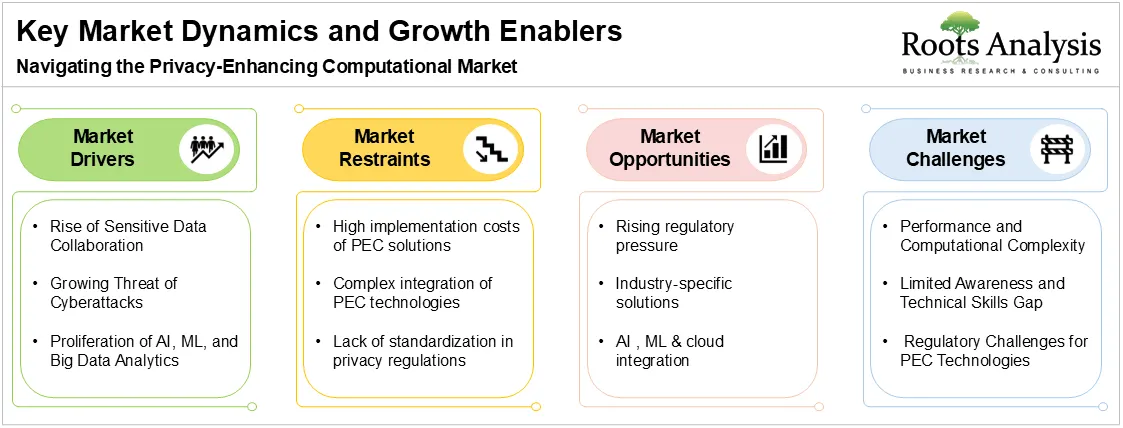
Key Market Drivers
- Rise of Sensitive Data Collaboration: This technology is beneficial in exchange of information across various stakeholders across multiple domains, such as healthcare, financial, life sciences and defense. Moreover, high usage of privacy-enhancing computation in healthcare data sharing is an important driving factor in the market, enabling secure cross-border data analytics, federated machine learning.
- Growing Threat of Cyberattacks: With a rise in ransomware, insider threats, and data leaks, organizations are turning to PEC as it offers zero-knowledge proofs technology and mathematically guaranteed protection.
- Proliferation of AI, ML, and Big Data Analytics: As organizations leverage cloud AI, ML and big data to generate insights, the need for PEC is growing rapidly. These technologies support privacy-by-design in AI systems, confidential data analytics, and secure digital identity, all while adhering to privacy mandates.
Key Market Challenges
- Performance and Computational Complexity: Many PEC frameworks are still resource-intensive and can introduce significant latency and cost compared to conventional processing, limiting deployment in latency-sensitive or large-scale environments.
- Limited Awareness and Technical Skills Gap: PEC is a relatively new and sophisticated field. Most enterprises lack cryptography expertise, and decision-makers may not fully understand PEC’s benefits, requirements, or practical use cases, hindering broader adoption.
- Regulatory Compliance Challenges for PEC Technologies: Ambiguities around cross-border data sharing, sector-specific privacy mandates, and evolving legal interpretations of “anonymization” or “pseudonymization” create uncertainty for global deployments.
Market Segmentation
The privacy-enhancing computation market report presents an in-depth analysis of the various companies, across different segments, as in the figure below:

Market Share Insights
Technology Market Share Leader and Fastest Growing Segment
As per our PEC market analysis, the homomorphic encryption sub-segment is expected to hold the largest share of 35.97% in the privacy-enhancing technology market.
The homomorphic encryption market growth is due to rising demand for data security from the industrial data-sharing requirements. Companies are leveraging multiple parties and analyzing encrypted data collectively through this technology due to its ability to protect sensitive information, making it suitable for stringent data privacy regulations.
On the other hand, the personal data store sub-segment is projected to have the fastest CAGR (31.41%) during the forecast period.
This growth is due to their ability to allow individuals to control the flow of their private data by granting or revoking access for third-party providers. This technology offers several advantages for businesses, including more effective data gathering and storage, reduced legal risks associated with unauthorized disclosure of private data, and easy data updates.
Regional Forecast Estimates: North America Leads the Market, Fueled by Rising Cyberattacks
North America is projected to hold the most substantial share of 39.63% within the current global year. Stringent data protection regulations, such as GDPR and CCPA, compel organizations to adopt privacy-enhancing technologies to ensure compliance and mitigate legal risks.
Apart from this, North America’s role as a technological hub fosters innovation in privacy-enhancing technologies, such as secure multi-party computation (MPC) adoption trends, with key market players actively driving advancements.
Further, the convergence of regulatory requirements, cybersecurity imperatives, and technological innovation positions North America at the forefront of privacy-enhancing computation adoption across diverse industries.
Your Business is Unique – Why Shouldn’t Your Report Be?
Key Market Takeaways
Which are the Top Players in the Privacy-Enhancing Computation Market?
Examples of leading privacy-enhancing computation manufacturers (which have also been captured in this market report, arranged in alphabetical order) include AVG Technologies, Check Point Software Technologies, Cisco Systems, Fortinet, Google, IBM, Intel, Kaspersky, McAfee, Microsoft, Palo Alto Networks, RSA Security, Sophos Group, Symantec, and Trend Micro.

What Strategies are the Companies Using to Gain PEC Market Share?
Companies are gaining privacy enhancing computation (PEC) market share by developing advanced cryptographic solutions like homomorphic encryption, collaborating with hardware vendors for secure enclaves, encrypted data processing techniques, enabling privacy-preserving analytics on cloud platforms.
Some are forming strategic partnerships and rapidly innovating AI-driven approaches such as federated learning and privacy-preserving machine learning.
For instance, In December 2024, Optalysys collaborated with Zama to supercharge fully homomorphic encryption development. The partnership aimed at the integration of Zama’s FHE solution with Optalysys’ hardware acceleration product range, Enable, to expedite FHE adoption for its customers.
The companies are also expanding R&D investments, and offering interoperability-focused solutions and differential privacy applications tailored to finance, healthcare, and tech sectors. There is also a shift in inclination towards cloud-based PEC services for financial institutions.
Unlock Deeper Insights – Schedule Your Personalized Workshop Today!
PEC Integration in Decentralized Digital Identity Platforms
Privacy-enhancing computation enables decentralized digital identity platforms to process and verify identity attributes without exposing users’ sensitive data. Techniques such as secure multi-party computation or federated identity verification allow individuals to prove credentials, like age or citizenship, while actual data remains private.
The decentralized identity approach ensures self-sovereign control, prevents third-party data misuse, and supports regulatory compliance. PEC empowers trustless systems, where parties do not need to rely on a central authority for privacy; instead, data privacy is built into the computational flow.
PEC Solutions for Secure Federated Learning
PEC is fundamental for secure federated learning, where multiple organizations collaboratively train AI models without sharing raw private data. Methods include secure aggregation, homomorphic encryption, and differential privacy, allowing model updates to be exchanged in privacy-preserving formats.
AI model training with privacy-enhancing computation helps in keeping the data local, mitigating exposure to external threats and satisfying strict data privacy regulations. PEC ensures that individual participants’ data never leaves their own infrastructure during learning, making it ideal for sectors like healthcare and finance where data sensitivity is high.
Zero-Knowledge Proofs in Privacy-Preserving Analytics
Zero-knowledge proofs (ZKPs) are a core type of privacy-enhancing computation that allows a party to prove knowledge of or compliance with certain rules without revealing underlying sensitive data. For analytics, ZKPs enable validation (e.g., age, creditworthiness) or transaction proofs without disclosing identities or transaction details.
This technique prevents unwanted data disclosure, supports secure access controls, and builds trust in analytics pipelines for regulated domains. ZKPs are especially useful for data sharing across organizations, secure audits, and privacy-preserving authentication, where revealing data would violate privacy.
Confidential Computing and Trusted Execution Environments (TEE)
Confidential computing combines hardware-based Trusted Execution Environments (TEEs) with privacy-enhancing computation techniques to protect sensitive data during processing. By running PEC protocols, such as multi-party computation or differential privacy, inside TEEs, organizations gain robust protection against internal and external threats during computation.
TEEs also provide attestation capabilities to ensure only approved code is executed, strengthening privacy compliance. This approach is vital for safeguarding personal, financial, and health data in cloud, edge, and distributed environments where data privacy and secure analytics must coexist.

Privacy-Enhancing Computation Market: Scope of the Report
| Key Report Attributes | Details | |
| Historical Trend | Since 2020 | |
| Forecast Period | Till 2035 | |
| Market Size in 2026 | $ 7.28 Billion | |
| Market Size in 2035 | $ 46.29 Billion | |
| CAGR (Till 2035) | 22.82% | |
| Segments Covered |
|
|
Unlock Deeper Insights – Schedule Your Personalized Workshop Today!
Market Segments
Based on the research, we have segmented the privacy-enhancing computation market into technology, deployment mode, end use vertical, geographical regions, and key players.
By Technology
- Differential Privacy
- Homomorphic Encryption
- Multi-party Computation
- Personal Data Stores
- Trusted Execution Environments
By Deployment Mode
- Cloud
- On-Premises
By End Use Vertical
- BFSI
- Government
- Healthcare
- IT and Telecommunication
- Manufacturing
- Retail
By Geographical Regions
- North America
- US
- Canada
- Mexico
- Rest of North America
- Europe
- Austria
- Belgium
- Denmark
- France
- Germany
- Ireland
- Italy
- Netherlands
- Norway
- Russia
- Spain
- Sweden
- Switzerland
- UK
- Rest of Europe
- Asia-Pacific
- Australia
- China
- India
- Japan
- New Zealand
- Singapore
- South Korea
- Rest of Asia-Pacific
- Latin America
- Brazil
- Chile
- Colombia
- Venezuela
- Rest of Latin America
- Middle East and Africa (MEA)
- Egypt
- Iran
- Iraq
- Israel
- Kuwait
- Saudi Arabia
- UAE
- Rest of MEA


