Quantum Cryptography Market by Type of Offering (Quantum Key Distribution, Quantum Random Number Generation, Software and Services), Type of Service (Consulting, Deployment and Integration, Support and Maintenance), Component (Hardware and Software), Deployment Protocol, Application Area, End Use Industry, Type of Enterprise, and Geographical Regions – Trends and Forecast 2026-2035
Market Size
The global quantum cryptography market, valued at USD 0.71 billion in 2025, is projected to reach USD 0.82 billion in 2026 and USD 3.73 billion by 2035, representing an overall CAGR of 18.3% during the forecast period 2026 to 2035.
It is important to note that rapid technological advancements, rising cybersecurity needs, and increased public-private investment could further accelerate the growth of quantum cryptography market. If these enablers materialize, the market is likely to see broader adoption and a significantly higher growth trajectory during the forecast period. Our upside scenario estimates indicate that, in 2026, the global market size for quantum cryptography is estimated to be USD 1.2 billion, and this value is projected to reach USD 15.6 billion by 2035, growing at a CAGR of 32.6%.

See What’s in the Full Report - Request Your Complimentary Insights!
Market Report: Key Takeaways
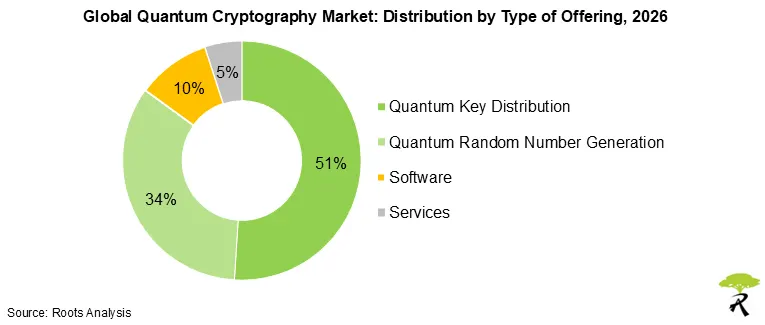
- In terms of type of offering, quantum key distribution (QKD) dominates the global market, accounting for a 51.67% share of the overall market in 2026.
- In 2026, hardware captures the largest share (89.5%) of the quantum cryptography market by component.
- Based on the deployment protocol, the BB84 protocol holds the largest share (80.4%) of overall revenue in 2026.
- In terms of application area, network security dominates the global market, accounting for 40.4% of overall revenue in 2026. Meanwhile, cloud security is expected to grow at a relatively higher CAGR through 2035.
- In 2026, the government sector captures the largest quantum cryptography market share (53.7%) by end use industry.
- Nearly 95% of players offer quantum cryptography solutions, while over 45% also provide services to enable scalable, cost-effective access to advanced quantum security for clients.
- Around 4,100 patents focused on the quantum cryptography solutions have been filed or granted in the last five years, indicating significant research activity in this domain.
- Since 2024, stakeholder interest in the quantum cryptography domain has risen sharply, as reflected by a wide array of partnerships; 20% of the overall deals have been signed for product development purposes.
- Over the past few years, close to USD 170 million has been raised across various funding rounds, with venture capital emerging as the most prominent funding model adopted by stakeholders in this domain.
Market Overview
Quantum cryptography is a cutting-edge technology that harnesses the principles of quantum mechanics to secure communication. It operates by using quantum states (primarily photons) to transmit information, ensuring that any attempt to intercept or observe the communication disturbs the quantum state, thereby alerting the parties involved.
Quantum cryptography provides a highly secure solution for protecting sensitive data, primarily through quantum key distribution. QKD generates encryption keys that are theoretically unbreakable due to the laws of quantum physics, forming the foundation for secure data transmission with quantum encryption across highly sensitive communication infrastructures.
Safeguarding company data from rising cyber security threats and cybercrime is a pressing necessity that is fueling the growth of the quantum cryptography market. Additionally, increasing privacy concerns regarding the protection of critical data from hackers, advancements in quantum cryptography technology, and the adoption of cloud-based quantum cryptography solutions and other wireless networks are further propelling the market growth in quantum cryptography industry.
Recent Industry Developments
- In October 2025, LuxQuanta raised USD 9.3 million through its venture series A round to accelerate the global deployment of quantum-safe cybersecurity solutions.
- In September 2025, IonQ signed a memorandum of understanding (MoU) with the US Department of Energy (DoE) to advance quantum technologies in space, specifically to design and execute an orbital demonstration of quantum-secure communications.
- In June 2025, Toshiba entered into a commercial agreement with Orange Business to launch the first commercial quantum-safe network service in France.
- In June 2025, Quantum Dice received a grant of USD 2.1 million from the University of Oxford to accelerate the development of their compact, high-speed, and continuously self-certifying quantum random number generator (QRNG) technology.
Pay Only for What You Need – The Best Way to Optimize
Market Share Insights
Quantum Key Distribution to Drive the Market
According to the global quantum cryptography market report, quantum key distribution sub-segment dominates the market, accounting for 51.67% of the market share in 2026. This dominance of QKD is driven by its proven capability for secure communication over long distances (>500 km via fiber and >1000 km via satellite data transmissions) and eavesdropping detection.
Market trends in quantum key distribution technology adoption, such as continued evolution of fiber-optimized and free-space QKD systems also contribute to significant quantum cryptography market growth across countries like Japan, China, and the US. In addition, major financial services corporations and national-level cyber command units are validating QKD-powered models for secure data transmission with quantum encryption, minimizing the probability of key extraction and positioning QKD for sustained dominance in global marketplace.
Consulting Services to Shape the Future of Quantum Cryptography Industry
The consulting services sub-segment holds the maximum market share (over 45%) in 2026. This dominance is driven by growing demand from enterprises seeking expert guidance to integrate quantum-safe encryption into their legacy IT infrastructures and ensure compliance with evolving regulations. Further, specialized consulting services enable organizations to strategize enterprise quantum cryptography adoption and to manage associated risks rapidly, thereby accelerating global deployment.
North America Leads Quantum Cryptography Market
According to the quantum cryptography market forecast, North America leads the market by capturing ~34% of the global market share in 2026. Despite a relatively low number of headquartered companies and moderate funding activity compared to other regions, North American region dominates the global industry. This dominance is due to robust technological infrastructure, advanced research capabilities, strong government support, early adoption in key sectors like finance and defense, and strategic public-private collaborations that accelerate innovation, commercialization, and scalability.
On the other hand, Asia-Pacific is expected to witness a higher CAGR of 19.7% during the forecast period. This rapid market growth is fueled by large-scale, government-backed QKD infrastructure programs, including China’s 4,600 km Beijing-Shanghai backbone, South Korea’s SK Telecom-led urban QKD networks, and India’s USD 1 billion National Mission on Quantum Technologies. These programs are driving accelerated infrastructure development and faster commercialization across the region.
Want Information on Specific Region / Segment?
Market Dynamics
Competitive Landscape of Market Players Studied
The competitive landscape of the global quantum cryptography market is shaped by a blend of established companies and innovative emerging firms specializing in offering quantum cryptography solutions and services catering to different industries. Notably, the current market is dominated by small and mid-sized companies; examples of small companies (in alphabetical order) include Alea Quantum Technologies, Applied Quantum and Crypta Labs.
In terms of components, the quantum cryptography solution providers offer specialized hardware, driven by the essential role of devices like photon sources, detectors, and QKD (quantum key distribution) technology in enabling secure communication. Meanwhile, 44% of the players offer software, reflecting growing demand for scalable, flexible cryptographic algorithms and management tools that complement hardware and integrate with existing IT infrastructure.
It is imperative to note that the most of the solution providers deploy BB84 protocol due to its proven quantum security and real-time eavesdropping detection, while TLS / SSL protocol remains in limited use. Moreover, players are focusing on advancements in quantum-resistant encryption algorithms, including lattice-based and hash-based approaches, aligned with emerging NIST-backed standards in order to enhance cybersecurity resilience, and ensure quantum cybersecurity for critical infrastructure, cloud environments, and next-generation digital communication networks.
Regulatory Standards for Quantum Cryptography Deployments
The regulatory frameworks established for quantum cryptography vary across countries, upholding a common goal of ensuring secure quantum communication networks that protect critical data from emerging quantum computing threats. Further, the growing need for safety and quality, high-performance, reliable quantum cryptography solutions across various industries significantly drives the evolution of regulatory frameworks.
Regulatory authorities shaping the quantum cryptography market dynamics include ITU-T Y.3800 Series (governed by ITU- Telecommunication Standardization Sector), ETSI GS QKD Series (governed by ETSI Industry Specification Group on QKD), ETSI TC Cyber QSC, EuroQCI rollout (governed by ETSI TC Cyber QSC).
It is worth highlighting that India and China are advancing investments in national quantum communication infrastructure, while the NSA and NCSC continue to highlight operational and scalability challenges of quantum cryptography infrastructure that limit broad QKD deployment in the near term.
Key Market Drivers
- Increasing Need for Secure Communications: The surge in global cyber-attacks has heightened the demand for secure communication systems, especially in critical sectors like finance, government, and healthcare. Quantum cryptography offers unparalleled security against emerging threats (including “harvest-now, decrypt-later" attacks), driving rapid adoption and investment across mission-critical sectors.
- Ongoing Advancements in Enabling Hardware and Integration Technology: Continuous improvements in enabling hardware, such as single-photon detectors, integrated photonics, and hybrid classical / quantum networking interfaces enhancing the feasibility and scalability of quantum key distribution. These advancements are driving market growth by improving performance of quantum cryptography hardware and software products and allowing broader real-world deployment beyond laboratory environments.
- Rising Government Investment and Strategic Partnerships: Significant government funding for quantum cryptography, strategic alliances between tech companies, academia, and agencies are fostering innovation in QC. These collaborations also focus on promoting regulatory standards and training professionals for required skillset; consequently, supporting market expansion.
Market Challenges
- Standards, Interoperability and Certification Gaps: The quantum cryptography ecosystem faces significant challenges due to ongoing compliance shifts and lack of robust, widely accepted standards, protocols, and certification frameworks. This absence affects vendor interoperability, increases integration costs, and prolongs procurement cycles, collectively slowing down industry-wide adoption.
- Physical and Hardware Vulnerabilities: Quantum cryptography hardware remains susceptible to practical issues such as photon losses, side-channel attacks, calibration errors, and environmental disturbances. These real-world vulnerabilities challenge the industry by undermining theoretical security promises and necessitating continuous hardware improvement, quality control, and testing to maintain trust in system reliability.
- Lack of Mature Commercial Ecosystem: The industry is still developing a mature commercial ecosystem, characterized by limited standardized equipment and weak interoperability with existing IT infrastructure. This fragmented landscape increases operational complexity, slows integration efforts, and creates uncertainty for enterprise adoption, thereby creating challenges in the commercialization and scalability of quantum cryptographic solutions.
Have Questions? Let’s Get Them Answered.
Market Segmentation
Quantum Cryptography Market: Report Attributes / Market Segmentations
| Key Report Attributes | Details | |
| Historical Trend | Since 2021 | |
| Forecast Period | Till 2035 | |
| Market Size 2026 | USD 0.82 Billion | |
| Market Size 2035 | USD 3.73 Billion | |
| CAGR till 2035 | 18.3% | |
| Segments Covered |
|
|
| Key Players Profiled |
|
|
| PowerPoint Presentation (Complimentary) | Available | |
| Customization Scope | 15% Free Customization | |
| Excel Data Packs (Complimentary) |
|
|
Market Segments
Based on the research, we have segmented the quantum cryptography market into type of offering, type of service, component, deployment protocol, application area, end use industry, type of enterprise, and geographical regions
Market Share by Type of Offering
- Quantum Key Distribution
- Quantum Random Number Generation
- Software
- Services
Market Share by Type of Service
- Consulting
- Deployment and Integration
- Support and Maintenance
Market Share by Component
- Hardware
- Software
Market Share by Deployment Protocol
- BB84 Protocol
- TSL/SSL Protocol
Market Share by Application Area
- Application Security
- Cloud Security
- Database Security
- Network Security
Market Share by End Use Industry
- BFSI
- Energy & Utilities
- Government
- Healthcare
- IT and Telecom
- Others
Market Share by Type of Enterprise
- Large Enterprises
- Small and Medium Enterprises
Market Share by Geographical Regions
- North America
- US
- Canada
- Europe
- France
- Germany
- Italy
- Spain
- UK
- Rest of Europe
- Asia-Pacific
- Australia
- China
- India
- Japan
- South Korea
- Rest of Asia-Pacific
- Latin America
- Brazil
- Columbia
- Rest of Latin America
- Middle East and Africa (MEA)
- Israel
- Qatar
- Saudi Arabia
- UAE
- Rest of MEA


