Radioisotope Thermoelectric Generator (RTG) Market by Type of Radioisotope (Americium-241, Cobalt-60, Plutonium-238, Polonium-210, and Strontium-90), Application (Military and Defense, Remote Weather Stations, Scientific Research, Space Exploration, and Underwater Surveillance), Generator Capacity, Technology, End Use Sector, Geographical Regions, and Key Players - Trends and Forecast 2026-2035
Market Size
The global radioisotope thermoelectric generator (RTG) market, valued at USD 0.61 billion in 2025, is projected to reach USD 0.66 billion in 2026 and USD 1.35 billion by 2035, with a CAGR of 8.29% during the forecast period 2026 to 2035.

See What’s in the Full Report–Request Your Complimentary Insights!
Market Report: Key Takeaways
- In terms of radioisotope, plutonium-238 holds the largest share of revenue in the global market (58%).
- In terms of leading region, North America dominates the global market (with a share of 55%) during the forecast period.
- Space exploration currently dominates by capturing 62% share through 2035.
- Expanding planetary exploration missions and advances in compact, efficient RTG designs are propelling the electronic parking brake market growth.
Market Overview
Radioisotope thermoelectric generators (RTGs) are specialized power sources that convert heat released from the natural decay of radioactive isotopes into electricity using advanced thermoelectric materials.
RTGs are uniquely suited for environments requiring long-term and reliable autonomy particularly in remote or harsh conditions where conventional energy sources are impractical or ineffective. RTG applications in deep space exploration missions, planetary rovers, and satellites, make RTG a crucial component of space research. Beyond aerospace, they also serve remote terrestrial installations such as Arctic scientific outposts, underwater military systems, and isolated communication equipment requiring maintenance-free, durable energy supplies.
The use of RTG in unmanned and remote applications underpins their growing deployment across defense, space, and specialized industrial sectors as they can operate uninterrupted for decades in extreme environments.
The RTG market growth is driven by accelerating investments in space missions, particularly RTG NASA space missions which include deep-space exploration and lunar research, where solar power’s limitations necessitate dependable nuclear-based sources. Additionally, advances in thermoelectric materials and manufacturing technologies are enhancing RTG efficiency and lifespan, reducing costs and widening their usability.
The demand for autonomous, low-maintenance power supply solutions for remote, harsh environments is rising in tandem with global initiatives for sustainable, long-duration energy supplies.
Pay Only for What You Need–The Best Way to Optimize
Recent Developments
- In April 2025, Dragonfly, a Pu-fueled drone with plutonium-238-fueled RTG, heading to Titan, got key NASA approval.
- In May 2025, NASA announced its Orbilander Mission, with a spacecraft using RTG for power, to search for alien life on Saturn’s moon ‘Enceladus’.
- In May 2023, Zeno Power got a funding for $30 million to build radioisotope-powered satellite for the US military.
Market Dynamics
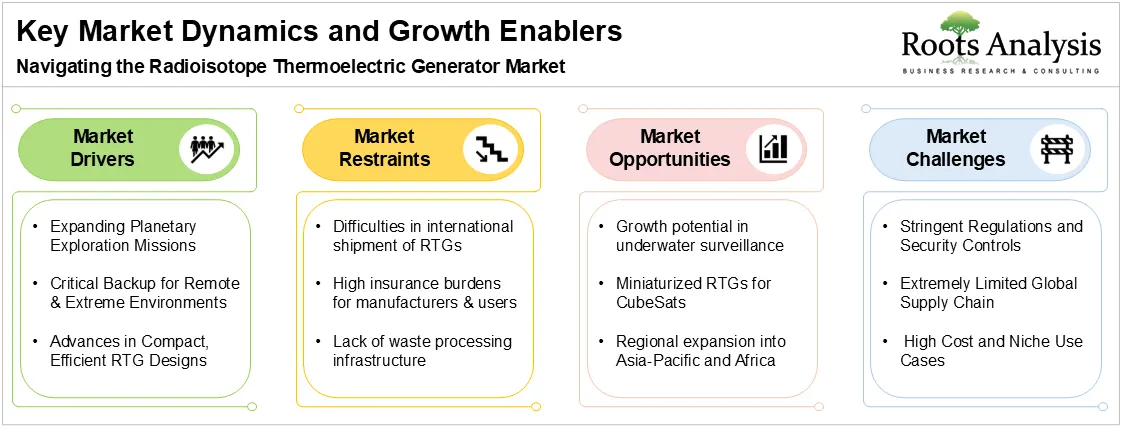
The industry is set to witness a lucrative growth phase, with the RTG market shaped by a dynamic interplay of drivers, restraints, opportunities, and challenges that will influence its trajectory in the coming years.
Market Key Drivers
The advanced thermoelectric generators market growth is due to several key drivers. Here are some significant factors contributing to this expansion:
- Expanding Planetary Exploration Missions: Use of RTG for planetary exploration, by NASA, ESA, CNSA, ISRO, and private players, are major drivers of RTG development and procurement.
- Critical Backup for Remote and Extreme Environments: Evolving market outlook for RTGs in defense and remote outposts situated in extreme environments, which are inaccessible to conventional power grids.
- Advances in Compact, Efficient RTG Designs: Progress in thermoelectric module innovation (e.g., advanced skutterudite and telluride alloys) and containment systems is improving conversion efficiency, reducing weight, and enhancing safety and reliability for space and remote terrestrial RTG systems.
Your Business is Unique–Why Shouldn’t Your Report Be?
Key Challenges
- Stringent Regulations and Security Controls: RTG safety and regulatory standards for nuclear space power, spanning their manufacture, transport, and use, which are tightly regulated for environmental safety, leading to increased costs and production time.
- Extremely Limited Global Supply Chain: Limitations in plutonium-238 RTG supply chain, one of the most suitable radioisotopes, highly affects production capacity and market scalability.
- High Cost and Niche Use Cases: RTGs are expensive to manufacture, with cost-per-watt far above conventional power systems. As such, they are unlikely to see volume adoption in mass-market or terrestrial commercial applications.
Market Segmentation
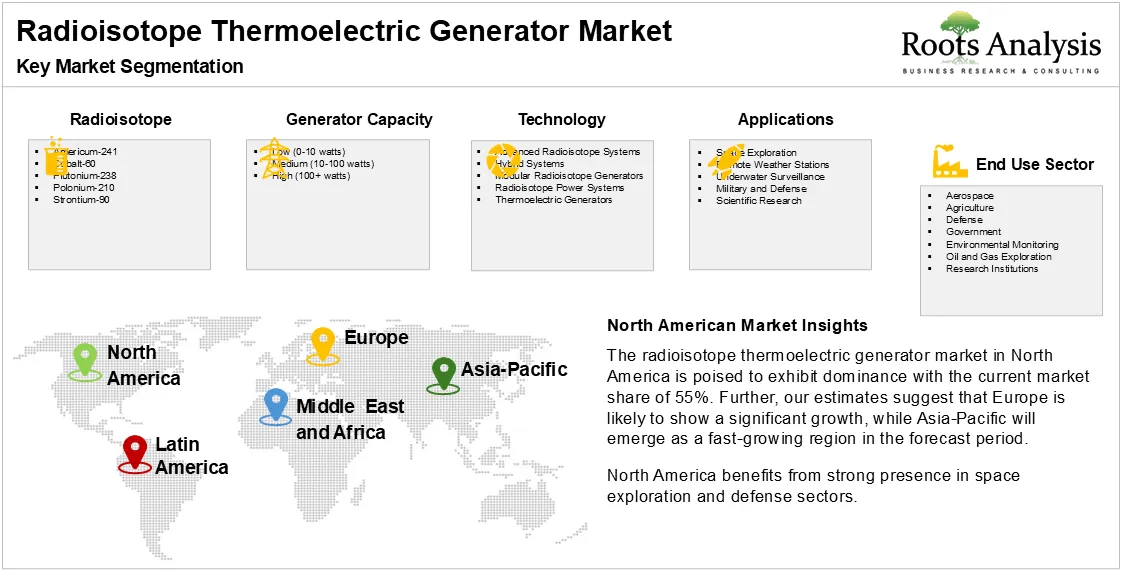
The RTG market report presents an in-depth analysis of the various companies that are involved in offering RTGs, across different segments, as in the figure below:
Market Share Insights
Which Radioisotope is the Most Dominant in the RTG Market?
As per our RTG industry analysis, the plutonium-238 sub-segment is expected to hold the largest share of 58% within the current global year.
The plutonium-238 sub-segment stands out as the most prominent due to its high energy density and being one of the long-life isotope power sources. Plutonium-238 based RTGs are extensively used in space exploration missions, generating power for spacecrafts, rovers, research instruments and deep space power systems.
RTG Market Share Insights for Application Segment
The RTG applications market estimates suggest that the space exploration sub-segment is expected to hold the largest share of 62% in the current year.
This dominance is driven by mission-critical applications wherein reliable power for long-duration is essential. RTGs are uniquely suited for these tasks, such as missions to the outer planets, asteroids, and comets, where basically the solar power is insufficient.
Substantial government funding, and next-generation RTG advancements such as multi-mission RTGs, and expanding international interest are also reinforcing this lead.
Along with this, factors, including the continued development of deep space probes and the increasing focus on lunar and Martian exploration requiring robust power solutions like RTGs to sustain operations and scientific instrumentation, are also fueling the growth.
Regional Forecast Estimates: North America Leads the Radioisotope Thermoelectric Generator Market, Fueled by RTG NASA Space Missions
North America is projected to hold the most substantial share of 55% in the current year, as per our radioisotope thermoelectric generator market forecast. This growth is driven by extensive space exploration programs conducted by NASA and defense applications managed by the US Department of Defense.
Apart from this, the US also maintains the world’s most advanced RTG technology capabilities, with major production facilities operated by the Department of Energy at Idaho National Laboratory and Oak Ridge National Laboratory.
The region doesn’t have to face supply chain challenges for radioisotope sourcing in RTGs due to a well-established supply chain for nuclear materials and specialized manufacturing capabilities which further benefit the market.
Want Information on Specific Region/Segment?
Key Market Insights
Which are the Top Players in the Radioisotope Thermoelectric Generator Market?
Examples of leading radioisotope thermoelectric generator manufacturers (which have also been captured in this market report, arranged in alphabetical order) include Aerojet Rocketdyne, American Elements, BWX Technologies, China National Nuclear Corporation, Curtiss-Wright, Department of Energy, European Space Agency, French Atomic and Alternative Energies Commission, General Atomics, Japan Aerospace Exploration Agency, Lockheed Martin, NASA, Northrop Grumman, Rolls-Royce, Rosatom State Atomic Energy, Roscosmos, Russian Research Institute of Atomic Reactors, Teledyne Technologies, Thales Group, Thermo Fisher Scientific, and Ultra Electronics.

What Strategies are the Companies Using to Gain Radioisotope Generator Market Share?
Companies in the RTG market are leveraging strategies such as heavy investment in R&D to improve thermoelectric efficiency and longevity, forming strategic partnerships and collaborations with space agencies and defense contractors, expanding into emerging geographic markets, and focusing on innovations in RTG miniaturization for small spacecraft.
Additionally, they emphasize product differentiation by developing customized RTG solutions for diverse applications like deep space exploration, RTG technology for oceanographic and polar research, and defense systems.
These approaches, combined with adapting to evolving regulatory frameworks and increasing government funding, are helping companies strengthen their market share and drive growth in this niche yet critical energy segment.
How is the Global Pu-238 Radioisotope Supply Chain for RTG Manufacturing Affecting the Market?
The global Plutonium-238 (Pu-238) supply chain for RTG manufacturing significantly affects the market by directly limiting or enabling mission planning and production capacity. Pu-238 is produced via complex irradiation and chemical processing of neptunium-237 targets, mostly at US national labs, and in limited facilities internationally.
Past shortages have constrained RTG availability, but recent resumption of production and increases in output capacity aim to stabilize supply, supporting NASA and international deep-space mission ambitions. However, production scale-up remains a multi-year challenge affecting market dynamics and pricing.
What are the RTG Market Growth Trends in Unmanned Systems?
RTG market growth in unmanned systems is propelled by the need for autonomous, long-duration, maintenance-free power in distant, harsh, or inaccessible environments. Unmanned space probes, planetary rovers like Mars rovers, remote weather stations in polar regions, and underwater surveillance systems increasingly rely on RTGs.
RTGs ensure uninterrupted operation where solar or conventional batteries fail. This steadily expands the RTG installed base with continuous opportunities for technological improvements targeting durability, miniaturization, and power density.
What are the RTG Safety and Regulatory Standards for Nuclear Space Power?
RTGs for space power adhere to stringent safety and regulatory standards designed to minimize the risk of radiological release during all mission phases, including launch, operation, and potential accidents.
These standards require containment of nuclear fuel in highly durable, multi-layered protective capsules made of iridium and graphite, with the fuel in a chemically stable ceramic form to withstand high temperatures, impacts, and re-entry conditions. Regulatory compliance includes checks under frameworks, such as the National Environmental Policy Act and Presidential directives.
Which International Collaboration for RTG Development and Deployment are the Most Prominent?
International collaboration is prominent between agencies like NASA (US), ESA (Europe), Roscosmos (Russia), JAXA (Japan), and organizations such as the Department of Energy (US) and Canadian Nuclear Partners.
Joint efforts focus on developing advanced RTG technologies, ensuring isotopic fuel supply security, and sharing expertise in mission design and safety protocols. Collaborations like NASA’s partnerships with Oak Ridge National Laboratory and Canadian facilities for Pu-238 production exemplify effective multinational approaches to sustaining RTG availability and advancing next-generation systems.

Radioisotope Thermoelectric Generator Market: Scope of the Report
| Key Report Attributes | Details | |
| Historical Trend | Since 2020 | |
| Forecast Period | Till 2035 | |
| Market Size in 2026 | $ 0.66 Billion | |
| Market Size in 2035 | $ 1.35 Billion | |
| CAGR (Till 2035) | 8.29% | |
| Segments Covered |
|
|
| Source | Roots Analysis | |
Unlock Deeper Insights–Schedule Your Personalized Workshop Today!
Market Segments
Based on the research, we have segmented the radioisotope thermoelectric generator (RTG) market into radioisotope, generator capacity, technology, application, end use sector, geographical regions, and leading players.
By Type of Radioisotope
- Americium-241
- Cobalt-60
- Polonium-210
- Stronium-90
By Generator Capacity
- High (100+ watts)
- Medium (10-100 watts)
- Low (0-10 watts)
By Technology
- Advanced Radioisotope Systems
- Hybrid Systems
- Modular Radioisotope Generators
- Radioisotope Power Systems
- Thermoelectric Generators
By Application
- Military and Defense
- Remote Weather Stations
- Scientific Research
- Space Exploration
- Underwater Surveillance
By End Use Sector
- Aerospace
- Agriculture
- Defense
- Government
- Environmental Monitoring
- Oil and Gas Exploration
- Research Institutions
By Geographical Regions
- North America
- US
- Canada
- Mexico
- Rest of North America
- Europe
- Austria
- Belgium
- Denmark
- France
- Germany
- Ireland
- Italy
- Netherlands
- Norway
- Russia
- Spain
- Sweden
- Switzerland
- UK
- Rest of Europe
- Asia-Pacific
- Australia
- China
- India
- Japan
- New Zealand
- Singapore
- South Korea
- Rest of Asia-Pacific
- Latin America
- Brazil
- Chile
- Colombia
- Venezuela
- Rest of Latin America
- Middle East and Africa (MEA)
- Egypt
- Iran
- Iraq
- Israel
- Kuwait
- Saudi Arabia
- UAE
- Rest of MEA


