Reconfigurable Intelligent Surfaces (RIS) Market by Type of Component (Hardware and Software), by Type of Material (Ceramic, Metal and Polymer), by Area of Application (Automotive, Healthcare, Industrial Automation, Smart Homes and Buildings and Telecommunications), End User, Type of Enterprise, Geographical Regions, and Leading Players – Trends and Forecasts 2026-2035
Market Size
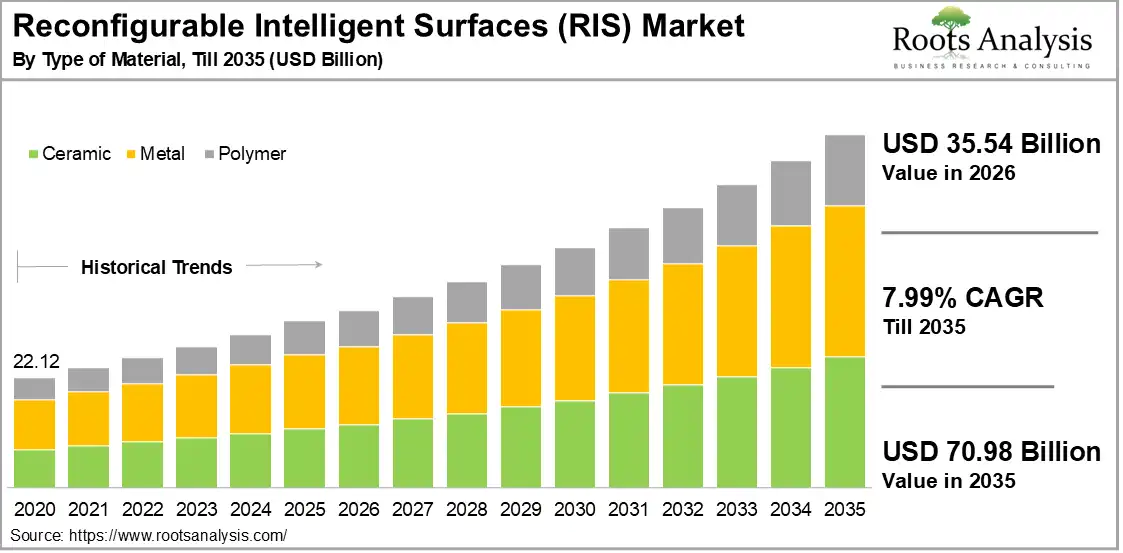
The global reconfigurable intelligent surfaces (RIS) market, valued at USD 33.54 billion in 2026, is projected to reach USD 52.19 billion in 2030 and USD 70.98 billion by 2035, representing a CAGR of 7.99% during the forecast period.
See What’s in the Full Report – Request Your Complimentary Insights!
Market Overview
Digitalization has revolutionized the world. As it becomes a crucial part of human life, the need for a fast and reliable network is unavoidable. Reconfigurable intelligent surfaces offer enhanced and optimized wireless communication systems.
What’s driving the growth of the reconfigurable intelligent surfaces (RIS) market is the radio frequency signal enhancement for improved signal strength and coverage. The other main factor of the growth is capability of overcoming signal obstructions for 5G network performance improvement.
It is worth highlighting that the introduction of smart building wireless systems for improved security that neglects the possibility of eavesdropping is also accelerating adoption rates. Besides this, the cost effectiveness and long life make it ideal for residential application.
In reference to this, the implementation of RIS in telemedicine connectivity solutions due to reliable and quick data transmission is accelerating RIS in healthcare market. Briefly, this fast speed allows healthcare institutes to remotely monitor patients.
Consequently, the research institutions RIS development system provides policy research and expertise on various aspects of economy, trade and technology. This is playing a pivotal role in swift adoption of the RIS software market.
Recent Industry Developments
- In June 2025, Greenerwave and Safran Passenger Innovation entered into the strategic partnership to develop next-generation Ka-band aero SATCOM terminal. This solution will merge SPI’s deep expertise in entertainment and onboard connectivity with Greenerwave’s pioneering work in Reconfigurable Intelligent Surfaces (RIS) and passive electromagnetic wave control.
Pay Only for What You Need – The Best Way to Optimize
Market Share Insights
Which Type of Component Will Dominate the Reconfigurable Intelligent Surfaces (RIS) Market?
When it comes to the global reconfigurable intelligent surfaces (RIS) market, the hardware segment is set to take the lead, holding a significant market share of over 55.37% of the market. Also, this segment is expected to grow with a relatively higher CAGR of 7.94%. This RIS market growth is largely a result of the need for antennas, sensors, unit cells and controllers in the reconfigurable intelligent surfaces technology.
In addition, these programmable surfaces for signal control offer improved coverage and extended signal range, making them ideal for the regions where network strength is limited or obstructed.
Further, these systems can effortlessly optimize intelligent signal propagation, minimizing the need for high transmitting power forwardly boosting RIS hardware market.
Which Type of Material will Witness the Fastest Growth Rate?
When it comes to the reconfigurable intelligent surfaces (RIS) industry analysis, the metal segment acquires 41.38% of the reconfigurable intelligent surfaces (RIS) market share. Further, this segment is also expected to grow the fastest with a projected CAGR of 8.33% during the forecast period. Here’s why: metal offers high durability and strength, excellent corrosion and impact resistance.
Metal reconfigurable intelligent surfaces (RIS) are designed for efficiently wireless communication optimization by dynamically manipulating signal propagation. Adding to the benefits, these are also relatively inexpensive and easy to deploy.
Which End User is Most Popular in Reconfigurable Intelligent Surfaces (RIS)?
When we look at the end-user of the reconfigurable intelligent surfaces (RIS) market, the telecommunication service providers segment really stands out as the dominant end-user with 25.71% market share. In fact, it’s expected to grow with a reconfigurable intelligent surface (RIS) market growth rate of 8.43% during the forecast period.
Why is North America Leading the Reconfigurable Intelligent Surfaces?
According to our reconfigurable intelligent surfaces (RIS) market by region analysis, the North America reconfigurable intelligent surfaces (RIS) market currently exhibits dominance with 47.34% of the overall market share. In fact, this region is also forecasted to grow with a relatively higher CAGR of 7.84% in the coming decade.
The main reason for this rapid growth is the result of strong research and development in field of wireless communication and signal processing. This is worth highlighting that the presence of prominent players such as Evolv Technologies and Lumotive are securing the future of research institutions RIS development.
Another reason is the adoption of RIS for smart homes. That is due to their reflected and redirect wireless signals, that easily penetrate walls and offer enhanced signal strength is strengthening future trends in RIS applications for smart homes and healthcare.
Want Information on Specific Region / Segment?
Key Market Insights
What are the key drivers for RIS adoption in telecommunications?
The rising demand for high-speed and low latency networks is majorly driving the reconfigurable intelligent surfaces market. Adding to this, the growth IoT adoption for reliable and efficient connection coupled with enhanced traffic management is also playing a crucial role in the growth.
Various industries around the world are mandating reconfigurable intelligent surfaces (RIS) due to the development of holographic radio and terahertz communication that are achieved by AI and machine learning integration with RIS.
Furthermore, the creation of customized wireless environments and optimized signal paths are continuously aiding RIS applications in telecommunications.
What Strategies are Companies Using to Gain Reconfigurable Intelligent Surfaces (RIS) Market Share?
Reconfigurable intelligent surfaces (RIS) suppliers are using smart strategies to stay ahead. Big players are focusing on partnerships, acquisitions, joint ventures, and innovations to strengthen their position while also investing in R&D to bring innovative and novel products to the market. Launching new technologies and expanding into regions where industry automation is growing are key moves helping them capture more market share.
What are the Challenges in the Reconfigurable Intelligent Surfaces (RIS) Market?
The major challenges in reconfigurable intelligent surfaces (RIS) market are high initial costs that are affiliated with the requirement of specialized hardware and complex control algorithms. Not limited to this, the replacement of traditional wires into RIS demands high investments.
The other major challenge is technical complexities and standardization. As these systems need to go through careful consideration of channel characteristics and signal processing. This procedure ensures enhanced operations but can also lead to high costs and need for reconfiguring.
Another major challenge is possible performance degradation, estimation issues and ineffective algorithms coupled with potential malicious issues.
What is the Difference Between RIS and IRS?
Both RIS (Reconfigurable Intelligent Surface) and IRS (Intelligent Reflecting Surface) refer to the same technology that is used to enhance signal coverage. Yet, RIS is often used for broader research and engineering literature, while IRS is common in certain technical discussions.
What is RIS for 5G?
5G RIS technology market is focused on a passive, planar array that dynamically controls the propagation of wireless signals by adjusting their reflection characteristics. These are efficient in overcoming signal obstructions and improved coverage, marking an impact of RIS technology on 5G and future wireless networks.
What are the Two Types of IRS?
IRS are divided into two types: active IRS and passive IRS. While active IRS offers improved coverage, passive focuses more on energy efficiency.
Your Business is Unique – Why Shouldn’t Your Report Be?
Reconfigurable Intelligent Surfaces (RIS) Market: Scope of the Report
| Key Report Attributes | Details | |
| Historical Trend | Since 2020 | |
| Forecast Period | Till 2035 | |
| Market Size 2026 | $ 35.54 Billion | |
| Market Size 2035 | $ 70.98 Billion | |
| CAGR till 2035 | 7.99% | |
| Type of Component |
|
|
| Type of Material |
|
|
| Area of Application |
|
|
| End-User |
|
|
| Type of Enterprise |
|
|
| Geographical Regions |
|
|
| Key Players Profiled |
|
|
| PowerPoint Presentation (Complimentary) | Available | |
| Customization Scope | 15% Free Customization | |
| Excel Data Packs (Complimentary) |
|
|


