


 Download Free Sample
 Buy Now
Market Size
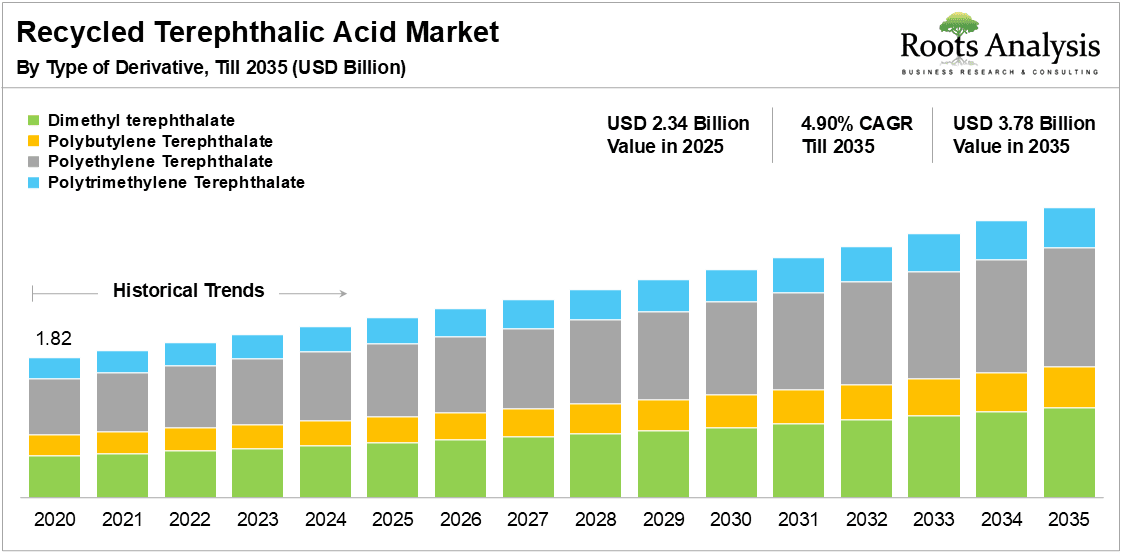
The global recycled terephthalic acid market, valued at USD 2.34 billion in 2025, is projected to reach USD 3.12 billion by 2030 and USD 3.78 billion by 2035, with a CAGR of 4.90% during the forecast period 2025 to 2035.
See What’s in the Full Report–Request Your Complimentary Insights!
Market Report: Key Takeaways
- In terms of type of product, the clear materials segment secures >58.24% of the overall revenue share of the global market.
- In terms of application area, packaging segment holds the largest share of terephthalic acid global market.
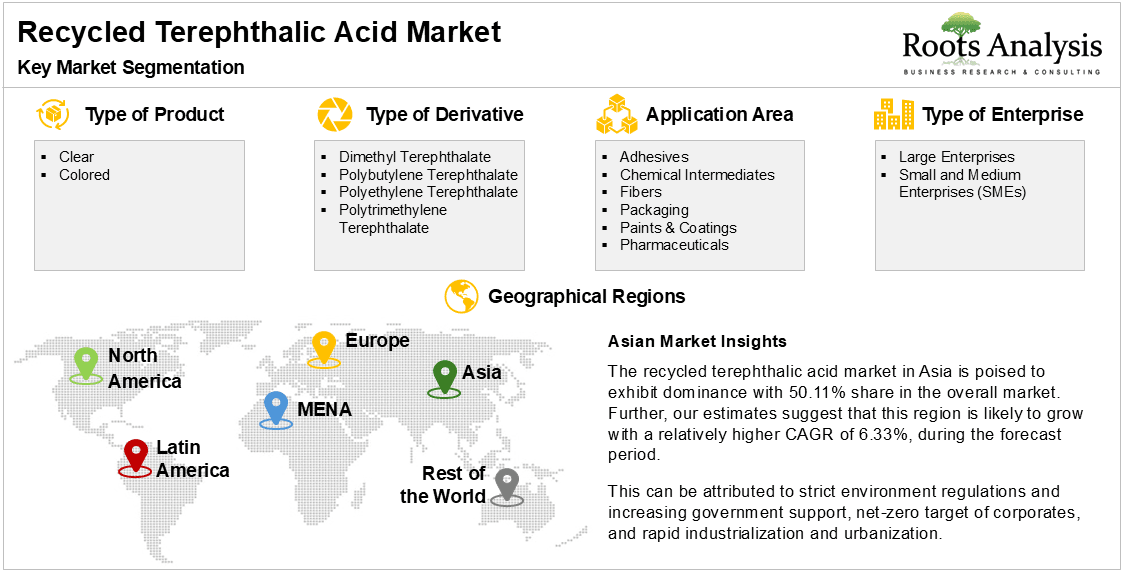
- In terms of leading region, Asia holds the largest share with 50.11% share of the market.
- Key market driver is the automotive manufacturing industry, which is putting emphasis on sustainability.
Market Overview
The global push for sustainability is driving the recycled terephthalic acid industry, vital for circular plastics, eco-friendly automotive, and packaging solutions. According to the OECD Global Plastic Outlook, plastic waste generation has more than doubled since 2000; however, only 9% is recycled globally, intensifying demand for chemical recycling and circular economy solutions like r-PTA.
Recycled terephthalic acid (r-PTA) is a vital component in the circular economy, produced through advanced chemical recycling of polyethylene terephthalate (PET) plastic waste. It enables the creation of high-quality recycled PET products with applications across various industries, such as automotive, packaging, textiles, and construction.
The growing emphasis on sustainability in automotive manufacturing is driving demand for r-PTA, with companies like Ford incorporating recycled plastics into interior and exterior vehicle components. This shift supports eco-friendly production and aligns with consumer preferences for greener products.
Stringent environmental regulations in regions, such as Europe and India are accelerating the adoption of r-PTA by mandating higher recycled content and reducing plastic pollution. These policies are key drivers of Indian terephthalic acid market growth, encouraging manufacturers to comply with quality benchmarks for recycled terephthalic acid and sustainability targets.
In response, industry leaders are investing in innovative recycling technologies (such as depolymerization technologies for r-PTA extraction) and forming strategic collaborations to address environmental concerns and regulatory demands. These efforts aim to scale r-PTA production, enhance quality, and expand its market presence, globally.
Recent Developments in Recycled Terephthalic Acid Market
- In March 2025, FSSAI published the Food Safety and Standards (Packaging) First Amendment Regulations, 2025, approving recycled PET for food packaging, storage, carrying, and dispensing, subject to notified standards and compliance with national regulations.
- In November 2024, Indorama Venture, Suntory, Neste, ENEOS, Mitsubishi and Iwatani partnered to advance bio-PET bottle collaborations, reflecting innovation in sustainable PET recycling.
- In October 2024, Carbios, a French-based biotech company, launched bio recycled T-shirt made entirely from recycled fibers.
Pay Only for What You Need – The Best Way to Optimize
Market Dynamics
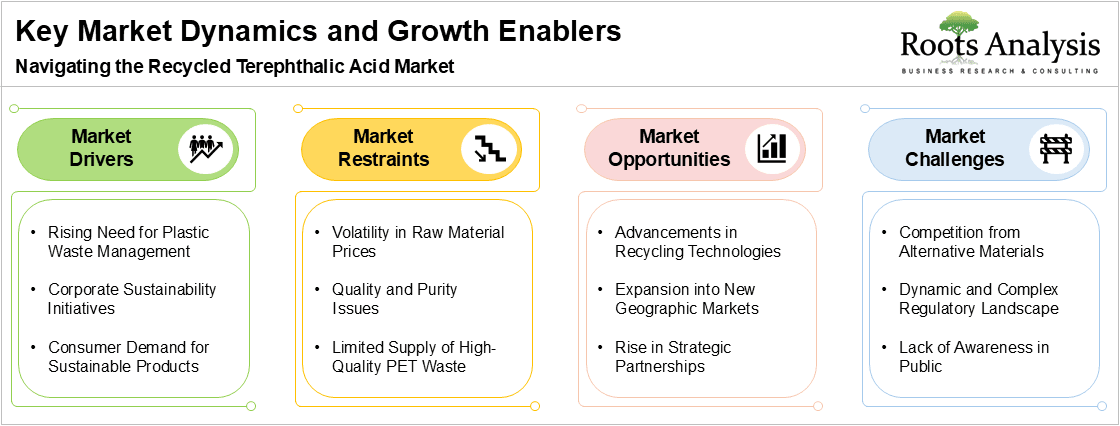
The industry is set to witness a lucrative growth phase, shaped by a dynamic interplay of drivers, restraints, opportunities, and challenges that will influence its trajectory in the coming years.
Key Market Drivers
- Rising Need for Plastic Waste Management: Growing emphasis on plastic waste management, fossil resource conservation, and regulatory mandates are fueling the global demand for recycled terephthalic acid.
- Corporate Sustainability Initiatives: Various countries around the world have mandated r-PTA, owing to which major corporations are setting ambitious targets to incorporate recycled content in their products, driving demand for r-PTA. These commitments align with global sustainability goals and enhance market growth.
- Consumer Demand for Sustainable Products: Growing consumer awareness and preference for eco-friendly products are compelling manufacturers to increasingly adopt recycled terephthalic acid in their offerings. This shift is pronounced in the sustainable fashion and packaging sectors, further supporting the expansion of the r-PTA market.
Key Market Challenges
- Competition from Alternative Sustainable Materials: The rise of bio-based plastics, such as bio-PET, and other eco-friendly alternatives is creating competitive pressure on the r-PTA market. These materials may offer superior performance or cost advantages, potentially limiting the adoption of r-PTA in certain applications.
- Navigating Complex Regulatory Landscapes: Varying and evolving regulatory standards across different regions pose significant hurdles for global r-PTA producers. Compliance with diverse certifications and policies demands substantial resources, complicating market expansion efforts.
- Promoting Awareness and Acceptance of r-PTA: Building consumer and industry confidence in r-PTA’s quality and benefits remains a key challenge. Overcoming misconceptions about recycled materials and educating stakeholders is critical to boosting the growth in this r-PTA industry.
Market Segmentation
The recycled terephthalic acid market report presents an in-depth analysis of the various companies that are involved in offering r-PTA solutions, across different segments, as in the figure below:
Market Share Insights
Clear r-PTA Products Dominate the Industry
Our recycled terephthalic acid market forecast estimates suggest that the clear products currently hold the maximum market share. Further, this dominance is unlikely to change during the forecast period as clear products sub-segment is poised to grow with a higher CAGR through 2035.
This market growth is largely a result of the fact that clear plastic waste to terephthalic acid conversion is easier and has potential applications across various verticals. In addition, clear materials are generally more cost-effective to recycle as they do not require high filtering methods making an impact in PET recycling industry.
Which Industries Use Recycled Terephthalic Acid Most?
Based on our r-PTA market analysis, the packaging application area dominates the overall current market. Packaging materials made from recycled PET offer excellent resistance to solvents, chemicals, and moisture, making them highly suitable for food and beverage applications that require stringent safety and quality standards.
The increasing preference for sustainable packaging solutions, which reduce environmental impact without compromising material performance, is a key factor driving this growth. The dominance of the packaging segment is further reinforced by regulatory pressures and corporate sustainability commitments worldwide, which encourage the adoption of recycled materials in packaging. Consumer demand for environmentally responsible products continues to rise, prompting companies to integrate r-PTA extensively in packaging to meet these expectations.
Regional Forecast Estimates: Europe’s Growing Market Fueled by Green Deal and Circular Economy
Europe holds the second largest recycled terephthalic acid market share, underpinned by its stringent environmental regulations and strong commitment to plastic waste reduction. Europe’s leadership role in sustainability and innovation makes it a hub for r-PTA demand and development. In addition, surging investment trends in r-PTA recycling facilities foster a green plastics manufacturing ecosystem.
The region also benefits from forward-looking policies like the European Green Deal, which aggressively promotes circular economy adoption and sustainable materials. This robust regulatory framework, combined with growing industrial partnerships focused on advanced chemical recycling technologies, is propelling Europe’s r-PTA market.
Want Information on Specific Region / Segment?
Key Market Insights
Leading Companies in the r-PTA Industry
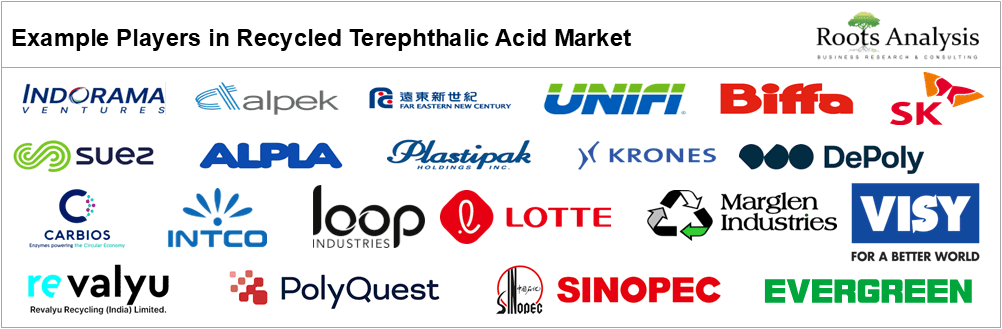
Examples of leading recycled terephthalic acid manufacturers (which have also been captured in this market report, arranged in alphabetical order) include Indorama Ventures Public Company, Indorama Ventures, Alpek, Far Eastern New Century Corporation, UNIFI, Biffa, SK Group, SUEZ, ALPLA Group, Plastipak Holdings Inc., Krones AG, DePoly, Carbios, INTCO Recycling, Loop Industries, Lotte Chemical Corporation, Marglen Industries, VISY, Revalyu Recycling India Limited, PolyQuest, Sinopec Group, Evergreen Plastics and Zhejiang Haili Environmental Technology.
What Strategies are the Companies Using to Gain Recycled Terephthalic Acid Market Share?
Companies are adopting diverse strategies to expand their market share amid tightening environmental regulations and surging demand for recycled terephthalic acid for sustainable PET production. Many are investing in advanced chemical recycling technologies to yield highly purified terephthalic acid.
For instance, Indorama Ventures continues its significant investments in capacity expansion and proprietary chemical recycling technologies to boost production scale and feedstock quality, underscoring the dynamic and innovation-driven nature of the r-PTA market.
Strategic partnerships for closed-loop rPTA supply chains also play a critical role; for instance, in January 2025, DePoly’s collaboration with Plastic Technologies Inc. focused on closed-loop recycling solutions to create recycled PET bottles, demonstrating how alliances secure steady raw materials and drive innovation.
Key Technologies Producing Recycled Terephthalic Acid
Recycled terephthalic acid is produced mainly by 4 technologies, which have been outlined below. These advanced chemical recycling technologies collectively boost the sustainability, quality, and scale of r-PTA supply, minimizing reliance on virgin petrochemical terephthalic acid and supporting global plastic waste reduction initiatives.
- Methanolysis process enables the chemical breakdown of complex and colored PET waste into high-purity intermediates, ensuring consistent r-PTA quality suitable for high-grade polyester products.
- Glycolysis process is energy-efficient and widely used to depolymerize PET waste into monomers that can be recycled into fibers, films, and packaging materials, supporting large-scale r-PTA production.
- Hydrolysis process offers an environmentally friendly route by using water and catalysts to produce high-purity r-PTA, making it ideal for food-grade and sustainable packaging applications.
- Depolymerization techniques collectively improve the recovery yield and purity of r-PTA from diverse PET waste streams, overcoming limitations of mechanical recycling and enabling circular economy goals.
How does r-PTA Support the Circular Economy?
- Recycled terephthalic acid (r-PTA) plays a crucial role in supporting the circular economy by enabling PET waste recycling, thereby significantly reducing plastic waste accumulation.
- Chemical recycling processes such as hydrolysis, glycolysis, and methanolysis facilitate the transformation of PET waste into high-purity r-PTA, essential for sustainable polyester production and circular plastics initiatives.
- Utilizing recycled terephthalic acid reduces reliance on virgin PTA derived from fossil fuels, helping lower carbon emissions and promoting eco-friendly plastic manufacturing.
- Adoption of advanced chemical recycling technologies accelerates the creation of a closed-loop PET recycling system, conserving raw materials and minimizing landfill waste, thus exemplifying a sustainable circular economy.
Role of PET Waste in r-PTA Supply
- The availability of post-consumer PET waste critically impacts the r-PTA supply chain by providing a substantial volume of recyclable material, directly influencing production scalability and cost efficiency.
- Post-industrial PET waste serves as a higher-quality feedstock with fewer contaminants, enabling more efficient chemical recycling PET processes and consistent r-PTA production output.
- Limited access to clean and sorted PET waste can constrain the growth of recycled terephthalic acid manufacturing, affecting the industry's ability to meet rising demand from sustainable packaging and automotive sectors.
- Effective management and collection systems for both post-consumer and post-industrial PET waste are essential to maintain a reliable feedstock supply, underpinning the circular economy and reducing plastic pollution.

Recycled Terephthalic Acid Market: Scope of the Report
| Key Report Attributes | Details | |
| Historical Trend | Since 2020 | |
| Forecast Period | Till 2035 | |
| Market Size in 2025 | $ 2.34 Billion | |
| Market Size in 2035 | $ 3.78 Billion | |
| CAGR (2025 - 2035) | 4.90% | |
| Segments Covered |
|
|


