


 Download Free Sample
 Buy Now
Market Outlook
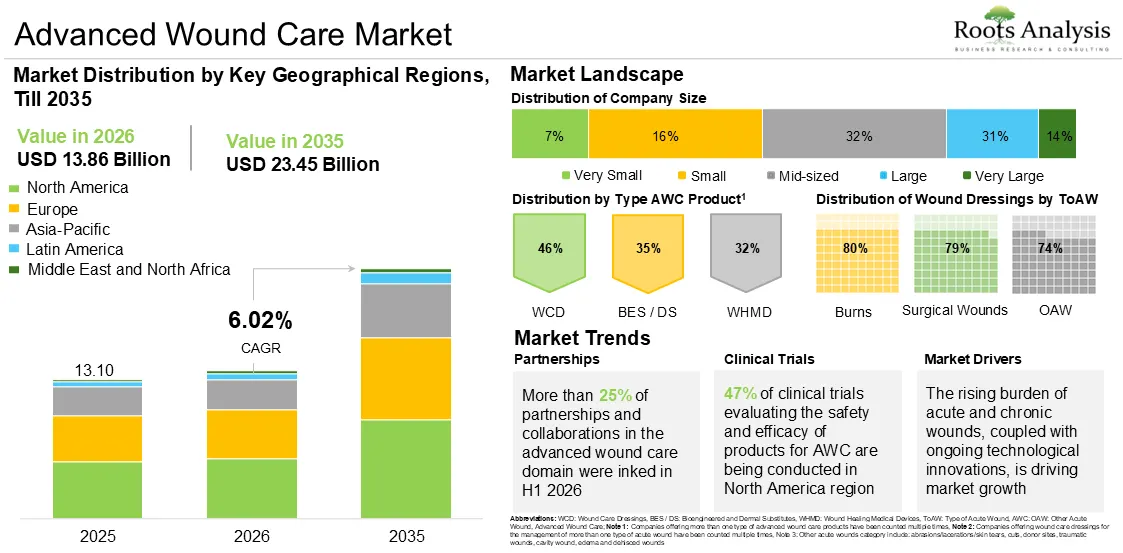
The global advanced wound care market, valued at USD 13.10 billion in 2025, is projected to reach USD 13.86 billion in 2026 and USD 23.45 billion by 2035, representing a CAGR of 6.02% during the forecast period 2026 to 2035.
See What’s in the Full Report – Request Your Complimentary Insights!
Market Report: Key Takeaways
Market Size & Trends
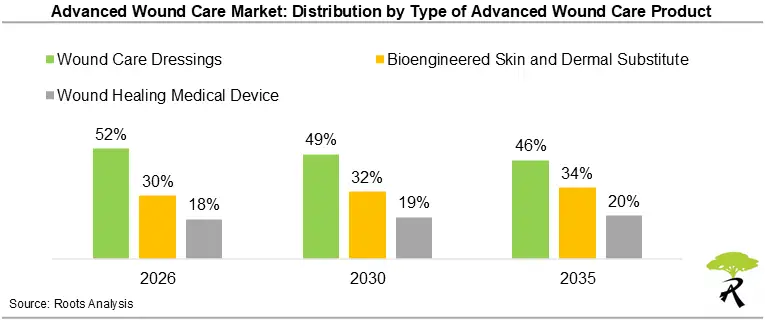
- In terms of type of advanced wound care product, wound care dressing holds the highest share (more than 50%) of the current market.
- With respect to type of advanced wound care dressing, foam dressings dominate the current market, a trend that is unlikely to change in the future.
- Based on the type of bioengineered skin and dermal substitutes, allografts capture the largest share (above 30%) of the current market.
- Amongst the type of wound healing medical devices, negative pressure wound therapy captures the majority of the current market.
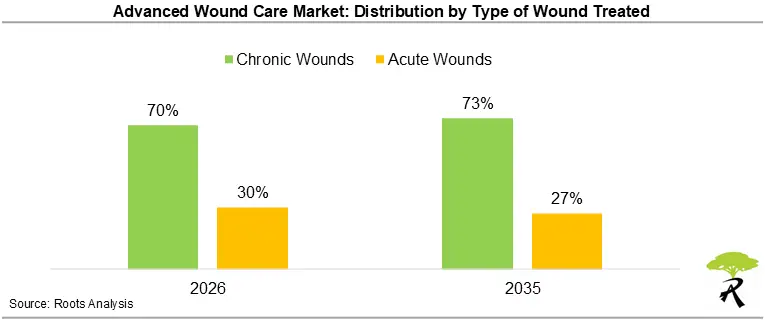
- Chronic wounds hold the highest share (close to 70%) of the current market.
- With respect to types of acute wounds treated, burns dominate the current market and this trend is likely to persist in the future as well.
- Based on the type of chronic wound treated, diabetic ulcers capture the largest share (more than 40%) of the current market.
- Hospital care captures the majority of the current market, a trend that we don’t anticipate will remain unchanged.
- North America currently holds the highest market share (more than 40%).
Key Market Statistics
- Market Size in 2026: $13.86 Billion
- Estimated Market Size in 2035: $23.45 Billion
- CAGR (2026-2035): 6.02%
- North America: Largest market in 2026
- Asia-Pacific: Fastest growing region
Market Introduction
Advanced wounds represent a major healthcare challenge due to their high prevalence, prolonged healing time, and significant clinical burden. Studies suggest that 10.5 million Medicare beneficiaries are currently living with chronic wounds in the US. Specifically, diabetic foot ulcers is associated with poor prognosis, accounting for more than 50% of deaths following lower-extremity amputation within five years. This highlights the urgent need for effective, advanced wound care products to improve healing outcomes and reduce complications.
Wound care is a process that involves various stages of wound management, such as diagnosis of the type of wound, factors affecting wound healing, and identification of treatments that can support the better management of wounds. The process involves removal of non-viable tissue material from the wound, which can either be achieved through surgical or autolytic / enzymatic mechanisms. Through both methods, the ultimate goal is to expose healthy and viable tissues having the ability to proliferate and heal the wound through the formation of an epithelial cell layer. The growing geriatric population, increasing prevalence of chronic disease conditions, and consequent rise in the number of surgeries have collectively contributed to a significant burden of wounds and an associated increase in morbidity rates. Owing to the increasing burden of wounds and associated infections, manufacturers involved in this domain are actively seeking promising solutions to minimize the associated economic, physiological, and social impact of wounds.
Advanced wound care products have transformed the management of chronic and complex wounds by overcoming the limitations associated with conventional wound care. These products incorporate advanced technologies and bioactive materials to support tissue regeneration, manage wound exudate, disrupt biofilms, reduce infection risk, and accelerate healing. Companies are increasingly investing in innovative wound care products to improve patient outcomes.
Market Segmentation
Based on the research, we have segmented the Advanced Wound Care Market Report into type of advanced wound care product, type of advanced wound care dressing, type of bioengineered skin and dermal substitutes, type of wound healing medical devices, type of wound treated, type of acute wound treated, type of chronic wound treated, end users and geographical regions.
By Type of Advanced Wound Care Product
- Wound Care Dressings, Bioengineered Skin and Dermal Substitutes, Wound Healing Medical Devices
By Type of Wound Care Dressing
- Foam Dressings, Antimicrobial Dressings, Hydrocolloid Dressings, Hydrogel Dressings, Alginate Dressings, Composite Dressings, Other Wound Care Dressings
By Type of Bioengineered Skin and Dermal Substitutes
- Allografts, Extracellular Matrices, Autografts, Other Dermal Substitutes
By Type of Wound Healing Medical Devices
- Negative Pressure Wound Therapy, Hyperbaric Oxygen Therapy, Hydrotherapy, Topical Oxygen Therapy, Electric Stimulation Therapy, Others
By Type of Wound Treated
- Chronic Wounds, Acute Wounds
By Type of Acute Wound Treated
- Burns, Surgical Wounds, Other Acute Wounds
By Type of Chronic Wound Treated
- Diabetic Ulcers, Venous Ulcers, Pressure Ulcers, Other Chronic Wounds
By End Users
- Hospital Care, Home Care / Door to Door Services, Other Type of End Users
By Geographical Regions
- North America: US, Canada, Mexico
- Europe: Germany, UK, France, Italy, Spain, Rest of Europe
- Asia-Pacific: China, Japan, South Korea, Australia, India, Rest of Asia-Pacific
- Latin America: Brazil, Argentina, Rest of Latin America
- Middle East and North Africa: Israel, Saudi Arabia, UAE, Egypt, Rest of Middle East and North Africa
Your Business is Unique – Why Shouldn’t Your Report Be?
Advanced Wound Care Market Key Insights
What are the Key Drivers for Advanced Wound Care Market Growth?
- Rising Prevalence of Chronic Wounds: The rising prevalence of chronic wounds and a growing public health burden affecting millions, globally, have significantly increased the demand for advanced wound care solutions. In the US alone, these wounds impact over 10 million people and cost billions, annually. Being a primary growth driver, the rising prevalence of chronic wounds is likely to drive the market expansion.
- Growing Technological Advancements: The integration of AI in wound care, such as smart bandages and dressings connected with sensors, allows for better wound management. This enables healthcare professionals to monitor various wound parameters remotely, continuously, and with predictive analytics.
What are the Main Challenges for Market Growth?
- Limited Availability in Developing Nations: In developing countries, geographical disparities, poor healthcare infrastructure, and limited expertise challenge the adoption of advanced wound care products. The lack of defined regulatory policies and logistical frameworks limits product access and worsens patient outcomes.
- Perception of Higher Cost of Treatment: The higher cost of advanced wound care dressings leads to a general patient perception of such dressings being expensive. However, these dressings require less frequent changes over the wound healing period, which ultimately presents them as a cost-effective alternative to traditional saline soaked gauze. This perception associated with high upfront cost acts as a challenge to the wider adoption of such dressings.
- Lack of Awareness: Limited awareness among the general population has significantly limited patient preference for advanced wound care products. Additionally, factors such as the complexity of new-generation products, absence of reimbursement policies, and patient resistance to adopting new technologies continue to restrict their widespread utilization, hindering optimal clinical outcomes and advanced wound care market growth.
Recently Launched Innovative Products for Wound Healing
- In May 2026, Smith+Nephew announced the launch of two new wound care innovations, including ALLEVYN® COMPLETE CARE Foam Dressing and RENASYS® EDGE Negative Pressure Wound Therapy System to simplify wound management and reduce the associated clinical burden.
- In February 2026, Polaroid Therapeutics announced that its antimicrobial wound dressing, POLTX_Fiber, received CE Mark certification as a Class IIb medical device. The company claimed that this certification has allowed introduction of new options in wound care, setting a new standard for care and protection.
Recent Developments in Advanced Wound Care Market
- In June 2026, H.B. Fuller acquired Advanced Medical Solutions to strengthen its advanced wound care portfolio. The acquisition expands the company's medical product offerings by adding tissue bonding adhesives, surgical tapes and dressings, formulated biosurgicals, personal protective equipment (PPE), and medical device assembly solutions.
- In June 2026, Lavior partnered with Lovell Government Services to expand access to its advanced botanical wound and skin care solutions across federal healthcare systems, including the Veterans Health Administration (VHA), Military Health System (MHS), and Indian Health Service (IHS).
- In May 2026, MTF Biologics announced a distribution agreement with New Horizon Medical Solutions for its product, AmnioBand® Membrane, in the US. The agreement aims to expand access to advanced wound care solutions across post-acute and outpatient care settings.
Methodology and Industry Experts Interviews
The market for advanced wound care has a transformative future and is likely to remain progressive. A key driver of progression is the rising prevalence of chronic wounds and growing technological advancements in this domain.
Thomas Lash (Co-Founder and COO, Aatru Medical), stated that, “Negative pressure technology has been used in wound care for over 20 years, starting with wall-mounted vacuum systems and later evolving into portable, battery-operated devices for surgical incisions. Aatru's device uses a patented oxygen management mode of action; a small zinc-based packet regulates oxygen levels within a sealed chamber connected to the wound dressing. As a result, it generates negative pressure without any moving parts, batteries, or electronics.”
Discussions with multiple stakeholders in this domain influenced the opinions and insights presented in this study. The market report includes transcripts of the following discussions:
- Chief Medical Officer and Chief Scientific Officer, and Co-Founder and Chief Executive Officer, Small Company, US
- Founder and Chief Executive Officer, and Healthcare Policy Advisor, US
- Chief Executive Officer (CEO), Small Company, UK
- Co-Founder and COO, Small Company, US
- Founder & Medical Director, US
- President, Chief Medical Officer, Small Company, US
- President - CWS Comprehensive Wound Care, Very Small Company, US
- Vice President of Research and Development, Large Company, US
- National Commercial Strategy Lead, Very Large Company, Denmark
- Home Care Physical Therapist, Mid-Sized Company, US
Pay Only for What You Need – The Best Way to Optimize
Market Share Insights
Which Type of Advanced Wound Care Product Accounts for the Largest Share in the Advanced Wound Care Market?
- Wound dressings occupy the highest market share (above 50%), owing to their effectiveness in infection control, moisture management, and improved healing across both acute and chronic wounds, as per advanced wound care market analysis.
- The bioengineered skin and dermal substitutes segment is likely to witness a higher CAGR (7.29%) during the advanced wound care market forecast period. This accelerated growth is primarily due to the increasing demand for advanced regenerative therapies to manage complex, non-healing wounds such as diabetic foot ulcers, venous leg ulcers, and severe burns.
Amongst Acute Wounds and Chronic Wounds, Which Segment Holds the Highest Share in the Advanced Wound Care Market?
The chronic wounds segment is likely to occupy a higher advanced wound care market share (~70%) by 2035. The increasing prevalence of diabetes, obesity, and vascular disorders will primarily drive this growth, as these conditions contribute to a growing burden of diabetic foot ulcers, venous leg ulcers, and pressure ulcers that require prolonged treatment. The recurrent nature of these wounds, frequent dressing changes, and the higher healthcare expenditure that long-term wound management demands will continue to drive product demand. Within this workflow, hydrocolloids provide moisture-retentive materials used in wound dressings and other medical applications.
Which End User Accounts for the Largest Share of Market?
The hospital care segment currently occupies the largest market share, owing to the high volume of patients requiring advanced wound management following surgeries, trauma, burns, and severe chronic wounds. The home care / door-to-door services will likely grow at a higher CAGR (6.59%) during the forecast period. The shift toward outpatient and home-based wound management for chronic wounds, particularly among the aging population and patients with limited mobility, will primarily drive this growth. Advancements in remote patient monitoring are expected to support the broader adoption of home-based advanced wound care solutions over the coming years.
Regional Analysis: Which Regions are Showing the Fastest Growth in Advanced Wound Care Domain?
North America Dominates the Market
North America advanced wound care market currently captures the majority (>40%) of the overall market share, owing to the high prevalence of chronic wounds, widespread adoption of advanced wound care products across hospitals and outpatient settings, favorable reimbursement for advanced dressings and negative pressure wound therapy.
Asia-Pacific to Drive Future Market Expansion
Asia-Pacific advanced wound care market is likely to grow at a higher CAGR till 2035, owing to the growing access to advanced wound care products in emerging economies such as China and India. Furthermore, increasing healthcare expenditure, growing awareness among healthcare professionals regarding evidence-based wound management, and rising investments by global and regional manufacturers are likely to further accelerate advanced wound care market growth across the region.
Get an Instant Quote in 10 Minutes. Lowest Price Guaranteed
Key Players in the Advanced Wound Care Market
The report profiles Advanced Medical Solutions, Arthrex, Cardinal Health, Coloplast, Convatec, DeRoyal, Essity, Ethicon (a subsidiary of Johnson & Johnson), Fidia Farmaceutici, Integra Life Sciences, Medline Industries, Mölnlycke Health Care, Organogenesis, Smith + Nephew, Solventum, and Zimmer Biomet.
Report Deliverables and Customization
Alongside the core market report, purchasers receive complimentary Excel data packs covering the advanced wound care product providers' market landscape, company competitiveness analysis, clinical trial analysis, partnerships and collaborations, and market sizing and opportunity analysis. A complimentary PowerPoint presentation summarizing the full report is also included, and 15% free customization scope is available on request.
Report Authorship
This report was authored by Simriti Gupta, member of Roots Analysis healthcare and pharmaceutical research practice. Her work focuses on drug development and manufacturing, competitive intelligence, company benchmarking and market forecasting.
Independence and Non-Affiliation
Roots Analysis is an independent secondary and primary market research publisher. This report is not affiliated with, endorsed by, or produced on behalf of any company named or profiled within it, including all key players and industry expert interviewees referenced above.
Roots Analysis' findings draw on a combination of secondary research and primary interviews with industry experts, of the kind referenced above, to validate market sizing, segment shares, and forecast assumptions independently of any single company's disclosures.


