


 Download Free Sample
 Buy Now
Market Size
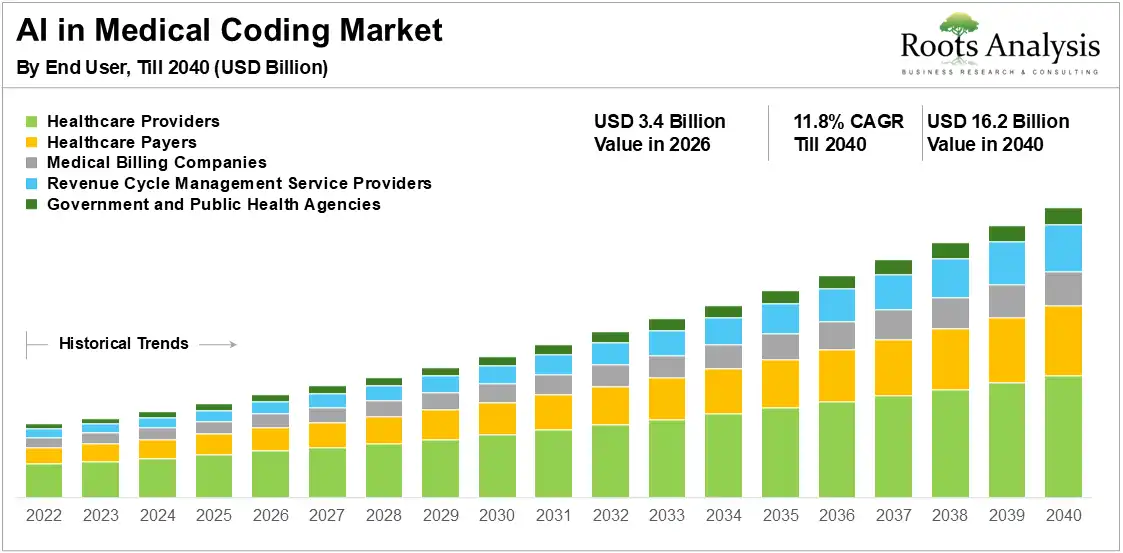
The global AI in medical coding market is expected to rise from USD 3.4 billion in 2026 and reach USD 16.2 billion by 2040, growing at a CAGR of 11.8% over the forecast period 2026 to 2040, driven by revenue cycle automation and coder productivity pressure.
See What’s in the Full Report – Request Your Complimentary Insights!
Market Report: Key Takeaways
- Based on Component, Software platforms is both the dominant and fastest-growing category, holding 72.0% share in 2026 and expanding at 12.4% CAGR through 2040, driven by scalable autonomous coding engines.
- Based on Deployment Mode, Cloud-based captures 61.0% market share in 2026 and registers a 13.2% CAGR through 2040, driven by multi-site deployment economics.
- Based on Application, Automated code assignment captures 34.0% market share in 2026, whereas Risk adjustment coding registers a 12.8% CAGR through 2040, driven by payer and Medicare Advantage documentation needs.
- Based on Technology Type, Natural language processing captures 26.0% market share in 2026, whereas Generative AI and agentic AI register an 18.5% CAGR through 2040, driven by autonomous workflow orchestration.
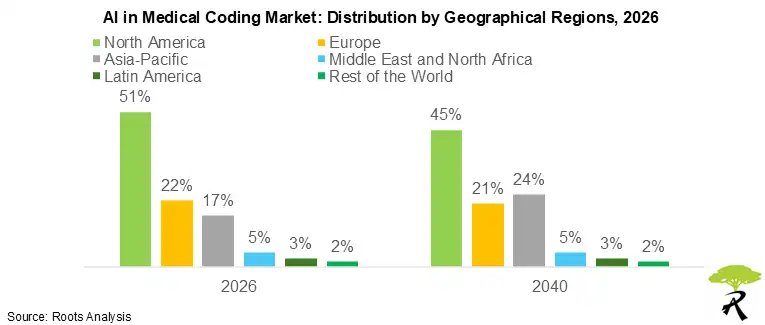
- Based on Geography, North America captures 51.0% market share in 2026, whereas Asia-Pacific registers a 14.6% CAGR through 2040, driven by healthcare digitization and outsourced coding scale.
AI in Medical Coding Market Outlook
AI-powered medical coding automation is moving from coder-assist software toward autonomous revenue cycle infrastructure. The AI in medical coding market reached USD 3.4 billion in 2026, after expanding from USD 2.1 billion in 2022. Demand now centers on scalable software platforms, which hold 72.0% share in 2026. Providers are shifting from manual review queues toward autonomous code assignment, CDI support, denial prevention, and revenue integrity workflows.
Growth comes from coding labor pressure, payer scrutiny, and constant code-set updates. CMS announced 80 new ICD-10-PCS codes effective April 1, 2026, increasing update requirements for coding engines and provider workflows. Arintra launched documentation-improvement capabilities in April 2026, helping providers identify documentation gaps that affect coding and reimbursement.
The market will reach USD 16.2 billion by 2040, growing at 11.8% CAGR from 2026. Software platforms will rise to 78.0% share, while generative AI and agentic AI will grow at 18.5% CAGR. Fathom secured strategic investment from CVS Health Ventures in May 2026 to accelerate enterprise-wide autonomous coding. The outlook remains high-growth, with adoption expanding through audited, cloud-based automation.
AI in Medical Coding Market Dynamics
AI in Medical Coding Market Drivers
Healthcare providers drive adoption because coding backlogs directly affect reimbursement speed, denial exposure, and coder productivity. Automated code assignment holds 34.0% share in 2026, reflecting demand for direct labor substitution in high-volume workflows. Natural language processing leads technology adoption with 26.0% share because coding engines must extract meaning from clinical notes. CMS ICD-10-PCS updates also create recurring maintenance needs for AI medical coding solutions.
AI in Medical Coding Market Restraints
Compliance exposure restrains autonomous coding because every generated ICD-10, CPT, HCC, or DRG code affects payment integrity. Coding audit and quality assurance still hold 12.0% share in 2026, showing persistent demand for human review. Payers and providers must validate model output against documentation rules, specialty variation, and payer-specific edits. This slows full automation, especially in complex inpatient coding and risk adjustment workflows.
AI in Medical Coding Market Opportunities
Generative AI and agentic AI create the strongest opportunity because they move coding tools from suggestions into workflow execution. This technology category will expand at 18.5% CAGR through 2040, outpacing NLP and traditional computer-assisted coding engines. Waystar announced AI-powered autonomous revenue cycle capabilities in April 2026 to validate assignments, documentation, and coding accuracy earlier in workflows.
AI in Medical Coding Market Challenges
Enterprise scaling remains difficult because multi-site health systems require centralized model updates, specialty coverage, and audit evidence. Cloud-based deployment holds 61.0% share in 2026 and will reach 73.0% by 2040, but migration requires security controls and EHR integration. Hybrid deployment will still gain share, reflecting data-control concerns. Vendors must prove accuracy, explainability, and compliance before providers expand autonomous coding across specialties.
AI in Medical Coding Market Size Estimation Methodology
- As a starting point, the AI in medical coding market estimate used verified 2025 to 2026 market-size ranges clustered around USD 2.9 billion to USD 3.4 billion. The base year was anchored at USD 3.4 billion in 2026. The forecast excluded unusually narrow or aggressive scopes that did not match provider, payer, and RCM use cases.
- Moving forward, the model segmented demand by component, deployment mode, application, code set, end user, technology type, and geography. Segment shares used vendor product taxonomies, market-report structures, and validated adoption signals. Software platforms started at 72.0% share because autonomous coding engines scale faster than services. Cloud deployment started at 61.0% share because centralized model updates support distributed provider networks.
- Building on this, growth assumptions used healthcare revenue cycle AI adoption, clinical documentation improvement AI expansion, and risk adjustment coding automation. Relevant data types included regulatory submission counts, ICD-10 update activity, provider deployment announcements, and EHR workflow integration evidence. These inputs helped separate mature computer-assisted coding systems from faster LLM-based medical coding and agentic workflow automation.
- Drawing upon these, each segment received a CAGR based on automation maturity, compliance sensitivity, and enterprise buying behavior. Cloud-based deployment received a 13.2% CAGR because centralized model updates support multi-site health systems. Generative AI and agentic AI received an 18.5% CAGR because autonomous orchestration expands beyond code suggestions into workflow execution.
- The projected value was then tested against the annual forecast curve from USD 3.4 billion in 2026 to USD 16.2 billion in 2040. The implied AI in medical coding market forecast CAGR equals 11.8% across the forecast period. This check aligned the long-term outlook with moderated enterprise adoption, coder workflow integration, payer scrutiny, and automation maturity.
- Finally, the forecast was reviewed for buyer concentration, regional differences, and implementation constraints. North America retained 51.0% share in 2026 because U.S. reimbursement complexity accelerates AI medical coding solutions. Asia-Pacific received the fastest regional CAGR at 14.6% because of digitization and outsourced coding scale support adoption. Sensitivity checks compared provider, payer, and RCM service provider growth against software platform penetration.
AI in Medical Coding Market Share Insights
Market Share by Component
According to our analysis, software platforms lead because hospitals and RCM firms need repeatable, auditable automation across specialties. In February 2026, CodaMetrix said its platform supports enterprise-grade AI automation across specialties and provider networks.
Further, software platforms will also grow fast as autonomous coding shifts from point tools into enterprise infrastructure. In May 2026, Fathom secured strategic investment from CVS Health Ventures to accelerate enterprise-wide autonomous coding.
Market Share by Coding Classification / Code Set
According to our analysis, ICD-10-CM diagnosis coding leads because diagnosis capture underpins reimbursement, analytics, and risk scoring workflows. In March 2026, Your Health reported more complete and specific ICD-10 coding after deploying Fathom.
On the other hand, HCC and risk adjustment coding will grow fast as Medicare Advantage compliance pressure increases. In March 2026, RAAPID highlighted compliance-first medical coding for Medicare Advantage risk adjustment.
Want Information on Specific Region / Segment?
Regional Analysis: North America Leads the Market and Asia-Pacific is Likely to Register Higher CAGR
Presently, North America holds 51.0% share in 2026. The region leads because U.S. providers have mature EHR systems, complex reimbursement rules, and deep health IT capital access. In April 2025, Cleveland Clinic partnered with AKASA to deploy generative AI coding tools across U.S. locations.
Further, Asia-Pacific registers a 14.6% CAGR from 2026 to 2040. Growth will accelerate as healthcare systems digitize records, expand insurance coverage, and localize coding operations. In March 2025, Apollo Hospitals said it would increase AI investment to reduce staff workload, including documentation automation.
Market Ecosystem Analysis
The AI in medical coding market is shifting from computer-assisted coding toward autonomous coding and revenue-cycle platform convergence. Large RCM vendors now bundle coding, CDI, denials prevention, and claims workflows, while startups compete on automation depth, specialty coverage, and EHR integration. The primary commercial force reshaping behavior is provider margin pressure, which pushes buyers toward measurable coding automation, denial reduction, and coder-capacity relief.
- In May 2025, Optum launched Optum Integrity One to consolidate RCM functions in one interface. The platform uses AI from point of care through final coding, including documentation review and code assignment. This positions Optum to defend large health-system accounts against specialized autonomous coding vendors. Independent coverage also highlighted the same May 2025 launch and final-coding automation scope.
- FinThrive introduced Agentic AI at HFMA in June 2025 for revenue-cycle performance transformation. The company positioned the launch around modernizing operations, reducing friction, and proactively recovering revenue. The activity strengthens FinThrive’s role in AI-enabled revenue intelligence rather than standalone coding.
- R1 RCM announced in October 2025 that it would acquire Phare Health, an AI platform for inpatient coding and pre-bill CDI. R1 said Phare Health would join its R37 AI lab, which already had agentic applications in autonomous coding. The move accelerates acquisition-driven consolidation around inpatient coding, CDI, and full-cycle revenue orchestration.
- CodaMetrix announced in June 2025 a contextual coding automation platform and a new emergency department coding solution. The company linked the launch to adoption by health systems representing $180 billion in net patient revenue. This expands competition from narrow specialty automation into enterprise, multi-source coding automation.
- Fathom announced in October 2025 that KLAS customers validated 90% automation rates in autonomous coding. A March 2026 customer deployment release reported 95.5% encounter-level automation and 98.3% accuracy after an October 2025 go-live. These examples pressure incumbents to prove production accuracy, not just product capability.
- Nym was recognized in September 2025 in TIME’s inaugural World’s Top HealthTech Companies list. The company emphasized its autonomous medical coding engine for simplifying coding and improving provider focus. The recognition supports vendor credibility in an early market where buyer trust remains central.
- Microsoft launched Dragon Copilot in March 2025 as a unified voice AI assistant for clinicians. In October 2025, Microsoft said Dragon Copilot would support third-party solutions covering automated prior authorization and revenue-cycle management. This creates a distribution layer for coding-adjacent workflow apps inside clinical documentation.
- Oracle reported in March 2025 that Clinical AI Agent reduced physician documentation time by nearly 30%. In September 2025, independent coverage said Oracle added AI features for revenue cycle and clinical trials. The activity links ambient documentation productivity with broader healthcare workflow automation.
- Suki launched expanded AI coding in October 2025 for ICD-10, HCC, CPT, and E/M codes. The solution generates codes after ambient sessions and updates codes once notes move into the EHR. This pushes coding closer to point of care and raises expectations for clinician-reviewable automation. Independent coverage confirmed the October 2025 launch and code-set scope.
Startup Companies and their Key Highlights
1. Ambience Healthcare
- Event type and funding amount: $243 million Series C
- Month and year: July 2025
- Lead investor or strategic partner name: Oak HC/FT and Andreessen Horowitz
- Stated purpose of the event: Scale its AI platform for health systems across documentation, coding, and CDI.
- Market implication: Accelerates ambient AI documentation and coding-aware CDI for enterprise health systems.
2. Abridge AI
- Event type and funding amount: $250 million Series D
- Month and year: February 2025
- Lead investor or strategic partner name: Elad Gil and IVP
- Stated purpose of the event: Support a Contextual Reasoning Engine, enterprise growth, and new revenue-cycle workflows.
- Market implication: Accelerates revenue-cycle documentation at the point of conversation, linking notes with billable workflows.
3. Arintra
- Event type and funding amount: $21 million Series A
- Month and year: August 2025
- Lead investor or strategic partner name: Peak XV Partners
- Stated purpose of the event: Expand adoption across health systems and physician groups nationwide.
- Market implication: Accelerates GenAI-native autonomous coding and revenue assurance for U.S. providers.
4. RapidClaims
- Event type and funding amount: Strategic investment
- Month and year: April 2025
- Lead investor or strategic partner name: Accel
- Stated purpose of the event: Transform revenue-cycle management for healthcare providers through AI-driven automation.
- Market implication: Accelerates AI RCM automation covering coding, claims, denials, and provider financial performance.
5. RAAPID
- Event type and funding amount: Product launch
- Month and year: September 2025
- Stated purpose of the event: Automate retrospective reviews using its Novel Clinical AI engine.
- Market implication: Accelerates risk adjustment coding, audit readiness, and value-based care documentation review.
AI in Medical Coding Market Trends / Opportunities
AI in Medical Coding Market Shift from Assisted Coding to Autonomous Code Assignment Expands Software Platform Share
Autonomous code assignments are becoming the main commercialization route because it attacks the largest coding labor bottleneck. Automated code assignment holds 34.0% share in 2026 and will gain share through 2040. Your Health deployed Fathom in March 2026 and reported high automation and accuracy across service lines.
Software platforms are gaining share because repeatable automation scales are better than manual coding services. Platforms hold 72.0% share in 2026 and will reach 78.0% by 2040. CodaMetrix highlighted enterprise-grade AI automation across specialties and provider networks in February 2026. This favors vendors that can support specialty depth and auditability.
AI in Medical Coding Market Growth in Documentation-to-Coding Workflows Raises Revenue Integrity Differentiation
CDI is becoming commercially linked to coding because incomplete notes delay reimbursement and increase denial exposure. Clinical documentation improvement holds 18.0% share in 2026 and will reach 20.0% by 2040. Arintra expanded its autonomous coding platform with documentation improvement capability in April 2026. This shifts competition toward platforms that improve documentation before billing.
Ambient AI documentation-to-coding systems are tying clinical note creation to downstream revenue workflows. Suki launched expanded AI coding capabilities in October 2025 for ICD-10, HCC, CPT, and E/M codes with supporting rationale. This creates differentiation for vendors that connect clinician workflow, code rationale, and compliance review.
Risk Adjustment Coding Automation Increases Payer Demand and Expands HCC-Focused Competition
HCC and risk adjustment coding will grow fastest among code-set segments because Medicare Advantage documentation pressure remains high. The HCC and risk adjustment coding segment will expand at 14.3% CAGR by 2040. RAAPID secured funding in March 2026 to scale neuro-symbolic AI for Medicare Advantage risk adjustment and coding. This raises demand for compliance-first payer automation.
Healthcare payers will grow faster than providers because risk adjustment, fraud detection, and auto-adjudication increasingly use AI. Payers will expand at 13.5% CAGR through 2040, compared with 11.2% for providers. India’s PM-JAY program advanced AI systems for detecting healthcare insurance fraud in May 2026. This broadens the market beyond provider coding operations.
Generative AI and Agentic AI Acceleration Reshapes Competitive Advantage in Revenue Cycle Automation
Generative AI and agentic AI are gaining because buyers want workflow execution, not only code suggestions. This technology category will grow at 18.5% CAGR through 2040, the fastest rate in the forecast. FinThrive introduced agentic AI at HFMA 2025 to support revenue cycle modernization and autonomous workflows. This rewards vendors that combine coding, workflow automation, and revenue cycle intelligence.
Platform roadmaps are expanding beyond coding into clinical intelligence, engagement, and research workflows. Ambience Healthcare unveiled a platform roadmap in April 2026 spanning revenue integrity, clinical workflows, patient engagement, care orchestration, and research. This makes ecosystem breadth a stronger competitive factor than narrow coding accuracy alone.
Your Business is Unique – Why Shouldn’t Your Report Be?
Market Access Considerations
Coding Compliance and Audit Evidence Requirements
Market access depends on proving that AI-generated codes align with documentation, payer rules, and compliance review standards. Coding audit and quality assurance holds 12.0% share in 2026 because providers still need defensible evidence. IKS Health launched audit-ready autonomous coding capabilities in April 2026, combining AI code generation, human validation, and pre-bill compliance review. Audit readiness strengthens enterprise buyer trust.
ICD-10, CPT, HCC, and DRG Update Management
Coding engines must absorb frequent code-set changes, specialty edits, and reimbursement logic updates before providers can scale usage. CMS announced 80 new ICD-10-PCS codes effective April 1, 2026, creating update requirements for coding tools and provider workflows. Vendors with structured update pipelines gain faster access to enterprise buyers. Vendors without reliable maintenance processes face higher validation costs and slower commercialization.
EHR and Revenue Cycle Workflow Integration
Providers prefer AI medical coding solutions that connect documentation, coding, billing, and denial prevention inside existing workflows. Cloud-based deployment holds 61.0% share in 2026 because multi-site systems need centralized monitoring and model updates. Cleveland Clinic partnered with AKASA in April 2025 to deploy generative AI coding tools across U.S. locations. Integrated vendors can scale faster than standalone point tools.
Payer Scrutiny and Risk Adjustment Governance
Payer-facing market access depends on documentation completeness, risk adjustment validation, and fraud-detection credibility. Healthcare payers will expand at 13.5% CAGR through 2040 because AI supports risk adjustment, fraud detection, and auto-adjudication. RAAPID secured funding in March 2026 to scale neuro-symbolic AI for Medicare Advantage risk adjustment and coding. Governance credibility improves payer adoption.
How Stakeholders Benefit from the Key Focus Areas of Our AI in Medical Coding Market Report
Revenue cycle automation has become commercially urgent as providers face coding labor pressure, payer scrutiny, and frequent ICD-10 updates. This report links market size, segment growth, technology adoption, and company positioning to practical investment, product, and commercialization decisions.
- Unmet Needs and Market Gaps in AI in Medical Coding Market: The report identifies where coding automation still fails to meet enterprise buyer expectations, including auditability, specialty coverage, and documentation completeness. Health system executives can use these gaps to prioritize automation budgets across code assignment, CDI, and denial prevention. Product teams can also assess whether to build focused coding modules or broader revenue integrity platforms.
- Funding and Venture Investment Opportunities in AI in Medical Coding Market: The report highlights growth pockets with strong capital signals, including autonomous coding, GenAI-native platforms, and payer risk adjustment automation. Investors can compare software platforms at 72.0% share with generative AI and agentic AI at 18.5% CAGR. This supports screening decisions for platform scale, compliance depth, and enterprise deployment traction.
- Technology Innovation and Adoption Trends: The report maps how NLP, machine learning, LLMs, and agentic AI compete across coding workflows. Technology leaders can use the adoption curve to decide where model accuracy, explainability, and workflow orchestration matter most. The analysis also shows why cloud-based deployment will reach 73.0% share by 2040.
- AI in Medical Coding Market Competitive Landscape and Industry Analysis: The report profiles Tier 1 leaders, Tier 2 specialists, and emerging startups across autonomous coding, RCM platforms, CDI, and payer workflows. Business development teams can identify where Optum, Solventum, Microsoft, Nuance, Oracle, CodaMetrix, Fathom, Nym, Waystar, and FinThrive compete. This supports partner targeting, channel planning, and differentiation strategy.
- Mapping Strategic Partnerships and Ecosystem Synergies: The report examines how health systems, AI vendors, RCM firms, and cloud marketplaces form commercial routes to market. Partnership teams can evaluate examples such as Cleveland Clinic and AKASA, Ambience Healthcare on Azure Marketplace, and Infinx with Maverick Medical AI. This supports decisions on integration partners, deployment channels, and buyer access.
- AI in Medical Coding Market CAGR and Growth Trends: The report provides an annual forecast from USD 3.4 billion in 2026 to USD 16.2 billion in 2040. Strategy teams can compare 11.8% market CAGR with faster subsegments such as Asia-Pacific at 14.6% and generative AI at 18.5%. This supports portfolio prioritization, regional expansion, and long-term revenue planning.
AI in Medical Coding Market: Scope of the Report
| Key Report Attributes | Details | |
| Forecast Period | Till 2040 | |
| Market Size 2026 | USD 3.4 Billion | |
| Market Size 2040 | USD 16.2 Billion | |
| CAGR (Till 2040) | 11.8% | |
| Segments Covered |
|
|
| Geographical Regions Covered |
|
|
| Key Sections Covered |
|
|
Market Segmentation
The AI in medical coding market report presents an in-depth analysis, highlighting the capabilities of various stakeholders, based on different segments, such as component, deployment mode, application, coding classification / code set, end user, technology type, geographical regions, and leading players.
By Component
- Software platforms
- Services
By Deployment Mode
- Cloud-based
- On-premise
- Hybrid
By Application
- Automated Code Assignment
- Clinical Documentation Improvement
- Risk Adjustment Coding
- Fraud Detection and Compliance Monitoring
- Coding Audit and Quality Assurance
- Denial Prevention and Revenue Integrity
By Coding Classification / Code Set
- ICD-10-CM Diagnosis Coding
- ICD-10-PCS Procedure Coding
- CPT Coding
- HCPCS Coding
- HCC / Risk Adjustment Coding
- DRG Coding
By End User
- Healthcare Providers
- Healthcare Payers
- Medical Billing Companies
- Revenue Cycle Management Service Providers
- Government and Public Health Agencies
By Technology Type
- Natural Language Processing
- Machine Learning and Deep Learning
- Large Language Models
- Generative AI and Agentic AI
- Computer-Assisted Coding Engines
- Ambient AI Documentation-To-Coding Systems
By Geographical Regions
- North America
- US
- Canada
- Mexico
- Rest of North America
- Europe
- Austria
- Belgium
- Denmark
- France
- Germany
- Ireland
- Italy
- Netherlands
- Norway
- Russia
- Spain
- Sweden
- Switzerland
- UK
- Rest of Europe
- Asia-Pacific
- Australia
- China
- India
- Japan
- New-Zealand
- Singapore
- South Korea
- Rest of Asia-Pacific
- Latin America
- Argentina
- Brazil
- Chile
- Colombia
- Venezuela
- Rest of Latin America
- Middle East and Africa (MEA)
- Egypt
- Iran
- Iraq
- Israel
- Kuwait
- Saudi Arabia
- UAE
- Rest of MEA
- Rest of the World


