


 Download Free Sample
 Buy Now
Market Size
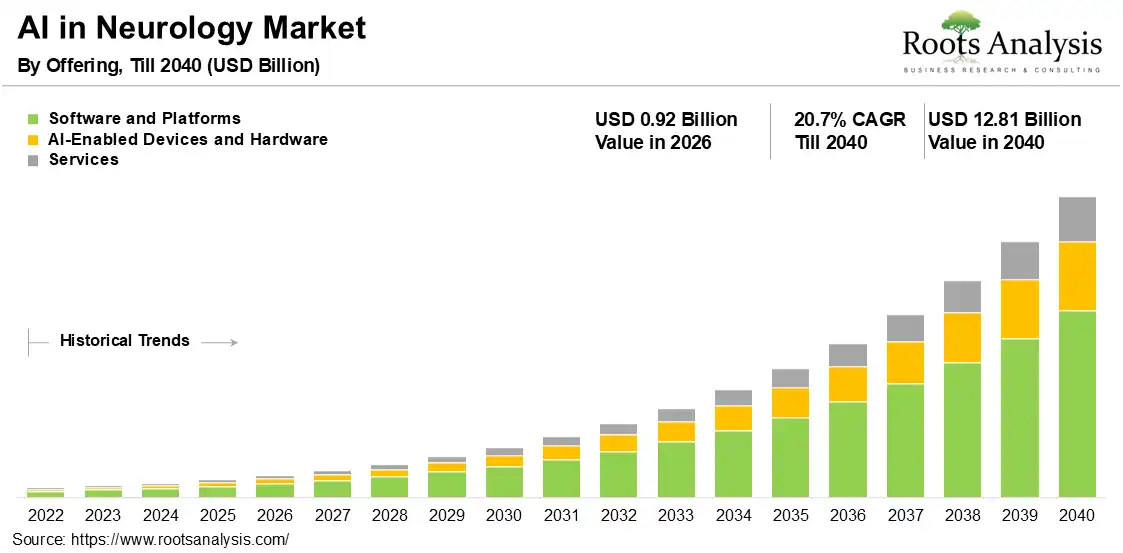
The global AI in neurology market is expected to rise from USD 0.92 billion in 2026 and is projected to reach USD 12.81 billion by 2040, growing at a CAGR of 20.7% over the forecast period 2026 to 2040, driven by faster neuroimaging, clinical decision support, and precision neurology adoption.
See What’s in the Full Report – Request Your Complimentary Insights!
Market Report: Key Takeaways
- Based on offering, Software and Platforms capture 62.0% market share in 2026, whereas AI-Enabled Devices and Hardware registers a 22.4% CAGR through 2040, supported by expanding neurotechnology and closed-loop device pipelines.
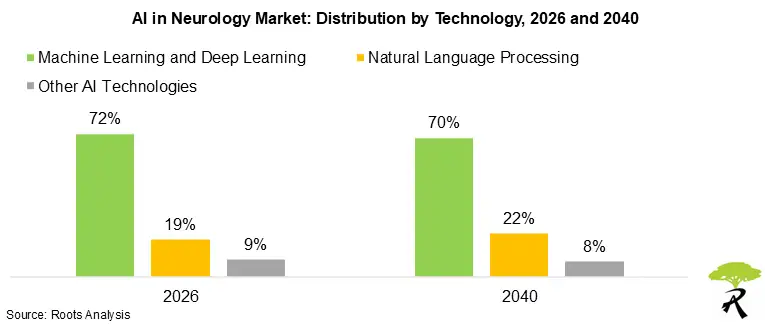
- Based on technology, Machine Learning and Deep Learning capture 72.0% market share in 2026, whereas Natural Language Processing registers a 22.0% CAGR through 2040, supported by multimodal assistants and automated clinical documentation.
- Based on application, Neuroimaging and Diagnosis capture 35.0% market share in 2026, whereas Research and Drug Development registers a 23.2% CAGR through 2040, driven by scalable biological datasets and generative discovery platforms.
- Based on neurological condition, Stroke and Other Cerebrovascular Disorders captures 31.0% market share in 2026, whereas Alzheimer’s Disease and Other Dementias register a 22.3% CAGR through 2040, driven by earlier detection and therapy-monitoring requirements.
- Based on geography, North America captures 47.0% market share in 2026, whereas Asia-Pacific registers a 23.9% CAGR through 2040, supported by hospital digitalization and localized stroke-care networks.
AI in Neurology Market Outlook
Clinical demand is shifting from isolated imaging algorithms toward connected platforms that coordinate diagnosis, triage, treatment planning, and monitoring. Earlier deployments focused mainly on stroke scans and single-point radiology alerts. Current buyers increasingly seek enterprise integration across PACS, electronic records, communication tools, and longitudinal neurological workflows. This transition favors software platforms today. Portable imaging, wearable EEG, adaptive stimulation, and digital biomarkers broaden the addressable market beyond hospital radiology.
Growth reflects rising neurological caseloads, specialist shortages, faster imaging requirements, and demand for measurable workflow gains. The regulatory environment also shapes adoption costs and product design. In January 2025, the United States Food and Drug Administration issued draft lifecycle guidance for AI-enabled medical devices. It covered transparency, documentation, maintenance, and bias management. These requirements reward vendors with strong clinical validation, quality systems, and post-market monitoring capabilities.
Through 2040, the market will remain high-growth as neuroimaging expands into multimodal decision support, disease monitoring, drug discovery, and AI-enabled devices. Natural language processing and research applications will outpace mature diagnostic categories. Asia-Pacific adoption will accelerate through hospital digitalization and localized stroke networks. In April 2026, Hyperfine introduced its Swoop portable MRI system at AIIMS New Delhi for bedside neurological imaging. Long-term growth remains strong, though regulation and integration will determine commercial winners.
AI in Neurology Market Dynamics
AI in Neurology Market Drivers
Neuroimaging and diagnosis drive adoption because CT, MRI, PET, EEG, and physiological signals already generate structured digital data. This application holds 35.0% market share in 2026, supported by automated detection, segmentation, quantification, and faster specialist coordination. Hospitals also gain measurable turnaround improvements without replacing core imaging infrastructure. Machine learning and deep learning therefore command 72.0% technology share, reinforcing established deployment pathways across stroke, hemorrhage, tumors, and neurodegeneration.
AI in Neurology Market Restraints
Regulatory evidence requirements slow commercialization and raise lifecycle costs for smaller developers. The January 2025 United States Food and Drug Administration draft guidance sets broad expectations for AI-enabled devices. These include documentation, transparency, bias management, maintenance planning, and post-market oversight. Vendors must also validate performance across scanners, patient groups, and clinical settings. These obligations can delay submissions and restrict rapid model updates. They favor companies with mature quality systems, clinical partnerships, and capital for continuous compliance.
AI in Neurology Market Opportunities
AI-enabled devices and neurological drug development offer the strongest expansion paths beyond established imaging software. Hardware will grow at 22.4% CAGR through 2040, while research and drug development will reach 23.2% CAGR. In May 2026, Lunai Bioworks and BrainStorm Therapeutics launched a discovery collaboration using AI, organoids, and in vivo models. The program targets Parkinson’s disease and rare genetic epilepsies. Such models create partnership opportunities across diagnostics, therapeutics, and translational research.
AI in Neurology Market Challenges
Enterprise integration remains difficult because neurological workflows span emergency departments, radiology, neurology, surgery, rehabilitation, and external referral networks. Buyers require compatibility with PACS, electronic records, communication systems, and treatment protocols. Natural language processing will grow at 22.0% CAGR as multimodal assistants combine imaging with notes and laboratory data. Yet poor interoperability, workflow disruption, cybersecurity demands, and uncertain reimbursement can prevent technically strong products from achieving system-wide adoption.
AI in Neurology Market Size Estimation Methodology
- As a starting point, the analysis compiled historical and current estimates for the AI in neurology market. It used multiple credible secondary sources worldwide. Values were normalized to a common definition covering software, AI-enabled devices, hardware, and services. Overlapping categories, including general healthcare AI and neurology operating-room solutions, were excluded unless their neurological revenue contribution could be isolated reliably.
- Moving forward, the model mapped commercial activity across neuroimaging, clinical decision support, disease monitoring, rehabilitation, research, and workflow connectivity. Company product pages, regulatory clearances, hospital deployments, and clinical trial use cases helped establish adoption maturity. The assessment also reviewed FDA submission activity for stroke, hemorrhage, brain MRI quantification, and seizure-detection tools. This separated regulated demand from experimental development clearly.
- Building on this, segment shares were assigned using deployment breadth, purchasing behavior, and technology readiness. Software received the largest base share because hospitals can integrate algorithms into existing PACS, electronic records, and communication systems. Faster growth assumptions for AI-enabled devices reflected portable MRI, wearable EEG, adaptive stimulation, and brain-computer interface pipelines. These technologies are entering clinical use or human studies globally.
- Drawing upon these, regional estimates incorporated imaging infrastructure, hospital digitalization, specialist availability, reimbursement channels, venture funding, and medical-device regulation. North America received the highest 2026 share because of advanced hospital networks and active commercialization. Asia-Pacific received the fastest growth rate because expanding imaging capacity, localized stroke networks, and lower-cost diagnostic infrastructure support wider deployment across hospitals.
- The projected value was then developed through a bottom-up and top-down reconciliation process. Segment growth rates were applied to offering, technology, application, neurological condition, end-user, and regional baselines. These outputs were checked against company funding rounds, product launches, partnership activity, regulatory submission counts, and commercial deployments. This prevented any single source or category from disproportionately shaping the forecast outcome.
- Finally, the forecast was tested through conservative, base, and accelerated adoption scenarios. Sensitivity checks examined slower regulatory approvals, delayed hospital integration, stronger pharmaceutical demand, faster natural language processing adoption, and wider device commercialization. The final curve preserved the 20.7% overall CAGR. It also allowed faster expansion in research, AI-enabled hardware, Alzheimer’s applications, pharmaceutical users, and Asia-Pacific markets over the forecast period.
AI in Neurology Market Share Insights
Market Share by Offering
According to our analysis, software and platforms leads because hospitals can integrate algorithms into existing imaging, electronic records, and communication systems. Cloud delivery also reduces initial capital requirements while supporting updates across multiple clinical locations. In June 2025, Viz.ai received FDA clearance for software that labels and quantifies subdural hemorrhage measurements.
AI-Enabled Devices and Hardware will gain share as sensing, adaptive stimulation, wearables, and brain-computer interfaces enter human studies. These systems extend AI beyond interpretation into continuous monitoring, rehabilitation, and personalized neurological intervention. In July 2025, CorTec announced the first human implantation of its closed-loop Brain Interchange system for stroke rehabilitation.
Market Share by Technology
Machine Learning and Deep Learning leads because neurological workflows rely heavily on CT, MRI, PET, EEG, and physiological signals. Established validation pathways and extensive imaging datasets reinforce deployment across stroke, hemorrhage, tumors, and neurodegeneration.
In November 2025, RapidAI received five FDA clearances covering advanced neurological, radiology, and vascular imaging modules.
Natural Language Processing will expand through ambient documentation, clinical summarization, patient communication, and unstructured-record analysis. Multimodal systems will combine neurological imaging with clinical notes, laboratory data, medications, and longitudinal histories. In October 2025, Viz.ai launched Viz Assist, combining generative summaries, ambient inputs, electronic records, and imaging algorithms.
Want Information on Specific Region / Segment?
Regional Analysis: North America Leads the Market and Asia-Pacific is Likely to Register Higher CAGR
Presently, North America holds a 47.0% share in 2026. The region benefits from advanced imaging infrastructure, specialist hospitals, venture capital, established reimbursement channels, and active medical-device regulation. Large hospital networks also provide scalable environments for evaluating and deploying neurological AI across multiple clinical departments. In April 2026, Aidoc raised USD 150 million to expand its regulated foundation model and enterprise clinical-AI platform.
On the contrary, Asia-Pacific registers a 23.9% CAGR from 2026 to 2040. Hospital digitalization, specialist shortages, expanding imaging capacity, and localized algorithms will accelerate adoption throughout major healthcare markets. Regional growth will increasingly involve connected stroke networks, cloud-based interpretation, mobile decision support, and lower-cost diagnostic infrastructure. In October 2025, Apollo Hospitals expanded an AI-supported stroke network across Chennai using nine advanced laboratories and decision-support tools.
Market Ecosystem Analysis
The supplied ecosystem includes seven Tier 1 leaders, 13 specialists and five emerging companies across 25 participants. Seven leaders control most commercial activity through neurovascular platforms, enterprise imaging infrastructure and integrated MRI hardware. Acquisition-driven consolidation and platform convergence now dominate, while national health networks increasingly purchase multi-site workflow solutions instead of isolated algorithms. Competitive advantage is shifting toward clinical integration, multi-condition coverage, longitudinal evidence and deployment across hospitals, clinics and remote settings.
- Brainomix received FDA clearance in April 2025 for ischemic-core measurement using standard noncontrast CT images. This reduces dependence on advanced perfusion imaging and pressures competitors requiring specialized acquisition protocols. The clearance strengthens neuroimaging, diagnosis and treatment-selection applications within stroke care.
- Viz.ai partnered with Johnson & Johnson in April 2026 to expand AI-supported subdural hemorrhage care. The collaboration extends Viz.ai beyond stroke triage into hemorrhage quantification, visualization and patient-context summarization. This raises competitive barriers for single-condition neurovascular tools lacking care-coordination capabilities.
- RapidAI entered a strategic partnership with Saudi Health Holdings Company in November 2025. RapidAI became the enterprise clinical-AI provider across a network covering 20 health clusters. This agreement strengthens its Middle East position and reinforces demand for multi-disease enterprise platforms.
- Nicolab secured a Queensland Health arrangement covering 36 hospitals in May 2025. The deployment strengthens its cloud-native stroke workflow platform across regional and rural care networks. It pressures smaller vendors lacking government-scale implementation and telestroke integration capabilities.
- GE HealthCare announced its intended acquisition of icometrix in September 2025. The transaction combines MRI systems with neurological quantification for multiple sclerosis, dementia and brain injury. It increases pressure on independent software vendors lacking direct scanner integration and global distribution.
- Hyperfine received FDA clearance in June 2025 for its next-generation Swoop system with Optive AI software. The integrated platform improves image quality while retaining portable, low-field brain-imaging accessibility. This strengthens diagnostic imaging across neurology clinics, emergency departments and underserved settings.
- Ceribell received FDA clearance in November 2025 for neonatal seizure detection using its Clarity algorithm. The clearance expanded its point-of-care EEG coverage from premature newborns through adults. This creates a broader hospital platform and raises the evidence threshold for competing seizure-monitoring systems.
- Epitel received expanded FDA clearance for its REMI Wireless EEG System in April 2025. The expansion supports wearable neurological monitoring across more hospital workflows and patient environments. It strengthens competition around continuous EEG access, remote review and decentralized seizure detection.
- Linus Health expanded its Anywhere platform and League partnership in July 2025. The collaboration brings AI-supported cognitive screening and care pathways into private health-plan digital environments. This lowers distribution barriers and expands dementia screening beyond specialist neurology clinics.
- NeuraLight partnered with CHDI Foundation in September 2025 to develop Huntington’s disease eye-movement biomarkers. The collaboration builds trial-ready endpoints from webcam-based oculometric measurements. It strengthens disease-progression monitoring and research applications across neurodegenerative drug development.
- IXICO aligned its neuroimaging platform with Medidata in March 2026 for CNS clinical trials. The collaboration connects image collection, eligibility reporting, safety assessment and biomarker analysis within one regulated workflow. This improves IXICO’s route to pharmaceutical and CRO customers while pressuring fragmented imaging-service providers.
- Neurotrack received a dated NIA commercialization profile in June 2025. NIA reported more than USD 62.8 million in venture investment and USD 4.3 million in grants. The profile strengthens Neurotrack’s positioning in primary-care cognitive screening and technology-enabled dementia management.
Startup Companies and their Key Highlights
- Hyperfine, Inc.
- Event type: FDA clearance and next-generation product launch
- Month and year: June 2025
- Stated purpose: Combine redesigned portable MRI hardware with Optive AI software for improved brain-image quality and broader clinical adoption.
- Market implication: Accelerates AI-enabled devices within neurology clinics, emergency departments and remote-care settings by reducing conventional MRI infrastructure requirements.
- Ceribell, Inc.
- Event type: FDA 510(k) clearance
- Month and year: November 2025
- Stated purpose: Extend the Clarity seizure-detection algorithm to premature newborns and neonatal patients.
- Market implication: Expands AI-assisted EEG across neonatal intensive care, pediatric neurology and emergency neurological assessment. The clearance gives Ceribell coverage across the widest patient-age range among point-of-care seizure systems.
- Epitel, Inc.
- Event type: Expanded FDA 510(k) clearance
- Month and year: April 2025
- Stated purpose: Expand the REMI Wireless EEG System’s authorized neurological monitoring capabilities and clinical use.
- Market implication: Accelerates wearable EEG adoption within hospitals by supporting continuous monitoring without conventional wired EEG infrastructure. This strengthens the epilepsy, seizure-detection and remote-monitoring segments.
- Linus Health
- Event type: Platform expansion and strategic collaboration
- Month and year: July 2025
- Strategic partner: League
- Stated purpose: Expand online cognitive screening and brain-health services through private health-plan platforms.
- Market implication: Extends AI-enhanced cognitive assessment into payer-managed populations and increases access outside specialist memory clinics. This supports Alzheimer’s disease screening, longitudinal monitoring and care-navigation applications.
- NeuraLight
- Event type: Biomarker-development collaboration
- Month and year: September 2025
- Strategic partner: CHDI Foundation
- Stated purpose: Develop sensitive eye-movement biomarkers and trial endpoints for Huntington’s disease research.
- Market implication: Accelerates digital biomarker use in CNS clinical trials by providing objective measurements from scalable webcam-based assessments. It strengthens disease-progression monitoring and pharmaceutical research applications.
- Nicolab
- Event type: National clinical study and multi-hospital deployment
- Month and year: August 2025
- Strategic partners: Health New Zealand, University of Otago and Capital, Coast and Hutt Valley
- Stated purpose: Deploy StrokeViewer across up to 30 hospitals and evaluate treatment rates, delays and implementation outcomes.
- Market implication: Accelerates Asia-Pacific adoption of cloud-native stroke imaging and care coordination. The study may strengthen evidence requirements for future national procurement of neurovascular AI platforms.
AI in Neurology Market Trends / Opportunities
AI in Neurology Market Shifting from Image Alerts to Enterprise Workflow Platforms
Neurological AI is moving from isolated image alerts toward platforms that connect detection, summaries, communication, and treatment coordination. In October 2025, Viz.ai launched Viz Assist with generative summaries, ambient inputs, electronic records, and imaging algorithms. Vendors with broad workflow integration can compete for enterprise contracts instead of single-algorithm purchases.
Hospital networks increasingly value coordinated deployment across emergency, radiology, neurology, and referral pathways. In October 2025, Baptist Health reported statewide use of RapidAI for stroke imaging, coordination, and treatment decisions. Proven network-scale performance strengthens retention, cross-selling, and expansion across clinical departments.
Portable Neurotechnology Expanding Care Sites and Hardware Competition
AI-enabled hardware is extending neurological assessment beyond conventional imaging suites. In April 2026, Hyperfine placed its Swoop portable MRI system into clinical use at AIIMS New Delhi for bedside brain imaging. Portable systems can open critical-care, trauma, and lower-infrastructure settings that software-only vendors cannot directly serve.
Closed-loop devices are shifting AI from interpretation toward personalized intervention and rehabilitation. In July 2025, CorTec announced the first human implantation of its Brain Interchange system for stroke rehabilitation. Device developers face longer clinical pathways, but successful platforms can secure differentiated positions and recurring data-driven service opportunities.
AI in Neurology Market Moving into Drug Discovery and Longitudinal Biomarkers
Pharmaceutical demand is expanding AI use into target discovery, biomarker analysis, and trial design. In October 2025, Recursion, Roche, and Genentech disclosed an AI-searchable microglia map containing about 46 million images. Large biological datasets strengthen partnership value and create defensible discovery assets.
Longitudinal monitoring is becoming more valuable as disease-modifying therapies increase patient-selection and treatment-response requirements. In January 2026, Siemens Healthineers began co-leading ACCESS-AD, which integrates AI across Alzheimer’s diagnosis, imaging, treatment, and monitoring. Vendors that connect diagnostics with monitoring can capture broader clinical and pharmaceutical workflows.
Regulatory Lifecycle Controls Raising Evidence Standards and Favoring Scaled VendorsH
Regulators increasingly expect AI-enabled devices to address transparency, bias, maintenance, and documentation throughout the product lifecycle. The United States Food and Drug Administration issued comprehensive draft guidance in January 2025. Compliance depth now influences development speed, update practices, and buyer confidence.
Multiple clearances can signal platform maturity across connected neurological use cases. In November 2025, RapidAI received five FDA clearances covering advanced neurological, radiology, and vascular imaging modules. Companies with reusable regulatory, clinical, and quality infrastructure can expand portfolios faster than narrowly funded entrants.
Your Business is Unique – Why Shouldn’t Your Report Be?
Market Access Considerations
Total Product Lifecycle Evidence Requirements
Regulated neurological AI requires evidence across design, validation, maintenance, transparency, and bias controls. The United States Food and Drug Administration’s January 2025 draft lifecycle guidance raises documentation and post-market expectations for AI-enabled medical devices. These requirements increase development costs and can slow model updates across multiple clinical indications and patient populations. Vendors with established quality systems, clinical evidence, cybersecurity controls, and regulatory teams gain faster commercialization paths. They also build stronger credibility with hospital procurement committees.
Clinical Validation Across Care Settings
Hospital access depends on clinical validation that reflects diverse scanners, populations, and care settings. Buyers evaluate whether tools improve turnaround, specialist coordination, and treatment decisions without disrupting emergency workflows. The FDA clearance for Methinks NCCT Stroke covered AI-supported hemorrhage and vessel-occlusion triage from routine non-contrast CT. Clear, workflow-linked evidence supports reimbursement discussions, procurement approval, and differentiation from research-stage competitors. It strengthens adoption decisions involving the same clinical budgets, partnerships, and specialist attention.
Longitudinal Data Access and Clinical Coordination
Longitudinal neurological applications require reliable access to imaging, cognitive, biomarker, and treatment-response data. ACCESS-AD integrates AI across Alzheimer’s diagnosis, imaging, treatment, and monitoring, showing the scale of coordination needed for disease-modifying therapy pathways. Data fragmentation can delay deployment, weaken model generalizability, and complicate cross-site validation. Companies with clinical partnerships and interoperable data pipelines can build stronger monitoring products and pharmaceutical collaborations. They can also secure recurring revenue across extended care pathways, treatment cycles, and follow-up programs.
How Stakeholders Benefit from the Key Focus Areas of Our AI in Neurology Market Report
Neurological care requires faster imaging, earlier disease detection, and coordinated treatment across increasingly complex clinical pathways. The report connects these macro pressures with segment growth, regulatory evidence, funding activity, and technology adoption. Decision-makers can compare where demand is strongest and where commercialization remains constrained.
- Unmet Needs and Market Gaps in AI in Neurology Market: The report identifies gaps in specialist access, bedside imaging, longitudinal monitoring, cognitive screening, and integrated stroke coordination. Strategy teams can compare unmet demand across stroke, Alzheimer’s disease, epilepsy, Parkinson’s disease, and other neurological conditions. This supports decisions on product positioning, clinical use cases, and priority customer groups. It also clarifies where workflow integration matters more than isolated algorithm performance.
- Funding and Venture Investment Opportunities in AI in Neurology Market: Funding analysis tracks capital flowing toward regulated platforms, portable imaging, blood-based diagnostics, and pre-CT stroke triage. Investment committees can compare mature software opportunities with higher-risk device and biomarker ventures. The assessment supports decisions on entry timing, portfolio exposure, and commercialization readiness. Brainomix, Aidoc, Enlife Research, and AI-Stroke provide verified signals of current investor interest.
- Technology Innovation and Adoption Trends: Technology coverage compares machine learning, deep learning, natural language processing, portable MRI, wearable EEG, and closed-loop neurotechnology. Product and engineering leaders can see which technologies hold current share and which will gain fastest through 2040. This supports platform architecture, development budgets, and clinical-validation planning. It also shows how multimodal systems combine imaging, notes, laboratory data, and longitudinal histories.
- AI in Neurology Market Competitive Landscape and Industry Analysis: Competitive analysis maps Tier 1 leaders, specialist vendors, and emerging companies across imaging, triage, monitoring, biomarkers, devices, and infrastructure. Corporate strategy teams can benchmark product breadth, commercialization maturity, and geographic reach. This supports build, partner, acquire, or compete decisions. It also highlights where enterprise platforms differ from disease-specific tools and research-stage technologies.
- Mapping Strategic Partnerships and Ecosystem Synergies: Partnership mapping examines hospital networks, pharmaceutical collaborations, patient associations, imaging specialists, and technology infrastructure providers. Business development teams can identify combinations that improve data access, clinical validation, distribution, or workflow coverage. This supports partner selection and alliance sequencing. Recent collaborations involving icometrix, Lunai Bioworks, BrainStorm Therapeutics, Recursion, Roche, and Genentech illustrate distinct ecosystem models.
- AI in Neurology Market CAGR and Growth Trends: Growth analysis explains the 20.7% overall CAGR and faster expansion in hardware, natural language processing, research, Alzheimer’s disease, and Asia-Pacific. Finance and planning teams can compare share shifts through 2040. This supports revenue scenarios, capacity planning, and regional investment choices. The analysis also separates high-growth opportunities from segments losing relative share despite continued expansion.
AI in Neurology Market: Scope of the Report
| Key Report Attributes | Details | |
| Forecast Period | Till 2040 | |
| Market Size 2026 | USD 0.92 Billion | |
| Market Size 2040 | USD 12.81 Billion | |
| CAGR (Till 2040) | 20.7% | |
| Segments Covered |
|
|
| Geographical Regions Covered |
|
|
| Key Sections Covered |
|
|
Market Segmentation
The AI in Neurology Market report presents an in-depth analysis, highlighting the capabilities of various stakeholders, based on different segments, such as offering, technology, application, neurological condition, end user, geographical regions, and leading players.
By Offering
- Software and Platforms
- AI-Enabled Devices and Hardware
- Services
By Technology
- Machine Learning and Deep Learning
- Natural Language Processing
- Other AI Technologies
By Application
- Neuroimaging and Diagnosis
- Disease Progression Monitoring
- Treatment Planning and Clinical Decision Support
- Surgical Planning
- Rehabilitation
- Research and Drug Development
- Training and Education
- Workflow Integration and Connectivity
By Neurological Condition
- Stroke and Other Cerebrovascular Disorders
- Alzheimer’s Disease and Other Dementias
- Parkinson’s Disease and Other Movement Disorders
- Epilepsy and Seizure Disorders
- Multiple Sclerosis
- Brain Tumors
- Traumatic Brain Injury
- Other Neurological Disorders
By End User
- Hospitals and Neurology Clinics
- Diagnostic Imaging Centers
- Ambulatory Surgical Centers
- Pharmaceutical and Biotechnology Companies
- Contract Research Organizations
- Academic and Research Institutions
By Geographical Regions
- North America
- US
- Canada
- Mexico
- Rest of North America
- Europe
- Austria
- Belgium
- Denmark
- France
- Germany
- Ireland
- Italy
- Netherlands
- Norway
- Russia
- Spain
- Sweden
- Switzerland
- UK
- Rest of Europe
- Asia-Pacific
- China
- India
- Japan
- Singapore
- South Korea
- Rest of Asia-Pacific
- Latin America
- Argentina
- Brazil
- Chile
- Colombia
- Venezuela
- Rest of Latin America
- Middle East and Africa (MEA)
- Egypt
- Iran
- Iraq
- Israel
- Kuwait
- Saudi Arabia
- UAE
- Rest of MEA
- Rest of the World


