AI in Skincare Market by Type of Component (Solutions and Services), Type of Technology (Computer Vision & Image Recognition, Machine Learning & Predictive Analytics, 3D Face / Body Scanning & AR / VR, and Cloud & Edge AI Solutions), Application Area (Skin Analysis and Diagnostics, R&D & Product Innovation, Personalized Skincare Solutions, and Virtual Try-On / AR), End User, Geographical Regions, and Key Players – Trends and Forecast 2025-2035
Market Size
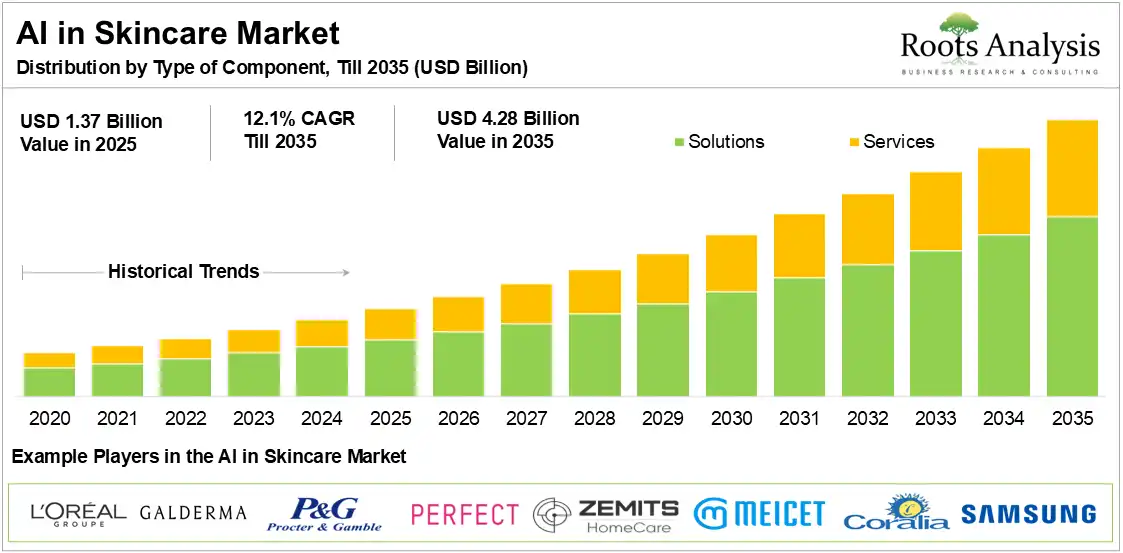
The global AI in skincare market, valued at USD 1.19 billion in 2024, is projected to reach USD 1.37 billion in 2025 and USD 4.28 billion by 2035, with a CAGR of 12.1% during the forecast period. This market is growing due to the growing adoption of AI algorithm for skin analysis to prepare personalized skincare solutions.
See What’s in the Full Report - Request Your Complimentary Insights!
Market Report: Key Takeaways
- The rising consumer awareness about personalized skincare products is fueling the demand for AI technology in skincare industry.
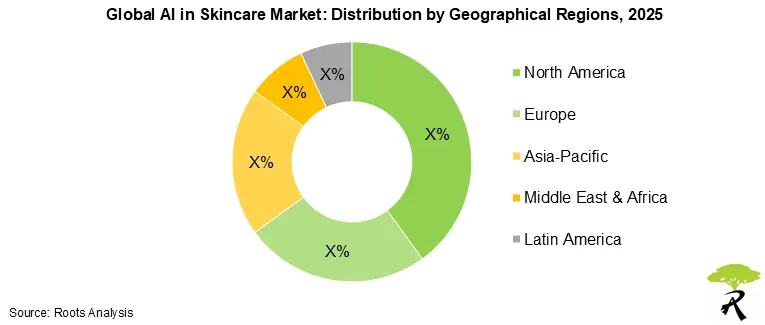
- In terms of geographical regions, the North America dominates the market due to the increasing acceptance of tech-driven skincare solutions.
- In terms of components, the solutions segment accounts for 65% of the overall market share. This is due to the increasing usage of smart wearables devices, chatbots and predictive analytical tools.
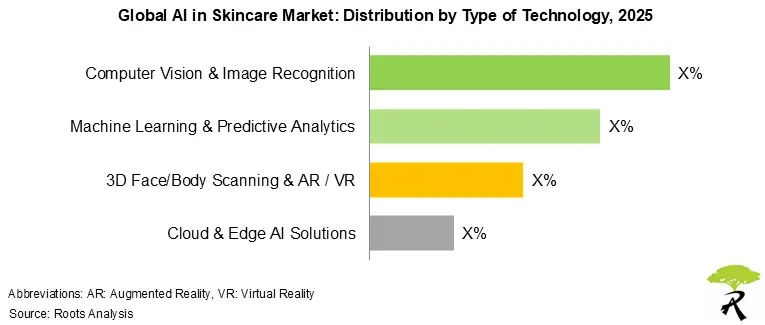
- On the basis of technology, the computer vision & image recognition segment holds the largest share (nearly 40%) of the market due to the widespread adoption for designing novel skincare formulations based on skincare metrics.
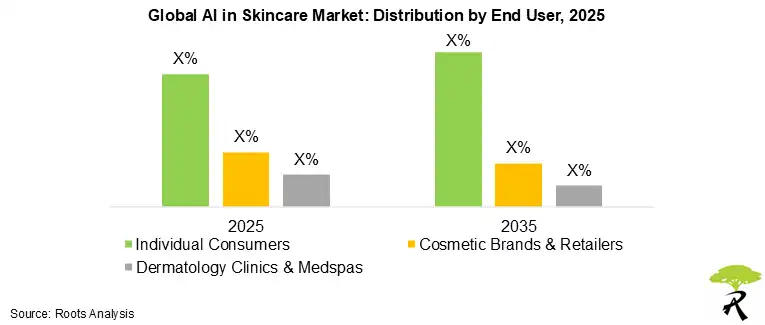
- Based on the end users, individual consumers segment is the largest shareholder of the market. This is due to the growing use of skincare analytic tools, AI-powered apps for skin analysis and personalized product recommendations.
Market Introduction
With growing shift from one-size-fits-all to personalized skincare solutions, there is a surge in the demand for AI technology in this field. Artificial intelligence enables skincare industry leaders to discover core ingredients, clinical testing, and formulation optimization with higher accuracy. Notably, AI-powered analytical tools play a significant role in analyzing skin concerns, such as fine lines, acne, and pigmentation. The information is further used by skincare industry and dermatologist provide custom-made products to the consumers to address these concerns, contributing to the growth of the market.
Additionally, the rising social media hype and celebrity style beauty standards has further prompted the demand for smart technologies, such as AI algorithms for professional-grade skin analysis. Considering the ongoing demand, skincare industry players, such as L’Oreal Groupe (France), P&G (US), and Galderma (Switzerland) are increasingly undertaking initiatives, such as investments, partnerships, collaborations and acquisitions to strengthen their product portfolio.
For instance, in June 2025, Noli (UK AI-powered multi-brand beauty startup company backed by the L’Oreal Groupe (France)) entered in the collaboration with Accenture (Ireland) to enhance their product optimization and lead the AI-driven consumer experience within the skincare and beauty industry. As the demand for customized skincare solution increases, we believe that AI in skincare market will grow unprecedently in the future.
Recent Developments in AI in Skincare Market
- In August 2025, Debut (US) raised USD 20 million to accelerate the expansion of its AI-based ingredient discovery platform to enhance innovation in skin longevity.
- In June 2025, L’Oreal Groupe (France) and NIVIDIA (US) entered into a collaboration to harness AI across multiple beauty aspects. Under this collaboration, L’Oreal Groupe (France) will leverage the NIVIDIA’s AI enterprise platform to for the development and deployment of AI and generative AI to turn consumers beauty dreams into reality.
- Inn June 2025, Revive (UK) entered into the partnership with Simon Urian (US) to launch an AI-powered skincare and nutrition digital recommendation tool.
- In May 2025, Clinikally (India) launched Clara, an AI-driven skin analysis tool which is designed to hyper-personalized the skincare solutions recommendations for millions of consumers.
Pay Only for What You Need – The Best Way to Optimize
Market Trends
- Generative AI for Personalized Skincare Formulation: In the future, the use of Generative AI in skincare will become a standard practice, specifically in R&D process. This integration enable the identification of novel ingredients to design skincare formulation with a personalized approach.
- Fundings and Investments Analysis: The robust growth of the AI in Skincare industry is driven by the major investments and fundings by the industry players for the integration of AI in Skincare apps with wearable health devices. Some of the buzzing investments in this field are listed below:
- L’Oreal Groupe (France): The company is investing heavily in AI and entering into collaborations and partnerships. One of the major collaboration of L’Oreal Groupe (France) is with IBM (US) to use generative AI for the development of sustainable cosmetic solutions.
- Kult (India): Thie beauty tech startup company has successfully raised USD 20 million to expand its AI platform for hyper-personalization of skincare recommendations.
- Cureskin (India): This AI-driven dermatology platform has secured USD 20 million in a series B funding round to use AI-powered tools to bridge the gap in accessing qualified dermatologists recommendations in rural areas.
Industry Experts on AI in Skincare Market
Experts believe that AI is the future of personalized skincare. The technology is empowering skincare industry to shift from one-size-fits-all to customized solutions.
According to Guive Balooch (head of L'Oréal's Technology Incubator), 'AI has the potential to revolutionize product development by accelerating the research process and uncovering new beauty ingredient combinations that were previously overlooked.’
AI in Skincare Market Drivers
- Hyper-Personalization: The heightened demand for personalized skincare solutions is likely to fuel the demand for AI skin analysis for personalized skincare routines. Notably, AI-powered predictive analytical tools and applications can help to analyze skin condition, skin tone, and skin type to recommend personalized products and routines. This result into widespread adoption of AI tools across consumers and skincare brands in the future.
- Integration of Wearables and IoT: The future of AI beauty technology market will be centered around the integration of AI with smart wearable medical devices and IoT devices. This integration will help to monitor skin metrics, such as hydration level, and UV exposure. With real-time analysis, consumers will be enabled to adapt a customized skincare routines based on physiological changes and environmental conditions.
How Is AI Integrated Into Skincare Apps, Diagnostic Devices, and E-Commerce Platforms?
AI-powered skin analysis apps typically use computer vision in skin assessment. These AI tools helps to analyze photos and videos to access skin concerns, such as acne, blemishes, fine lines, and wrinkles. The detailed analysis can be used by dermatologists to recommend personalized skincare products. Moreover, this information is also helpful for skincare brands for designing personalized skincare formulations.
- Diagnostic Devices: AI-powered tools are integrated with smart mirrors, and handheld scanners for in-depth analysis of skin condition at home. The information will be shared with dermatologists and skincare analysts for clinical-grade assessment and recommendation of personalized products.
- E-Commerce Platforms: AI-powered recommendation engines for skincare products are integrated into e-commerce platforms for skin analysis and suggest tailored skincare solutions to meet aesthetic goals of their consumers. Moreover, these platforms also include virtual try-on features and AI-powered chatbots that act as digital beauty advisors, enhancing customer engagement and reducing product returns.
Have Questions? Let’s Get Them Answered.
Market Segmentation Analysis
Solutions Holds the Largest Share of the Market
- Based on the type of component, the global market is bifurcated across solutions and services. According to the AI in Skincare industry analysis, the solutions segment is dominating the market by holding 65% of the overall revenue share. This growth is driven by the rising demand for AI-driven skin care solutions to achieve youthful glowing skin.
- Notably, this segment will continue to dominate the market in the future, anticipating growth at a higher CAGR. This lucrative growth is due to the increasing acceptance of smart beauty devices, chatbots and predictive analytics for skin aging with AI algorithms.
Computer Vision & Image Recognition Technology Dominates the Market
- This segment is bifurcated across different type of technology, such as computer vision & image recognition, machine learning & predictive analytics, 3D face / body scanning & AR / VR, and cloud & edge AI solutions. According to our AI in Skincare market report, the computer vision & image recognition segment is accounting for nearly 40% of the market share. This growth stems from the rising adoption of computer vision in skin assessment by skincare product manufacturing companies to develop personalized products.
- It is important to highlight here that this segment will continue to dominate the market in the future. The increasing focus of industrial players on advancements in computer vision technology to enhance accuracy is fueling its demand in the future.
Consumer Segments are Most Engaged with AI-Powered Skincare Services
- This segment highlights the distribution of global market across different type of end user, such as consumers, cosmetic brands & retailers, and dermatology clinics & medspas. Among these, the consumers segment is dominating by securing AI in skincare market share. This is driven by the increasing integration of AI in Skincare apps with wearable health devices for real-time skin health monitoring.
- It is worth noting that cosmetic & retailers segment is likely to grow at a higher CAGR in the future. The widespread usage of AI in cosmetic product formulation, chatbots, and analytical tools across various stages of skincare product formulation is likely to be a key growth factor for this segment.
Market Regional Insights
North America: The Hubspot of Innovation
According to the AI in Skincare market analysis, North America is dominating the market, driven by the growing adoption of advanced skin tech for personalized skincare solutions. Moreover, the growing spending on luxury skincare solutions by Gen Z generation is fueling the market growth in this region.
Europe: The Second Largest Share Holder of the Market
Europe holds the second largest AI in skincare market growth due to the growing demand for sustainable and personalized skincare solutions. Additionally, the well-established industrial players, such as Loreal Groupe (France), Unilever (UK), and Beiersdorf (Germany) are consistently focused on leveraging AI technologies to personalize their skincare solutions.
AI in Skincare Industry is Evolving at a Higher CAGR in Asia-Pacific
In Asia-Pacific, the market for AI in skincare is booming at a higher CAGR during the forecast period. This growth reflects the increasing adoption of personalized skincare solutions and hype generated by celebrity endorsement. Moreover, the major investments by top skincare brands, such as Cureskin (India) is expanding the market in this region.
Want Information on Specific Region / Segment?
South Korea: The beauty secrete of Korean is grabbing the global attention, specifically in Asian countries, like India. Driven by the rising demand, the skincare industry players are aiming to enhance the adoption of AR / VR technologies, and computer vision in skin lesion and pigmentation analysis to provide customized skincare solutions.
India: The widespread adoption of smart beauty devices with AI is likely to encourage market growth in this country. Moreover, the rising awareness about personalized skincare solutions has heightened the demand for AI to recommend personalized solutions.
Case Study: Olay’s AI-Powered Skin Advisor
This case study demonstrates the success of Olay’s company after the integration of AI-powered tools.
Olay’s AI skin advisor tool is the real-world example of implementation of AI in skincare industry. This AI skin tone and texture analysis tool allow users to take a selfie and receive instant skin analysis. Based on the data, users will receive product recommendations to address their skin concerns. The successful implementation of the AI tool has yielded impressive results for Olay company.
- Doubled sales conversion rates for consumers who used the tool.
- Increased the average basket size by 40% in key markets like China.
- Reduced product return rates by better matching customers with the right products.
AI in Skincare Market: Scope of the Report
| Key Report Attributes | Details | |
| Historical Trend | Since 2020 | |
| Forecast Period | Till 2035 | |
| Market Size 2025 | USD 1.37 Billion | |
| Market Size 2035 | USD 4.28 Billion | |
| CAGR (Till 2035) | 12.1% | |
| Key AI in Skincare Players Profiled |
(A complete list of companies captured is available in the report) |
|
| Segments Covered |
|
|
| Excel Data Packs (Complimentary) |
|
|
| PowerPoint Presentation (Complimentary) |
|
|
| Customization Scope |
|
|
AI in Skincare Market Segments
Based on the research, we have segmented the AI in skincare market into type of component, type of technology, application area, end user, geographical regions, and leading players.
AI in Skincare Market, by Type of Component
- Solutions
- Services
AI in Skincare Market, by Type of Technology
- Computer Vision & Image Recognition
- Machine Learning & Predictive Analytics
- 3D Face / Body Scanning & AR / VR
- Cloud & Edge AI Solutions
AI in Skincare Market, by Application Area
- Skin Analysis and Diagnostics
- R&D & Product Innovation
- Personalized Skincare Solutions
- Virtual Try-On / AR
AI in Skincare Market, by End User
- Consumers
- Cosmetic Brands & Retailers
- Dermatology Clinics & Medspas
AI in Skincare Market, by Geographical Regions
- North America
- US
- Canada
- Mexico
- Europe
- France
- Germany
- Italy
- Spain
- UK
- Rest of Europe
- Asia-Pacific
- China
- India
- Japan
- South Korea
- New Zealand
- Rest of the Asia-Pacific
- Middle East & Africa
- Egypt
- Iran
- Iraq
- Israel
- Saudi Arabia
- South Africa
- United Arab Emirates
- Latin America
- Argentina
- Brazil


