


 Download Free Sample
 Buy Now
Market Size
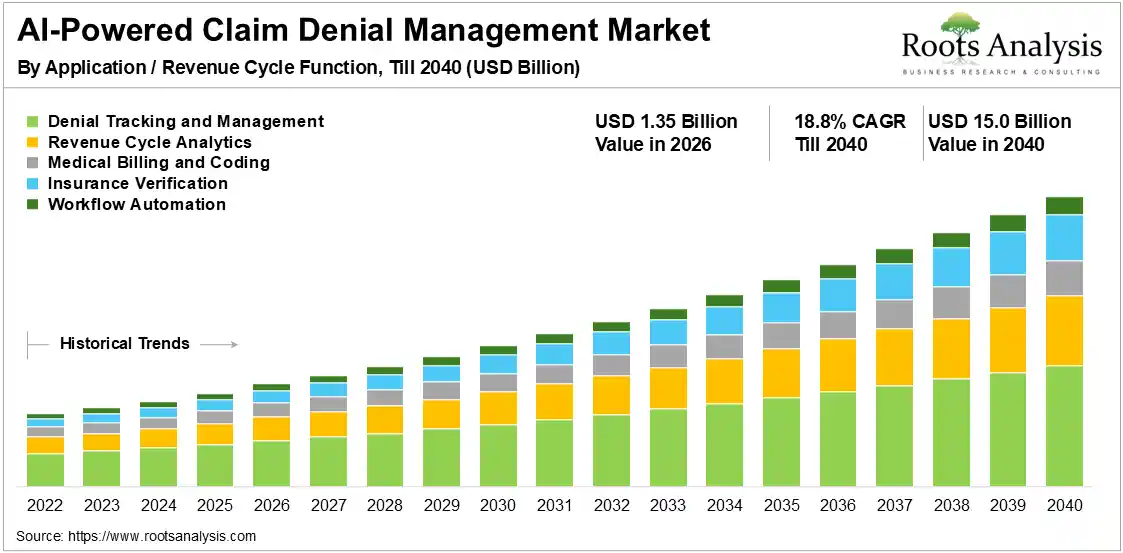
The global AI-Powered claim denial management market is expected to rise from USD 1.35 billion in 2026 and is projected to reach USD 15.0 billion by 2040, growing at a CAGR of 18.8% over the forecast period 2026 to 2040, driven by rising claim denials and payer-policy complexity.
See What’s in the Full Report – Request Your Complimentary Insights!
Market Report: Key Takeaways
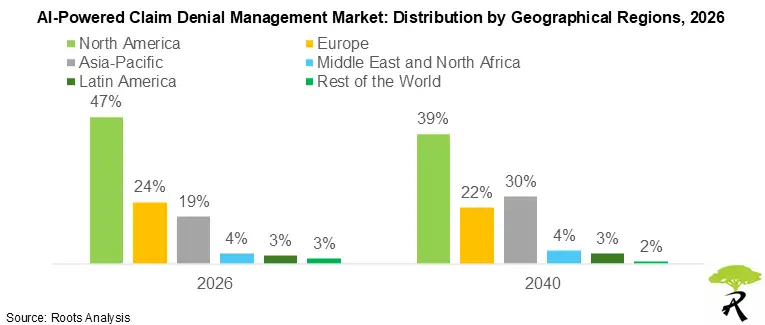
- Based on geography, North America captures 47.0% market share in 2026, whereas Asia-Pacific registers a 22.6% CAGR through 2040, driven by public claims digitization.
- Based on product / solution type, claims automation tools capture 27.0% market share in 2026, whereas eligibility and prior authorization tools register a 20.4% CAGR through 2040, driven by payer-rule complexity.
- Based on application / revenue cycle function, denial tracking and management captures 31.0% market share in 2026, whereas revenue cycle analytics registers a 20.6% CAGR through 2040, driven by leakage prevention.
- Based on technology layer, predictive analytics and machine learning captures 28.0% market share in 2026, whereas agentic workflow automation registers a 25.7% CAGR through 2040, driven by autonomous RCM execution.
- Based on end user, hospitals and health systems capture 41.0% market share in 2026, whereas revenue cycle management companies register a 20.8% CAGR through 2040, driven by AI-enabled outsourcing scale.
AI-Powered Claim Denial Management Market Outlook
AI denial management has moved from after-the-fact worklists into predictive denial prevention, payer rule intelligence, and generative AI appeal drafting. The AI claim denial management market now reflects a broader shift from staff-heavy recovery operations toward embedded revenue cycle automation. Providers face rising denial rates, documentation pressure, and legacy claims technology constraints. Vendors now compete on pre-submission risk scoring, real-time adjudication, appeal evidence generation, and payer-specific remediation intelligence.
Current growth comes from payer complexity, provider margin pressure, and policy scrutiny around prior authorization. CMS added pressure in July 2025 through a six-year technology-enabled prior authorization model for selected Medicare fee-for-service. FinThrive launched Denials Prevention Manager in June 2026 for high-risk claim detection before submission. The tool recommends corrective actions and protects revenue before payer adjudication across large health system operations.
Through 2040, the market will remain high-growth as automation shifts earlier in the claim lifecycle. Pre-submission denial prevention, agentic workflow automation, and revenue cycle analytics will gain share over reactive triage. R1 launched Phare OS in June 2026 to support real-time adjudication and AI-enabled provider-payer revenue cycle workflows. The outlook favors integrated platforms that reduce preventable denials while preserving auditability, data lineage, and operational provider-payer accountability.
AI-Powered Claim Denial Management Market Dynamics
AI-Powered Claim Denial Management Market Drivers
Provider denial pressure now drives spending from recovery queues into predictive denial prevention and payer rule intelligence. Experian Health reported in September 2025 that 41% of providers faced denial rates of 10% or higher. That level of leakage pushes hospitals toward claims scrubbing automation, revenue cycle analytics, and pre-submission risk scoring. The AI claim denial management market benefits as finance leaders target avoidable write-offs before adjudication.
AI-Powered Claim Denial Management Market Restraints
Data fragmentation limits deployment speed because denial prediction depends on payer history, coding data, eligibility checks, documentation, and appeal outcomes. Hospitals and physician groups often run these workflows across clearinghouses, EHRs, RCM vendors, and payer portals. Predictive analytics and machine learning lose value when claim edits lack payer-specific feedback loops. Vendors with weak integration depth face slower scaling, higher implementation cost, and weaker proof of recoverable revenue.
AI-Powered Claim Denial Management Market Opportunities
Pre-submission denial prevention creates the largest opportunity as providers move AI upstream from appeal queues. The segment grows from 28.0% share in 2026 to 36.0% share by 2040. FinThrive launched Denials Prevention Manager in June 2026 to identify high-risk claims before submission and recommend corrective actions. Platforms that stop denials before payer adjudication can capture larger enterprise budgets quickly.
AI-Powered Claim Denial Management Market Challenges
Auditability challenges grow as generative AI appeal letters, autonomous work queues, and real-time adjudication reshape RCM controls. Hospitals need explainable outputs because denial recovery touches contracts, clinical documentation, payer policies, and compliance review. Agentic workflow automation grows fastest at 25.7% CAGR, yet it requires governance across task execution and exception handling. Vendors must prove accuracy, traceability, and human oversight before replacing established denial specialists.
AI-Powered Claim Denial Management Market Size Estimation Methodology
- As a starting point, the forecast normalized the AI claim denial management market around provider revenue cycle workflows. Claims automation, denial tracking, eligibility, appeals management, underpayment recovery, and payer take-back management formed the demand frame. The baseline used industry data on denial management software, AI medical billing, healthcare claims management, and AI revenue cycle management. The process screened each source for scope overlap before weighting.
- Moving forward, the model separated denial-specific AI revenue from broader RCM automation. Broad AI RCM totals include coding, fraud analytics, patient billing, payment posting, and full outsourcing services. Those figures served only as upper-bound checks because the market here focuses on denial prevention, triage, appeals, and recovery. Billing outsourcing indicators also helped flag unrealistic scale assumptions.
- Building on this, the methodology assigned segment shares through bottom-up adoption logic across six dimensions. These dimensions covered geography, product type, application, denial lifecycle stage, technology layer, and end user. Inputs included denial-rate survey outputs, vendor product launches, funding announcements, payer policy events, and claims-volume references. The analysis gave higher growth to categories with clear 2025 or 2026 activity.
- Drawing upon these, the regional forecast weighted digital claims maturity, payer complexity, public insurance digitization, and regulatory program activity. North America received the leading 2026 share because providers, clearinghouses, payers, and RCM vendors already run mature claims infrastructure. Asia-Pacific received the fastest CAGR because public insurance digitization and AI adjudication programs create new automation demand. Regional shares also reflected insurance penetration and claims data readiness.
- The projected value was then stress-tested against lifecycle shifts from post-adjudication triage toward pre-submission denial prevention. The model aligned product shares with claims automation, prior authorization tools, and denial management tools. It aligned technology shares with predictive analytics, generative AI appeal drafting, and agentic workflow automation. The model checked CAGR calculations across every segment from 2026 through 2040. Share gains stayed limited where adoption depends on integration depth.
- Finally, the methodology reconciled the forecast with competitive signals from the listed vendors. The review covered Waystar, Experian Health, R1, FinThrive, athenahealth, Microsoft, RapidClaims, Cofactor AI, and other listed participants. These signals helped distinguish established platform demand from emerging specialist demand. The final methodology favors audited growth where dated launches, partnerships, funding events, or program announcements support the directional estimate.
AI-Powered Claim Denial Management Market Share Insights
Market Share by Product / Solution Type
According to our analysis, claims automation tools lead because providers prioritize clean-claim submission before investing in downstream appeal workflows. RapidClaims received new backing in April 2025 for an AI-native platform covering claims submission, denial management, and billing automation.
On the other hand, eligibility and prior authorization tools will expand fastest as payer rules become more dynamic and documentation-heavy. Waystar expanded authorization automation in February 2025 to address providers’ top investment priority.
Market Share by End User
Hospitals and health systems lead because they manage the highest denial volumes, payer contracts, and documentation complexity. Waystar cited 450 million annual denied claims in January 2025 while launching provider-facing generative AI appeal technology.
Fastest-growing sub-segment: Revenue cycle management companies will grow fastest as outsourced providers embed proprietary AI into scaled operating models. R1 launched R37 with Palantir in March 2025 to transform healthcare financial performance through automated RCM workflows.
Want Information on Specific Region / Segment?
Regional Analysis: North America Leads the Market and Asia-Pacific is Likely to Register Higher CAGR
Presently, North America captures 47.0% market share in 2026. The region leads because hospitals, clearinghouses, payer platforms, and RCM services already operate at high digital maturity. Capital access and complex payer reimbursement rules sustain strong investment in denial prevention, appeal automation, and analytics. In July 2025, CMS announced a six-year technology-enabled prior authorization model for selected Medicare fee-for-service.
On the contrary, Asia-Pacific registers a 22.6% CAGR from 2026 to 2040. The region will expand as insurance penetration, public claims exchanges, and digital health programs localize claims automation demand. India provides the clearest near-term signal, with NHA and IndiaAI Mission advancing AI-enabled auto-adjudication for AB PM-JAY in May 2026.
Market Ecosystem Analysis
The scoped ecosystem includes 25 companies: 7 Tier 1 leaders, 8 Tier 2 specialists, and 10 emerging entrants. The bulk of commercial activity sits with enterprise RCM platforms that already control claims, coding, eligibility, analytics, and payer workflow integrations. The dominant consolidation dynamic is platform convergence, as denial prevention, underpayment recovery, coding automation, and prior authorization intelligence merge into unified RCM operating layers. Competitive advantage is shifting toward vendors that combine payer-policy intelligence, clinical evidence, coding context, and executable workflow automation.
- Waystar strengthened its position in September 2025 by unveiling AltitudeAI capabilities for scaled denial appeals and denial prevention. The company said providers can create hundreds of appeal packages simultaneously, cutting appeal preparation time by more than 90%. This raises the execution bar for denial-only tools and strengthens pre-submission denial prevention, appeals management, and hospital revenue recovery.
- athenahealth expanded AI-native athenaOne RCM capabilities in October 2025, including automated denial advice and insurance selection. Its AI denial advice generated real-time claim correction suggestions for coding-related denials, improving recovery versus manual correction. This strengthens ambulatory RCM, physician-group claims automation, and coding-denial workflows.
- FinThrive launched its Denials and Underpayments Analyzer in June 2025 to unify denial and underpayment visibility. The product gives hospitals line-level detail, reimbursement calculations, configurable denial classification, and workflow integration. This pressures standalone analytics vendors by linking denial tracking, underpayment recovery, and revenue cycle analytics in one operating view.
- R1 secured a Khosla Ventures investment in May 2025 after launching R37 with Palantir. TechTarget reported the investment supports agentic AI across RCM, including medical billing and denials management. This strengthens R1’s managed-services barrier by combining proprietary workflow data, AI labs, and execution-heavy RCM operations.
- Infinx unveiled its Revenue Cycle Agent Platform and Document Capture AI Agent Platform in February 2025. The platform uses AI agents, automation agents, and human specialists for workflows including denial-risk prediction, eligibility verification, claim status, payment posting, and complex denials. This strengthens agentic workflow automation and A/R recovery for providers needing technology plus operational labor.
- Microsoft launched Claims Denial Navigator in October 2025 through its Rural Health AI Innovation Lab. The free GitHub-based tool helps hospitals resolve denied Medicare, Medicaid, and commercial claims, with local deployment and feedback-based recommendations. This lowers access barriers for rural providers and pressures commercial vendors serving smaller hospitals.
- AKASA launched CDI Optimizer in May 2025, a generative AI assistant for clinical documentation integrity. HIT Consultant reported the tool reviews inpatient encounters, identifies documentation gaps, and surfaces evidence-backed query opportunities. This strengthens mid-cycle optimization, medical coding, and clinical-denial prevention for hospitals.
- CodaMetrix announced CMX CARE and an Emergency Department coding automation module in June 2025. The company said its health-system customers represent over USD 180 billion in net patient revenue. This strengthens coding automation, documentation-to-claim consistency, and enterprise revenue cycle data integration.
Nym published July 2025 denial-reduction evidence tied to autonomous medical coding. It cited a 97% decrease in radiology professional-fee coding denials at one health system and coding-related denials below 0.1% at Geisinger. This strengthens medical billing and coding, denial prevention, and audit-trail defensibility against payer scrutiny.
Startup Companies and their Key Highlights
- SmarterDx
- Event type and funding amount: Series B funding, USD 50 million
- Month and year: March 2025
- Lead investor: Transformation Capital
- Stated purpose of the event: Bolster hospital revenue integrity and quality with clinical AI.
- Market implication: Accelerates clinical AI revenue integrity for hospitals by tying clinical evidence to reimbursement and quality workflows.
- AKASA
- Event type: Product launch
- Month and year: May 2025
- Stated purpose of the event: Launch CDI Optimizer to improve clinical documentation integrity, compliance, and mid-cycle performance.
- Market implication: Accelerates medical billing, coding, and pre-submission denial prevention by finding documentation gaps before claims move downstream.
- CodaMetrix
- Event type: Product and platform expansion
- Month and year: June 2025
- Stated purpose of the event: Launch CMX CARE and a new Emergency Department coding automation solution.
- Market implication: Accelerates coding automation and revenue cycle data integration by standardizing coding across longitudinal clinical documentation.
- MD Clarity
- Event type: Denial management module expansion
- Month and year: May 2025
- Stated purpose of the event: Help providers identify, appeal, and analyze denials for optimal reimbursement.
- Market implication: Accelerates denial tracking, appeals management, and payer-pattern analytics for provider revenue teams.
- Counterforce Health
- Event type: AI appeal tool deployment
- Month and year: April 2025
- Stated purpose of the event: Help patients fight insurance claim denials using AI-generated appeal letters and insurer-calling support.
- Market implication: Expands the market toward patient-facing denial appeals, reducing barriers outside provider-led RCM workflows.
AI-Powered Claim Denial Management Market Trends / Opportunities
AI-Powered Claim Denial Management Market Shift to Pre-Submission Controls Expanding Platform Budgets
Pre-submission risk scoring is replacing downstream denial cleanup as providers target avoidable write-offs earlier. FinThrive launched Denials Prevention Manager in June 2026 to identify high-risk claims before submission and recommend corrective actions. This shift favors vendors that connect claim edits, payer rules, and workflow automation before adjudication.
Prior authorization automation is becoming a denial-prevention control rather than a standalone administrative tool. Waystar expanded authorization automation in February 2025 to address providers’ top 2025 investment priority. Vendors that manage eligibility, documentation, and authorization evidence can capture broader revenue cycle budgets.
Workflow Automation Turning AI-Powered Claim Denial Management Market Into Operating Infrastructure
Autonomous task execution is moving denial tools from analytics dashboards into revenue cycle operating systems. R1 and Palantir launched R37 in March 2025 to automate coding, billing, and denials management. This raises the competitive bar from insight generation to measurable work completion.
Real-time adjudication is narrowing the gap between provider submission and payer decisioning. R1 launched a Phare OS intelligence engine in June 2026 for real-time adjudication and provider-payer workflows. Platforms that coordinate documentation requests and denial appeals can become embedded RCM infrastructure.
Evidence Automation Separating Clinical AI Specialists From RCM Generalists
Generative AI appeal drafting is creating a specialist layer inside denial recovery and reimbursement recovery. Waystar advanced AltitudeAI capabilities in September 2025 with AI-enabled denial appeal packages and root-cause insights. This differentiates vendors that combine payer-specific evidence, appeal letters, and denial root-cause analytics.
Clinical denial evidence generation is pulling mid-cycle documentation into denial management workflows. SmarterDx positions SmarterDenials around clinical AI appeals and denial evidence generation for providers. Specialist vendors can compete against RCM incumbents where clinical documentation depth matters more than generic worklist automation.
Public Claims Digitization Expanding Regional Demand Beyond Mature United States RCM
Public insurance digitization is creating new claim adjudication datasets outside mature North American infrastructure. India’s NHA and IndiaAI Mission recognized AI-driven claims adjudication solutions in May 2026. The effort targeted AB PM-JAY claims workflows. This supports faster Asia-Pacific growth and creates demand for localized payer-rule intelligence.
Rural provider financial pressure is opening targeted niches for denial automation tools. Microsoft announced Claims Denial Navigator in October 2025 to help rural hospitals manage denied Medicare, Medicaid, and commercial claims. Vendors that package AI for constrained hospital settings can reach underserved provider segments.
Your Business is Unique – Why Shouldn’t Your Report Be?
Market Access Considerations
Prior Authorization Policy Exposure
Prior authorization policy exposure shapes access because denial platforms must interpret changing payer requirements before claims reach adjudication. CMS added a six-year technology-enabled prior authorization model for selected Medicare fee-for-service in July 2025. Vendors need authorization automation, documentation checks, and payer-rule intelligence to scale. Firms without policy-update workflows face slower commercialization, heavier implementation work, and weaker provider trust. Buyers favor tools that document why each authorization recommendation changed before contracting or enterprise rollout.
Claims Data Integration Depth
Claims data integration depth determines whether AI tools can move from pilots into enterprise revenue cycle operations. Denial prediction needs eligibility, coding, documentation, payer response, and appeal outcome data in one workflow. Providers often split those records across clearinghouses, EHRs, RCM platforms, and payer portals. Vendors with stronger integration layers gain faster deployments, better benchmarking, and higher renewal confidence. Point solutions face higher services costs when interfaces remain incomplete or payer data remains inaccessible.
Proof of Recoverable Revenue
Proof of recoverable revenue strongly influences buying because provider finance teams judge denial tools by cash impact. Waystar cited 450 million annual denied claims while launching generative AI denial-appeal technology in January 2025. Market access improves when vendors show appeal yield, prevented denials, and underpayment recovery. Weak evidence lengthens procurement cycles, increases pilot scrutiny, and pushes buyers toward established RCM incumbents. Commercial teams need validated recovery metrics by payer and denial category before budget approval.
Public Program Localization
Public program localization affects access in growth regions because claims workflows depend on national benefit rules and local adjudication logic. India’s NHA and IndiaAI Mission recognized AI-driven claims adjudication solutions in May 2026. The work focused on AB PM-JAY claims workflows. Vendors need localized coding, payer rules, and public scheme alignment to scale. Global platforms gain advantage when they adapt models to local claims infrastructure and reimbursement behavior.
How Stakeholders Benefit from the Key Focus Areas of Our AI-Powered Claim Denial Management Market Report
Rising denial rates and payer-policy complexity make denial prevention commercially urgent for providers, RCM vendors, and AI platform developers. The report links segment growth, competitive positioning, and technology adoption to decisions on product investment, partnerships, and market entry. It also separates denial-specific AI demand from broader revenue cycle automation.
- Unmet Needs and Market Gaps in AI-Powered Claim Denial Management Market: The report identifies where providers still rely on reactive denial triage, manual appeals, and fragmented payer feedback. Health system finance teams can use this gap analysis to prioritize pre-submission denial prevention and revenue cycle analytics. Product teams can decide whether to build claims automation, payer policy intelligence, or appeal evidence modules.
- Funding and Venture Investment Opportunities in AI-Powered Claim Denial Management Market: The report tracks where venture and strategic capital aligns with denial prevention, claim recovery, and AI-native RCM workflows. Investment teams can compare fast-growth segments such as agentic workflow automation, revenue cycle analytics, and eligibility tools. The analysis supports decisions on platform acquisitions, specialist investments, and diligence around recoverable revenue claims.
- Technology Innovation and Adoption Trends: The report explains which technology layers are gaining share across predictive analytics, generative AI appeal drafting, and autonomous RCM execution. Technology leaders can assess whether to prioritize model accuracy, workflow orchestration, payer-rule intelligence, or document understanding. The findings support roadmap choices tied to deployment speed, auditability, and operational control.
- AI-Powered Claim Denial Management Market Competitive Landscape and Industry Analysis: The report maps Tier 1 leaders, Tier 2 specialists, and emerging vendors across denial prevention, appeals, underpayment recovery, and claims automation. Commercial leaders can benchmark Waystar, Experian Health, R1, FinThrive, athenahealth, Microsoft, and specialist AI entrants. The analysis supports partner selection, competitor monitoring, and positioning against bundled RCM platforms.
- Mapping Strategic Partnerships and Ecosystem Synergies: The report shows where provider-payer workflows, RCM services, AI infrastructure, and clinical documentation capabilities converge. Business development teams can identify partners that add adjudication intelligence, appeal drafting, or integration reach. The findings support build-partner-buy decisions and help vendors avoid narrow point-solution positioning. This helps channel teams focus outreach on partners with measurable workflow adjacency.
- AI-Powered Claim Denial Management Market CAGR and Growth Trend: The report quantifies the overall 18.8% CAGR and compares growth across regions, lifecycle stages, product types, and end users. Strategy and finance teams can prioritize Asia-Pacific, pre-submission prevention, agentic workflow automation, and RCM company channels. The analysis supports portfolio planning, revenue targets, and market-entry timing. It helps executives sequence spending toward high-growth segments before competitor’s scale.
AI-Powered Claim Denial Management Market: Scope of the Report
| Key Report Attributes | Details | |
| Forecast Period | Till 2040 | |
| Market Size 2026 | USD 1.35 Billion | |
| Market Size 2040 | USD 15.0 Billion | |
| CAGR (Till 2040) | 18.8% | |
| Segments Covered |
|
|
| Geographical Regions Covered |
|
|
| Key Sections Covered |
|
|
Market Segmentation
The AI-Powered Claim Denial Management market report presents an in-depth analysis, highlighting the capabilities of various stakeholders, based on different segments, such as product / solution type, application / revenue cycle function, denial lifecycle stage, technology layer, end user, geographical regions, and leading players.
By Product / Solution Type
- Claims Automation Tools
- Denial Management Tools
- Eligibility and Prior Authorization Tools
- Payment Posting and Reconciliation Tools
- Patient Billing and Collections Tools
- Others
By Application / Revenue Cycle Function
- Denial Tracking and Management
- Revenue Cycle Analytics
- Medical Billing and Coding
- Insurance Verification
- Workflow Automation
By Denial Lifecycle Stage
- Pre-Submission Denial Prevention
- Post-Adjudication Denial Triage
- Appeals Management
- Underpayment Recovery
- Recoupment and Payer Take-Back Management
By Technology Layer
- Predictive Analytics and Machine Learning
- Generative AI Appeal Drafting
- Agentic Workflow Automation
- Natural Language Processing and Document Understanding
- Payer Policy and Rules Intelligence
- Revenue Cycle Data Integration and Analytics
By End User
- Hospitals and Health Systems
- Revenue Cycle Management Companies
- Physician Groups
- Diagnostic Centers
- Ambulatory Surgery Centers
- Health Insurance Companies
By Geographical Regions
- North America
- US
- Canada
- Mexico
- Rest of North America
- Europe
- Austria
- Belgium
- Denmark
- France
- Germany
- Ireland
- Italy
- Netherlands
- Norway
- Russia
- Spain
- Sweden
- Switzerland
- UK
- Rest of Europe
- Asia-Pacific
- China
- India
- Japan
- Singapore
- South Korea
- Rest of Asia-Pacific
- Latin America
- Argentina
- Brazil
- Chile
- Colombia
- Venezuela
- Rest of Latin America
- Middle East and Africa (MEA)
- Egypt
- Iran
- Iraq
- Israel
- Kuwait
- Saudi Arabia
- UAE
- Rest of MEA
- Rest of the World


