


 Download Free Sample
 Buy Now
Antimalarial Drugs Market Overview
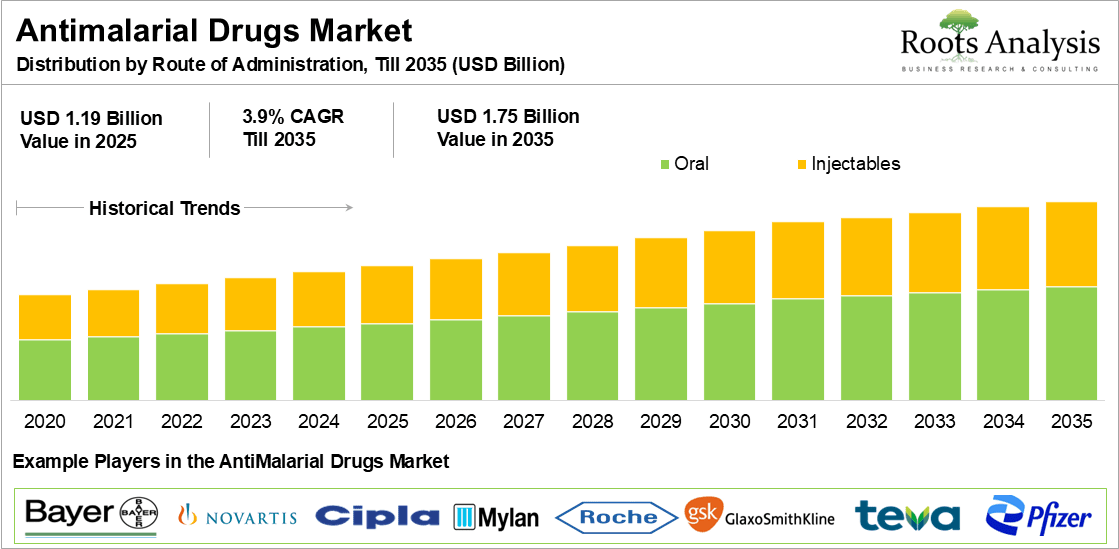
The global antimalarial drugs market size, valued at USD 1.13 billion in 2024, is projected to reach USD 1.19 billion in 2025 and USD 1.75 billion by 2035, representing a CAGR of 3.9% during the forecast period.
 |
See What’s in the Full Report - Request Your Complimentary Insights!
Antimalarial Drugs Market: In Summary
The escalating incidence of malaria cases globally highlights the critical need for antimalarial drugs. This strong demand is fueling market expansion and encouraging the development of next-generation drug formulations.
- Driven by the high demand, the antimalarial drugs market is highly competitive, and industrial players have a strong focus on innovation and collaboration to address drug resistance and develop advanced formulations.
- In terms of drug class, Antifolate compounds dominate the market with over 35% of the share, owing to their effectiveness in disrupting the parasite's life cycle. However, artemisinin compounds are anticipated to witness the highest CAGR in the future, as they form the backbone of artemisinin-based combination therapies (ACTs), the first-line treatment for P. falciparum malaria.
- Oral administration holds the largest revenue share at nearly 60%, primarily due to high patient preference and the increasing focus on developing pediatric-friendly oral formulations for infants. This segment is projected to continue growing at a higher CAGR.
- North America currently holds the largest market share (38%) due to robust research and development in advanced drug-resistant malaria solutions and the presence of key industry players. Meanwhile, the Asia-Pacific region is poised for the highest CAGR growth, driven by increasing government malaria control initiatives and public-private treatment partnerships.
- Future opportunities in the market are ample, particularly in the development of new drug classes with novel mechanisms of action, long-acting injectables, and pediatric-friendly formulations.
- The approval of Novartis' (Switzerland) Coartem® for newborns in July 2025 signifies a major milestone, highlighting the industry's commitment to addressing unmet needs.
- Strategic partnerships between industrial players, such as Novartis (Switzerland), GlaxoSmithKline (GSK) (UK), Pfizer (US), and Roche (Switzerland), and non-profit endeavors such as Medicines for Malaria Venture (MMV) are crucial in de-risking and accelerating innovation in this collaborative ecosystem.
Would Like to Preview the Actual Report?
Antimalarial Drugs Market Introduction
Given the rising concern of malaria, there is a surge in the demand for antimalarial drugs globally. Malaria is a disease caused by Plasmodium parasites transmission through the bite of female anopheles mosquito into the blood. These parasites multiple into the liver and start rupturing the blood cells, thereby causing chill cycles and severe anemia. Malaria can be fatal if the patient does not get treatment on time and may also lead to seizures, and coma condition.
According to the report of Medicines for Malaria Ventures, nearly 76% of the death reported due to the malaria were in children under 5 year old. Nearly, 94% of cases were reported in the African region. This rapid increase in the malaria incidence is underscoring the need for efficient therapeutic treatment. To date, several drug classes, such as quinoline-related compounds, artemisinin derivates, antifolates and antimalaria drugs has been developed by the industrial players. Despite of drug availability, there is limited, or no malaria treatment is available for infants, which further rises urgent demand for effect Antimalarial Drugs for young infant too.
Considering the significant treatment gap, several market players are taking initiatives to develop next-generation Antimalarial Drugs. For instance, in July 2025, Novartis announced that its Coartem® (artemether-lumefantrine) has been approved by Swissmedic for young infants. This is the first-ever malaria medicine to be approved for newborns. The approval of therapeutic drug has further caught the attention of industrial players for strategic initiatives, which is likely to maintain long term competitiveness in the antimalarial drugs market.
Antimalarial Drugs Market: Report Attributes
| Key Report Attribute | Details | |
| Historical Trend | Since 2020 | |
| Forecast Period | Till 2035 | |
| Market Size 2025 | USD 1.19 Billion | |
| Market Size 2035 | USD 1.75 Billion | |
| CAGR (Till 2035) | 3.9% | |
One of the key objectives of the antimalarial drugs market report was to estimate the current size, opportunity, and the market growth potential, over the forecast period, till 2035. We have provided informed estimates on the likely evolution of the market for the forecast period.
The global antimalarial drugs market analysis also features the likely distribution of the current and forecasted opportunity within the market across various segments, such as type of malaria, type of drug class, route of administration, mechanism of treatment, distribution channel, geographical regions, and leading players.
In order to account for future uncertainties associated with some of the key parameters and to add robustness to our model, we have provided three market forecast scenarios, namely conservative, base, and optimistic scenarios, representing different tracks of industry’s evolution.
Recent Developments in Antimalarial Drugs Market
Several recent developments in the field of antimalarial drugs industry have occurred, and we outlined some of these below.
- In May 2025, Health leaders from the African countries, specifically malaria-endemic region and global partners join forces to mitigate the growing concern of antimalarial drug resistance in African region.
- In April 2025, the University of Coimbra (Portugal), the Oswaldo Cruz Foundation (Brazil) and ICNAS Pharma (Portugal) signed a partnership to bring an anti-malaria drug into Portugal.
- In January 2025, the Calibr-Skaggs Institute for Innovative Medicines (US) announced that its long-acting preventative medicine for malaria has reached the first-in human study / Phase I clinical trial where this drug will be administered to the human volunteers.
- In January 2025, the researchers of National Institute of Health discovered a novel class of antibodies that can directly target the malaria parasites. This new invention can lead to the next generation of Antimalarial Drugs to prevent malaria.
Antimalarial Drugs Market Segmentation Insights
The market report provides comprehensive information on antimalarial drugs developers who are currently active across various segments of the industry as mentioned in the table below.
Antimalarial Drugs Market : Market Segmentation
| Market Segmentations | Details | |
| Type of Malaria |
|
|
| Type of Drug Class |
|
|
| Distribution by Route of Administration |
|
|
| Mechanism of Action |
|
|
| Distribution Channel |
|
|
| Geographical Regions |
|
|
| Market in North America |
|
|
| Market in Europe |
|
|
| Market in Asia-Pacific |
|
|
| Market in Middle East & Africa |
|
|
| Market in Latin America |
|
|
Industry Experts on Antimalarial Drugs Market
The antimalarial drug industry is constantly witnessing an upward trajectory as players are focusing on the development of resistance-free antimalarial drugs to mitigate the concern of drug resistance. A recent success in antimalarial drugs has been shared by the Karine Le Roche, (professor of molecular, cell and systems biology, University of California, Riverside).
“We’ve now shown mechanistically how RAP proteins regulate translation in an organelle that’s completely foreign to the human body.” “This evolutionary expansion suggests that RAP proteins may perform parasite-specific functions, making them exciting drug targets to treat malaria in the future”.
Antimalarial Drugs Market Share Insights
Market Share by Type of Malaria: Why Plasmodium Falciparum Segment Holds the Highest Share?
- The global market is segmented based on the type of malaria into Plasmodium Falciparum, Plasmodium Vivax, Plasmodium Malariae, and Plasmodium Ovale. According to the antimalarial drugs market report, the Plasmodium Falciparum segment holds nearly 45% of the market share. Plasmodium falciparum causes severe malaria to humans, and it can lead to brain damage. The WHO African region reported the increasing cases of malaria due to Plasmodium falciparum, which underscore the demand for antimalarial drugs.
- Notably, the Plasmodium falciparum segment will continue to gain momentum at a higher CAGR during the forecast period. This is driven by the fact that majority of the malaria cases globally has been reported by this species and is likely to rise the demand for drugs in the future to treat malaria.
Market Share by Type of Drug Class: How Antifolate Compounds are Holding Maximum Share of The Market?
- This segment highlights the distribution of global market across different types of drug class, such as antifolate compounds, artemisinin compounds, aryl aminoalcohol compounds, and others. Among these, antifolate compounds segment holds more than 35% of the antimalarial drugs market share. Antifolate compounds have shown high effectiveness in treating malaria. Drug compounds, such as sulfadoxine-pyrimethamine inhibit the folate synthesis which is crucial for the reproduction of malaria parasites. Thus, this drug causes disruption in life cycle of parasite, making it beneficial in malaria prevention and treatment.
- In the long tune, artemisinin compounds segment is likely to witness higher CAGR during the forecast period. These compounds are broadly used in artemisinin-based combination therapies (ACTs), which is known as first-line treatment for treating malaria caused by P. falciparum.
Have Questions? Let's Get Them Answered
Market Share by Route of Administration: Does Oral Segment Continue to Dominate the Market?
- Based on the route of administration, the global market is segmented into oral and injectables. According to the antimalarial drugs market forecast, the oral segment is holding nearly 60% of the overall revenue share. This is likely to be the result of high preferences for orally administered drugs for adults and newborn babies.
- It is important to highlight here that the oral segment will continue to grow at a higher CAGR in the future. This can be attributed to the fact that researchers are focusing on the development of pediatric antimalarial formulation for young infants so they can administer drug through oral route easily.
Market Share by Mechanism of Action: How Antimalarial Drugs are Effective in the Treatment of Malaria?
- This segment is further divided into modes of action, such as treatment of malaria, and prevention of malaria. According to the antimalarial drugs market analysis, the treatment of malaria segment is holding highest share of the market. This is primarily due to the growing focus effective therapeutic interventions against active infections to mitigate the concern of malaria.
- While treatment of malaria segment holds highest share, the prevention of malaria segment is likely to grow at a higher CAGR during the forecast period. The increasing burden of malaria has bolstered the requirement for preventative solutions of malaria.
Market Share by Distribution Channel: Why Hospital Pharmacy is the Primary Distributor of Antimalarial Drugs?
- The global market is categorized across different distribution channels, such as hospital pharmacy, e-commerce, retail pharmacy, and others. According to the antimalarial drugs industry analysis, the hospital pharmacy segment is dominating the market by holding 47% of the overall revenue share. This is potentially due to the fact that hospital pharmacy plays a crucial role in distributing novel antimalarial drugs. Moreover, the increasing patient pool in hospitals is likely to fuel the demand for antimalarial drugs.
- It is worth noting that the ability of healthcare professionals for malaria treatment has enhanced the dependency on hospital pharmacy for drug distribution. Owing to the increasing dependency, this segment will continue to grow at a higher CAGR in the future.
Market Share by Geographical Regions: Why is North America Holding the Maximum Share of the Market?
- Based on the geographical regions, the global market is distributed across North America, Europe, Asia-Pacific, Middle East & Africa, and Latin America. According to the malaria treatment drugs market, North America is dominating by occupying 38% of the market share. This can be attributed to the increasing research on advanced drug-resistant malaria solutions and presence of established market players, such as Pfizer (US), Merck (US), and Thermo Fisher Scientific (US) who are continually focusing on the development of drugs.
- In Asia-Pacific, the market for antimalarial drugs is expected to grow at a higher CAGR during the forecast period. This can be attributed to the increasing government malaria control initiatives and public-private treatment partnerships in malaria.
Antimalarial Drugs Market: Report Deliverables
| Report Deliverables | Details | |
| Excel Data Packs (Complimentary) |
Available | |
| Key Antimalarial Drugs Companies Profiled |
|
|
| PowerPoint Presentation (Complimentary) |
Available | |
| Customization Scope | 15% Free Customization | |
Antimalarial Drugs Market Major Takeaways
The “Antimalarial Drugs Market Report: Industry Trends and Global Forecasts, till 2035” market report features an extensive study of the current market landscape, market size, market share, market growth, market trends, market value, market forecast, market outlook, statistics, and future opportunities for antimalarial drugs industry players. The market research report lays emphasis on the antimalarial drugs that are being developed for malaria treatment. Key takeaways of the market report are briefly discussed below.
Market Competitive Landscape: Government and NGO Initiatives Driving Global Access to Antimalarial Medications
The increasing sub-Sharan African malaria burden has caught the attention of market players and government organizations, which makes this market highly competitive. The primary focus of industrial players is on the development of next-generation Antimalarial Drugs to treat adults and young infants. In order to meet global demand, several market players are expanding their partnerships and collaborations, which is expected to drive the market growth in the upcoming years. In addition to strategic partnerships between industrial players, the initiatives by government, regulatory agencies and NGO organizations are encouraging innovations in this field.
For instance, in April 2025, the WHO and partners campaign known as “Malaria Ends with Us”: reimaging, reinvest, reignite, seeking to combine efforts at all level to eliminate the malaria. As more market players and government organizations continue to accelerate the drug development, we believe that artemisinin-based combination therapies market / antimalarial drugs industry continue to grow at a higher rate in the future.
Market Drivers: What are the Main Drivers Behind Increased Antimalarial Drug Demand?
The antimalarial drugs market growth is propelled by several factors that are listed below:
Persistently High Global Burden of Malaria : How it Expand Malaria Drug Development Pipeline?
The significant rise in the prevalence of malaria, specifically Plasmodium falciparum and Plasmodium vivax is likely to surge the demand for malaria drugs to treat patients. According to the data published in Lancet.com, in 2025, nearly 1,04,000 death has been reported due to malaria in African region. In addition to adults, the young infants have been affected by the malaria in African region, which significantly increase the demand for advanced drug formulation for young infants and adults.
Regulatory Approval and Guidelines for Drug Formulation: How Do Regulatory or WHO Recommendations Affect Antimalarial Drug Trends?
Regulatory agencies, such as WHO, EMA in Europe, NAFDAC in Nigeria, SAHPRA in South Africa, are providing strategic guidelines to initiative the antimalarial drug development. For instance, the WHO has initiatives “Global Technical Strategy for Malaria” and “WHO Guidelines for Malaria” for the development of artemisinin-based combination therapies to target malaria caused by Plasmodium falciparum. However, their primary focus is on mitigating the risk of antimalarial drug resistance and the development of first line and second line malaria treatment.
Market Challenges: Are Drug-Resistant Malaria Strains Impacting Drug Development?
Despite immense demand, the global market is witnessing several challenges. Some of the notable challenges are mentioned below.
Rising Drug Resistance: How It Impacts Antimalarial Drug Resistance Trends?
It is worth noting that the continuous usage of malarial drugs, such as chloroquine, proguanil, sulfadoxine-pyrimethamine, and mefloquine has developed drug resistance, creating difficulty in treating patients. For instance, Plasmodium falciparum becomes resistant to the drug chloroquine. Resistance to chloroquine is primarily linked to mutations in the Plasmodium falciparum chloroquine resistance transporter (PfCRT) protein, located on the parasite's digestive vacuole membrane. This rising concern of antimicrobial drug resistance has necessitated the demand for advanced drug classes and combination therapies to treat patients with a new approach.
High Cost of Drugs: How Drug Cost Can Limit the Adoption of Antimalarial Drugs?
Notably, the antimalarial drugs specifically artemisinin-based combination therapies (ACTs), are significantly more expensive than other drugs, such as chloroquine, which are now largely ineffective due to resistance. This high cost of the therapeutic drugs may limit its adoption across low-to-middle income individuals. Hence, there are subsequent needs for cost-effectiveness analysis of new antimalarial treatment options to expand its availability for individuals with low income across the globe.
Market Trends : What Innovations or New Drug Classes are in The Pipeline for Malaria Treatment?
Several antimalarial drug resistance trends that are shaping industry growth are listed below.
Shift Towards Combination Drugs: What Innovations or New Drug Classes are in the Pipeline for Malaria Treatment?
With rising drug resistance in malarial parasites, antimalarial drugs market players are shifting from monotherapies to combination therapies. The recent breakthrough includes artemisinin-based combination therapies and the development of triple artemisinin-based combination therapies. These emerging drugs are currently being evaluated to mitigate the growing concern of drug resistance. However, the primary focus of industrial players will be on new drug classes with novel mechanisms of action that can inhibit the life cycle of malaria parasites.
Long-Acting Injectables and Pediatric Friendly Formulations
The market players are also focusing on the development of long-acting drugs and pediatric-friendly formulations to ensure better palatability and adherence among young infants. Recently, the Novartis (Switzerland) has developed Coartem® (artemether-lumefantrine), which is specifically designed for infants to treat malaria. This is a key milestone for the industrial players to address the growing concern of malaria among children.
In addition, In January, The Calibr-Skaggs Institute for Innovative Medicines (US) developed a long-lasting preventive drug against malaria (CBE161 (MMV371)) The trial is supported by Medicines for Malaria Venture (MMV), the primary product development partnership for malaria drug research. The increasing focus on pediatric friendly formulations and long-acting injectables are likely to offer investment opportunities in next-generation antimalarial therapeutics to the market players.
Antimalarial Drugs Market Size Analysis: Which Regions are Seeing the Highest Use of Antimalarial Drugs?
In 2025, the antimalarial drugs market is valued at USD 1.19 billion and is projected to reach USD 1.75 billion by 2035. This exponential growth is driven by the high prevalence of malaria across the globe that underscore the demand for next-generation drug formulations. In terms of region, African and Asian region are seeing as the highest user of antimalarial drugs. This is primarily attributed due to the increasing incidence of malaria in these regions.
Leading Antimalarial Drugs Manufacturers and Their Innovations
It is important to highlight here that research and development activities will remain a major cornerstone of this industry. Notably, the market players are focusing on strategic initiatives to discover and develop innovative antimalarial drugs and to enhance the efficacy of existing treatments. Some of the major drugs that has been developed or currently being investigated by the market players are listed below.
- Novartis (Switzerland): A leading manufacturer of therapeutic drugs, its flagship product is Coartem®, a combination therapy of artemether and lumefantrine.
- GlaxoSmithKline (GSK) (UK): Malarone, a combination of atovaquone and proguanil, and has achieved WHO prequalification for its single-dose anti-relapse drug Tafenoquine for P. vivax.
- Sanofi (France): Its portfolio includes Artesunate Winthrop, and Eurartesim.
- Pfizer (US): Maintains a presence with Chloroquine, a long-standing treatment for malaria.
- Cipla (India): A major supplier of generic antimalarial drugs, including artemether-lumefantrine and quinine sulfate.
Antimalarial Drugs Market Report Coverage
The market report presents an in-depth analysis, highlighting the capabilities of various stakeholders in the Antimalarial Drugs industry, across different geographies. Amongst other elements, the market report includes:
- An Infographic Executive Summary
- Regulatory Scenario
- Comprehensive Database of Leading Players
- Competitive Landscape
- Porter’s Five Forces Analysis
- Company Competitiveness Analysis
- Startup Ecosystem in the Antimalarial Drugs Market
- Company Profiles
- Patent Analysis
- Partnerships and Collaborations
- Grant Analysis
- Funding and Investment Analysis
- Clinical Trial Analysis
- Market Opportunity Analysis
- SWOT Analysis
Don't Pay for What You Don't Need. Individual Sections of the Report Are Available for Purchase Now.
Glossary
- ACTs (Artemisinin-based Combination Therapies): This is a gold standard therapy for treating uncomplicated Plasmodium falciparum malaria, combining an artemisinin derivative with a longer-acting partner drug to improve efficacy and reduce resistance development.
- Antifolate Compounds: A class of antimalarial drugs, such as sulfadoxine-pyrimethamine, that inhibit the synthesis of folate, a crucial component for malaria parasite growth.
- Artemisinin: A potent antimalarial compound isolated from the plant Artemisia annua, known for its rapid action against malaria parasites.
- Prophylaxis: The use of drugs to prevent malaria infection, typically taken by travelers to endemic areas or vulnerable populations in high-transmission settings
- MMV (Medicines for Malaria Venture): A leading product development partnership (PDP) in antimalarial drug R&D, focused on discovering, developing, and facilitating delivery of new, effective, and affordable antimalarial drugs.
From the Author’s Desk
Author’s View on Antimalarial Drugs Market
The global antimalarial drugs market is expected to show lucrative growth during the upcoming years. The increasing prevalence of malaria and growing initiatives by regulatory agencies along with an extensive list of pipeline candidates are the robust drivers of the market. Furthermore, the major pharmaceutical companies Novartis (Switzerland), Sanofi (France), GSK (UK), and Merck (US) demonstrate that antimalarial drug development functions as a highly collaborative ecosystem, often driven by product development partnerships (PDPs) and non-profit initiatives. The active engagement of industrial players shows their commitment to global health goals, making this market immensely competitive in the future.
Customization Opportunities
At Roots Analysis, we genuinely care about your success and understand that your business requirements are unique. While our market research reports provide valuable insights, we recognize that they might not cover every aspect you need to make well-informed strategic decisions. To account for that, we offer 15% free report customization tailored to your specific needs. Whether you require additional quantitative analysis, qualitative insights, or any other information related to the electric vehicles market, reach out to us today at support@rootsanalysis.com
Looking For a Deal Aligning with your Budget? Don't Miss Out on Our Promotional Campaigns!


