
Lowest Price Guaranteed
Pages
233
Last Updated
September 2026
View Count
3195
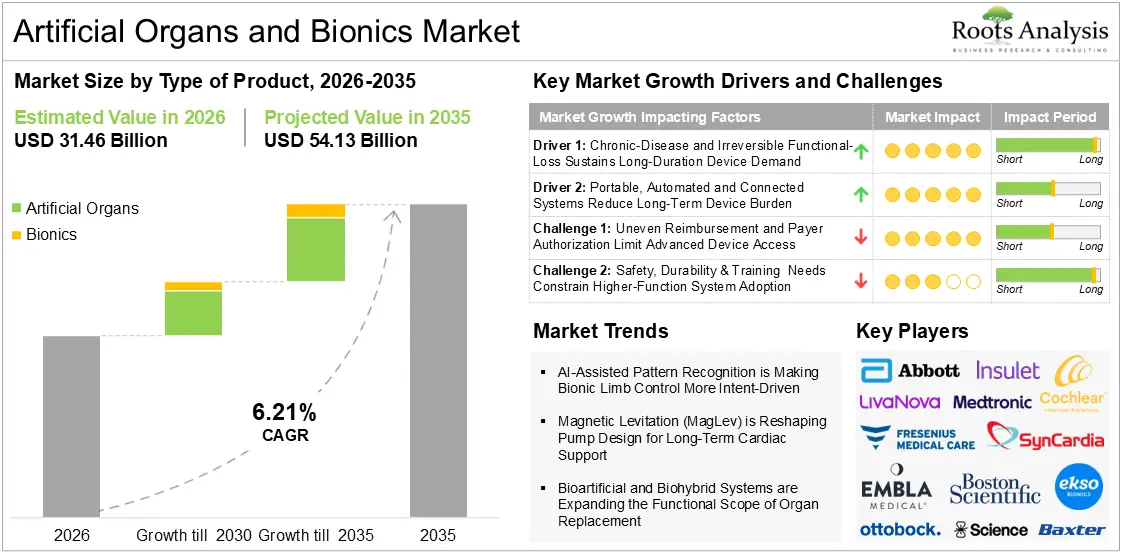
The global artificial organs and bionics market, valued at USD 29.40 billion in 2025, is estimated at USD 31.46 billion in 2026 and is projected to reach USD 54.13 billion by 2035, representing a CAGR of 6.21% during the forecast period 2026 to 2035. Growth is being supported by sustained demand for long-duration organ support and the wider use of automated, wearable and restorative systems across chronic and irreversible conditions.
To learn more about this report, request a free sample copy
Artificial organs and bionics comprise medical systems designed to replace, support or restore physiological, sensory and motor functions that have been impaired by organ failure, chronic disease or irreversible functional loss. The market spans established renal replacement and mechanical circulatory support systems, artificial pancreas technologies, cochlear implants, bionic limbs and medical exoskeletons, as well as newer retinal, neural and biohybrid platforms. These categories differ substantially in clinical maturity, treatment setting and frequency of use. Dialysis equipment and extracorporeal support systems operate within established care infrastructure, whereas implantable and wearable bionic systems depend more heavily on specialist assessment, device fitting, programming, rehabilitation and long-term patient management.
The market is evolving as replacement and support technologies become more adaptive and capable of restoring increasingly complex biological functions. Automated insulin delivery systems combine continuous sensing with algorithm-controlled insulin administration, myoelectric prostheses are incorporating pattern-recognition technologies to interpret muscle signals more intuitively, and advanced cardiac-support systems are using magnetically levitated pump architectures to reduce mechanical contact within the device. Research into bioartificial organs is extending this progression further by combining engineered filtration systems with living-cell components intended to reproduce functions that conventional mechanical devices cannot provide.
Over the coming years, the artificial organs and bionics market is expected to progress beyond conventional replacement and support systems toward technologies that provide more adaptive, continuous and restorative functions. Established renal, cardiac, metabolic and sensory systems will continue to form the commercial foundation of the market, while advances in sensing, control systems, implantable interfaces and biohybrid engineering gradually expand the range of functions that can be restored or supported. The next phase of market development is likely to be defined by technological advancements alongside the ability to translate increasingly advanced device capabilities into dependable long-term patient use.
The artificial organs and bionics market is organized around interconnected product, clinical and access networks rather than standalone device supply. Manufacturers such as Fresenius Medical Care and LivaNova support renal and cardiopulmonary treatment infrastructure through equipment, accessories and recurring disposables, while Insulet, Tandem Diabetes Care and Medtronic integrate wearable hardware with continuous glucose sensing and automated control. Cochlear combines implantable components with external processors and specialist programming, whereas Ottobock and Embla Medical depend on orthotics and prosthetics clinics, rehabilitation teams and fitting expertise to translate advanced limb technologies into sustained functional use. Emerging developers such as Science Corporation, Neuralink and biohybrid research groups rely more heavily on specialist clinical centers, evidence generation and regulatory progression before wider use can develop.
These relationships become more complex as technologies move towards continuous or restorative function. Hospitals, dialysis centers, mechanical-circulatory-support programs, cochlear-implant centers, endocrinology practices, orthotics and prosthetics (O&P) clinics and rehabilitation providers determine candidacy, implantation, fitting, programming, training and follow-up. Payers influence funded access through coverage and authorization requirements, while authorities including the FDA, EU medical-device system, MHRA, MHLW and PMDA, NMPA, TGA and Health Canada govern market entry, safety and post-market performance. Together, these stakeholders determine how effectively advanced artificial-organ and bionic technologies move from product availability into sustained clinical use.
The matrix below presents information on the type of product, technology, system placement, end user and geographic coverage of selected commercial suppliers and their in-scope platforms.
| Company | Product / Platform | Type of Product | Technology | SystemPlacement | End User | Geography Coverage |
| FreseniusMedical Care | 5008X™ / NxStage® renal replacementsystems | Artificial Kidney | Mechanical /ElectromechanicalSystems | Extracorporeal /External Systems | Specialty Clinics &Rehabilitation Centers,Home Care &Ambulatory Settings | North America and other global markets |
| Insulet | Omnipod® 5 automated insulindelivery | Artificial Pancreas | Electronic /BioelectronicSystems | Wearable /Body-worn Systems | Home Care &Ambulatory Settings | North America and Europe |
| Ottobock | bebionic Hand with Myo Plus pattern-recognition control | Orthopedic Bionics (Bionic Limbs) | Electronic /BioelectronicSystems | Wearable /Body-worn Systems | Specialty Clinics &Rehabilitation Centers,Home Care &Ambulatory Settings | Global Orthotics and Prosthetics Markets |
| ScienceCorporation | PRIMA retinalprosthesis | Vision Bionics | Electronic /BioelectronicSystems | ImplantableSystems | Hospitals & SurgicalCenters, Specialty Clinics& Rehabilitation Centers | Europe |
Upper-limb bionics are moving beyond fixed switching patterns towards control systems that interpret individualized muscle activity and automate part of the movement-selection process. Conventional myoelectric systems translated electrical activity from residual muscles into predefined device commands, but users still needed to switch repeatedly between grip patterns or learn specific activation sequences. Artificial intelligence enabled pattern-recognition systems are reducing this dependence on fixed command structures by analysing combinations of muscle signals and associating them with intended movements. Ottobock has incorporated this approach through Myo Plus and myosmart, where individualized muscle-activity patterns are used to support more responsive prosthetic control.
Recent research is extending this concept; for example, a Nature Communications study published in December 2025 highlighted improved grasping and reduced cognitive burden in transradial amputees using a modified commercial bionic hand that combined surface electromyography with autonomous sensing. Although the commercial availability of such advanced shared-control architecture remains limited, the competition is progressively shifting from mechanical sophistication alone towards the quality of the human-machine interface, particularly the ability of the prosthesis to interpret intention accurately while reducing the concentration and repeated control effort required from the user.
Mechanical circulatory support is placing greater emphasis on pump designs that minimize physical contact between moving components and blood. Abbott's commercially established HeartMate 3 left ventricular assist device uses Full MagLev technology to suspend its rotor, while BiVACOR's investigational total artificial heart uses a magnetically suspended dual-sided rotor without conventional mechanical bearings. Although these devices differ substantially in indication and maturity, both use magnetic suspension to reduce contact, mechanical wear and blood trauma within continuously operating pumps.
Magnetic suspension enables designers to reconsider how the rotor is stabilized and how blood moves through the pump, placing greater emphasis on hemocompatibility alongside reliable continuous operation. It does not remove the wider clinical risks associated with mechanical circulatory support, including bleeding, thrombosis, anticoagulation requirements and infection. However, the adoption of magnetic-levitation principles across both established ventricular-assist devices and next-generation artificial-heart programs shows how cardiac-bionics innovation is increasingly being directed towards systems capable of sustaining support for longer periods with fewer mechanical interfaces and improved blood-flow characteristics.
Artificial organ development is also moving towards systems that reproduce biological functions which conventional mechanical devices can only partially replace. Dialysis, for example, can perform essential filtration and fluid-management functions, but it does not recreate the complete cellular activity of a healthy kidney. Bioartificial and biohybrid approaches are being developed to narrow this functional gap by combining engineered membranes with living cells. In fact, the Kidney Project is developing an implantable bioartificial kidney that couples a silicon hemofilter with a renal-cell bioreactor, while the European KIDNEW program is advancing high-flux filtration technologies, kidney-tubule cell layers and integrated biohybrid filter and tubule units.
These programs indicate a broader shift in artificial-organ engineering from replacing a single mechanical function towards recreating a larger part of the organ's physiological role. Living-cell components may eventually provide transport, metabolic or regulatory functions that cannot be achieved through filtration hardware alone, while engineered membranes and compact device architectures could make such functions compatible with implantable systems.
Advances in artificial organs are also changing how established mechanical-support technologies are being evaluated within clinical care. Mechanical circulatory support has traditionally been closely associated with patients experiencing advanced heart failure or acute deterioration, but newer clinical programs are examining whether temporary support can be introduced earlier and in more planned settings for carefully selected high-risk patients. The IMPACT pilot, reported in May 2026, evaluated planned use of the Impella 5.5 in a high-risk, non-shock cardiac-surgery cohort before separation from cardiopulmonary bypass.
Edward Soltesz, MD, MPH, Surgical Director of the Kaufman Center for Heart Failure and Recovery at Cleveland Clinic and principal investigator of the study, stated, "These early positive findings support the feasibility of this approach and provide an important foundation for future studies."
The artificial organs and bionics market report includes transcripts of the following third-party discussions:
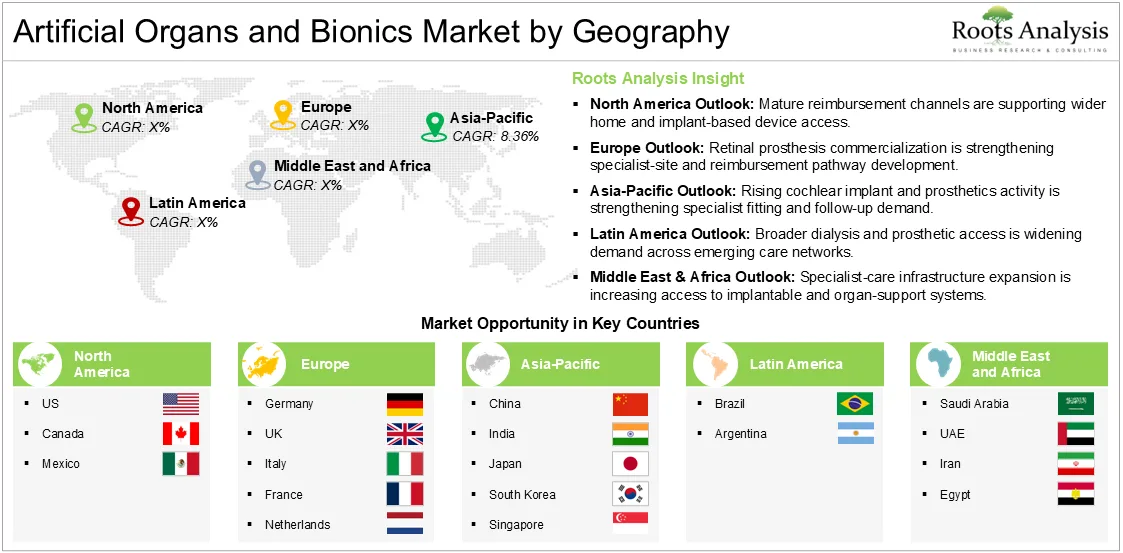
North America holds the largest share of 39.23% within the current global market, driven by the coexistence of mature treatment infrastructure and established access pathways across several of the market's largest commercial categories. Specialist implant programs, endocrinology networks, rehabilitation providers and home-care channels operate alongside comparatively developed reimbursement and referral mechanisms, allowing multiple artificial-organ and bionic technologies to sustain commercial use within the same healthcare system. Recent access developments illustrate this institutional depth; for example, Medtronic expanded Medicare access for MiniMed™ 780G configurations in 2026, while Cochlear made Nucleus Nexa available through US Veterans Affairs clinics nationwide. Such pathways reduce the time between regulatory availability and routine use by supporting patient identification, funding, clinical initiation and continued device management across established care networks.
Asia-Pacific is projected to record the fastest CAGR of 8.36% through 2035, driven by the rising relevance of hearing bionics and advanced prosthetics across the region as specialist implant, fitting and rehabilitation capabilities become available across a wider set of care settings. Cochlear's FY2026 reporting showed continued activity across Asia-Pacific, while Embla Medical reported robust prosthetics and neuro-orthotics volume growth across EMEA and Asia-Pacific during Q2 2026. These signals indicate that advanced-device use is developing beyond latent clinical need as implant, fitting and rehabilitation pathways become more active. Improving access to these capabilities, together with broader product availability, is supporting greater participation across regional markets, although reimbursement, regulatory requirements and affordability continue to vary materially between countries.
The market forecast and opportunity analysis of the artificial organs and bionics market has been distributed across the key segments outlined below.
| Market Segments | Sub-segment Details | |
| Type of Product | Artificial Organs (Heart, Kidney, Lung, Liver, Pancreas, Other Artificial Organs) and Bionics (Hearing / Ear, Orthopedic (Bionic Limbs and Medical Exoskeletons), Vision, Neural / Brain, Other Bionics) | |
| Technology | Mechanical / Electromechanical Systems, Electronic / Bioelectronic Systems, Bioartificial / Biohybrid Systems | |
| System Placement | Implantable Systems, Wearable / Body-worn Systems, Extracorporeal / External Systems | |
| End User | Hospitals & Surgical Centers, Specialty Clinics & Rehabilitation Centers, Home Care & Ambulatory Settings, Other Institutional End Users | |
| Geographical Regions | North America, Europe, Asia-Pacific, Latin America, Middle East and Africa | |
Artificial kidney products dominate the market, capturing close to 60% of the global market in the current year, supported by the scale and continuity of renal replacement therapy across established dialysis networks. Hemodialysis depends on repeated treatment over prolonged periods and requires a continuing base of machines, cartridges, circuits and related equipment. This recurring treatment model has created substantial installed infrastructure across both dialysis centers and home-care settings. Fresenius Medical Care, for instance, reported more than 15,300 patients using NxStage portable home hemodialysis in the US during 2025 and, by August 2026, had converted 227 US clinics to the 5008X platform, where more than 600,000 treatments had been delivered. The combination of treatment frequency, clinical capacity, and a large installed equipment base sustain the commercial scale of artificial kidney systems and their current market leadership.
Vision bionics, on the contrary, are projected to record the fastest CAGR through 2035, as retinal prostheses begin to move beyond clinical development into early commercial use. This transition is being led by PRIMA, where peer-reviewed clinical evidence demonstrated improvement in central visual function among patients with geographic atrophy, followed by Science Corporation's European commercial launch in July 2026 after CE marking, bringing a clinically evaluated retinal prosthesis into specialist treatment settings. Wider use will depend on the development of experienced implant centers, appropriate patient selection, post-implant visual rehabilitation and reimbursement pathways capable of supporting a high-complexity restorative device. Continued clinical evidence and experience across treated patients will also be important in defining the practical role of retinal prostheses within ophthalmic care.
Mechanical / electromechanical systems currently account for the largest share within the artificial organs and bionics market. Their leadership reflects the long-established role of pumps, filtration systems, oxygenation equipment and other mechanical support technologies in dialysis, cardiopulmonary bypass and circulatory support. These systems are embedded in specialist treatment pathways, have large installed bases and often generate recurring demand for disposable components. LivaNova's Essenz heart-lung platform and associated oxygenation and perfusion products represent this established technology model, where the equipment operates as part of a broader procedural system rather than as an isolated device.
Bioartificial / biohybrid systems are projected to grow at a higher CAGR during the period 2026-2035 as developers pursue functions that mechanical replacement alone cannot fully reproduce. These platforms combine engineered filtration or structural components with viable cells intended to provide selective transport, metabolic or regulatory activity. The Kidney Project is developing an implantable architecture that pairs a silicon hemofilter with a renal-cell bioreactor, while KIDNEW has reported progress in high-flux filtration, kidney-tubule cell monolayers, blood-compatible materials and integrated filter-tubule units. The remaining development challenge extends beyond demonstrating biological activity to maintaining cell function, material compatibility and device performance over the prolonged operating periods required of an implantable organ substitute.
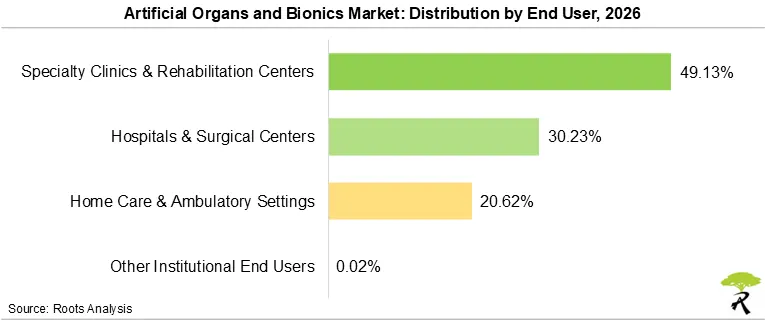
Specialty clinics and rehabilitation centers account for the largest end-user share at 49.13% in 2026. Many artificial-organ and bionic technologies require clinical involvement that extends well beyond initial device selection. Prosthetic limbs must be fitted, aligned and configured to the user, cochlear implants require activation and repeated programming, while medical exoskeletons depend on supervised training before functional use can extend beyond rehabilitation. Renal-support technologies similarly require specialist initiation and continued clinical oversight even when treatment subsequently moves into the home. This concentration of fitting, programming, training and follow-up expertise makes specialist settings an important point of access for technologies whose performance depends on continued interaction between the patient, device and care team.
Home care and ambulatory settings are projected to record the fastest CAGR through 2035. Automated insulin delivery, portable hemodialysis and personal mobility systems are allowing a larger proportion of routine device use to occur outside specialist facilities, supported by compact hardware, automated control and remote clinical oversight. This change also requires care pathways that can support training, maintenance and reimbursement beyond the clinic. Lifeward reported Medicare Advantage payment for ReWalk 7 in 2025 and a broader Aetna authorization pathway in 2026, illustrating how payer access is beginning to support qualifying personal exoskeleton use outside rehabilitation settings. Greater home-based use will therefore depend on the parallel development of device capability and the support systems required for patients to manage these technologies safely over extended periods.
Implanted brain-computer interfaces could create a new restorative use case for people with severe paralysis or amyotrophic lateral sclerosis who cannot reliably control digital devices through conventional motor interfaces. Implanted brain computer interfaces (BCI) address this gap by recording neural activity associated with intended movement and converting those signals directly into commands for computers or other assistive systems.
Human studies are testing this capability in defined patient populations. Neuralink's PRIME study is evaluating an implanted wireless interface in people with severe tetraparesis or tetraplegia, while Synchron's INTENT program is investigating digital-device control in people with ALS and upper-limb impairment. FDA guidance for implanted BCIs intended to restore motor or sensory capability also provides a dedicated development framework for this class of neuroprosthesis. Commercial participation remains prospective rather than established as invasive implantation, durable neural-signal capture, long-term device safety, decoding reliability and continued technical and clinical support must be demonstrated across larger and longer studies before these systems can support routine use. If those requirements are met, direct neural control could extend medical bionics into a distinct product territory centered on restoring digital autonomy for patients with otherwise limited motor-interface options.
The study examines commercial artificial-organ and bionic products that replace, support or restore physiological, sensory or motor function through implantable, wearable or extracorporeal systems. The analysis uses the proprietary Roots Analysis research framework, supported by proprietary databases repositories, company disclosures, regulatory publications, product information, industry literature and secondary sources. Market estimates and forecasts were triangulated against current commercial activity, clinical maturity, access conditions and technology development to establish market estimates and forecasts through 2035. For further details, see the complete research methodology adopted by Roots Analysis across its market reports.
| Key Report Attributes | Details | |
| Historical Trends | Since 2022 | |
| Forecast Period | Till 2035 | |
| Market Size 2026 | USD 31.46 Billion | |
| Market Size 2035 | USD 54.13 Billion | |
| CAGR (till 2035) | 6.21% | |
| Market Scope | The study commercial artificial-organ and bionic products supporting, replacing or restoring physiological, sensory and motor function across renal, cardiac, metabolic, hearing, vision and mobility applications, including implantable, wearable and extracorporeal systems. Associated clinical services revenue is excluded. | |
| Key Companies Profiled | Fresenius Medical Care, Johnson & Johnson MedTech, Abbott, LivaNova, Insulet, Boston Scientific, Medtronic, Cochlear, Embla Medical, Ottobock, Ekso Bionics, Science Corporation | |
| PowerPoint Presentation (Complimentary) | Available | |
| Customization Scope | 15% Free Customization Available | |
| Excel Data Packs (Complimentary) |
|
|