Market Outlook
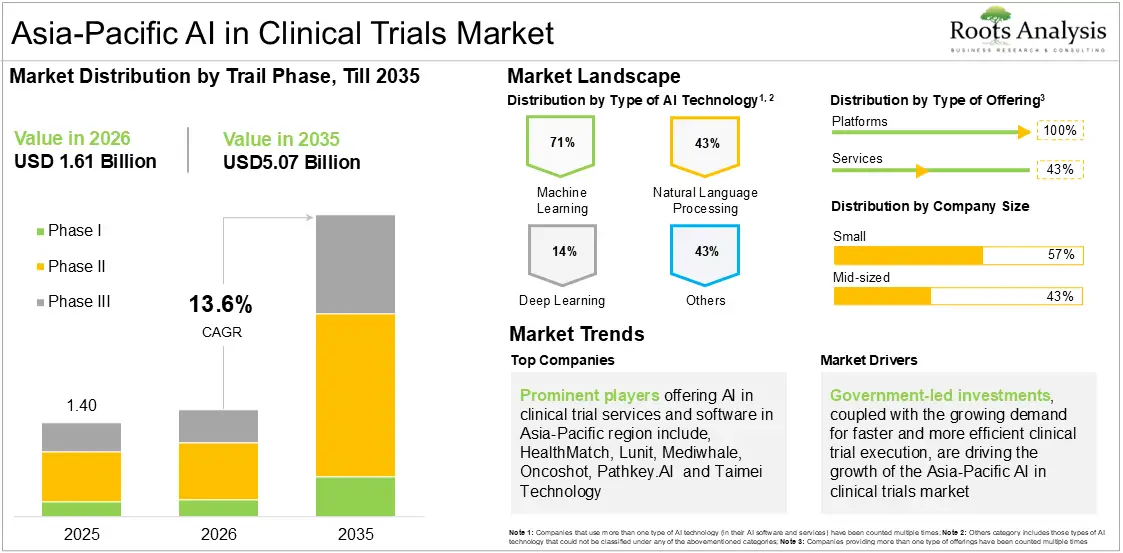
The Asia-Pacific AI in clinical trials market, valued at USD 1.40 billion in 2025, is projected to reach USD 1.61 billion in 2026 and USD 5.07 billion by 2035, with a CAGR of 13.6% during the forecast period, from 2026 to 2035.
To learn more about this report, request a free sample copy
Market Report: Key Takeaways
Market Size and Trends
- In terms of trial phase, phase II holds the largest share of the current market.
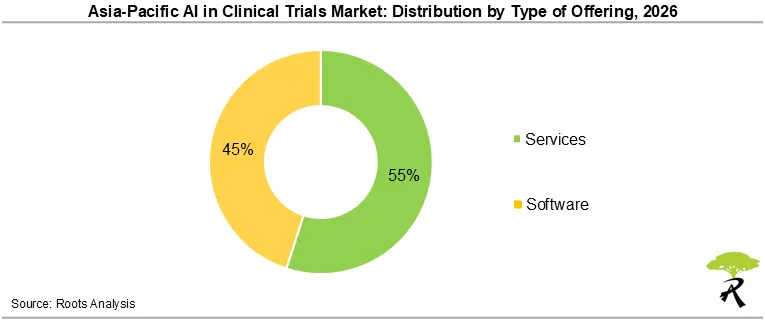
- With respect to type of offering, the services segment dominates (around 55%) the current market.
- Based on the deployment mode, cloud-based AI solutions capture the largest share of the current market, and the trend is unlikely to change in the future.
- In terms of therapeutic areas, oncological disorders are likely to hold the largest market share (more than 40%) in 2026.
- With respect to technology exposure, machine learning dominates (around 40%) the current market.
- Based on end-user, biotechnology and pharmaceutical companies capture the largest share of the current market, and the trend is unlikely to change in the future.
Key Market Statistics
- Market Size in 2026: $1.61 billion
- Estimated Market Size in 2035: $5.07 billion
- CAGR (Till 2035): 13.6%
Market Introduction
The integration of artificial intelligence in clinical trials represents a transformative shift in the pharmaceutical and biotechnology industries worldwide. By leveraging advanced algorithms to streamline processes, enhance data accuracy, and accelerate drug development timelines, AI is addressing longstanding challenges such as high costs, lengthy recruitment periods, and complex data management. This technological evolution is not only improving operational efficiency but also enabling more personalized and predictive approaches to clinical research, ultimately bringing innovative therapies to patients faster.
In the Asia-Pacific region, this momentum is amplified by a unique confluence of factors that position the market as both a leader and a high-growth powerhouse. With a large and diverse patient population, coupled with rapidly expanding digital infrastructure, countries across the region are increasingly adopting AI to optimize clinical trial operations. Notably, China has emerged as a leader, supported by government-backed AI initiatives and a surge in clinical trial activities, where AI tools are being deployed to analyze vast genomic datasets and improve patient stratification in oncology studies. For instance, in March 2025, AstraZeneca invested USD 2.5 billion in a new strategic R&D center in Beijing, supported by an AI and data science laboratory, designed to advance early-stage research and clinical development.
Favorable regulatory environments, substantial investments from pharmaceutical giants and a thriving technology ecosystem further propel the region's growth. In India, AI-powered platforms are enhancing patient recruitment in large-scale trials for chronic diseases like diabetes and cardiovascular conditions, capitalizing on the country's vast treatment-naïve population and cost-effective trial sites. Similarly, Japan and South Korea are pioneering the use of AI in real-time monitoring and predictive analytics, with examples including AI-assisted radiology systems that have demonstrably improved early cancer detection rates and trial outcomes.
AI Use Cases in Asia-Pacific Registered Clinical Trials
| AI Use Case |
Key Companies |
Representative AI Capability |
| Patient recruitment and trial matching |
Lind Asia, IQVIA, TrialX, Triomics |
EHR-based patient identification, AI trial matching, AI-simplified trial listings |
| Clinical data management and review |
Medidata, Saama, Clinion, MaxisIT |
AI-enabled data review, query management, EDC automation and clinical data analytics |
| Decentralized and hybrid trial operations |
Medable, Clinion, IQVIA |
eCOA, eConsent, remote participation workflows and decentralized trial deployment |
| Risk-based quality management and trial oversight |
MaxisIT, Saama, Medidata |
RBQM, operational analytics, risk dashboards and oversight systems |
| Protocol automation and study setup |
Clinion, Medable, Veeva |
AI-assisted protocol automation, study build and workflow setup |
| Oncology trial screening |
Triomics, Lind Asia, Vellitix |
Oncology-specific LLMs, AI trial matching and evidence-backed screening summaries |
As the Asia-Pacific AI in clinical trials market continues to evolve, it offers compelling opportunities for stakeholders seeking to navigate this dynamic landscape. Moreover, the ongoing technological advancements and strategic collaborations in the region are likely to play an increasingly pivotal role in shaping the future of the Asia-Pacific AI in clinical trials market.
Market Segmentation
Based on the research, we have segmented the Asia-Pacific AI in clinical trials market report into trial phase, type of offering, deployment mode, therapeutic area, technology exposure, end-user and countries.
By Trial Phase
- Phase I
- Phase II
- Phase III
By Type of Offering
By Deployment Mode
By Therapeutic Area
- Oncological Disorders
- Infectious Diseases
- CNS Disorders
- Metabolic Disorders
- Immunological Disorders
- Cardiovascular Disorders
- Other Disorders
By Technology Exposure
- Machine Learning
- Molecular Modeling and Simulation
- Deep Learning
- Omics Integration
- Generative Models
- Other Technologies
By End-user
- Biotechnology and Pharmaceutical Companies
- Academic Research Institutes
- Other End-users
By Countries
- China
- Japan
- South Korea
- Australia
- India
- Rest of Asia-Pacific
Key Market Insights
What Factors are Driving Increased Adoption of AI in Clinical Trials within Asia-Pacific?
- Large and Genetically Diverse Patient Populations: Asia-Pacific's genetically diverse populations create a strong need for AI-enabled patient stratification and trial design that account for ancestry-related differences in disease progression, biomarker expression and treatment response. For instance, Singapore's PRECISE-SG100K resource integrates genomic, clinical, imaging, lifestyle and phenotypic data from approximately 100,000 participants representing multiple Asian ancestries. Applying AI and machine-learning models to such multimodal datasets can help sponsors identify population-specific biomarkers, define more precise eligibility criteria and select trial sites with suitable patient subgroups.
- Expansion of Digital Health and Data Infrastructure: National digital-health programs are improving the availability and interoperability of healthcare data required for AI development. India's Ayushman Bharat Digital Mission is establishing an integrated digital-health infrastructure, while Australia's 2026-2036 National Health and Medical Research Strategy identifies national health-data assets and AI-enabled computational tools as important research capabilities. These initiatives can support AI-based cohort identification, real-world evidence generation and long-term patient follow-up, enabling more efficient and data-driven clinical trial execution.
What are the Main Challenges in Asia-Pacific AI in Clinical Trials Market Growth?
- Limited Model Transparency Restricts AI Adoption: Complex machine-learning and deep learning systems operate as "black boxes," making it difficult for investigators, regulators and patients to understand how an output was generated. This is particularly challenging when AI influences participant eligibility, endpoint assessment, safety monitoring or treatment-related decisions. The Asia-Pacific region has witnessed an increasing emphasis on traceability, detailed documentation, transparency and appropriate human oversight for high-risk AI applications, leading to stricter governance frameworks and extended implementation timelines for AI-enabled clinical trials.
- Uneven Digital Infrastructure and AI Implementation Capabilities: Digital health infrastructure remains uneven across the Asia-Pacific region. While countries such as Japan, Singapore and South Korea have established advanced digital healthcare ecosystems, many emerging economies continue to experience limitations in cloud infrastructure, interoperable health information systems and the availability of AI-skilled professionals. As a result, sponsors, contract research organizations (CROs) and healthcare providers face challenges in deploying AI solutions consistently across multicenter clinical trials, slowing market adoption and constraining operational efficiency.
Emerging Trends in Asia-Pacific AI in Clinical Trials Market
Cross-border CRO collaborations, policy-supported digitalization and healthcare-data interoperability are emerging as important trends in the Asia-Pacific AI in clinical trials market. In March 2026, South Korea-based Lunit expanded its strategic collaboration with Canada-based CRO CellCarta to integrate the Lunit SCOPE digital-pathology AI platform into biomarker development, immune-phenotyping, clinical-trial testing and companion-diagnostic workflows. In parallel, China's Healthy China 2030 framework and its 2023-2025 healthcare-information connectivity program have promoted integrated national and regional health-data platforms, while subsequent initiatives have emphasized unified data standards and interoperability protocols. These developments provide sponsors and CROs with more connected, standardized datasets, supporting scalable AI deployment across multicountry clinical trials.
Recent Developments in Asia-Pacific AI in Clinical Trials Market
- In June 2026, HistoIndex and D&D Pharmatech announced AI-based quantitative analysis of liver biopsy samples from the Phase 2 zabopegdutide MASH trial. HistoIndex used qFibrosis to provide objective fibrosis assessment for treatment response evaluation in clinical trials.
- In May 2026, PREMIA and Lind formed Lind Asia, a joint venture to expand AI-powered clinical trial screening across Taiwan, Japan, South Korea, Singapore and Australia. The platform analyzes EHR and molecular data to accelerate eligibility screening for multinational trials.
- In May 2026, Shanghai Noah AI Technology announced the development of AI Clinical Expert ahead of BIO Asia-Taiwan 2026 for protocol design, medical writing, protocol review, document management, translation and quality control. The platform targets end-to-end clinical research workflow automation for trial sponsors and sites.
Industry Experts on Asia-Pacific AI in Clinical Trials Market
Given the increasing investments in digital health infrastructure, AI innovation and advancements in clinical research capabilities, the Asia-Pacific AI in clinical trials market is poised for transformative growth over the coming years.
Bernhard Seiser (Vice President of Digital, Data and IT at AOP Health) stated that, "Safety cases were one of the most critical areas to address. We had a partially paper-based approach, and then also a more legacy system-driven setup. With the industry cloud, we now have an end-to-end case management solution in place, which helps a lot and strengthens process control, traceability, and compliance readiness."
Discussions with multiple stakeholders in this domain influenced the opinions and insights presented in this study. The market report includes transcripts of the following discussions:
- Co-founder, Chief Executive Officer and Chief Technology Officer, Small Company, Switzerland
- Founder and Chief Executive Officer, Mid-Sized Company, US
- Founder and Chief Executive Officer, Small Company, US
- Co-founder and Executive Director, Mid-Sized Company, US
- Chief Technology Officer, Chief Commercial Officer, Chief Delivery Officer, Head of Marketing, Mid-Sized Company, US
In addition, the market report includes transcripts of the following third-party discussions:
- Co-Founder and Chief Executive Officer, Mid-Sized Company, US; Chief Science Officer, Large Company, US; Chief Executive Officer, Mid-Sized Company, US; Associate Professor and Blue Cross California Distinguished Professor, Large Organization, US
- Co-Founder and Chief Executive Officer, Mid-Sized Company, US
- EVP, Chief Information, Technology, and Product Officer, Large Company, US
- Chief Technology Officer, Mid-Sized Company, US
- Director of the Office of Medical Policy (CDER), Large Organization, US
- Professor of Medicine, Large Organization, US; Program Manager, Large Organization, US; Director, Bioethics Lead, Large Company, US; Associate Dean, Human Research Protections and Director of the Human Research Protections Program, Large Organization, US; Executive IRB Chair and VP of IBC Affairs, Large Company, US
- Hematologist, AI Specialist, and Research Group Leader, Large Organization, Germany
- Cardiologist and Associate Director of the Accelerator for Clinical Transformation Research Group, Large Organization, US
- Heart Failure Cardiologist and Researcher, Large Organization, US
- Senior Community Development Manager, Mid-Sized Company, Netherlands
- EVP, Chief Information, Technology, and Product Officer, Large Company, US
Market Share Insights
Which Type of Offering Accounts for the Largest Market Share?
- Based on the Asia-Pacific AI in clinical trials market analysis, the services sub-segment is likely to occupy the highest (around 55%) market share in 2026. This dominance is primarily attributable to the region's fragmented regulatory environment, heterogeneous patient populations, and uneven digital infrastructure, which encourage sponsors to rely on specialized service providers for data integration, localized model validation, patient recruitment, site selection, regulatory compliance, and end-to-end AI implementation.
- The software sub-segment is likely to be the fastest growing segment in this industry, with an annualized growth rate (CAGR) of 10.5% during the forecast period. The growth in software adoption is increasing as sponsors and CROs seek scalable platforms that can be deployed across multiple studies with lower incremental costs. Cloud-based delivery, modular AI tools and enterprise licensing models are also enabling companies to internalize capabilities that were previously outsourced. For instance, in May 2026, China-based Taimei Technology partnered with South Korea's C&R Research to develop an AI-based clinical trial operations system and deploy AI agents across multiple trials for automated trial design, electronic data capture, eCRF generation, and data governance.
Which Therapeutic Area Accounts for the Largest Asia-Pacific AI in Clinical Trials Market Share?
- In 2026, oncological disorders are likely to capture the highest (>40%) market share. Further, this segment is likely to witness a significant growth rate during the forecast period. This dominance is primarily attributable to the high complexity of oncology trials, which creates strong demand for AI tools that can identify suitable patients, analyze multimodal datasets, and reduce time-intensive manual screening.
- Notably, IndiaAI and the National Cancer Grid's 2026 CATCH initiative are accelerating the validation and deployment of AI solutions in cancer care; one of its recognized projects, developed with Malabar Cancer Centre, uses an AI oncology agent for clinical-trial matching and evidence-based treatment support. Further, South Korea-based Lunit partnered with the US National Cancer Institute in March 2025 to advance AI-powered biomarker research, demonstrating the growing use of computational pathology to identify clinically relevant patient subgroups for precision-oncology research.
Based on the Technology Exposure, Which Segment is Likely to Capture the Largest Share of the Asia-Pacific AI in Clinical Trials Market?
- Currently, the machine learning sub-segment occupies a higher (around 40%) Asia-Pacific AI in clinical trials market share. This dominance is primarily attributable to the technology's operational maturity and its ability to analyze extensive historical patient, site and trial-performance datasets for established applications, including patient trial matching, site selection, enrollment forecasting and risk-based monitoring. For instance, in July 2025, India-based CRO Veeda Lifesciences partnered with Mango Sciences to deploy the Querent™ clinical intelligence platform for improving patient matching, trial design and study monitoring. The platform specifically uses machine-learning and natural-language-processing models to analyze free-text clinical notes, pathology reports, medication histories and radiology summaries.
- Generative models are likely to grow at a higher CAGR (16.1%) in the Asia-Pacific AI in clinical trials market during the forecast period. This is because of their ability to process large volumes of unstructured and multilingual clinical data, automate protocol and eCRF development, generate site and patient communications, summarize medical records and support faster patient trial matching. This growth is further supported by expanding multicountry trials and increasing demand from sponsors and CROs for scalable tools that reduce manual documentation, accelerate study setup and improve operational consistency across geographically diverse trial sites.
Scope of Asia-Pacific AI in Clinical Trials Market Report
| Key Report Attribute |
Details |
| Historical Trend |
Since 2022 |
| Forecast Period |
Till 2035 |
| Market Size 2026 |
USD 1.61 Billion |
| Market Size 2035 |
USD 5.07 Billion |
| CAGR (Till 2035) |
13.6% |
| Segments Covered |
- Trial Phase
- Type of Offering
- Deployment Mode
- Therapeutic Area
- Technology Exposure
- End-user
- Countries
|
| Key Players Profiled |
(A complete list of companies captured is available in the report) |
PowerPoint Presentation
Complimentary) |
Available |
| Customization Scope |
15% Free Customization |
Excel Data Packs
(Complimentary) |
Available |
Frequently Asked Questions
How does AI help in reducing clinical trial failures?
AI helps in reducing clinical trial failures by predicting risks early through data analysis. It optimizes patient selection and trial design using historical data and biomarkers, cutting issues like inefficacy and toxicity.Will AI speed up clinical trials?
AI has the potential to accelerate clinical trial processes by enhancing the efficiency of key trial activities and reducing overall development timelines.How big is the Asia-Pacific AI in clinical trials market?
The market opportunity is substantial, with significant growth and wide reach. The market size is projected to reach USD 5.07 billion by 2035. What is the Asia-Pacific AI in clinical trials market growth?
The market is likely to grow at an annual rate of 13.6% from 2026 to 2035.Who are the key AI in clinical trial companies?
HealthMatch, Lunit, Oncoshot, Pathkey.AI, and Taimei Technology.