


 Download Free Sample
 Buy Now
Market Outlook
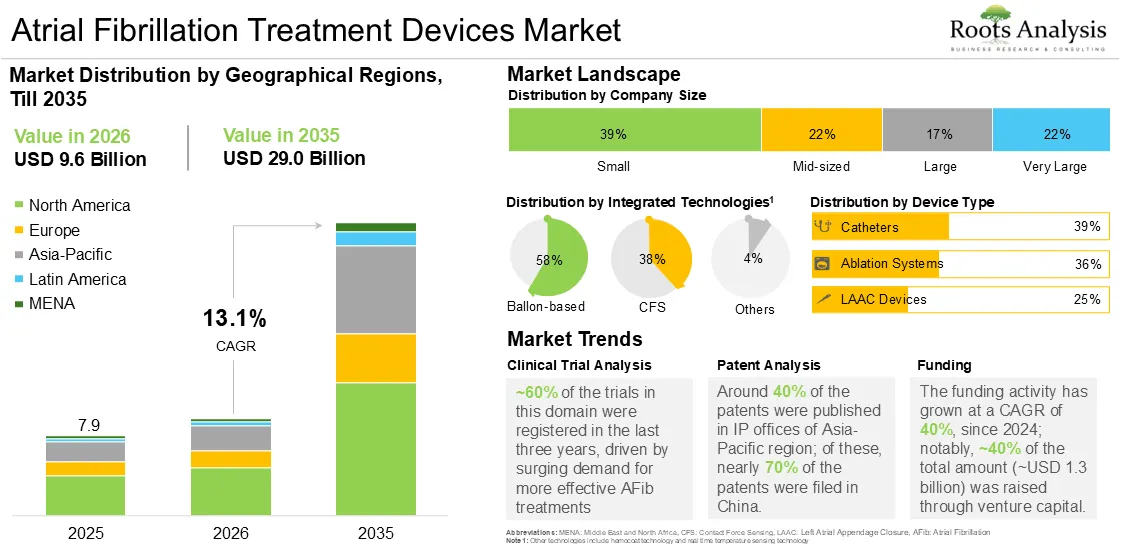
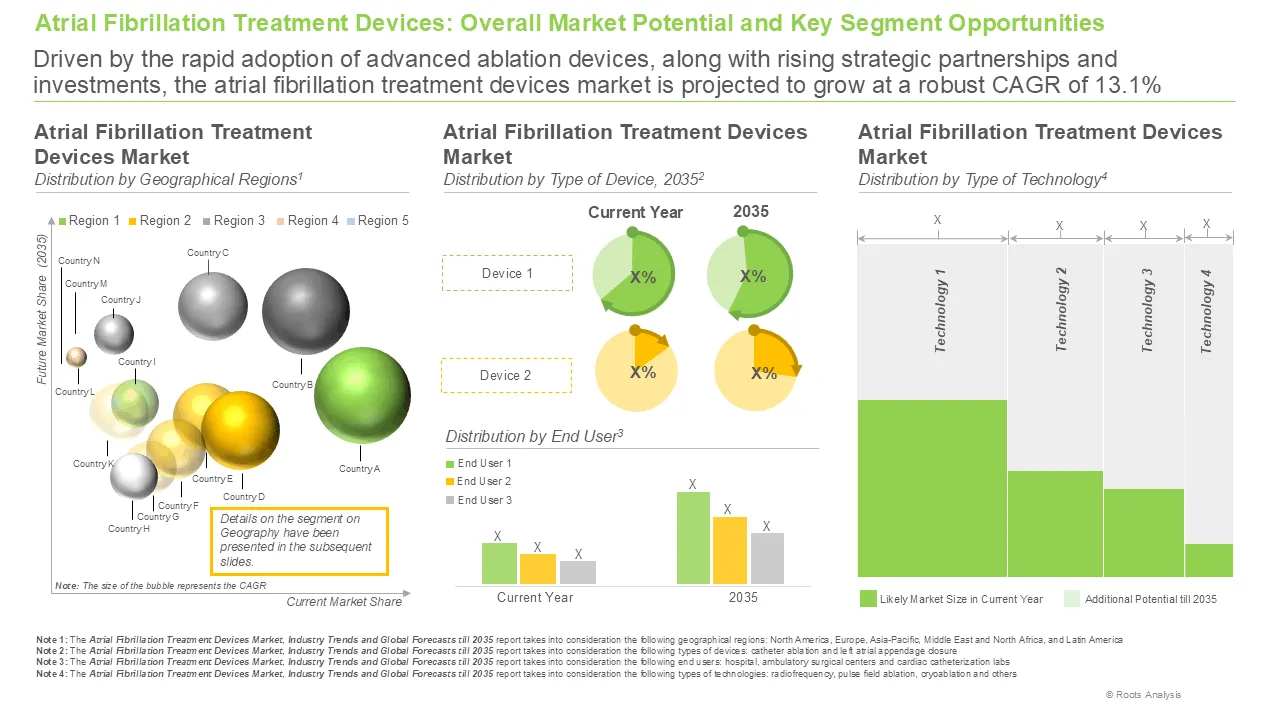
The global atrial fibrillation treatment devices market, valued at USD 7.9 billion in 2025, is projected to reach USD 9.6 billion in 2026 and USD 29.0 billion by 2035, representing a CAGR of 13.1% during the forecast period 2026 to 2035.
See What’s in the Full Report – Request Your Complimentary Insights!
Market Report: Key Takeaways
Market Size & Trends
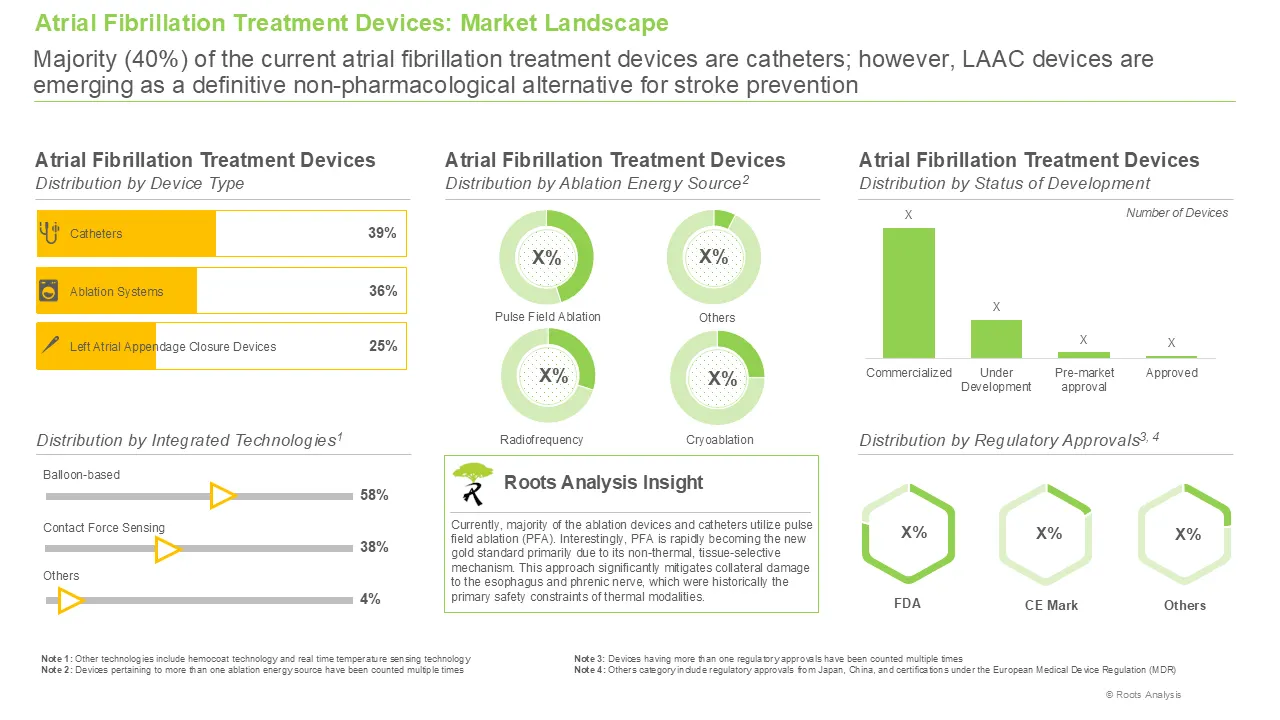
- In terms of type of device, ablation catheter holds the highest share (nearly 75%) of the current market.
- With respect to the type of technology, pulse field ablation dominates (nearly 50%) the current market.
- Based on the end user, hospitals capture the largest share (over 80%) of the current market; this trend is unlikely to change in the future.
- In terms of geographical regions, North America currently holds the highest atrial fibrillation treatment devices market share (nearly 50%).
Key Market Statistics
- Market Size in 2026: $9.6 Billion
- Estimated Market Size in 2035: $29.0 Billion
- CAGR (2026-2035): 13.1%
- North America: Largest market in 2026
- Asia-Pacific: Fastest growing region
Market Introduction
Over the years, technological advancements have transformed the management of cardiac arrhythmia. One such critical area is the development of advanced atrial fibrillation (AF) treatment devices, which offer substantial improvement in patient outcomes while overcoming various limitations associated with traditional pharmacological interventions, such as long-term anticoagulation and its associated bleeding risks.
Atrial fibrillation currently affects tens of millions of individuals worldwide, with global prevalence estimates exceeding 50 million cases. Driven by the aging populations and growing prevalence of hypertension, obesity, diabetes, and unhealthy lifestyles, the escalating burden has made AF devices a cornerstone of disease management. These devices play a vital role in rhythm control, stroke prevention, and comprehensive patient care.
In response to the above-mentioned factors, researchers and industry leaders have introduced numerous innovative solutions, including advanced ablation technologies, advanced mapping systems, and left atrial appendage closure (LAAC) devices. Several of these have already received regulatory approval from bodies such as the FDA, reflecting rapid progress towards safer, more precise, and minimally invasive treatment options with shorter procedure times and improved safety profiles.
The manufacturing and deployment of these devices demand highly controlled environments, specialized materials, precision engineering, and rigorous regulatory compliance to ensure biocompatibility, durability, and clinical efficacy. In order to ensure a competitive edge in this domain, players are prioritizing greater device flexibility, automation, user-friendly interfaces, and integration with digital health platforms to reduce human error and procedural variability. As a result, it is becoming increasingly important for developers to invest in innovative, scalable technologies. Such advancements are likely to assist companies in delivering higher-quality, cost-effective solutions while expanding access to effective AF treatment globally.
Market Segmentation
Based on research, we have segmented the atrial fibrillation treatment devices market into type of device, type of technology, end user, and geographical regions.
By Type of Device
- Catheter Ablation
- Left Atrial Appendage Closure Devices
By Type of Technology
- Cryoablation
- Pulse Field Ablation
- Radiofrequency
- Others
By End User
- Ambulatory Surgical Centers
- Cardiac Catheterization Labs
- Hospitals
By Geographical Regions
- North America
- US
- Canada
- Europe
- Germany
- UK
- France
- Italy
- Spain
- Rest of Europe
- Asia-Pacific
- China
- Japan
- India
- South Korea
- Rest of Asia-Pacific
- Middle East and North Africa
- Saudi Arabia
- Egypt
- Israel
- Rest of the Middle East and North Africa
- Latin America
- Brazil
- Mexico
- Argentina
- Rest of Latin America
Your Business is Unique – Why Shouldn’t Your Report Be?
Top Companies and Key Technologies in Atrial Fibrillation Treatment Devices Market
The atrial fibrillation treatment devices market landscape is highly competitive and dynamic, driven by the rapid innovation in this domain.
| Company | Year of Establishment | Headquarters | Device Name | Type of Technology | Approval Status | Key Features |
| Abbott | 1888 | US | Volt | Pulsed Field Ablation (PFA) | Approved (FDA) | Balloon-in-basket design with integrated mapping capability |
| AtriCure | 2000 | US | AtriClip | Surgical Left Atrial Appendage Exclusion | Approved (FDA) | Minimally invasive surgical approach which is compatible with hybrid procedures |
| Boston Scientific | 1979 | US | FARAPULSE / FARAPOINT | Pulsed Field Ablation (PFA) | Approved (FDA) | Non-thermal tissue-selective ablation |
| Boston Scientific | 1979 | US | WATCHMAN FLX / FLX Pro | Left Atrial Appendage Closure (LAAC) | Approved (FDA) | Polymer-coated frame for reduced thrombus risk with enhanced visualization markers |
| Johnson & Johnson (Biosense Webster) | 1886 | US | Varipulse | Pulsed Field Ablation (PFA) | Approved (FDA) | Integrated with CARTO 3D mapping system, Precise lesion creation with real-time guidance |
| Medtronic | 1949 | US | PulseSelect / Affera Sphere-9 | Pulsed Field Ablation (PFA) | Approved (FDA) | Circular loop catheter with integrated mapping ablation |
Atrial Fibrillation Treatment Devices Market Key Insights
What are the Key Drivers for Atrial Fibrillation Treatment Devices Market Growth?
- Rising Atrial Fibrillation Prevalence in Geriatric Population: The global surge in atrial fibrillation among the aging population is driving demand for advanced treatments. Notably, older patients are more susceptible to risk of strokes and heart failures, with atrial fibrillation rising from 6.4% at ages 65-69 to 28.5% at age 85 and above. This necessitates advanced rhythm management solutions like catheter ablation, wearable medical devices, and novel anticoagulants. While antiarrhythmic drugs remain first-line treatment, catheter ablation is increasingly adopted, reducing arrhythmia recurrence by 38% and hospitalizations by 68% as compared to the drugs. Moreover, ablation is now recommended for patients when drugs fail, particularly those with heart failure, offering improved quality of life and better survival. This escalating patient burden strains healthcare systems worldwide and is fueling robust atrial fibrillation market growth, driven by rising incidence rates and technological advancements in cardiac care.
- Adoption of Minimally Invasive Stroke Prevention Devices: There is a growing clinical preference for Left Atrial Appendage Occlusion (LAAO) devices (such as Amplatzer Amulet by Abbott and Watchman FLX/FLX Pro by Boston Scientific) over long-term treatment with warfarin or DOACs. This shift is particularly notable for patients who are at a high risk of bleeding. Improved reimbursement policies and safety records, and next-generation innovations are accelerating the move towards interventional stroke prevention. Notably, Conformal Medical’s CLAAS® AcuFORM™ LAAO device, a foam-based, anatomy-conforming implant recently enrolled its first EU patient in the CONFORM Pivotal Trial, promising simplified same-day procedures under conscious sedation. Additionally, W.L. Gore's 2026 acquisition of Conformal Medical expands structural heart portfolios, signaling strong industry confidence in LAAO's future.
What are the Main Challenges for Market Growth?
- Complexity of Comorbidity Management: The high prevalence of comorbidities among atrial fibrillation populations complicates the selection between pharmacological and procedural interventions. Moreover, increased bleeding risks reduce the efficacy of anticoagulation therapies following left atrial appendage closure. Such clinical complexities necessitate innovative approaches to reduce the risk of therapeutic failure.
- Long-Term Efficacy of Novel Devices: The inconsistent long-term efficacy of novel procedural interventions remains a significant clinical concern. Additionally, demonstrating consistent efficacy relative to established anticoagulants is essential to address concerns regarding recurrence rates. Therefore, the absence of sustained data presents a substantial barrier to shifting preferences from pharmacological baselines.
Recent Developments in Atrial Fibrillation Treatment Devices Market
- In April 2026, Johnson & Johnson initiated the PERSIGMA head-to-head trial to compare the investigational VARIPULSE Pro's safety and effectiveness against other pulsed field ablation systems.
- In April 2026, Medtronic presented new clinical data at a conference showing 65.5% freedom from ventricular tachycardia (VT) recurrence at six months using the Affera system with Sphere-9 catheter for ablation.
- In January 2026, Abbott received CE Mark for the TactiFlex Duo Ablation Catheter, which allows both radiofrequency and pulsed field ablation for treating atrial fibrillation. Notably, the firm has also completed initial commercial cases in the EU.
Industry Experts on Atrial Fibrillation Treatment Devices Market
The market for atrial fibrillation treatment devices has a transformative future and is likely to remain progressive in the future.
Christopher Piorkowski (Chief Medical Officer, Abbott), stated that, “In Europe, where pulsed field ablation (PFA) devices is already commercially available, many physicians are transitioning from cryoablation to PFA due to its faster pulmonary vein isolation times. With significant waiting lists, hospitals and physicians seek tools that enhance procedural efficiency and enable faster patient treatment. The situation with radiofrequency (RF) ablation differs. RF remains valuable for targeting lesions beyond the pulmonary veins. While future shifts are hard to predict precisely, we expect both energy modalities to coexist. For instance, PFA has been associated with coronary artery spasms in certain anatomies; near coronary arteries, RF may be preferred for its safety profile. In regions without such proximity, PFA offers clear advantages. Ultimately, optimal outcomes will depend on selecting the right energy source for each clinical scenario.”
Discussions with multiple stakeholders in this domain influenced the opinions and insights presented in this study. The market report includes transcripts of the following third-party discussions:
- Cardiologist, Very Large Organization, US
- Senior Vice President and President, Cardiac Rhythm Management & Diagnostics, Very Large Organization, US
- Chief Medical Officer, Very Large Organization, US
- Chief of Cardiac Surgery and Co-Director, Very Large Organization, US
- President, and Vice President of Preclinical and Clinical Research & Medical Affairs, Very Large Organization, New Zealand
- Co-Founder and Chief Executive Officer, Small Company, Switzerland
Pay Only for What You Need – The Best Way to Optimize
Market Share Insights
Which Type of Device Accounts for the Largest Share in the Atrial Fibrillation Treatment Devices Market?
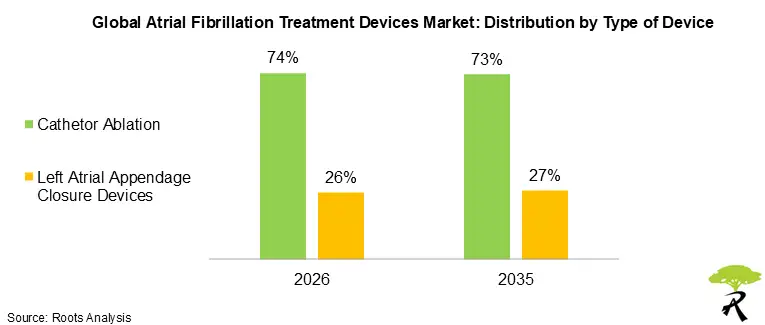
- In 2026, the ablation catheter segment occupies the highest market share (around 75%), owing to its minimally invasive nature, which offers superior safety, precision, and patient comfort compared to open or surgical methods. This dominance is further supported by the procedure's clinical benefits, including shorter recovery times, reduced hospital stays, and a lower risk of complications.
- The left atrial appendage closure (LAAC) segment is likely to grow at a higher CAGR (13.4%) during the forecast period. This trend stems from the increasing stroke risk from clots in the left atrial appendage, boosting LAAC demand as a targeted prevention tool.
Amongst Radiofrequency, Pulse Field Ablation, Cryoablation, and Others, Which Segment Holds the Highest Atrial Fibrillation Treatment Devices Market Share?
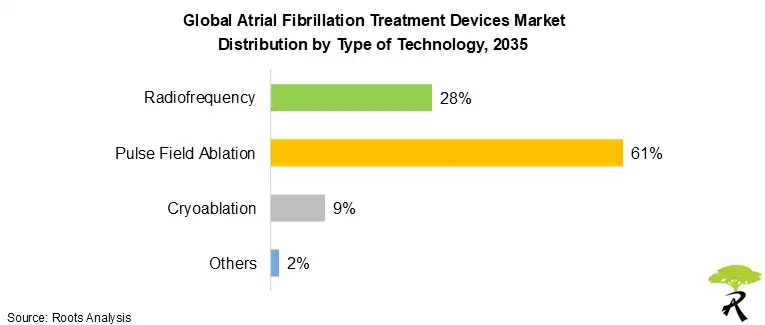
- In 2035, the pulse field ablation segment is likely to occupy a higher share (with >60% share) in the market. Further, this segment is likely to witness a significant growth rate during the forecast period.
- This is primarily due to its superior safety and tissue-selective mechanism enable pulsed field ablation to selectively target myocardial tissue while minimizing collateral damage to surrounding structures, such as the esophagus and phrenic nerve, which reduces the risk of complications compared with traditional thermal ablation modalities.
Regional Analysis: Which Regions are Showing the Fastest Growth in Atrial Fibrillation Treatment Devices Industry?
North America: Dominating the Market by Securing Highest Share
According to our projections, North America is likely to capture majority (~50%) of the atrial fibrillation treatment devices market share in 2026. This can be attributed to the region's high prevalence of atrial fibrillation, driven by an aging population and rising rate of associated risk factors, such as obesity, hypertension, and diabetes. Additionally, this region benefits from advanced healthcare infrastructure, substantial investments in medical technology, and the presence of leading device manufacturers, which accelerate the adoption of innovative treatments like ablation catheters and pulsed field ablation systems. Favorable reimbursement policies and a high volume of electrophysiology procedures further solidify its position in this domain.
Asia-Pacific: An Emerging Growth Spot
In Asia-Pacific, the market is likely to grow at a higher CAGR during the forecast period. This growth is propelled by the expanded cardiac care facilities and medical tourism in countries like China, India and Japan, and increasing healthcare expenditures alongside government initiatives to enhance access to advanced treatments. Moreover, technological advancements, such as minimally invasive procedures, further accelerate adoption by improving efficacy and reducing recovery times.
Pay Only for What You Need – The Best Way to Optimize
Scope of Atrial Fibrillation Treatment Devices Market Report
| Key Report Attribute | Details | |
| Historical Trend | Since 2023 | |
| Forecast Period | Till 2035 | |
| Market Size 2026 | $ 9.6 Billion | |
| Market Size 2035 | $ 29.0 Billion | |
| CAGR (Till 2035) | 13.1% | |
| Segments Covered |
|
|
| Key Players |
|
|
| PowerPoint Presentation (Complimentary) |
Available | |
| Customization Scope | 15% Free Customization | |
| Excel Data Packs (Complimentary) |
Available | |


