


 Download Free Sample
 Buy Now
Biodegradable Devices for IBD Market Overview
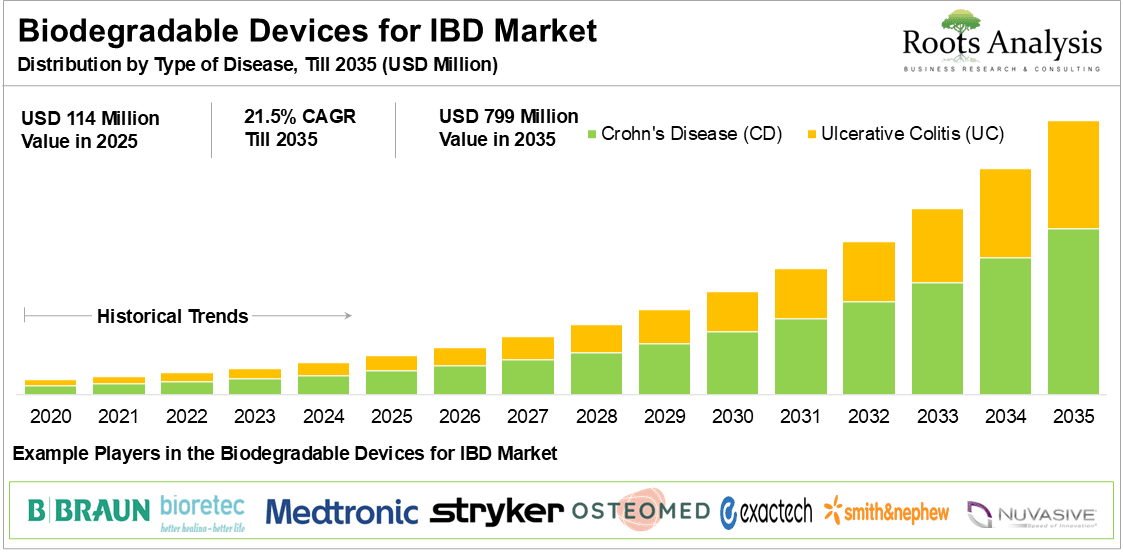
The global biodegradable devices for IBD market size, valued at USD 94 million in 2024, is projected to reach USD 114 million in 2025 and USD 799 million by 2035, representing a CAGR of 21.5% during the forecast period.
 |
Biodegradable Devices for IBD Market: In Summary
- The global market for biodegradable devices for inflammatory bowel disease (IBD) is experiencing a significant growth, driven by the rising concern of inflammatory bowel diseases globally and side effects associated with conventionally available drugs.
- Market players are greatly emphasizing the development of targeted drug delivery devices with higher biocompatibility, biodegradability, and efficacy in targeting diseases.
- Technological innovations will remain the center focus for the market players, such as smart ingestible pills, 3D printing and nanotechnology. Moreover, industrial players are aiming to develop smart biomaterials which helps to deliver drug in controlled manner.
- In terms of technology, the 3D printing segment is dominating the market driven by its increasing usage for design customized biodegradable stents and smart implants for IBD. However, the biohybrid / robotics segment is likely to witness a higher CAGR in the future.
- In terms of material, the polylactic acid (PLA) segment is accounting for the highest share of the market, driven by its increasing usage for the development of drug delivery systems.
- North America is currently dominating the market by securing nearly 60% of the overall revenue share. This highest share is due to the increasing research on the inflammatory bowel disease and devices for disease management.
- Market players, such as Medtronic (Ireland), B. Braun (Germany) and Conmed (US) are aiming for technological innovations.
- The future scope of this industry will be leveraging AI tools, personalized medicine, and smart implants / smart ingestible pills.
Biodegradable Devices for IBD Market Introduction
The global market for biodegradable devices for inflammatory bowel disease (IBD) is undergoing a transformative shift to meet the unmet clinical need. It is worth mentioning that the inflammatory bowel disease is a form of chronic inflammatory condition which affect gastrointestinal tract and leads to several complications. Notably, the most common inflammatory bowel diseases that are affecting global population are Crohn’s disease and ulcerative colitis.
While therapeutic treatment is available to manage this chronic inflammatory conditions, several limitations are still persisting, such as loss of response, non-responsive drugs, and side effects. These limitations are necessitating the demand for advance drug delivery devices that aims to deliver drugs at inflammation site for effective drug release. Biodegradable devices emerged as a promising solution to address the critical unmet need by allowing targeted drug release. These devices ensure prevention of premature drug clearance, reduce side effects and promote mucosal healing.
Unlock Deeper Insights – Schedule Your Personalized Workshop Today!
It is worth noting that several researchers are currently conducting clinical studies on biodegradable devices, smart ingestible pills, biosensors and smart technology that helps to proactive disease management with real-time data monitoring. In addition, the market players are focusing on biodegradable material innovations, leveraging 3D printing and nanotechnology to create a synergistic ecosystem where monitoring, diagnosing and treatment can be done continually. The ongoing clinical need and expanding research reflects a promising future of the biodegradable devise for IBD market.
Biodegradable Devices for IBD Market: Report Attributes
| Key Report Attribute | Details |
| Historical Trend | Since 2020 |
| Forecast Period | Till 2035 |
| Market Size 2025 | USD 114 Million |
| Market Size 2035 | USD 799 Million |
| CAGR (Till 2035) | 21.5% |
One of the key objectives of the biodegradable device for IBD market report was to estimate the current size, opportunity, and the market growth potential, over the forecast period, till 2035. We have provided informed estimates on the likely evolution of the market for the forecast period.
The global biodegradable device for IBD market analysis also features the likely distribution of the current and forecasted opportunity within the market across various segments, such as type of product, type of technology, type of disease, type of material, application area, end user, geographical regions, and leading players.
In order to account for future uncertainties associated with some of the key parameters and to add robustness to our model, we have provided three market forecast scenarios, namely conservative, base, and optimistic scenarios, representing different tracks of industry's evolution.
Recent Developments in Biodegradable Devices for IBD Market
Several recent developments in the field of biodegradable devices for IBD industry have occurred, and we have outlined some of these below:
- In July 2025, a team of researchers have published study on the ingestible colorimetric ingestible pills known as pill for reactive oxygen species-responsive inflammation monitoring. This newly developed ingestible biosensor pill is designed to detect intestinal inflammation by measuring the reactive oxygen species, such as hydrogen peroxide. It is a non-invasive and patient-friendly device which will be used for monitoring inflammatory bowel disease.
- In March 2025, Bionics Institute Chief Technology Officer, Prof James Fallon highlighted their researchers journey to find treatment for Crohn’s disease at the second Bionics Institute Preview Event. Prof. Fallon also updated about collaborators, institute supporters and broad members on the progress of research on vague nerve stimulation device to treat Crohn’s disease and epilepsy.
- In June 2025, a protein based nanoparticle drug delivery systems (PNP-DDSs) shows promising outcome for the treatment of inflammatory bowel disease (IBD) by addressing several limitations of conventional therapies.
Would Like to Preview the Actual Report?
Biodegradable Devices for IBD Market Segmentation Insights
The market report presents an in-depth analysis of biodegradable devices for IBD providers who are currently active across various segments of the industry as mentioned below:
Biodegradable Devices for IBD Market: Market Segmentation
| Market Segmentation | Details |
| Type of Product |
|
| Type of Technology |
|
| Type of Disease |
|
| Type of Material |
|
| Application Area |
|
| End User |
|
| Geographical Regions |
|
| Market In North America |
|
| Market In Europe |
|
| Market in Asia-Pacific |
|
| Market in Middle East & Africa |
|
| Market in Latin America |
|
Industry Experts on Biodegradable Devices for IBD Market
Meanwhile, massive progress have been made to understand the inflammatory bowel disease and treatments. There is still scope of innovation to prevent disease, early intervention, and treatment to improve quality of life of patients with IBD.
During the IBD Innovate 2025 conference, Dr Andres Hurtado-Lorenzo (the Foundation’s Senior Vice President of Translational Research & IBD Ventures) stated that, “IBD Innovate unites leaders from science, medicine, and industry, alongside patients and advocates, to foster partnerships and convert knowledge to accelerate the development of next generation therapies and devices that improve the lives of people living with IBD”.
Market Share by Type of Product: Do Drug Delivery Systems Holds a Promising Future in the Market?
- Based on the type of product, the global market is segmented into drug delivery systems, biodegradable stents, sutures / staples, surgical meshes, implants & patches, anti-adhesive, tissue barriers, wound dressings, scaffolds, and others. According to our projection, the drug delivery systems segment is dominating the biodegradable devices for IBD market. This can be attributed to the growing demand for advanced drug delivery devices that can cross gastrointestinal physiological barriers for targeted drug delivery.
- In the long run, biodegradable stents segment is likely to show lucrative growth at the highest CAGR. The heightened demand for biodegradable stents for IBD management is likely to be a key factor for robust growth of this segment in the future.
Market Share by Type of Technology: How Does 3D printing is Benefitting the Biodegradable Device Development?
- The global market is differentiated across different type of technology, such as 3D Printing, nanotechnology, biohybrid / robotics, and capsule endoscopy for IBD diagnosis and therapy. According to the biodegradable devices for IBD market report, the 3D printing segment is dominating the market, driven by its ability to print customize implants for treating inflammatory bowel disease.
- It is worth noting that the biohybrid / robotics segment is likely to bolster at a higher CAGR in the future. Notably, the biohybrid / robotics is an emerging trend in the industry. Currently, several researches are undergoing on micro robotic pills which has shown promising outcomes of IBD treatment in animal models.
Market Share by Type of Disease: Do Crohn’s Disease Segment Hold the Highest Share in the Future?
- The global market is categorized across different type of disease, such as Crohn’s disease, and ulcerative colitis. According to the biodegradable devices for IBD market forecast, the Crohn’s disease segment is accounting for more than 60% of the market share. This dominance stems from the increasing prevalence of Crohn’s disease and surge in the demand for minimally invasive procedures to treat patient to address the complications associated with disease, such as fistulas and strictures.
- In the long run, the ulcerative colitis segment is likely to grow at the fastest CAGR during the forecast period. There is a significant research initiatives are currently being undertaking to develop treatment for ulcerative colitis. This ongoing research and rise in the surge of ulcerative colitis is key a factor for lucrative share of this segment.
Have Questions? Let's Get Them Answered
Market Share by Type of Material: Which Biodegradable Polymers for IBD Therapy Will Dominate the Market?
- This segment highlights the distribution of global market across different type of material, such as polylactic acid (PLA), polyglycolic acid (PGA), polycaprolactone (PCL), polyhydroxyalkanoates (PHA), and others. According to our analysis, the polylactic acid (PLA) segment is dominating the market. Notably, the polyglycolic acid material is widely used in drug delivery systems to its high biocompatibility and stability.
- Owing to its widespread adoption for clinical use, polyglycolic acid is likely to remain dominant and grow at a higher CAGR during the forecast period.
Market Share by Application Area: Which Application Area Hold the Highest Share of the Market?
- The global market is sub-segmented based on application area into inflammatory bowel disease (IBD) treatment & management, drug delivery for IBD, and other applications. According to the biodegradable devices for IBD market forecast, the inflammatory bowel disease (IBD) treatment & management segment is dominating the market, driven by the rising prevalence of disease.
- It is important to note here that this segment will continue to dominate in the future and is expected to grow at a higher CAGR. This lucrative growth is due to the promising outcomes of biodegradable devices for IBD in clinical studies and high demand for targeted drug delivery solutions to manage disease.
Market Share by End User: Will Clinics and Research Dominate in the Future?
- Based on the end user, the global market is segmented into hospitals, ambulatory surgical centers, clinics and research and academic institutes. According to the biodegradable IBD devices industry analysis, the hospitals segment is dominating the market by holding largest biodegradable devices for IBD market share. This is potentially due to the increasing adoption of sustained-release biodegradable IBD systems for treating wide pool of IBD patients in hospitals.
- It is worth noting that the ambulatory surgical centers segment is likely to grow at the fastest CAGR in the future. The patient safety benefits from using biodegradable materials in IBD surgical interventions is likely to increase the demand of these materials for ambulatory surgical centers.
Regional Dynamics: Which Region is Expected to Dominate the Market?
- The global market is distributed into North America, Europe, Asia-Pacific, Middle East & Africa, and Latin America. According to our projection, the North America is dominating the market, accounting for the highest share (nearly 60%) of the biodegradable devices for IBD market growth. This highest share stems from the rising prevalence of inflammatory bowel disease, healthcare infrastructure advancements and significant research on biodegradable devices to treat patients.
- The Asia-Pacific region is likely to show robust growth, anticipating registering higher CAGR in the future. Several factors, such as rising concern of IBD and increasing expenditure on healthcare infrastructure to treat patients with a personalized approach.
Biodegradable Devices for IBD Market: Report Deliverables
| Report Deliverables | Details |
| Excel Data Packs (Complimentary) |
|
| Key Biodegradable Devices for IBD Companies Profiled |
(A complete list of companies captured is available in the report) |
| PowerPoint Presentation (Complimentary) | Available |
| Customization Scope | 15% Free Customization |
Biodegradable Devices for IBD Market Key Takeaways
The "Biodegradable Devices for IBD Market Report: Industry Trends and Global Forecasts, till 2035" market report features an extensive study of the current market landscape, and future opportunities for market players. The market research report lays emphasis on the biodegradable devices for IBD that are being developed to treat patients. Key takeaways of the market report are briefly discussed below.
Market Competitive Landscape: What Factors are Making Biodegradable Devices for IBD Market Competitive?
The global biodegradable devices for IBD industry is moderately competitive, featuring the presence of small, mid-sized and large companies. In order to leverage the competitive edge, several market players are undertaking strategic initiatives to advance materials and technologies, such as biodegradable polymers for IBD therapy. Moreover, the market players are also expanding partnerships and collaborations, which is expected to maintain a long-term competitiveness in the industry.
Market Size Analysis: What will be the Biodegradable Devices for IBD Market Size in 2035?
The global market for biodegradable devices for IBD is poised to reach USD 799 million by 2035. This lucrative growth stems from the positive clinical outcomes of implantable biodegradable devices in Crohn's disease management. According to the study published in ScienceDirect, biodegradable microspheres and nanoparticles have shown promising outcomes in delivering therapeutic drugs, such as budesonide and dexamethasone in preclinical studies, leads to reduce gut inflammation that occur due to inflammatory bowel disease and enhance tissue healing in animal models. These promising results in clinical studies, indicating that the industry is progressing and growing rapidly.
Get an Instant Quote in 10 Minutes. Lowest Price Guaranteed
Market Drivers: What Factors are Driving Biodegradable Devices for IBD Market Growth?
Notably, the IBD diseases, such as ulcerative colitis and Crohn’s disease require target specific therapeutics and medical device or disease management. The increasing prevalence of gastrointestinal diseases is likely to propel the demand for biodegradable devices for IBD management. Some other potential interconnected factors of market growth are listed below:
Demand for Minimal Invasive Devices for Disease Treatment
Inflammatory bowel disease is a debilitating disease. It is characterized by remission and period of flare-ups. The traditional approach have to pass through entire digestive systems, and some patients may require IBD-related surgeries, such as colectomies for implementing drug releasing implants and removal implants. The invasive nature and requirement of second surgeries has necessitated the demand for minimal invasive biodegradable devices. These devices eliminate the requirement of second surgery because it get dissolved into the body after some time, thereby creating a massive demand for disease management.
Expanding Research on Advanced Materials and Device Designs
Market players are continually focusing on biomaterials innovation to develop more reliable, efficient and customizable biodegradable devices for IBD. Additionally, emerging technologies, such as 3D printing, help in designing customized bioabsorbable implants for inflammatory bowel disease. It is worth noting that the industrial players are also focusing on nanoparticles for biodegradable devices that enable controlled drug release and enhance mechanical strength. These key innovations are likely to expand the market in the future.
Market Challenges: What Barriers Limit Scale-Up Manufacturing Biodegradable IBD Devices?
The market witness several barriers to commercializing biodegradable IBD medical devices in healthcare systems. Some of the potential challenges are listed below:
Targeted Drug Delivery and Efficacy
Inflammatory bowel disease is characterized by inflammation in the gastrointestinal tract. The prolong inflammation can cause pH variation in the gastrointestinal tract. Additionally, the multiple physiological barriers of the gastrointestinal tract further create difficulty in release drug at targeted sites through medical devices. Therefore, biodegradable devices must be engineered to overcome these obstacles and allow for effective drug penetration and absorption.
Complex Regulatory Pathways for Biodegradable Drug Delivery Systems Targeting Inflammatory Bowel Disease
Biodegradable devices require clinical validation to demonstrate safety and efficacy to treat inflammatory bowel disease. Given by the complex of IBD and requirement of long term monitoring, regulatory authorities have stringent guidelines, which may create challenges for the market players. Moreover, meeting regulatory standards require clinical validation documents which is an extensive and expensive process. These complexities associated with regulatory approval are significant barriers for the market players.
Market Trends: What are the Future Biodegradable Devices for IBD Market Trends?
Shift Towards Smart Biodegradable Devices for IBD Monitoring
One of the significant trend to be noticed in the market is shift towards smart implantable biodegradable drug delivery systems. These smart implants ensure non-invasive monitoring and provide real-time data about physiological changes for disease management. Moreover, the market players are aiming to develop smart ingestible pills to deliver therapeutics to inflamed colonic tissues. These smart devices also help to detect inflammation biomarkers by using engineered bacteria that enable healthcare personnel to manage disease proactively.
Personalized Biomarker-Guided Therapy for Mucosal Healing
Owing to the ongoing concern of inflammatory bowel disease, the market players are emphasizing shifting from one-size-fit-all approach to personalized medicine. This approach will involve biomarker guided therapy to heal mucosal wall damage that occur due to inflammation. The personalized medicine approach will also include multi-omics data analysis for biomarker discovery to guide therapy optimization for maximum efficiency of treatment.
Biodegradable Devices for IBD Market Report Coverage
The market report presents an in-depth analysis, highlighting the capabilities of various stakeholders in the biodegradable devices for IBD industry, across different geographies. Amongst other elements, the market report includes:
- An Infographic Executive Summary
- Regulatory Scenario
- Comprehensive Database of Leading Players
- Competitive Landscape
- Company Competitiveness Analysis
- Startup Ecosystem in the Biodegradable Devices for IBD Market
- Company Profiles
- Porter’s Five Forces Analysis
- Patent Analysis
- Partnerships and Collaborations
- Grant Analysis
- Funding and Investment Analysis
- Clinical Trial Analysis
- Market Forecast and Opportunity Analysis
- Adjacent Market Analysis
- Key Winning Strategies
- SWOT Analysis
Glossary
- Biocompatibility: This refers to the ability of a material to perform with an appropriate host response in a specific application. It means the material does not cause harmful or undesirable reactions in the body.
- Biodegradable Devices: Medical devices manufactured from materials designed to degrade or dissolve safely and independently within the body over a specific period after serving their functional purpose, eliminating the need for surgical removal.
- Biomarkers: Measurable indicators of a biological state or condition. In IBD, biomarkers can indicate inflammation, disease activity, or treatment response (e.g., C-reactive protein, fecal calprotectin).
- Biosensor: It is form of sensor device that detects, records, and transmits information regarding a biological change or process. In case of inflammatory bowel disease, these biosensors can monitor inflammatory markers.
From the Author’s Desk
Author’s View on Biodegradable Devices for IBD Market
The global biodegradable devices for IBD market is witnessing a robust growth trajectory and the market will continue to grow in the future. Some notable drivers, such as demand for minimally invasive procedures, and multi-disciplinary innovations to treat patients with inflammatory bowel diseases are propelling the market in the future. Experts in gastroenterology, biomaterials science, and the medical device industry largely concur that these devices represent a significant paradigm shift in IBD management. The current scenario reflects increasing research and clinical trials by market players and research organizations on next-generation biodegradable devices with integrated biosensors. However, the future, The focus will increasingly be on creating personalized, integrated solutions that combine diagnostics, targeted therapeutics, and long-term monitoring, ultimately enhancing the quality of life for IBD patients.
Customization Opportunities
At Roots Analysis, we genuinely care about your success and understand that your business requirements are unique. While our market research reports provide valuable insights, we recognize that they might not cover every aspect you need to make well-informed strategic decisions. To account for that, we offer 15% free report customization tailored to your specific needs. Whether you require additional quantitative analysis, qualitative insights, or any other information related to the electric vehicles market, reach out to us today at support@rootsanalysis.com


