
Lowest Price Guaranteed
Pages
224
Last Updated
July 2026
View Count
20054
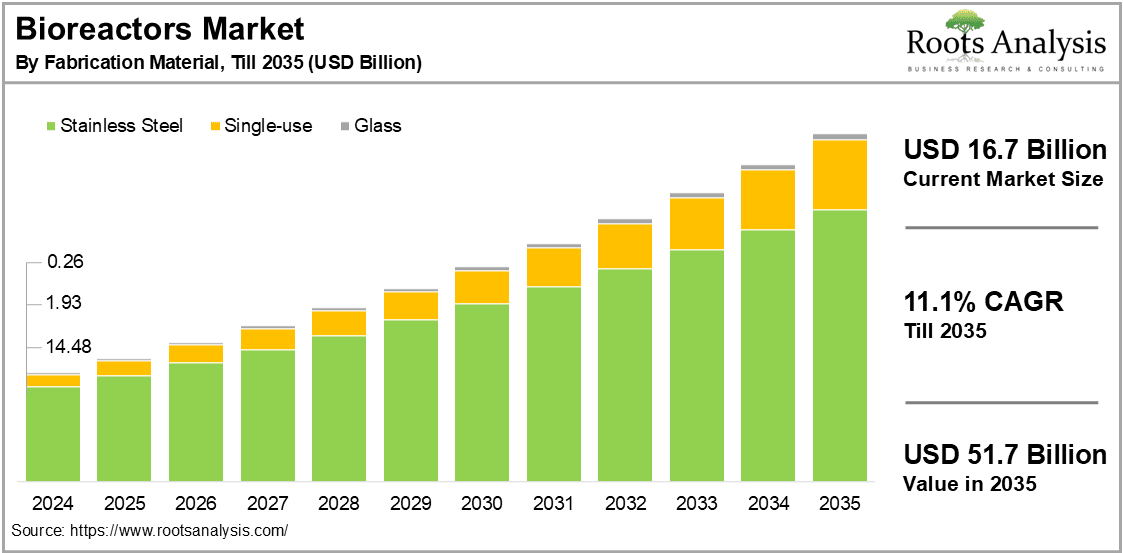
The bioreactors market size is estimated to grow from $16.7 billion currently to $51.7 billion by 2035, representing a CAGR of 11.1% during the forecast period, till 2035.
 |
Bioreactors are specialized vessels used in upstream biomanufacturing to cultivate cells (microorganisms, plant and animal cells), and tissues, under controlled conditions. They are designed to provide the ideal growth environment with ambient temperature, pH, pressure, aeration and nutrients to the live cells or cellular components for converting the substrates into various types of biological products. These biological products can range from therapeutic proteins such as vaccines, fusion proteins, antibodies, hormones, interleukins and enzymes to several advanced medicinal products (ATMPs), namely cell-based and oligonucleotide-based therapies, retroviral vectors for gene therapy and in vitro models of 2D and 3D tissue constructs, mimicking the natural physiological state for drug discovery purposes. Typically, the stainless steel bioreactors are cylindrical in shape, the size of bioreactors can vary, ranging from milliliters to several liters, depending on the design and mode of operation across different types of bioprocesses.
The global expansion of biopharmaceutical products has led to significant growth in the bioprocessing supplies market. Over the past two decades, this market has consistently grown at an annual rate of between 12 and 14%.
With companies either establishing their own biopharmaceutical manufacturing facilities or outsourcing production to biologics contract manufacturing organizations (CDMOs / CMOs), the demand for clinical and commercial-scale bioreactors has surged considerably. In fact, our research suggests that the current bioreactors capacity, including the captive and outsourced capacity, amounts to over 13 million liters, globally.
Given the immense demand, the bioreactors market has grown to be competitive market with a large number of active companies possessing the expertise to design, engineer and manufacture diverse types of bioreactors (in term of design and mechanism of action) for varying applications. Some examples of their offerings include stainless steel bioreactors, disposable / single use bioreactors, stirred-tank bioreactors, small scale bioreactors, air lift bioreactors, perfusion bioreactors, bubble column bioreactors, and photobioreactors.
The market research report presents an in-depth analysis of the various companies that are engaged in the bioreactors industry, across different segments, as defined in the table below:
| Key Report Attribute | Details | |
| Historical Trend | Since 2018 | |
| Forecast Period | 10+ Years | |
| Future Trend | Till 2035 | |
| Current Market Size | $ 16.7 Billion | |
| CAGR | 11.1% | |
| Fabrication Material |
|
|
| Type of Bioprocess |
|
|
| Type of Biologic |
|
|
| Key Geographical Regions |
|
|
| Key Companies Profiled |
|
|
| Customization Scope |
15% Free Customization Option (equivalent to 5 analysts working days) |
|
| Excel Data Packs (Complimentary) |
|
|
One of the key objectives of this market report was to estimate the current market size, opportunity and the future growth potential for bioreactor manufacturers, over the forecast period. Based on multiple parameters, likely adoption trends and through primary validations, we have provided an informed estimate on the market evolution during the forecast period, till 2035.
The market report also features the likely distribution of the current and forecasted opportunity within the bioreactors market across various segments, such as fabrication material (stainless steel bioreactors, single use bioreactors and glass bioreactors), type of bioprocess (batch and fed-batch, and continuous), type of biologic (antibodies, vaccines cell therapies and other biologics), and key geographical regions (North America, Europe, Asia-Pacific, and Rest of the World).
In order to account for future uncertainties and to add robustness to our model, we have provided three market forecast scenarios, namely conservative, base and optimistic scenarios, representing different tracks of the industry’s growth.
The opinions and insights presented in the bioreactors market report were influenced by discussions held with stakeholders in the industry. The report features detailed transcripts of interviews held with the following industry stakeholders:
All actual figures have been sourced and analyzed from publicly available information forums and primary research discussions. Financial figures mentioned in this report are in USD, unless otherwise specified.
Based on the fabrication material, the global bioreactor market is categorized into stainless steel bioreactors, single use bioreactors and glass bioreactors. The stainless steel bioreactors segment occupies the highest share in 2024. Further, the single use / disposable bioreactors segment is anticipated to show the highest market growth potential during the forecast period. This surge in the market is attributed to the increasing demand for emerging biologic modalities such as cell and gene therapy products as well as antibody drug conjugate, which require more flexible and smaller-scale production solutions. Single use / disposable bioreactors offer quick turnaround times, scalability, flexibility, and reduced risk of cross-contamination, making them ideal for multiproduct facilities in bioprocessing. Recently, ABEC introduced its 4000-L and 6000-L disposable bioreactors, and Thermo Fisher unveiled its 5000-L disposable bioreactor, addressing unmet market needs for high volume single use bioreactors which can deliver performance comparable to that of stainless steel bioreactors.
Based on type of bioprocess, the bioreactors market is categorized into batch and fed-batch, and continuous. The batch and fed-batch bioreactors segment currently occupies the highest market share and this trend is expected to remain same during the forecast period. Further, the continuous bioreactors segment is projected to grow at a relatively higher growth rate during the forecast period. Continuous bioprocessing integrates sequential steps, thereby reducing downtime, streamlining labor-intensive processes, and mitigating contamination risks. Many biopharmaceutical companies, particularly large contract manufacturers, are either adopting or contemplating the implementation of continuous bioprocessing technologies including the perfusion bioreactors. In December 2022, Merck acquired Erbi Biosystems, a developer of the 2 ml continuous perfusion cell culture platform technology, enabling scalable perfusion bioreactor processes from 2 ml to 2,000 L with rapid lab-scale process development.
Based on the type of biologic, the bioreactors market is segmented into antibodies, vaccines, cell therapies and other biologics. Presently, the market is dominated by revenues generated from the sales of bioreactors for manufacturing antibodies. Antibodies are experiencing rapid growth in the biomanufacturing industry due to their versatility, specificity, and efficacy in targeting diseases. According to the Umabs Antibody Therapies Database, till 2023, over 170 therapeutic antibodies have been approved by at least one regulatory agency in the world, whereas several hundred are in development. Beyond the traditional monoclonal antibodies, these modalities are available / under development in various formats, including bi-specific antibodies, antibody-drug conjugates (ADCs), antibody fragments, and Fc fusion proteins, thereby offering tailored approaches to address different diseases and therapeutic challenges, contributing to the growing traction of antibodies in the biomanufacturing landscape.
Based on the key geographical regions, the global bioreactors market is segmented into North America, Europe, Asia-Pacific and Rest of the World. Europe dominated the bioreactor market and currently accounts for the largest revenue share. It is worth noting that the US has the highest count for bioprocessing facilities, while Europe, known for its large-scale plants, holds the largest capacity. Further, the Asia-Pacific region is rapidly expanding the number of biomanufacturing facilities, although with relatively lower capacities.
The “Bioreactors Market: Distribution By Fabrication Material (Glass, Stainless Steel and Single use), Type of Bioprocess (Batch, Fed-batch and Continuous), Type of Biologic (Antibodies, Vaccines, Cell Therapies and Other Biologics), and Key Geographical Regions (North America, Europe, Asia-Pacific, and Rest of the World)” market report features an extensive study of the current market landscape, market size, market forecast and future opportunities for the bioreactor manufacturers. The market report highlights the efforts of several bioreactor developers engaged in this rapidly growing segment of the biomanufacturing equipment industry. Key takeaways of the market report are briefly discussed below.
The bioreactors market landscape features around 250 companies, which claim to possess the necessary technical expertise for manufacturing high-quality bioreactors to serve the needs of a wide range of end users, including biopharmaceutical companies, CMOs and CROs, and academic and research institutes. The players can either be original equipment manufacturers (OEMs) that produce different components of bioreactors, and / or engineering, procurement, and construction (EPCs) companies that integrate all the equipment designed by OEM engineers into a complete performing system. According to our research, the Asia-Pacific region has emerged as the key hub in this domain, featuring the presence of 122 bioreactor manufacturers.
The demand for high throughput bioreactor systems has led to the establishment of several start-ups in this field, which constitute 54% of the overall players engaged in this domain. While commercial scale capacity predominates globally, nearly 75% of the companies are involved in manufacturing bioreactors for preclinical purposes, primarily for drug screening, efficacy / toxicity testing, working with microbiological process for small biotech production facilities, and scientific and laboratory research.
As biomanufacturing demands substantial capital investment, there's a growing trend towards outsourcing various operations to CMOs and CDMOs, particularly specialized, repetitive, or non-core activities. Currently, over 305 biologics contract manufacturers offer diverse services for biologics, indicating a thriving outsourcing market. This trend is expected to continue, with outsourcing projected to outpace captive biopharmaceutical growth, driving increased demand for bioreactors. Additionally, factors like the COVID-19 pandemic, which initially boosted the bioreactors market due to their role in efficient vaccine production further contribute to the demand for bioreactors.
Further, the growth of the market is closely linked to the increasing popularity of global biosimilars and biobetters, particularly following the patent expiration of blockbuster biologics. After 2025, several high-profile biologics, such as Humira (adalimumab) and Rituxan (rituximab), are expected to lose patent protection, opening up opportunities for biosimilar manufacturers to enter the market. Moreover, as biosimilars and biobetters gain acceptance in the healthcare industry due to their cost-effectiveness and therapeutic advantages, the demand for bioprocessing technologies to support the production of these next-generation biopharmaceuticals is likely witness substantial growth.
The bioreactors market is witnessing a significant shift towards sustainable practices, evident in the development of bioreactors designed to minimize energy consumption, waste generation, and environmental impact. This emphasis on sustainability has led to the increased adoption of single use / disposable bioreactors, which offer benefits such as a 45% reduction in water and energy consumption and a 40% decrease in initial investment costs. In fact, two-thirds of clinical bioproduction processes leverage single use components. Our research suggests that nearly 25% of the bioreactor manufacturers provide single use / disposable bioreactors.
Moreover, there is a growing investment by stakeholders engaged in this domain in enhancing bioprocessing efficiency through automation, advanced control systems, and data analytics. More than 60% of bioreactor manufacturers now offer fully automated bioreactors. These are often integrated with digital manufacturing technologies like Process Analytical Technology (PAT) systems which enable real-time monitoring and control of critical process parameters (CPPs) like temperature, pH, dissolved oxygen, and biomass concentration throughout the bioprocess. Additionally, Cleaning in Place (CIP) and Sterilization in Place (SIP) features are becoming the mainstream requirements in bioreactor specifications, owing to the strict guidelines set by GMP and FDA standards. The industry is also embracing modular bioreactors that can be configured sequentially or in parallel, facilitating comparative studies and parallel experiments with ease and consistency.
Batch and fed-batch bioprocess currently hold the majority share within the global bioreactors market. These methods, although traditional, are still viewed as simpler, cost-effective, and associated with fewer failures. In addition, fed-batch processing has led to an improvement in product titer, as well as the molecule’s key quality attributes.
The key players engaged in this domain (which have also been captured in this report) include Applikon Biotechnology, Bionet, Cytiva, Eppendorf, Merck, Ollital Technology, Parr Instrument Company, Sartorius, Shanghai Bailun Biological Technology, Solaris Biotech, Solida Biotech and Zhengzhou Laboao Instrument Equipment (LABAO). This market report includes an easily searchable, excel database of all the bioreactor manufacturers, worldwide.
The report presents an in-depth bioreactors market analysis, highlighting the capabilities of various stakeholders engaged in this domain, across different regions. Amongst other elements, the report includes:
Several recent developments have taken place in the field of bioreactors. We have outlined some of these recent initiatives below. These developments, even if they took place post the release of our market report, substantiate the overall bioreactors market trends that have been outlined in our analysis.