
Lowest Price Guaranteed
Pages
199
Last Updated
June 2026
View Count
10992
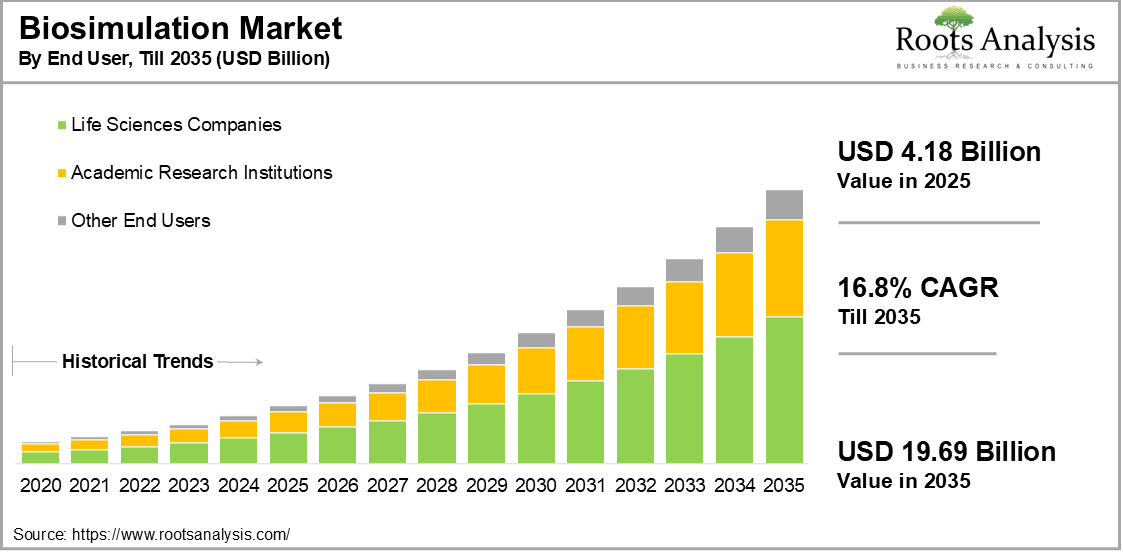
The global biosimulation market size, valued at USD 3.45 billion in 2024, is projected to reach USD 4.18 billion in 2025 and USD 19.69 billion by 2035, representing a CAGR of 16.8% during the forecast period.
To learn more about this report, request a free sample copy
Biosimulation refers to the computer-aided tool-based simulation of biological processes. It works like a virtual model of human body to predict how drugs interact within body, disease progression and response towards treatment regimens. Presently, biosimulation is widely used in the development of advanced drugs with high potency while minimizing the adverse effect.
Additionally, the growing focus on pharmacogenomics to develop tailored treatment has further underscored the requirement for advanced biosimulation tools and technologies that function as simulation model for diseases when integrated with predictive models.
It is worth mentioning that regulatory agencies, such as the USFDA and EMA are supporting biosimulation to solidify the drug approval regulatory submission, which further propels the market expansion. Furthermore, biosimulation solutions seems like a potential alternative to the animal models for drug testing, thereby reduce reliance on animal-based models for clinical trials of drugs. Owing to the acceptance of biosimulation by regulatory agencies and growing need, several industrial players are focusing on strategic initiatives to develop robust biosimulation tools and platforms.
For instance, in April 2025, Certara (global leader in model-informed drug development) announced the launch of latest Non-Animal Navigator™ solution (AI enabled biosimulation solution). This newly launched biosimulation solution will help biopharmaceutical companies in reducing their dependency on animal models for preclinical drug safety studies. Similarly, several industrial players are showing active interest in this market owing to the increasing clinical drug testing needs, which are likely to maintain competitiveness in the biosimulation market for the long term.
The market report provides comprehensive information on biosimulation companies developing software, who are currently active across various segments of the industry as mentioned in the table below.
| Key Report Attributes | Details | |
| Historical Trend | Since 2020 | |
| Forecast Period | Till 2035 | |
| Market Size 2025 | USD 4.18 Billion | |
| Market Size 2035 | USD 19.69 Billion | |
| CAGR (Till 2035) | 16.8% | |
| Type of Product |
|
|
| Application Area |
|
|
| Therapeutic Area |
|
|
| Type of Deployment Model |
|
|
| Type of Pricing Model |
|
|
| End User |
|
|
| Geographical Regions |
|
|
| Key Companies Profiled |
|
|
| PowerPoint Presentation (Complimentary) |
Available | |
| Customization Scope | 15% Free Customization | |
| Excel Data Packs (Complimentary) |
Available | |
One of the key objectives of the biosimulation market report was to estimate the current size, opportunity, and the market growth potential, over the forecast period, till 2035. We have provided informed estimates on the likely evolution of the market for the forecast period.
The global market analysis report also features the likely distribution of the current and forecasted opportunity within the market across various segments, such as type of product (software (molecular modeling & simulation software, clinical trial design software, PK / PD modeling and simulation software, Pbpk modeling and simulation software, toxicity prediction software and other software), services (contract services, consulting and other (implementation and training & support))), application area (drug discovery & development, disease modeling and other (precision medicine, and toxicology)), therapeutic area (oncology, cardiovascular disease, infectious disease, neurological disorders and others), type of deployment model (cloud-based, on-premises and hybrid model), type of pricing model (license-based model, subscription-based model, service-based model and pay per use model), end user (life sciences companies (pharmaceutical companies, biopharma companies, medical device companies and CROs / CDMOs), academic research institutions and others (regulatory authorities and others)), geographical regions (North America, Europe, Asia-Pacific, Middle East and North Africa, and Latin America) and leading players.
In order to account for future uncertainties associated with some of the key parameters and to add robustness to our model, we have provided three biosimulation market forecast scenarios, namely conservative, base, and optimistic scenarios, representing different tracks of industry’s evolution.
All actual figures have been sourced and analyzed from publicly available information forums and primary research discussions. The financial figures mentioned in this market report are in USD, unless otherwise specified.
Based on the type of product, the global market is categorized into software (molecular modeling & simulation software, clinical trial design software, PK / PD modeling and simulation software, Pbpk modeling and simulation software, toxicity prediction software and other software), services (contract services, consulting and other (implementation and, training & support)). According to our market report, presently the software segment occupies the highest biosimulation market share (62%), and the trend is likely to remain unchanged during the forecast period.
This is likely due to the heightened demand for biosimulation software, such as drug toxicity prediction software, clinical trial design software and disease model software to develop personalized drugs. Owing to the growing demand, this segment will continue to dominate the market, expecting to grow at a higher CAGR during the forecast period.
This segment highlights the distribution of global market for biosimulation across different application areas, such as drug discovery & development, disease modeling and other (including precision medicine software, and toxicology). According to our biosimulation market forecast, currently the drug discovery & development segment accounts for the largest share (56%) of the market. This is primarily due to the extensive usage of biosimulation clinical trial software and disease models for drug development.
Additionally, biosimulation models serve as an effective tool for determining drug toxicity, target efficacy and adverse effects, allowing pharmaceutical companies to develop drugs with higher precision. It is important to mention that disease modeling segment is likely to gain momentum at a higher CAGR during the forecast period. This can be attributed to the rising incidence of infectious diseases across the globe and the requirement of advanced solutions to diagnose disease and treatment outcomes with high efficiency.
The global biosimulation market size is further bifurcated based on the therapeutic area into oncology, cardiovascular disease, infectious disease, neurological disorders, and others. Among these, currently oncology segment holds the highest share of the market. Biosimulation models help to determine disease progression, treatment response and tumor dynamics so researchers can develop personalized therapies to treat patients.
In the long run, infectious disease segment is estimated to grow at a substantial CAGR during the forecast period. This can be attributed to the rising risk of infectious diseases and growing usage of biosimulation models to understand infection progression and treatment efficacy.
Based on the deployment mode, the global market is segmented into cloud-based, on-premises and hybrid models. According to our biosimulation market analysis presently cloud-based deployment holds the highest share (44%) of the market. Cloud-based deployment provides flexibility and interoperability with existing healthcare systems, allowing healthcare personnel and pharmaceutical players to implement biosimulation models effortlessly. It is worth mentioning that cloud-based deployment will remain dominant and is anticipated to grow at a higher CAGR during the forecast period.
On the basis of the pricing model, the global market is categorized into license-based model, subscription-based model, service-based model and pay per use model. According to our projection, presently, the license-based model holds the largest biosimulation market share. This is primarily due to the fact that license-based models offer access to advanced tools without making massive investment in infrastructure. Moreover, license-based models are flexible and scalable, allowing pharmaceutical companies to choose various options, such as single-user licenses and multi-user licenses.
However, in the future, subscription-based models’ segment is likely to grow at a higher CAGR during the forecast period. Subscription-based models are beneficial to use resources wisely based on the budget.
Based on the end user, the global market is segmented into life sciences companies (pharmaceutical companies, biopharma companies, medical device companies and CROs / CDMOs), academic research institutions and others (regulatory authorities and others). According to the biosimulation market report, currently life sciences companies hold the largest share (54%) of the market. This dominance is due to the growing adoption of biosimulation software and services for drug development by pharmaceutical companies.
However, academic research institutions segment is anticipated to register a higher CAGR over the forecasted period. This is potentially due to the increasing usage of biosimulation software for research on diseases and drug design.
The global market is categorized across different geographical regions, such as North America, Europe, Asia-Pacific, Middle East and North Africa, and Latin America. Currently, North America is dominating the market by holding 50% share of the market for biosimulation. This can be attributed to the fact that pharmaceutical companies established in this region are shifting to biosimulation software and services to enhance drug development with improved drug efficiency.
However, it is worth mentioning that the market in Asia-Pacific is expected to grow at a higher CAGR during the forecast period. This is potentially due to the presence of several contract research organizations and rising initiatives to adopt advanced predictive analytical tools for drug development in this region.
The “Biosimulation Market: Industry Trends and Global Forecasts, till 2035” market report features an extensive study of the current market landscape, market size, market share, market growth, market trends, market value, market forecast, market outlook, statistics, and future opportunities for biosimulation software companies. The market research report lays emphasis on the biosimulation software that are being developed. Key takeaways of the market report are briefly discussed below.
The biosimulation software companies market landscape is immensely competitive, featuring the presence of well-established and new entrants. Owing to the increasing adoption of biosimulation models for a wide range of applications, several industrial players are focusing on software innovations and expanding their product portfolio.
For instance, in April 2025, Certara has released a new version of Simcyp™ Simulator for physiologically based pharmacokinetics modeling. This Simcyp PBPK models helps to determine response of the drugs in different tissues of the body. Similarly, numerous industrial players are focusing on innovations and product development, which is expected to maintain a competitive edge in this industry.
The rising incidence of chronic diseases has necessitated the demand for advanced analytical tools that aid in designing personalized medicines. Biosimulation software enable researchers to perform virtual testing of drugs efficacy and response towards particular diseases. Additionally, the growing technological innovations in cloud services to enable simulation of complex biological systems is the key growth driver for the market.
Despite growing demand, the market players are experiencing several challenges that may impede market growth. Some of the potential challenges are high cost associated with installation, maintenance, and training of personnel. Furthermore, biosimulation models require regulatory agencies approval. Complex guidelines associated with the approval of biosimulation models may hinder the market progress during the forecast period.
Additionally, the complexity associated with integration of the existing operational units may create challenges for the market players.
Several factors that are propelling the market include growing preferences for cloud-based solutions for drug development and innovation in analytical models. Presently, industrial players are aiming for integrating artificial intelligence and machine learning with biosimulation models for real-time data analysis with utmost accuracy. Additionally, the market players are focusing on expanding usage of biosimulation models beyond drug discovery, such as biomarker identification and systematic study of disease progression, which is likely to be the key growth factors for the market.
In 2025, the global market for biosimulation software is valued at USD 4.18 billion in 2025 and is projected to reach USD 19.69 billion by 2035. This lucrative growth is likely to be the result of expanding initiatives by industrial players to develop innovative biosimulation software. For instance, in January 2025, Simulation Plus (global provider of biosimulation software solutions and platforms) announced a strategic funding partnership with Enabling Technologies Consortium. This collaboration aims to advance in vitro-in-vivo correlation approaches and extend their GastroPlus® platform (a biosimulation based platform) functionality and transit (ACAT™) model to develop immediate release oral drug products.
Examples of key players engaged in this domain (which have also been captured in this report) include Advanced Chemistry Development, BioSimulation Consulting, Chemical Computing Group, Certara, Dassault Systèmes, Genedata, Instem Group of Companies, In Silico Biosciences, PPD, Physiomics, Rosa &, Simulation Plus, Schrodinger and Yokogawa Insilico Biotechnology. This market report includes an easily searchable excel database of all the companies focusing on the development of biosimulation models.
The market report presents an in-depth analysis, highlighting the capabilities of various companies engaged in this domain across different segments. Amongst other elements, the market report includes:
Several recent developments have taken place in the field of biosimulation. We have outlined some of these recent initiatives below.