
Lowest Price Guaranteed
Pages
233
Last Updated
September 2026
View Count
3137
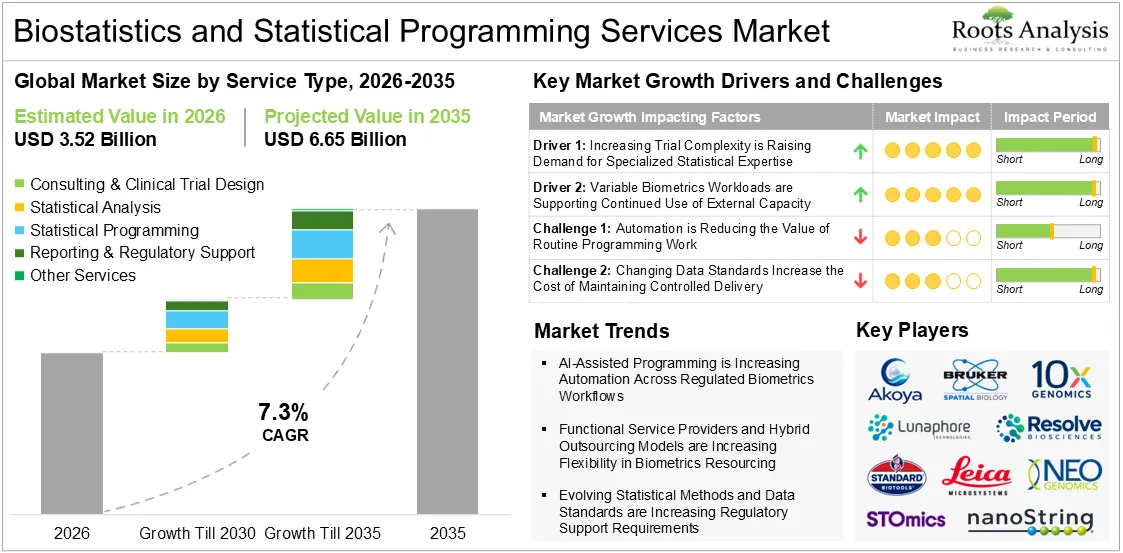
The global biostatistics and statistical programming services market, valued at USD 3.28 billion in 2025, is estimated at USD 3.52 billion in 2026 and is projected to reach USD 6.65 billion by 2035, representing a CAGR of 7.3% during the forecast period. Market growth is supported by rising statistical workload per clinical-development programs, flexible outsourcing of specialist biometrics capacity, and expanding regulatory and post-market statistical requirements.
To learn more about this report, request a free sample copy
Across clinical development, biostatistics and statistical programming provide the analytical framework used to design studies, evaluate outcomes and prepare evidence for scientific and regulatory review. Biostatisticians shape elements such as study design, sample size, endpoints, estimands and analysis strategy, while statistical programmers convert clinical data into standardized datasets, tables, listings, figures and other outputs required for interpretation and submission. As development programs become larger and more data-intensive, sponsors increasingly require these capabilities across multiple studies and regulatory milestones rather than at a single analytical stage.
External providers support this requirement through project-based assignments, dedicated functional teams and broader CRO engagements. The work can extend from protocol development and interim analysis through SDTM / ADaM programming, integrated safety and efficacy analyses, regulatory responses and post-market evidence generation. Outsourcing is particularly valuable when sponsors need specialist statistical expertise or programming capacity that can expand and contract with portfolio activity without maintaining equivalent internal teams across every therapeutic program.
As clinical development becomes more methodologically demanding, outsourced statistical support is moving beyond routine programming capacity toward work requiring greater scientific judgement and regulatory expertise. Adaptive and Bayesian methods, more complex trial designs, evolving data standards and expanding lifecycle evidence requirements are increasing the importance of experienced statistical oversight, validation and interpretation. Automation can streamline repetitive programming and quality-control tasks, but it does not replace the methodological decisions required to design analyses, interpret results or defend them during regulatory reviews. This is progressively concentrating service value in providers that combine scalable programming execution with experienced biostatistical and regulatory support across the development lifecycle.
The market operates through a sponsor-governed workflow in which statistical strategy is retained internally or jointly defined with an external partner, while execution can be distributed across global CROs, specialist biometrics providers, FSP teams and project-based consultants. Study questions, endpoints, estimands and analysis plans establish the analytical framework; programming teams then convert standardized clinical data into analysis datasets and validated outputs, followed by statistical interpretation, integrated summaries, submission support and regulatory-response analyses. Phase IV and real-world evidence work extends this relationship beyond the pivotal trial period into registries, non-interventional studies and post-market safety or effectiveness assessments.
These activities frequently interface with regulatory affair management, medical writing, and clinical operations, but the outsourced statistical work remains distinct. CDISC standards, version control, validation, reproducibility and audit trails form a common control layer across delivery models. Sponsors can therefore retain scientific and regulatory accountability while using external teams to absorb variable workload, access specialized statistical methods and maintain continuity from study design through submission and lifecycle evidence generation.
| Company | Headquarters | Year of Establishment | Type of Provider | Type of Service Offered | Therapeutic Area Coverage |
| ICON | Dublin, Ireland | 1990 | Global CRO | Statistical Consulting & Clinical Trial Design; Statistical Analysis; Statistical Programming; Statistical Reporting & Regulatory Support; Other Biostatistics & Programming Services | Broad coverage across all major therapeutic areas, including oncology, neurology, cardiovascular, immunology and rare diseases |
| Fortrea | Durham, North Carolina, US | 2023 | Global CRO | Statistical Consulting & Clinical Trial Design; Statistical Analysis; Statistical Programming; Statistical Reporting & Regulatory Support; Other Biostatistics & Programming Services | Cross-therapeutic Phase I-IV support, including oncology, neurology, cardiovascular, infectious diseases, immunology and rare diseases |
| Cytel | Cambridge, Massachusetts, US | 1987 | Specialist statistics and biometrics CRO | Statistical Consulting & Clinical Trial Design; Statistical Analysis; Statistical Programming; Statistical Reporting & Regulatory Support; Other Biostatistics & Programming Services | Broad clinical-development coverage with established work across oncology, rare diseases and other complex therapeutic programs |
| Veramed | London, UK | 2012 | Specialist biometrics CRO | Statistical Consulting & Clinical Trial Design; Statistical Analysis; Statistical Programming; Statistical Reporting & Regulatory Support; Other Biostatistics & Programming Services | Multi-therapeutic biometrics support across clinical-development and evidence-generation programs |
Generative AI is increasingly being incorporated into statistical programming workflows for activities such as SDTM / ADaM preparation, TLF generation and data review. At PHUSE US Connect 2026, 33.8% of sessions referenced AI, machine learning or large language models, indicating substantial practitioner attention to these technologies, although PHUSE cautioned that the conference sample should not be interpreted as an industry-wide adoption measure. Commercial offerings are nevertheless moving beyond experimentation. In May 2026, Veristat introduced InStat, a platform designed to produce submission-ready tables, listings and figures using validated statistical engines with biostatistician oversight.
The use of AI is therefore developing around assisted statistical production rather than autonomous analysis. Repetitive programming activities can be accelerated where specifications, metadata and reusable code patterns are sufficiently standardized, while regulated outputs continue to require reproducibility, validation and accountable statistical oversight. This increases the importance of governed workflows in which automation is incorporated within established sponsor standards, quality-control procedures and regulatory documentation requirements.
FSP and hybrid outsourcing models are allowing sponsors to obtain biostatistics and statistical programming capacity without transferring complete clinical programs to an external CRO. PPD's 2026 Pulse Survey of 150 biotechnology and pharmaceutical leaders found that full-service outsourcing represented roughly one-third of clinical-development activity, while FSP and mixed models each accounted for approximately one-quarter. Larger organizations reported greater use of FSP arrangements, whereas small and mid-sized companies relied more heavily on full-service outsourcing.
Biostatistics and statistical programming are well suited to this model because resource requirements change considerably across the development lifecycle. Sponsors may require specialist statistical input during protocol design, additional programming capacity around database lock and submission, or embedded teams that remain with a program across multiple studies. This flexibility is widening competition between global CROs and specialist biometrics providers around access to experienced personnel, continuity of statistical teams and the ability to operate within sponsor-specific standards and technology environments.
The regulatory workload surrounding clinical statistics is becoming more demanding at both the study-design and submission stages. In January 2026, the US FDA issued draft guidance addressing Bayesian methods for use including interim adaptation, dose selection and primary inference in drug and biologic trials. Applying these approaches requires substantially more than selecting a statistical technique at the analysis stage. Sponsors may need to define prior information, test operating characteristics through simulation, specify adaptation rules and document how the proposed design will preserve interpretability and regulatory validity before enrollment begins.
Data-standard requirements are also changing the way those statistical decisions are carried through to submission. CDISC released SDTM v3.0 in February 2026 and updated controlled terminology across ADaM, CDASH, DDF, Define-XML, SDTM and SEND in March, followed by the FDA's updated Study Data Technical Conformance Guide in June 2026. These changes affect dataset structures, metadata, mappings, validation and submission preparation rather than statistical methodology alone. These developments are increasing the need to connect statistical design with standard-aligned dataset construction, metadata, validation and submission programming, strengthening demand for providers that can support both methodological development and compliant regulatory execution.
Modern statistical methods are becoming more visible in regulatory policy as agencies seek ways to improve development efficiency without reducing evidentiary rigor. In January 2026, the FDA issued draft guidance describing how Bayesian approaches may be used for adaptive analyses, dose-selection decisions, prior information and primary inference in drug and biologic trials. Commenting on the guidance, FDA Commissioner Marty Makary, M.D., M.P.H., stated, "Bayesian methodologies help address two of the biggest problems of drug development: high costs and long timelines."
The significance for outsourced biostatistics lies in the additional design and validation expertise required to use these methods appropriately. Bayesian trials can demand simulation, operating-characteristic assessment, prior-data justification, interim decision rules and close alignment between statistical strategies and regulatory expectations. As more sponsors consider these approaches, providers with advanced design expertise can participate earlier in development rather than entering only when analysis datasets and final outputs are required.
The biostatistics and statistical programming services market report includes transcripts of the following third-party discussions:
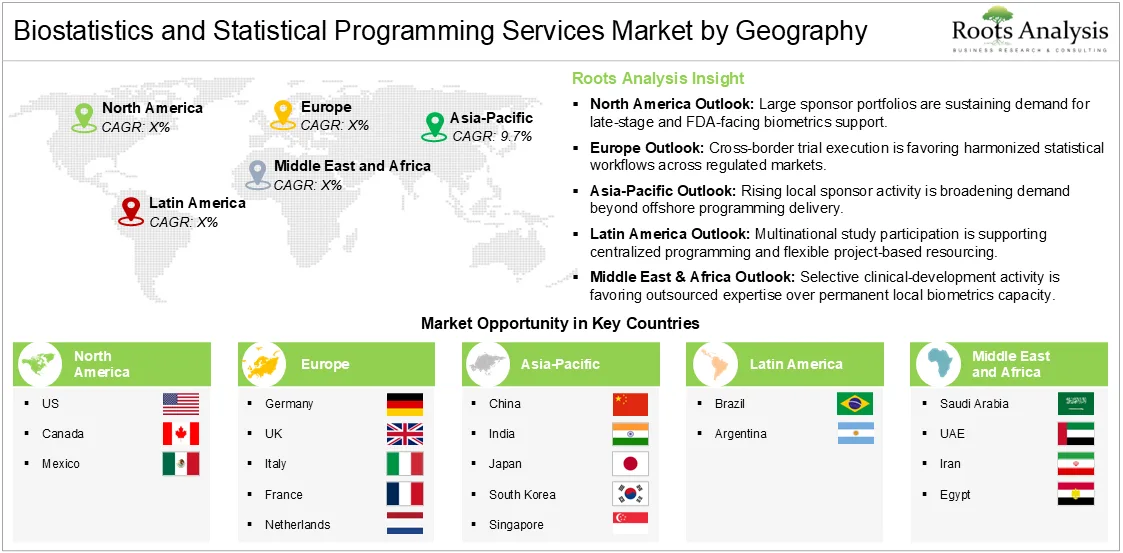
North America dominates the industry in the current year, capturing 43.0% of the global market revenues, supported by the concentration of pharmaceutical and biotechnology sponsors, large clinical-development portfolios and substantial demand for statistical support across pivotal studies and regulatory submissions. Sponsors in the US and Canada routinely require biostatistical input across protocol design, analysis planning, integrated summaries, submission programming and post-approval evidence generation. Although execution may be distributed across delivery centers in India, Europe and other locations, purchasing decisions and program ownership often remain with North American sponsor organizations. This combination of concentrated demand and globally distributed execution continues to reinforce the region's position as the largest contracting market.
Asia-Pacific is expected to expand at the fastest pace (9.7% CAGR) through 2035 as clinical-development activity becomes more deeply established across China, Japan, South Korea, India and Australia. Regulatory reforms, stronger domestic innovation pipelines and greater participation in multinational studies are increasing the number of programs requiring statistical design, programming and submission support. A 2026 Nature Reviews Drug Discovery assessment of China's innovative-drug trials highlighted the substantial expansion in clinical activity following regulatory reforms introduced from 2015. As more regional sponsors advance assets into later development and global programs incorporate Asian patient populations, demand is broadening beyond offshore programming toward locally informed biostatistics, standards implementation and regulatory analytics.
| Market Segment | Sub-segment Details | |
| Service Type | Statistical Consulting & Clinical Trial Design, Statistical Analysis, Statistical Programming, Statistical Reporting & Regulatory Support, Other Biostatistics & Programming Services | |
| Clinical Trial Phase | Phase I, Phase II, Phase III, Phase IV | |
| End User | Pharmaceutical & Biotechnology Companies, Medical Device & Diagnostics Companies, Academic & Research Institutions, Government & Public Health Organizations, Healthcare Organizations | |
| Therapeutic Area | Oncology, Neurology, Cardiovascular, Infectious Diseases & Vaccines, Immunology, Metabolic & Endocrine Disorders, Rare Diseases, Other Therapeutic Areas | |
| Geographical Regions | North America, Europe, Asia-Pacific, Latin America, Middle East & Africa | |
Statistical programming accounts for 44.0% of the market in 2026, reflecting its recurring role across most clinical-development programs. Standardized source data must be transformed into analysis-ready datasets, programmed according to statistical analysis plans and converted into tables, listings and figures that can be validated and reproduced. Programming also supports legacy-data conversion, integrated summaries and electronic-submission packages, so the function remains embedded throughout early- and late-stage development rather than appearing only at the end of a study. Current service portfolios from ICON, PPD, and Fortrea illustrate this breadth across Phase I-IV programs, SDTM and ADaM workflows, TLF production and submission support.
Statistical reporting & regulatory support is projected to record the highest CAGR through 2035. Growth is being supported by work that is more difficult to standardize into routine production, including ISS / ISE preparation, health authority responses, post-market analyses, RWE studies, and implementation of evolving data and submission standards. CDISC's March 2026 controlled-terminology update and the FDA's current technical-conformance requirements illustrate how metadata, traceability and regulatory formatting continue to change. As automation reduces manual effort in repeatable programming tasks, the relative value of regulatory interpretation, integrated reporting and validation-intensive work is becoming more pronounced.
Oncology segment dominates the biostatistics and statistical programming services market in current year, reflecting the breadth of cancer development and the statistical intensity of oncology trials. Oncology studies frequently require specialized endpoint strategies, time-to-event analyses, subgroup and biomarker assessments, treatment-switching methods and increasingly complex dose-optimization approaches. The FDA's Oncology Center of Excellence continues to advance statistical work around dose selection, novel endpoints, hybrid controls and changing standards of care in cancer trials, illustrating the range of methodological questions that require specialist biostatistical support.
Rare diseases are projected to record the highest CAGR through 2035 as statistical requirements in these programs are amplified by small and geographically dispersed patient populations, limited natural-history information and the difficulty of constructing conventional randomized control groups. FDA initiatives for rare and ultra-rare diseases increasingly address natural-history studies, external controls and alternative trial designs where conventional randomized trials may not be feasible. These development conditions increase the need for early statistical planning, simulation, sensitivity analyses and careful justification of endpoints and comparators, supporting faster growth in outsourced biostatistical expertise for non-oncology rare-disease programs.
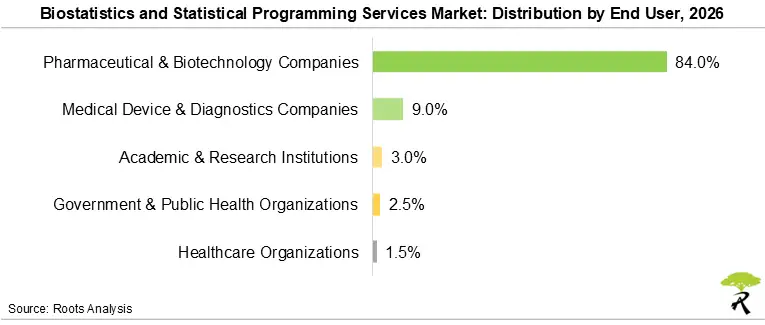
Pharmaceutical and biotechnology companies account for 84.0% of the biostatistics and statistical programming services market in 2026, supported by the sustained statistical workload generated across drug and biologic development programs. Requirements begin during protocol development with study design, endpoint strategy, sample-size determination and statistical analysis planning, and continue through interim analyses, database lock, submission programming, integrated safety and efficacy analyses and regulatory responses. The need for support across multiple studies, indications and development stages creates a recurring requirement for external statistical expertise rather than a one-time analytical assignment.
Outsourcing is further reinforced by the way sponsors manage biometrics capacity across their pipelines. Emerging biotechnology companies often rely on external specialists to supplement lean internal teams, while larger pharmaceutical organizations use FSP and hybrid arrangements to add statisticians and programmers during periods of concentrated workload, complex submissions or specialist-methodology requirements. This ability to scale expertise according to portfolio activity, while maintaining continuity across development programs and regulatory milestones, is expected to sustain pharmaceutical and biotechnology companies as the principal buyer group through 2035.
Real-world evidence (RWE) and post-market analytics are creating a broader statistical-services opportunity beyond conventional randomized clinical trials. Non-interventional studies require careful definition of research questions, data-source suitability, exposure and outcome variables, missing-data methods, confounding control and sensitivity analyses because treatment assignments and data collection are not controlled in the same way as a clinical trial. The FDA's final ICH M14 guidance, issued in March 2026, formalizes many of these expectations for RWD-based safety studies and notes their relevance to effectiveness assessments.
This expansion creates demand for providers that can connect clinical-trial statistics with epidemiologic methods, longitudinal data analysis and regulatory reporting. Phase IV services are projected to grow rapidly, while Statistical Reporting & Regulatory Support is also gaining share, increasing the commercial relevance of lifecycle evidence capabilities. However, growth depends on data fitness, privacy constraints, causal-inference quality and regulator acceptance of the evidence generated. Providers that combine robust statistical methods with transparent programming and submission-ready documentation are better positioned to participate in this emerging service layer.
The study examines third-party biostatistics and statistical programming services used across life-sciences and biomedical research, clinical development, regulatory submissions, and post-market evidence generation. Research draws on company disclosures, regulatory and standards documentation, peer-reviewed literature, clinical-development activity data, outsourcing studies and industry sources. Market estimates and forecasts are developed through the Roots Analysis research framework and are triangulated against sponsor activity, service intensity, outsourcing behavior, provider capabilities and current regulatory and technology developments. For further details, see the complete research methodology adopted by Roots Analysis across its market reports.
| Key Report Attribute | Details | |
| Historical Trends | Since 2022 | |
| Forecast Period | Till 2035 | |
| Market Size 2026 | USD 3.52 Billion | |
| Market Size 2035 | USD 6.65 Billion | |
| CAGR (till 2035) | 7.3% | |
| Market Scope | Third-party outsourced biostatistical consulting, statistical analysis, statistical programming and associated statistical support across clinical development, regulatory submissions and post-market evidence generation. Includes project-based and FSP delivery; excludes captive in-house teams, standalone data management, clinical operations, medical writing, software / SaaS and duplicated pass-through revenue. | |
| Key Companies Profiled | Thermo Fisher Scientific / PPD, ICON, Fortrea, IQVIA, Syneos Health, Cytel, PHASTAR, Veramed, Veristat, Ephicacy | |
| PowerPoint Presentation (Complimentary) | Available | |
| Customization Scope | 15% Free Customization Available | |
| Excel Data Packs (Complimentary) |
|
|
This report is an independent work of market research and analysis published by Roots Analysis. It is not affiliated with, sponsored by, endorsed by, or reviewed by Thermo Fisher Scientific / PPD, ICON, Fortrea, IQVIA, Syneos Health, Ephicacy, or any other pharmaceutical company, drug brand, or regulatory body referenced within it. No content in this report should be construed as medical advice. Roots Analysis maintains its own proprietary primary research process and does not receive compensation from any company profiled within the report, in exchange for inclusion or favorable characterization.