
Lowest Price Guaranteed
Slides
204
Last Updated
August 2025
View Count
13124
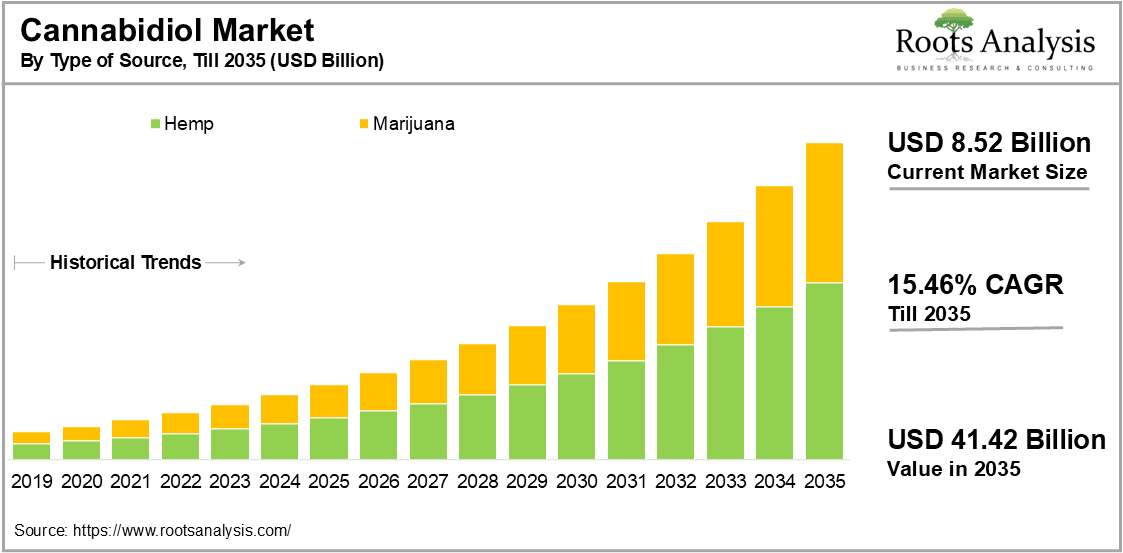
The global cannabidiol market size is estimated to increase from USD 8.52 billion in 2024 to reach USD 41.42 billion by 2035, representing a CAGR of 15.46% during the forecast period.
 |
To learn more about this report, request a free sample copy
Given the growing awareness about therapeutic health benefits of cannabidiol, this market is experiencing dramatic growth. Cannabidiol (CBD) is a form of phytocannabinoid that are extracted from cannabis plant. It has several characteristics properties such as anti-inflammatory and anti-inflammatory property which makes it ideal for seizure and chronic pain treatment. With the growing incidence of patients with chronic pain, there is surge in the demand for advanced drug formulation that aids in managing pain so patients can live a quality life.
According to the recent report of Centers for Disease Control and Prevention, close to 129 million people in United States are suffering from at least one chronic condition. Such patients require prolonged medication for the management of disease conditions and associated pain. Notably, there is a rapid increase in the patients with neurological conditions including seizures and anxiety disorders. Being an anticonvulsant, cannabidiol is widely adopted for managing pain conditions and disease progression. In addition, cannabidiol is also used as a muscle relaxant and analgesic, which further increased its demand for therapeutic purposes.
Driven by these applications, regulatory agencies, such as the United States Food and Drug Administration (USFDA) has provided supportive regulatory framework for the legalized use of cannabidiol in treatment of diseases. It is important to highlight here that, until 2023, the USFDA has approved medical cannabis-derived drug product, namely Epidiolex® (cannabidiol) for the treatment of seizures. Also, three synthetic medical cannabis-derived drug products, namely Cesamet™ (nabilone), Marinol® (dronabinol) and Syndros® (dronabinol) have been approved for the treatment of nausea (associated with cancer chemotherapy) and anorexia (associated with weight loss in AIDS patients). However, these drugs are only available with a prescription from certified / licensed healthcare providers.
In addition to therapeutic usage, these cannabidiol-based products, post cannabis testing, are currently being used to manufacture cannabis-infused drinks that promote relaxation and reduce anxiety. For instance, in January 2024, Aurora Cannabis launched three cannabis-infused ready-to-drink beverages (produced by Versus and Vacay). These cannabis-infused drinks are available in a variety of fruit flavors and are aimed to promote relaxation, pain alleviation and reduction of anxiety.
Moreover, cannabidiol oil is widely used as a key ingredient in making dermatological based products for treating wrinkles and acne. The increasing usage of cannabidiol based products across wide range of industrial verticals is catering attention of industry stakeholders widen their research on cannabidiol and drive new products. Driven by the growing adoption across various industries, we believe that cannabidiol market is likely to grow at a substantial rate during the forecast period.
The market report provides comprehensive information on the leading industrial players who are active across various segments as mentioned in the table below.
| Key Report Attributes | Details | |
| Historical Trend | Since 2019 | |
| Forecast Period | Till 2035 | |
| Market Size 2035 | $41.42 Billion | |
| CAGR (Till 2035) | 15.46% | |
| Type of Source |
|
|
| Type of Product |
|
|
| Application |
|
|
| Route of Administration |
|
|
| Sale Type |
|
|
| Distribution Channel |
|
|
| Geographical Regions |
|
|
| Key Companies Profiled |
|
|
| PowerPoint Presentation Complimentary) |
Available | |
| Customization Scope | 15% Free Customization | |
| Excel Data Packs (Complimentary) |
Available | |
One of the key objectives of the cannabidiol market report was to estimate the current market size, opportunity and the market growth potential, over the forecast period, till 2035. We have provided informed estimates on the likely evolution of the market for the forecast period.
The cannabidiol market analysis also features the likely distribution of the current and forecasted opportunity within the market across various segments, such as by type of source (hemp and marijuana), type of product (cannabidiol oil, cannabidiol isolates, cannabidiol concentrates and other products), application (anxiety / stress, insomnia, chronic pain, skincare and other applications, route of administration (oral, topical, inhalation, transdermal patches, rectal and sublingual), Sale Type (B2B and B2C), distribution channel (online pharmacies, hospitals, retail stories, drug stores and other distribution channels), geographical regions (North America, Europe, Asia-Pacific, Middle East and North Africa, and Latin America).
In order to account for future uncertainties associated with some of the key parameters and to add robustness to our model, we have provided three market forecast scenarios, namely conservative, base, and optimistic scenarios, representing different tracks of industry’s evolution.
All actual figures have been sourced and analyzed from publicly available information forums and primary research discussions. The financial figures mentioned in this market report are in USD, unless otherwise specified.
Based on the type of source, the global cannabidiol market is segmented into hemp and marijuana. Among these, currently hemp cbd accounts for the largest share (56%) of the overall market. This can be attributed to the fact that hemp is widely used for making wide range of CBD products, such as cannabidiol oil, capsules, tinctures, concentrates and topical solutions. Moreover, hemp cbd has anti-aging properties, showing richness in antioxidants and inflammatory properties.
Owing to the characteristic properties, it is widely used in industries, food and beverages, and nutraceutical industries. It is important to highlight here that the hemp cbd market segment will continue to grow at a higher CAGR owing to the growing legalized use of cannabidiol in preparation of medicines.
On the basis of the type of product, the global cannabidiol market size is segmented into cannabidiol oil, cannabidiol isolates, cannabidiol concentrates and other products. Currently, cannabidiol isolates accounts for the highest share of the market. This can be attributed to the fact that cannabidiol isolates are considered as a pure form, which contain 99% of cannabidiol and contain all the vital components, such as flavonoids, terpenes and other cannabinoids. These isolates can be used for producing a variety of therapeutic products having all the essential components.
Additionally, the purest form of cannabidiol isolates is easily incorporated into cosmetics, edibles and topical products, which has further heightened its demand across various industries. Driven by the ongoing demand for cannabidiol isolates, this segment will continue to grow at a substantial CAGR during the forecast period.
This segment highlights the distribution of global market based on the applications into anxiety, insomnia, chronic pain, skincare and migraine. According to our projection, currently chronic pain accounts for the highest cannabidiol market share (35%). This dominance is due to the fact that cannabidiol products have anti-inflammatory property which helps in reducing pain in patients suffering with chronic conditions.
Furthermore, products, such as topical creams and CBD oils are increasingly adopted as pain management products, contributing to the highest growth share of the market. Driven the growing popularity of cannabidiol for pain management, this segment will continue to grow at a higher CAGR during the forecast period.
The global cannabidiol market value is segmented across different routes of administration, such as oral, topical, inhalation, transdermal patches, rectal and sublingual. Among these, currently the oral route of administration (around 55%) holds the highest share of the market. This can be attributed to the ease of usage and oral administration is widely accepted for consuming therapeutic drugs for chronic pain management. Based on the growing preferences for oral route of administration, this segment will continue to grow at a higher CAGR during the projected period.
Based on the sale type, the global market is categorized into B2B sales and B2C sales. Currently, B2B sales dominate the overall market of cannabidiol with a share of 56%. This can be attributed to the increasing presence of retail and wholesale who are offering wide range of cannabidiol products including oil and tinctures. Furthermore, the growing demand for cannabidiol as a raw material for manufacturing different kinds of pharmaceutical products, cosmetic products and skincare products has increased the B2B sales over the years.
In addition, the legalization of cannabidiol products across different countries provided a favorable B2B sales environment. Driven by the growing demand of cannabidiol as raw material, this segment will continue to grow at a higher CAGR during the forecast period.
The global cannabidiol market is segmented on the basis of distribution channel into online pharmacies, hospitals, online stores, retail stores, drug stores and other distribution channels. According to our projection, presently online pharmacies occupy the largest share (25%) of the market driven by the convenience and affordability of purchasing cannabidiol-based products. Moreover, the availability of wide range of cannabidiol based products, such as therapeutic drugs and dermatologist-based skincare products has further contributed to the highest share of online pharmacies.
The global cannabidiol market is distributed across various geographical regions, such as North America, Europe, Asia-Pacific, Middle East Africa and North Africa, and Latin America. Presently, North America accounts for the highest share (88%) of the overall market. This dominance is likely to be the result of growing acceptance of cannabidiol products in skincare products and medicinal drugs. Furthermore, this region offers favorable regulatory support to use cannabidiol based products across various industrial verticals. Additionally, the increasing awareness among North American citizens several health benefits of cannabidiol as therapeutic drug has bolstered the market growth in this region.
However, the market for cannabidiol in Europe is anticipated to grow at substantial CAGR over the forecast period. This potential growth is driven by the accessibility and affordability of cannabidiol products in European products. In addition, the CBD products (such as CBD oil) are gaining popularity among consumers for managing chronic pain and epilepsy in this region. It is important to highlight here that the governments of Asian countries, such as China and India offer flexible policies to support the use of cannabidiol products, which is likely to boost the manufacturing of these products in this region.
The “Cannabidiol Market: Industry Trends and Global Forecast, till 2035” market research report also features an in-depth analysis, highlighting the capabilities of various industry stakeholders engaged in this market. The market report highlights the efforts of several stakeholders engaged in this market segment of various domains. Key takeaways of the market analysis are briefly discussed below.
Currently, the global market landscape witness the presence of several well-established industrial leaders who are currently engaged in the development of cannabidiol based products. It is important to highlight here that with increasing legal usage of cannabis for medicinal and growing acceptance of cannabidiol products for skin care products, this market is catering attention of various industrial leaders.
The key players, such as Aurora Cannabis, Medical Marijuana, and Medtera are focusing on the product portfolio expansion and leveraging partnerships for increasing bioavailability of cannabidiol. For instance, in January 2023, Medical Marijuana (along with its subsidiary HempMeds Brasil) launched two cannabidiol products, available in concentrations range from 3,000-6,000 mg, in Brazil. Overall, the market will remain competitive featuring several small, mid-sized and large industrial leaders who are currently active across different segments of industry.
Cannabidiol based products or cannabis derivates has shown therapeutic health benefits in the treatment of patients with chronic pain and neurological issues such as anxiety and stress. Driven by the growing recognition of cannabidiol as a therapeutic product, the USFDA has legalized cannabidiol for the product of drugs. Furthermore, the USFDA has provided a regulatory pathway for cannabidiol to ensure safety and efficacy of usage on humans.
In addition to the pharmaceutical sector, the stakeholders are also emphasizing on sourcing cannabidiol for food & beverage industries, which is expected to be a key driver for the market. Moreover, the companies are also receiving a positive safety assessment of CBD food products by the regulatory authorities. In May 2024, Pureis® received the first, positive safety assessment for Ultra-Pure CBD product, a novel food supplement, from the UK Foods Standards Agency (FSA). This supports the company’s plan to receive the FSA approval in order to launch the product in the UK market.
The market for cannabidiol is witnessing several challenges that hinder its wider acceptance and growth during the forecast period. Some of the potential challenges include complex regulatory guidelines and lack of awareness about cannabidiol products among population.
Notably, regulatory agencies such as the USFDA and EMA have stringent guidelines for using cannabidiol in therapeutic products. For instance, THC (tetrahydrocannabinol), a psychoactive compound if consumed in high quantity may cause psychoactive side effects, which is a cause of concern from a regulatory approval standpoint. Moreover, several countries are also cautious of allowing use of cannabidiol products with psychoactive effects.
Thus, strict guidelines may create challenges for the approval of cannabidiol based products. In addition, lack of awareness about therapeutic health benefits of cannabidiol may restraint its widespread adoption across the globe.
Beyond medicinal drugs, cannabidiol products including oil, tinctures and others are widely used in skincare industry. It is worth noting here that cannabidiol has anti-inflammatory property and rich in antioxidants. Owing to its high anti-inflammatory property, it is used for reducing pimples, acne, eczema and treatment of hair fall.
Cosmetic industries are widely using cannabidiol products in manufacturing moisturizers, body lotions, hair oils and face creams. For instance, in February 2024, Jublee entered into the CBD topical products through the launch of CBD skincare lines including bath salts and body butters. Such growing adoption in the skincare industry has significantly boosted the demand for cannabidiol, which is offering an opportunity to industrial leaders to broaden their research on these products.
Given by the legal adoption, several industrial leaders are also emphasizing technological advancements that help in improving bioavailability of cannabidiol for therapeutic and other medicinal products. In order to widen the research on cannabis-based products, various industry players have also forged partnerships, which has further become a key growth factor for the industry.
The global cannabidiol market is estimated to be USD 8.52 billion in 2024 and is poised to reach USD 41.42 billion by 2035, representing a CAGR of 15.46% during the forecast period. Across the various geographies, there have been different guidelines for the THC limits in the CBD products.
Notably, many regulatory authorities have announced the updated thresholds in these products, including isolates, oils, so as to confer its health benefits. Recently, in October 2024,Japan’s Ministry of Health, Labour and Welfare (MHLW) announced the different thresholds for various CBD products, such as 10 ppm threshold pertaining to CBD oil, powder, CBD hemp and cosmetic oils. The notification came in to resolve any conflicts arising on the size of the particles; however there have been certain ambiguities related to the threshold of CBD raw materials.
As stated by Dr Yuji Masataka, “However, most cannabinoid raw materials are highly viscous, and it is expected that only a limited number of products, such as CBD isolate powder, will be able to stably maintain the particle size below 850 µm, as stipulated in the latest guidelines. If the intention of adding the ‘powder’ category was to ease restrictions on cannabinoid raw materials, this design is insufficient.”
Examples of key companies who are currently engaged in the market (which have also been profiled in this market report; the complete list of items is available in the full report) include Aurora Cannabis, Canopy Growth, CV Sciences, Endoca, Elixinol, Folium Biosciences, Gaia Herbs, GW Pharmaceuticals, Isodiol International, Medical Marijuana, Medterra, NuLeaf Naturals, Tilray and Vapen CBD. This cannabidiol industry report includes an easily searchable excel database of all the companies active in this field worldwide.
Several recent developments have taken place in the field of cannabidiol. We have outlined some of these recent initiatives below.