


 Download Free Sample
 Buy Now
Market Size
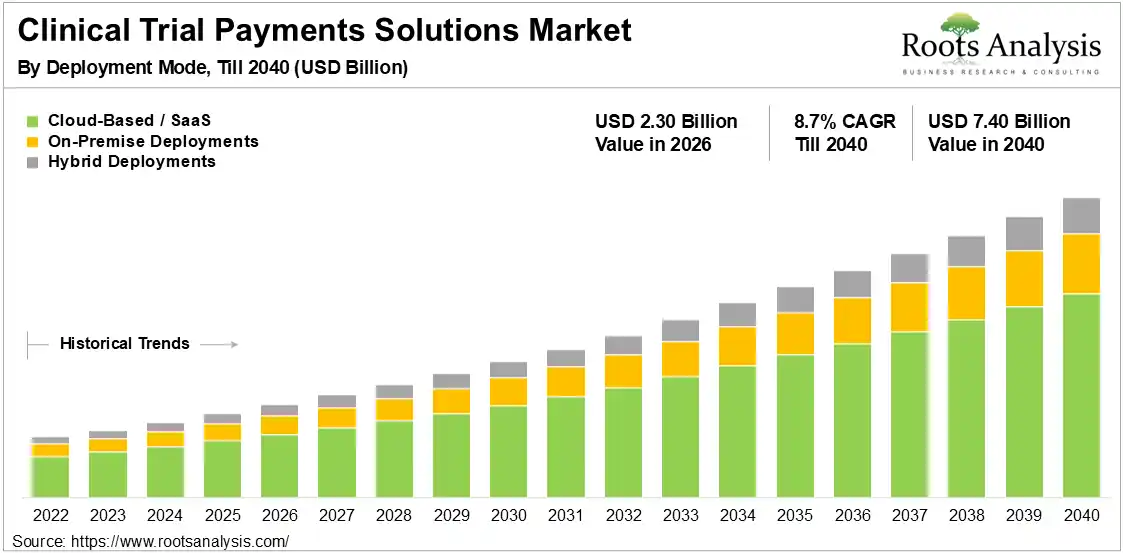
The global clinical trial payments solutions market is expected to rise from USD 2.30 billion in 2026 and is projected to reach USD 7.40 billion by 2040, growing at a CAGR of 8.7% over the forecast period 2026 to 2040, driven by faster site payments, participant reimbursement automation, and cross-border payout complexity.
See What’s in the Full Report – Request Your Complimentary Insights!
Market Report: Key Takeaways
- Based on solution type, participant payment platforms capture 31.0% market share in 2026, whereas reimbursement and expense management platforms register a 9.7% CAGR through 2040, driven by patient-burden reduction.
- Based on deployment mode, cloud-based / SaaS is both the dominant and fastest-growing category, holding 68.0% share in 2026 and expanding at 9.8% CAGR through 2040, driven by multi-country payment centralization.
- Based on payment method, direct deposits / ACH capture 27.0% market share in 2026, whereas other local payout methods register a 15.4% CAGR through 2040, driven by localized cross-border disbursement.
- Based on end user, pharmaceutical and biotechnology companies capture 41.0% market share in 2026, whereas contract research organizations register a 9.7% CAGR through 2040, driven by outsourced payment operations.
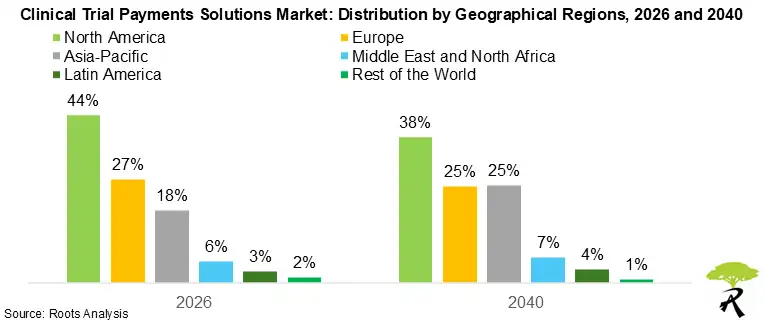
- Based on geography, North America captures 43.5% market share in 2026, whereas Asia-Pacific registers a 11.0% CAGR through 2040, driven by trial-volume migration.
Clinical Trial Payments Solutions Market Outlook
Payment execution is shifting from back-office administration to a patient-retention and site-performance lever. Earlier workflows centered on manual invoices, delayed reimbursements, prepaid cards, and fragmented grant tracking. Current demand favors automated site payments, participant reimbursement software, CTMS payment integration, and multi-currency trial payments. Sponsors now treat payment speed as a trial-operating constraint. Late stipends and site cash-flow gaps can slow enrollment and weaken investigator relationships.
Growth now comes from decentralized trials, cross-border enrollment, and policy pressure to reduce participant cost burden. Reimbursement clarity matters because travel, lodging, food, and copay support can widen access for underrepresented patients. ACS CAN supported the Clinical Trial Modernization Act in May 2025, citing sponsor support for patient costs across oncology trials. Suvoda also unified eCOA, patient payments, reminders, and visit scheduling in January 2026.
Through 2040, the clinical trial payments market will stay high growth as SaaS, local payout methods, and payment automation gain share. Cloud-based / SaaS rises from 68.0% in 2026 to 78.0% in 2040. Other local payout methods grow at 15.4% CAGR as international trial activity expands. IQVIA announced Clinical Trial Financial Suite in September 2025, signaling broader platform consolidation. This favors vendors that connect payments with audit trails and financial reporting.
Clinical Trial Payments Solutions Market Dynamics
Clinical Trial Payments Solutions Market Drivers
Clinical trial payments market growth now depends on payment speed, not only vendor compliance. Participant payment platforms hold 31.0% share in 2026, while site payment platforms gain share through 2040. Automated disbursement, CTMS payment integration, and payment audit trails reduce manual invoice handling. FDA finalized E6(R3) Good Clinical Practice guidance in September 2025, supporting flexible technology-enabled trial conduct for regulated sponsors.
Clinical Trial Payments Solutions Market Restraints
Fragmented payout rails still limit scalable payment execution across global and hybrid studies. Direct deposits / ACH hold 27.0% share in 2026, but digital wallets, virtual cards, and local payout methods gain share through 2040. Each payment method creates different reconciliation, tax reporting, and patient identity checks. These variations raise implementation costs for sponsors, CROs, and research sites managing multi-currency trial payments.
Clinical Trial Payments Solutions Market Opportunities
Localized reimbursement creates the strongest commercial opening for payment vendors. Other local payout methods grow at 15.4% CAGR through 2040, outpacing bank transfers, ACH, and prepaid cards. Mural Health expanded Mural Link in February 2026 to support local bank transfers and mobile-wallet payments worldwide. Vendors that handle local payment preferences can win cross-border studies earlier without adding prepaid-card dependency.
Clinical Trial Payments Solutions Market Challenges
Cross-border trial growth increases compliance complexity faster than many payment teams can standardize operations. Asia-Pacific grows at 11.0% CAGR through 2040, while North America loses share despite mature infrastructure. Sponsors must align participant reimbursement software with local currencies, tax rules, audit trails, and site-level payment reconciliation. Weak localization can delay enrollment, strain site relationships, and reduce platform stickiness across regions.
Clinical Trial Payments Solutions Market Size Estimation Methodology
- As a starting point, the clinical trial payments market baseline was built from payment-solution estimates, investigator-payment scope checks, and financial-management platform coverage. The model separated participant payments, site payments, investigator grants, reimbursements, travel support, budgeting, and reporting modules. This prevented narrower investigator-payment figures from overstating or understating the full addressable market. Historical values from 2022 through 2025 anchored the 2026 starting point.
- Moving forward, clinical trial databases and regional trial-registration signals were used to test demand exposure. The forecast considered sponsor and CRO activity, traditional site-based trial volumes, decentralized clinical trials, hybrid trials, and cross-border studies. ClinicalTrials.gov volume, WHO regional trial-registration growth, and Asia-Pacific trial expansion informed geography-level acceleration assumptions. Regional shifts were then reflected in North America, Europe, Asia-Pacific, and smaller emerging regions.
- Building on this, company product pages and recent platform announcements were mapped against solution-type adoption. Suvoda, IQVIA, Medidata, Veeva, Advarra, Clario, RealTime, Dash Solutions, DataCapt, Mural Health, Ledger Run, Scout Clinical, PayQuicker, Sitero, and Clinical.ly were reviewed by role. This mapping linked vendor functionality to payment calculation, multi-currency processing, participant stipend processing, and audit-trail reporting. Payment infrastructure providers were treated as enabling rails, not clinical workflow platforms.
- Drawing upon these, segment shares were calibrated using deployment mode, payment method, end-user, functionality, and study-model logic. Cloud-based / SaaS gained share where sponsors required centralized workflows across countries and studies. Other local payout methods gained share where mobile wallets, local bank transfers, and regional payment preferences reduced participant friction. CRO growth assumptions reflected outsourced trial operations and sponsor reliance on third-party execution.
- The projected value was then extended through 2040 using segment-level CAGR assumptions and share-shift testing. Faster rates were assigned to Asia-Pacific, local payout methods, decentralized clinical trials, and reimbursement workflows. Slower rates were assigned to checks, on-premise deployments, and standalone audit-trail reporting, because these functions face replacement or suite-level absorption. Annual interpolation preserved a smooth growth path while allowing share changes by segment.
- Finally, the forecast was cross-checked against regulations, policy signals, and operational constraints. FDA E6(R3), the Clinical Trial Modernization Act, and income-exemption proposals shaped assumptions about compliance and patient-cost support. The final model prioritized traceable payment audit trails, tax reporting, site payment reconciliation, and multi-currency payout readiness. Sensitivity checks tested whether reimbursement automation could grow faster than participant stipend processing.
Clinical Trial Payments Solutions Market Share Insights
Market Share by Solution Type
According to our analysis, participant payment platforms lead because patient stipends and reimbursements directly affect recruitment and retention. Dash Solutions, October 2025, launched dashClinical for real-time payments to clinical trial participants worldwide.
Reimbursement and expense management platforms will expand faster as sponsors reduce financial barriers. myTomorrows and Scout Clinical, April 2025, partnered on cross-border recruitment with travel, reimbursement, debit-card, and lodging support.
Market Share by Deployment Mode
Cloud-based / SaaS leads because sponsors need centralized payment workflows across countries, studies, and sites. IQVIA, September 2025, launched Clinical Trial Financial Suite with CTFS Site Payments as its first module.
Cloud-based / SaaS will also grow fastest as sites seek lower implementation burden. Veeva, April 2025, announced SiteVault CTMS for research sites, with an initial release planned in August 2025.
Want Information on Specific Region / Segment?
Regional Analysis: North America Leads the Market and Asia-Pacific is Likely to Register Higher CAGR
Presently, North America holds a 43.5% share in 2026. North America leads through mature sponsor infrastructure, CRO density, research-site networks, and established compliance expectations. ClinicalTrials.gov reported over 530,000 total registered studies in April 2025, reinforcing the region’s deep trial ecosystem.
On the contrary, Asia-Pacific registers an 11.0% CAGR from 2026 to 2040. Growth will come from digitalization, expanding trial volumes, regulatory acceleration, and localization of global studies. Beijing’s April 2025 innovative-medicines measures shortened trial application review timelines to 30 working days.
Market Ecosystem Analysis
Using the supplied scope, commercial activity concentrates around integrated clinical-finance suites and global payout rails, not standalone stipend tools. Platform convergence is the dominant dynamic: IQVIA launched CTFS to unify budgeting, contracting, forecasting, and payments, while Suvoda integrated Greenphire’s patient, site, travel, and payment assets into one ecosystem. Acquisition-led consolidation also matters, shown by Thermo Fisher’s October 2025 Clario deal and Sitero’s November 2025 studyOS acquisition. The main commercial force is replacing delayed, manual, and check-based payments with auditable workflows and payout choice.
- IQVIA launched Clinical Trial Financial Suite in September 2025 as an AI-enabled platform spanning budgeting, contracting, forecasting, and payments. This strengthens site payment automation and raises the integration barrier for point solutions focused only on disbursement. Its first module, CTFS Site Payments, targets budget setup, invoice processing, anomaly detection, and payment approvals. That directly strengthens site payment reconciliation, payment automation, budgeting, forecasting, and audit-ready reporting.
- Suvoda entered 2026 with Greenphire’s payment, travel, budgeting, and patient-support assets folded into its trial technology portfolio. Its January 2026 update highlighted a patient app combining eCOA, patient payments, reminders, and scheduling. This pressures vendors that separate participant payments from patient engagement. It strengthens participant payment platforms, travel-and-payment support, and hybrid trial workflows.
- Veeva announced SiteVault CTMS in April 2025, integrating CTMS with eISF and eConsent for research sites. The initial August 2025 release was positioned as free for sites with up to 20 active studies. This improves Veeva’s site workflow footprint around payments-adjacent operations. It pressures payment vendors that lack deep site CTMS integration.
- Dash Solutions launched dashClinical in October 2025 for real-time participant payments through physical or digital reloadable cards. The solution integrates with CTMS and EDC systems and supports HIPAA, SOC 2, and financial-grade security requirements. This raises the standard for prepaid-card providers. It strengthens participant stipend processing, reimbursement management, and site-level administrative efficiency.
- PayQuicker expanded instant clinical trial payouts across the UK and EU in February 2025. The solution supports real-time local-currency participant compensation and removes onsite card issuing from payment operations. PayQuicker also reported nearly USD 1 billion in global payouts in January 2026, with continued adoption in clinical trials. This strengthens cross-border trials, digital payment, virtual cards, bank transfers, and local payout methods.
- Mural Health gained a visible commercial validation point in March 2025 through ICON’s adoption of Mural Link. The platform supports participant payments, tax management, travel, and concierge support for clinical trial participants. This pressures payment-only vendors by bundling access, retention, and financial-neutrality workflows. It strengthens participant payment, reimbursement, travel-support, and decentralized trial use cases.
- Mastercard expanded Mastercard Move use through Checkout.com in February 2025 for UAE disbursements and payouts. Mastercard stated the portfolio spans 180 countries, 150 currencies, and more than 95% of the banked population. This raises payout optionality expectations for clinical trial platforms. It strengthens cross-border trials, bank-account payouts, wallet payouts, and card-based reimbursement models.
- PayPal’s Hyperwallet and Payouts solutions were included in Google’s September 2025 strategic partnership. Reuters reported that PayPal-branded checkout, Hyperwallet, and Payouts would integrate into Google products. This strengthens PayPal Hyperwallet’s relevance as embedded payout infrastructure. It pressures clinical trial payment vendors to offer consumer-grade payout choice and platform-integrated orchestration.
- Visa Direct gained sharper healthcare relevance in 2026 as industry coverage highlighted persistent paper payout reliance. PYMNTS reported that three-quarters of healthcare payouts still go by check, while only 5% to 12% move in real time. Nuvei also integrated Visa Direct for Account in November 2025 for direct bank-account payouts in eligible countries. This strengthens bank transfers, direct-to-card payouts, and real-time reimbursement infrastructure.
Startup Companies and their Key Highlights
1. Mural Health
- Event type: Strategic partnership
- Month and year: March 2025
- Strategic partner name: ICON
- Stated purpose of the event: ICON adopted Mural Link to provide payments, tax management, travel, and concierge support for trial participants.
- Market implication: This accelerates participant payment and travel-support platforms because reimbursement becomes part of retention and access strategy.
2. Ledger Run
- Event type: Product/platform upgrade
- Month and year: April 2026
- Stated purpose of the event: Ledger Run upgraded ClinRun with AI-powered automation for sponsor-site payments, invoice processing, and compliance workflows.
- Market implication: This accelerates site payment automation because invoiceables remain manual, unpredictable, and resource-heavy for sponsors and CROs.
3. PayQuicker
- Event type: Geographic expansion
- Month and year: February 2025
- Stated purpose of the event: PayQuicker expanded instant and local-currency clinical trial payouts across the UK and EU.
- Market implication: This accelerates cross-border participant payment platforms because sponsors need compliant local disbursement without onsite card issuing.
4. Clinical.ly
- Event type: Research working group launch
- Month and year: September 2025
- Stated purpose of the event: Clinical.ly launched a quarterly working group to let research sites shape clinical technology development.
- Market implication: This accelerates site-centered payment and operations tools because ClinicallyPay sits within a broader ResearchSuite workflow.
Clinical Trial Payments Solutions Market Trends / Opportunities
Clinical Trial Payments Market Platform Consolidation Raising Sponsor Switching Costs
Platform consolidation is turning payment tools into broader clinical finance suites. Suvoda completed Greenphire brand integration in September 2025, combining patient payments, travel, site payments, and budgeting under Suvoda. Sponsors may prefer fewer vendors when payments, travel, and budgeting share data.
Suite expansion is shifting competition from point solutions toward integrated operating systems. IQVIA announced Clinical Trial Financial Suite in September 2025, with CTFS Site Payments planned for commercial availability in Q1 2026. This raises the bar for smaller vendors selling standalone payment workflows.
Clinical Trial Payments Market Local Payout Expansion Reducing Cross-Border Enrollment Friction
Local payout expansion is replacing one-size prepaid-card programs in international studies. Mural Health expanded Mural Link in February 2026 to support local bank transfers and mobile-wallet payments for participants worldwide. Vendors with localized rails can support enrollment without forcing unfamiliar payment methods.
Cross-border patient support is linking recruitment, travel, accommodation, reimbursements, and payment funding. myTomorrows and Scout partnered in April 2025 to combine trial matching with travel, lodging, reimbursements, and pre-funded debit cards. This model gives reimbursement vendors a stronger role earlier in trial planning.
AI-Enabled Invoice Automation Compressing Site-Payment Cycle Times
AI-enabled invoice extraction is targeting one of the slowest sponsor-site payment steps. Ledger Run announced AI-enabled ClinRun upgrades in April 2026 covering invoice extraction, EDC handling, audit trails, and advance payments. Faster invoice conversion can improve site cash flow and sponsor relationships.
Site-burden reduction is making automated patient payments part of research-site productivity. SCRS highlighted automated patient payments in June 2025 as a way to reduce operational burden on sites. Payment vendors that fit site workflows can defend adoption beyond sponsor procurement.
Participant Cost-Support Policy Turning Reimbursement into Access Infrastructure
Policy attention is turning participant payments into an equity and enrollment issue. More than 100 patient and health-care organizations urged Congress in August 2025 to support the Clinical Trial Modernization Act. Broader policy support strengthens demand for auditable reimbursement and travel-support workflows.
Income-treatment uncertainty is shaping how sponsors structure stipend and reimbursement programs. Reps. Chrissy Houlahan and Mike Kelly introduced the Harley Jacobsen Clinical Trial Participant Income Exemption Act in June 2025. Clearer tax treatment would favor platforms with compliance and reporting controls.
Your Business is Unique – Why Shouldn’t Your Report Be?
Market Access Considerations
Regulatory Audit Trails and Tax Reporting
Payment vendors must prove that reimbursements, stipends, advance payments, and site payments follow study rules. FDA E6(R3) Good Clinical Practice guidance supports flexible technology-enabled conduct, but it raises expectations for traceable processes. Vendors that embed audit trails, tax reporting, and approval controls can access regulated sponsors faster. Weak documentation limits adoption in enterprise pharma and CRO accounts where finance, quality, compliance, and clinical operations teams jointly approve systems across large trial portfolios.
Localized Payment Rails and Currency Coverage
Global trial access depends on payment methods that participants and sites can actually use. IQVIA lists ACH, wire transfer, virtual cards, and local-currency options across more than 180 countries. Vendors without mobile wallets, local bank transfers, or FX-control workflows face slower cross-border scaling. Broad payout coverage improves positioning for Asia-Pacific, international, and decentralized trial contracts, especially where local payment acceptance affects recruitment, retention, reimbursement satisfaction, and site payment confidence.
Site Workflow Integration and Reconciliation Burden
Research sites resist tools that add payment administration instead of removing it. SCRS highlighted automated patient payments in June 2025 as a way to reduce operational site burden. Vendors must integrate with CTMS, EDC, invoicing, and reconciliation workflows to compete beyond procurement pilots. Site-friendly implementation can turn payment automation into a retention advantage for sponsors and reduce dispute cycles after milestone completion or participant visit closure in multi-site programs.
Patient Travel, Lodging, and Reimbursement Support
Participant access increasingly depends on reimbursement coverage beyond stipends. ACS CAN supported the Clinical Trial Modernization Act in May 2025, highlighting financial support for copays, travel, parking, food, and lodging. Platforms that combine travel support, reimbursement workflows, and payment disbursement can support broader enrollment. Vendors limited to basic cards may lose studies requiring patient-navigation services, cross-border logistics, lodging coordination, pre-funded reimbursement options, and sponsor-level access reporting.
How Stakeholders Benefit from the Key Focus Areas of Our Clinical Trial Payments Solutions Market Report
Payment speed, reimbursement localization, and site cash-flow pressure now shape trial execution economics. This report supports portfolio planning, vendor screening, and technology-roadmap decisions by linking segment growth with adoption constraints.
- Unmet Needs and Market Gaps in Clinical Trial Payments Solutions Market: The report identifies where delayed site payments, fragmented participant reimbursement, and weak local payout coverage still disrupt trials. Operations teams can use these gaps to prioritize automation, reconciliation, and participant reimbursement software. Commercial teams can identify accounts where site burden and patient-cost barriers create replacement opportunities.
- Funding and Venture Investment Opportunities in Clinical Trial Payments Solutions Market: The report tracks investment and consolidation signals across payment platforms, clinical finance suites, and enabling payout infrastructure. Thermo Fisher agreed in October 2025 to acquire Clario for up to USD 9.4 billion to strengthen clinical trial research technology. Corporate development teams can use this lens to evaluate build, buy, or partnership routes.
- Technology Innovation and Adoption Trends: The report shows which technologies gain adoption as clinical trial financial management becomes more platform-based. Cloud-based / SaaS rises from 68.0% share in 2026 to 78.0% in 2040, while other local payout methods grow at 15.4% CAGR. Product teams can prioritize mobile wallets, local bank transfers, AI invoice extraction, and audit-trail reporting.
- Clinical Trial Payments Solutions Market Competitive Landscape and Industry Analysis: The report maps Tier 1 leaders, Tier 2 specialists, emerging vendors, and payment-rail providers by market role. Strategy teams can compare Suvoda, IQVIA, Medidata, Veeva, Advarra, Clario, Dash Solutions, Mural Health, Ledger Run, and Scout Clinical. This supports vendor benchmarking, channel strategy, and differentiated positioning.
- Mapping Strategic Partnerships and Ecosystem Synergies: The report highlights how partnerships combine trial matching, travel logistics, reimbursements, debit cards, and site payments. Suvoda completed Greenphire brand integration in September 2025, while myTomorrows and Scout partnered in April 2025 for cross-border recruitment support. Business development teams can identify ecosystem partners that improve patient access and sponsor value.
- Clinical Trial Payments Solutions Market CAGR and Growth Trends: The report explains why the market expands at 8.7% CAGR through 2040 and which segments outpace the average. Asia-Pacific grows at 11.0% CAGR, decentralized clinical trials grow at 11.9%, and reimbursement workflows grow at 9.7%. Investment committees can use these growth differentials to rank segments, regions, and acquisition themes.
Clinical Trial Payments Solutions Market: Scope of the Report
| Key Report Attributes | Details | |
| Forecast Period | Till 2040 | |
| Market Size 2026 | USD 2.30 Billion | |
| Market Size 2040 | USD 7.40 Billion | |
| CAGR (Till 2040) | 8.7% | |
| Segments Covered |
|
|
| Geographical Regions Covered |
|
|
| Key Sections Covered |
|
|
Market Segmentation
The Clinical Trial Payments Solutions Market report presents an in-depth analysis, highlighting the capabilities of various stakeholders, based on different segments, such as solution type, deployment mode, payment method, end user, functionality, study model, geographical regions, and leading players.
By Solution Type
- Participant Payment Platforms
- Site Payment Platforms
- Investigator Grant Payment Platforms
- Budgeting and Benchmarking Platforms
- Reimbursement and Expense Management Platforms
- Travel-And-Payment Support Platforms
- Payment Analytics and Reporting Platforms
By Deployment Mode
- Cloud-Based / SaaS
- On-Premise Deployments
- Hybrid Deployments
By Payment Method
- Bank Transfers
- Direct Deposits / ACH
- Prepaid Cards
- Digital Wallets
- Virtual Cards
- Checks
- Other Local Payout Methods
By End User
- Pharmaceutical and Biotechnology Companies
- Contract Research Organizations
- Medical Device Companies
- Academic and Research Institutes
- Hospitals and Health Systems
- Dedicated Research Sites and Site Networks
By Functionality
- Payment Calculation and Automation
- Multi-Currency Processing
- Compliance and Tax Reporting
- Site Payment Reconciliation
- Participant Stipend Processing
- Expense Reimbursement Management
- Budgeting and Forecasting
- Audit-Trail and Financial Reporting
By Study Model
- Traditional Site-Based Trials
- Decentralized Clinical Trials
- Hybrid Clinical Trials
- Cross-Border / International Trials
- Expanded Access and Compassionate-Use Programs
By Geographical Regions
- North America
- US
- Canada
- Mexico
- Rest of North America
- Europe
- Austria
- Belgium
- Denmark
- France
- Germany
- Ireland
- Italy
- Netherlands
- Norway
- Russia
- Spain
- Sweden
- Switzerland
- UK
- Rest of Europe
- Asia-Pacific
- China
- India
- Japan
- Singapore
- South Korea
- Rest of Asia-Pacific
- Latin America
- Argentina
- Brazil
- Chile
- Colombia
- Venezuela
- Rest of Latin America
- Middle East and Africa (MEA)
- Egypt
- Iran
- Iraq
- Israel
- Kuwait
- Saudi Arabia
- UAE
- Rest of MEA
- Rest of the World


