Market Outlook
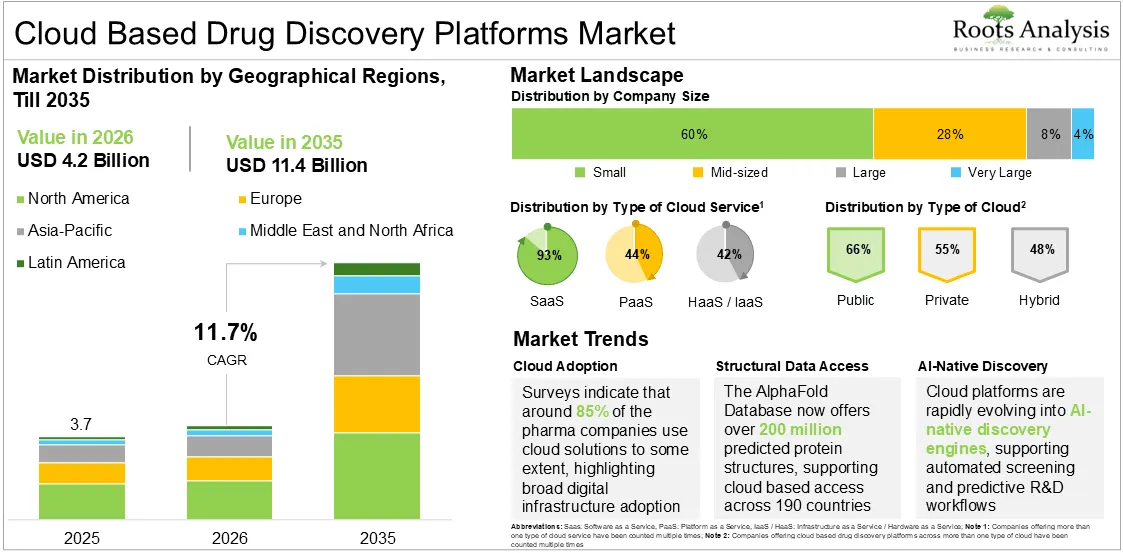
The global cloud based drug discovery platforms market, valued at USD 3.7 billion in 2025, is projected to reach USD 4.2 billion in 2026 and USD 11.4 billion by 2035, representing a CAGR of 11.7% during the forecast period 2026 to 2035.
To learn more about this report, request a free sample copy
Market Report: Key Takeaways
Market Size & Trends
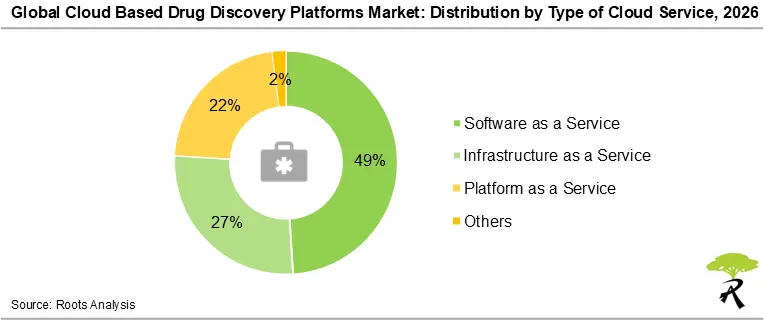
- In terms of type of cloud service, software as a service captures the largest share (around 50%) of the current market.
- With respect to type of cloud, hybrid cloud holds the highest share of the current market.
- Based on end user, pharmaceutical and life science companies capture the largest share of the current market.
- In terms of geographical regions, North America currently holds the highest market share (more than 40%).
Key Market Statistics
- Market Size in 2026: $4.2 Billion
- Estimated Market Size in 2035: $11.4 Billion
- CAGR (2026-2035): 11.7%
- North America: Largest market in 2026
- Asia-Pacific: Fastest growing region
Market Introduction
Cloud based drug discovery platforms are centralized, internet-hosted software ecosystems that provide scalable computing power, data storage, and advanced analytics tools to accelerate the discovery of new therapeutic compounds. These platforms support key drug discovery workflows, including target identification, molecular modeling, virtual screening, lead optimization, data management, predictive analytics, and collaborative research.
The growing complexity of drug discovery has increased the demand for platforms that can process large volumes of biological, chemical, clinical, and multi-omics data. Traditional on-premises systems often limit scalability, computational flexibility, and cross-functional collaboration. Cloud based platforms address these limitations by offering centralized data access, high performance computing capacity, workflow automation, and integration with AI and machine learning tools.
Adoption is also being driven by the rising use of data driven drug discovery models. Researchers are increasingly using cloud based platforms to improve hit identification, predict drug candidate properties, reduce experimental burden, and accelerate early-stage decision-making. These platforms also allow geographically distributed teams to collaborate more efficiently, which has become increasingly important as drug discovery programs involve multiple partners across research, development, informatics, and manufacturing functions.
Despite growing adoption, the market continues to face challenges related to data security, regulatory compliance, system interoperability, model validation, and integration with legacy research systems. However, continued advancements in AI-enabled discovery, cloud computing infrastructure, and collaborative research models are likely to create significant opportunities in the cloud based drug discovery platforms market.
Key Cloud Based Drug Discovery Platform Providers
| Company |
Established Year |
Headquarters |
Platform |
Core Platform Focus |
Key Capabilities |
| Amazon Web Services |
2006 |
Washington, United States |
Amazon Bio Discovery, AWS HealthOmics |
Cloud based AI, biological foundation models and omics workflow infrastructure |
Supports antibody design, AI guided model selection, lab-in-the-loop workflows, bioinformatics workflows and scalable research |
| Clarivate |
2016 |
London, United Kingdom |
Cortellis Drug Discovery Intelligence |
Scientific intelligence platform for early drug discovery and preclinical decision making |
Centralizes biological, chemical and pharmacological data to support target validation, disease profiling and compound optimization |
| Dassault Systèmes |
1981 |
Vélizy-Villacoublay, France |
BIOVIA Discovery Studio, BIOVIA Scientific Informatics Platform |
In silico modeling, molecular simulation and scientific data management |
Supports target identification, lead optimization, protein chemistry, molecular mechanics, free energy calculations, biotherapeutics developability |
| Google Cloud |
2008 |
California, United States |
Target and Lead Identification Suite, Google Cloud Life Sciences Solutions |
Cloud, AI and high-performance computing infrastructure for life sciences R&D |
Supports in silico drug design, antibody structure prediction, amino acid mutagenesis analysis, de novo protein design, AI model development |
| Accenture |
1951 |
Dublin, Ireland |
Life Sciences R&D Technology Services, AI and Cloud Transformation Services |
Digital transformation, AI implementation and cloud enabled R&D operating models |
Supports AI enabled drug discovery, R&D data modernization, cloud migration, workflow reinvention and integration of partner technologies |
| Alibaba Cloud |
2009 |
Zhejiang, China |
Alibaba Cloud HPC and AI Cloud Infrastructure |
Cloud infrastructure, high performance computing and AI support for computational drug discovery |
Enables researchers and hospitals to build computational drug discovery platforms on cloud, combining HPC simulation and AI algorithms |
| Cognizant |
1994 |
New Jersey, United States |
Digital Drug Discovery and Preclinical Solutions, Cognizant Neuro AI |
Generative AI, cloud and digital preclinical transformation services |
Supports novel compound generation, protein structure generation, RNA folding and scalable AI deployment across multi-cloud environments |
| HCLTech |
1991 |
Uttar Pradesh, India |
Life Sciences CloudSMART |
Cloud, AI and agentic R&D transformation services for life sciences |
Supports cloud modernization, data processing, generative AI enabled drug discovery, genomics research, scientific R&D workflows and AI driven discovery acceleration |
Market Segmentation
Based on the research, we have segmented the Cloud Based Drug Discovery Platforms Market into type of cloud service, type of cloud, end user, and geographical regions.
By Type of Cloud Service
- Software as a Service
- Infrastructure as a Service
- Platform as a Service
- Others
By Type of Cloud
- Hybrid Cloud
- Public Cloud
- Private Cloud
By End User
- Pharmaceutical and Life Science Companies
- CROs
- Others
By Geographical Regions
- North America
- Europe
- Asia-Pacific
- Middle East and North Africa
- Latin America
Cloud Based Drug Discovery Platforms Market Key Insights
What are the Key Drivers for Cloud Based Drug Discovery Platforms Market Growth?
- Rising Adoption of AI-Enabled Discovery Workflows: Pharmaceutical and biotechnology companies are increasingly using AI in drug discovery platforms to accelerate target identification, molecule generation, virtual screening, lead optimization, and candidate prioritization. Cloud based platforms support these workflows by providing scalable computing power, centralized data access, and the ability to run multiple models in parallel without building complex internal infrastructure. For instance, in April 2026, AWS launched Amazon Bio Discovery, which provides access to more than 40 AI biology models and supports AI-guided selection, computational workflow design, and wet lab validation.
- Growing Need for Scalable Data Integration and Collaborative Research: Modern drug discovery increasingly depends on large biological, chemical, genomic, transcriptomic, clinical, and real-world datasets. Cloud based platforms help research teams store, analyze, and share these datasets across distributed discovery networks, improving collaboration between pharmaceutical companies, technology providers, academic institutes, and CROs. This trend is reflected in recent large-scale cloud partnerships. For instance, in April 2026, Merck and Google Cloud announced a multiyear collaboration valued at up to USD 1 billion to deploy AI and cloud infrastructure across research and development, manufacturing, commercial, and corporate functions.
What are the Main Challenges for Market Growth?
- Data Security, IP Protection, and Regulatory Compliance Concerns: Drug discovery platforms handle highly sensitive data, including proprietary molecular structures, target biology, screening results, patient-linked datasets, and competitive pipeline information. This makes data security, access control, auditability, and vendor governance critical concerns for platform adoption. Pharmaceutical companies must also ensure that cloud based systems align with regulatory and data protection requirements, particularly when platforms support regulated research workflows or generate evidence used in development decisions.
- Data Quality and Model Validation Requirements: The effectiveness of cloud based drug discovery platforms depends on the quality and compatibility of input datasets. Many organizations still manage fragmented research data across legacy systems, internal databases, laboratory platforms, and external sources, making integration difficult. In addition, AI models used in drug discovery require robust validation, explainability, and context-specific performance assessment before stakeholders can rely on their outputs for discovery and development decisions.
Recent Developments in Cloud Based Drug Discovery Platforms Market
- In July 2026, Insilico Medicine entered into a strategic collaboration with Takeda to use its proprietary end-to-end Pharma.AI platform across Takeda's therapeutic areas. Under the agreement, Insilico will lead AI-driven discovery to identify molecules that meet predefined scientific and early development criteria. Takeda will then use its development capabilities to advance selected candidates through clinical validation.
- In June 2026, Evogene completed a major milestone in its collaboration with Google Cloud by integrating agentic computational systems into its ChemPass AI™ platform for small molecule discovery and optimization. The enhanced platform uses Google's Gemini models and Gemini Enterprise Agent Platform to support earlier biological and clinical target product profiling, improving scalability and candidate selection in early discovery.
- In June 2026, SandboxAQ announced that it will make its Large Quantitative Models accessible through Google Cloud Marketplace. The company stated that AQPotency, its drug discovery model, will become available on Google Cloud Marketplace in Q3 2026. This will enable researchers to computationally identify and prioritize promising binders at high throughput without specialized code or infrastructure.
- In April 2026, Flagship Pioneering entered into a collaboration with Amazon Web Services to accelerate drug discovery and life sciences innovation. Under the agreement, AWS became Flagship's preferred cloud provider. Flagship's early-stage companies will receive AWS cloud credits, technical support, and AI capabilities to build and scale digitally native and AI-native scientific platforms.
Industry Experts on Cloud Based Drug Discovery Platforms Market
Driven by the increasing digitalization of pharmaceutical R&D, cloud based drug discovery platforms are becoming the foundational infrastructure for integrating advanced technologies across discovery workflows.
Emphasizing this shift, Suketu Shah (Managing Director, Soham ERP), stated, "Pharma companies are using modern technologies like the Internet of Things (IoT), Cognitive Science, AI/ML, blockchain and RPA in unison, with cloud as the foundation."
Discussions with multiple stakeholders in this domain influenced the opinions and insights presented in this study. The market report includes transcripts of the following discussions:
- Vice President Growth, Small Company, US
- Regional Manager North and South America, Small Company, Switzerland
In addition, the market report includes transcripts of the following other third-party discussions:
- Chief Executive Officer, Chief Architect and Founder, Mid-sized Company, US
- Founder and Chief Executive Officer, Large Company, US
- Chief Executive Officer, Mid-sized Company, US
- Chief Executive Officer, Small Company, Canada
- Former Chief Technology Officer, Mid-sized Company, UK
- Former Chief Scientific Officer, Mid-sized Company, US
- Managing Director, Mid-sized Company, India
- Head of Data Science, Small Company, US
- Head of GTM, Strategic Partnerships & Alliances, Mid-sized Company, Germany
- Technical Lead, Large Company, US
Market Share Insights
Which Type of Cloud Service Accounts for the Largest Share in the Cloud Based Drug Discovery Platforms Market?
- As per cloud based drug discovery platforms market analysis, the software as a service segment occupies the highest market share (around 50%) in the current year, owing to its lower upfront infrastructure requirements, faster deployment, and subscription-based access to advanced drug discovery tools.
- The platform as a service segment is likely to grow at a higher CAGR during the forecast period. This growth is driven by the fact that PaaS enables pharmaceutical and biotechnology companies to build, integrate, and scale customized drug discovery workflows across AI modeling, molecular simulation, data analytics, and collaborative research environments.
Regional Analysis: Which Regions are Showing the Fastest Growth in Cloud Based Drug Discovery Platforms Industry?
North America: Dominating the Market by Securing Highest Share
According to our projections, North America is likely to capture the majority share (>40%) of the cloud based drug discovery platforms market in 2026. The region benefits from the strong presence of pharmaceutical companies, biotechnology firms, cloud infrastructure providers, and AI-driven drug discovery companies. Further, the early adoption of digital research platforms, advanced computational infrastructure, and high research expenditure supports the large-scale deployment of cloud based platforms across target identification, lead optimization, molecular modeling, and preclinical research workflows.
Asia-Pacific: Emerging as the Fastest Growing Region
The cloud based drug discovery platforms market in Asia-Pacific is likely to grow at the highest CAGR during the forecast period. The region is witnessing rising adoption of cloud based research platforms, driven by expanding pharmaceutical research activity, increasing biotechnology investments, and growing demand for cost-efficient drug discovery solutions. In addition, countries such as China, India, Japan, and South Korea are strengthening their digital healthcare and life sciences ecosystems. This enables regional companies and research institutes to adopt cloud enabled platforms for collaborative drug discovery, data management, and computational screening.
Scope of Cloud Based Drug Discovery Platforms Market Report
| Key Report Attribute |
Details |
| Historical Trend |
Since 2021 |
| Forecast Period |
Till 2035 |
| Market Size 2026 |
$ 4.2 Billion |
| Market Size 2035 |
$ 11.4 Billion |
| CAGR (till 2035) |
11.7% |
| Segments Covered |
- Type of Cloud Service
- Type of Cloud
- End User
- Geographical Regions
|
| Key Players |
(A complete list of players captured is available in the report)
|
PowerPoint Presentation
(Complimentary) |
Available |
| Customization Scope |
15% Free Customization |
Excel Data Packs
(Complimentary) |
Available |
Frequently Asked Questions
What are cloud based drug discovery platforms?
Cloud based drug discovery platforms are internet-hosted software ecosystems that support early-stage drug discovery workflows. These platforms provide scalable computing power, data storage, AI-enabled analytics, molecular modeling tools, virtual screening capabilities, and collaborative research environments.How big is the cloud based drug discovery platforms market?
The global cloud based drug discovery platforms market is estimated to be worth USD 4.2 billion in 2026.What is the projected market size of the cloud based drug discovery platforms market by 2035?
The cloud based drug discovery platforms market is anticipated to reach USD 11.4 billion by 2035.What is the likely growth rate of the cloud based drug discovery platforms market?
The market is likely to grow at a CAGR of 11.7% during the forecast period 2026 to 2035.Which region holds the largest share in the cloud based drug discovery platforms market?
Currently, North America holds the largest share of the cloud based drug discovery platforms market.Who are the leading players in the cloud based drug discovery platforms market?
Amazon Web Services, Clarivate, Dassault Systèmes, Google Cloud, Accenture, Alibaba Cloud, Cognizant and HCLTech.