
Lowest Price Guaranteed
Slides
227
Last Updated
September 2026
View Count
10885
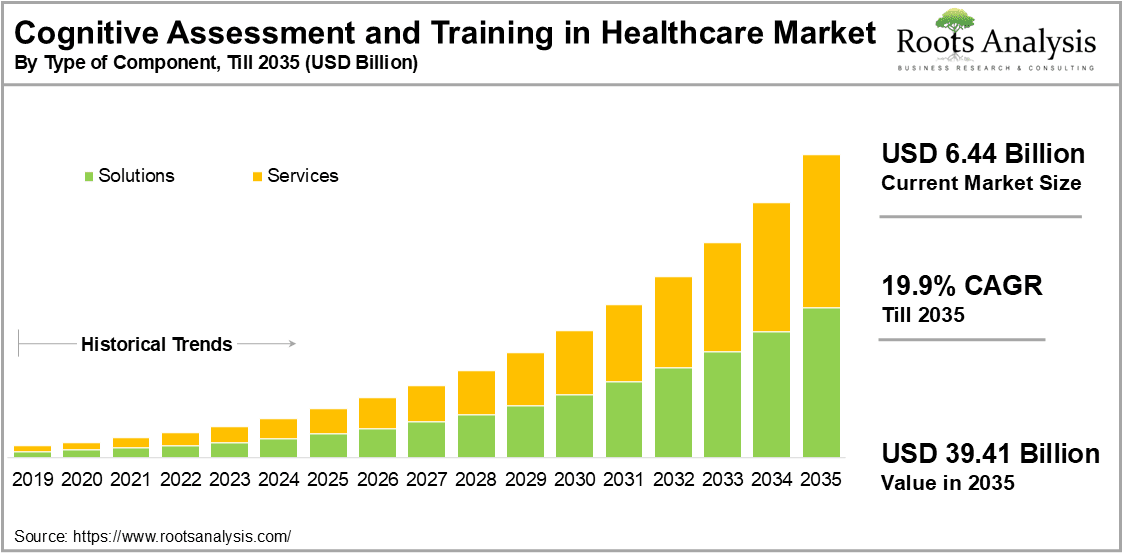
The cognitive assessment and training in healthcare market is estimated to grow from USD 6.44 billion in 2025 to USD 39.41 billion by 2035, representing a CAGR of 19.9% during the forecast period.
 |
To learn more about this report, request a free sample copy
Cognitive assessment and training is a unique approach for determining degree of intellect, verbal skills and perceptual skills. This methodology is helpful in evaluating the cognitive abilities of an individual. Cognitive assessment is also a mental process of understanding things through common sense and experience. It is important to highlight here that the demand for cognitive assessment and training has increased significantly due to the rising incidence of dementia and the increasing geriatric population with mental disorders. Cognitive assessment can also contribute to concussion evaluation and follow-up when interpreted alongside symptoms and other clinical findings.
A recent report published by the World Health Organization (WHO) highlighted that in 2023, over 55 million people suffered from dementia and around 10 million new cases are reported annually. Such rapid increase in dementia cases has necessitated the demand for advanced cognitive assessment instruments that aid in diagnosis and treatment planning. Cognitive assessment and training solutions in this instance emerge as a promising solution to diagnose dementia at early stages and designing treatment plans.
Furthermore, cognitive evaluation tools and instruments are also playing a crucial role in detecting abnormalities, such as dyscalculia and dyslexia in children. Currently, the industrial players are focusing on the development of cutting-edge cognitive assessment instruments featured with artificial intelligence and machine learning technologies for more personalized evaluation experience.
Additionally, industrial players are launching brain health applications and telehealth services that enable patients in self-assessment and disease management. For instance, in October 2024, FreelQTest.com launched an online IQ test platform, offering a professionally developed intelligence quotient (IQ) test. This platform features advanced algorithms and question generation technology that generate numerous questions for an IQ test session, enabling individuals to access cognitive assessment with higher accuracy rate.
Similarly, several investors have made significant investments in the field to make cognitive assessments more accessible and affordable to the population. For instance, in March 2024, BrainCheck (digital health company specializing in cognitive assessment) successfully secured USD 15 million in venture funding round led by Next Coast Ventures, UPMC and S3 ventures. The company will utilize these funds to accelerate innovations in cognitive assessment platform. As more industrial players continue to take strategic initiatives to offer advanced assessment solutions, we believe the market for cognitive assessment and training healthcare will continue to gain traction during the forecast period.
The market report provides comprehensive information about the leading industrial players who are active across various segments as mentioned in the table below.
| Key Report Attributes | Details | |
| Historical Trend | Since 2019 | |
| Forecast Period | Till 2035 | |
| Market Size 2035 | $39.41 Billion | |
| CAGR (Till 2035) | 19.9% | |
| Type of Assessment |
|
|
| Type of Component |
|
|
| Type of Technology |
|
|
| Indication Area |
|
|
| Type of Application |
|
|
| Delivery Mode |
|
|
| End Users |
|
|
| Geographical Regions |
|
|
| Key Companies Profiled |
|
|
| PowerPoint Presentation (Complimentary) |
Available | |
| Customization Scope | 15% Free Customization | |
| Excel Data Packs (Complimentary) |
Available | |
One of the key objectives of the cognitive assessment and training in healthcare market report was to estimate the current size, opportunity and the market growth potential, over the forecast period, till 2035. We have provided informed estimates on the likely evolution of the market for the forecast period.
The market analysis also features the likely distribution of the current and forecasted opportunity within the market distributed across various segments such as type of assessment (neuropsychological assessments, cognitive screenings, functional assessments, and behavioral assessments), type of component (solutions (assessment, data analysis & reporting, data management, and other solutions) and services (trainings & supports, and other services), type of technology (artificial intelligence, virtual reality, augmented reality, mobile applications and other technologies), by indication area (dementia, Alzheimer's disease, stroke, traumatic brain injuries, and multiple sclerosis), type of application (diagnostics, monitoring, treatment planning and rehabilitation), mode of delivery (in-clinics, remote and self-administered), end user (healthcare providers, education institutes, corporate organizations and research institutes), geographical regions (North America, Europe, Asia-Pacific, Middle East and North Africa, and Latin America) and leading players.
In order to account for future uncertainties associated with some of the key parameters and to add robustness to our model, we have provided three market forecast scenarios, namely conservative, base, and optimistic scenarios, representing different tracks of industry’s evolution.
All actual figures have been sourced and analyzed from publicly available information forums and primary research discussions. The financial figures mentioned in this market report are in USD, unless otherwise specified.
Based on the type of assessment, the global cognitive assessment and training in healthcare market is segmented into neuropsychological assessments, cognitive screenings, functional assessments, and behavioral assessments. According to our projection, currently neuropsychological assessment segment accounts for the highest share (45%) of the market. This dominance is due to the fact that cognitive assessment solutions and software are widely used to diagnose and treatment of patients with neurodegenerative diseases, such as Parkinson’s and Alzheimer’s. Moreover, this type of test can help in evaluating various cognitive capabilities and evaluate different types of cognitive functions, such as visual-spatial ability, working memory, concentration, informed processing speed and reaction time.
However, it is important to highlight here that cognitive screening is expected to register highest CAGR during the forecast period. This is likely to be the result of increasing usage of community-based programs for the detection of cognitive impairments. In January 2025, the Richardson police department in North Texas announced the launch of Take Me Home program that will support law enforcement to assist the people suffering from cognitive / developmental disabilities.
This segment highlights the distribution of market value across various types of components, such as solutions (assessment, data analysis & reporting, data management, and other solutions) and services (trainings & support, and other services). Currently, the services segment holds the maximum cognitive assessment and training in healthcare market share (over 50%). This can be attributed to the increasing shift towards telehealth services and high demand for advanced technologies-based solutions for cognitive assessment. In January 2025, Cambridge Cognition launched its rater training service to support efficient clinical trials for CNS disorders, training the clinical trial staff to score the assessments during trials.
It is important to highlight here that the solutions segment is anticipated to register a higher CAGR during the forecast period. This can be attributed to the fact that industrial players are offering various technology-based solutions for digital cognitive assessment, data management and analysis. In March 2024, Neurotrack Technologies entered into a partnership with Midi Health in order to offer a tool that will help women experiencing menopause to identify the reason behind brain fog, whether it is indicative of severe cognitive impairment or is due to menopause alone. As stated by Kathleen Jordan (Chief Medical Officer, Midi Health), “For most women with brain fog symptoms, a Neurotrack screening provides reassurance, but for a few it could help identify early dementia - a progressive disease that benefits from early detection and early treatment.”
The global cognitive assessment and training in healthcare market is segmented across various types of technology, such as artificial intelligence, virtual reality, augmented reality, mobile applications and other technologies. According to our projections, artificial intelligence accounts for the largest share (35%) of the market. AI-powered cognitive assessment instruments help in analyzing large amounts of data in real time, ensuring accuracy in diagnosis and identification of disease pattern. In the long run, virtual reality and augmented reality segment are likely to grow at a substantial CAGR during the forecast period. This lucrative growth is due to the fact that these metaverse in healthcare technologies offer immersive experience of assessment and improve patient outcomes with a realistic approach.
On the basis of targeted population, the global cognitive assessment and training in healthcare market is segmented into dementia, Alzheimer's disease, stroke, traumatic brain injuries, and multiple sclerosis. According to our projection, dementia holds the highest share of the market. Cognitive assessment solutions play a significant role in improving cognitive functions of the patients with dementia. Moreover, the growing awareness about benefits of using cognitive assessment solutions for early diagnosis and treatment has further contributed to the growth of this segment. It is important to highlight here that Alzheimer’s disease is likely to register highest CAGR during the forecast period.
Based on the type of application, global cognitive assessment and training in healthcare market is segmented into diagnostics, monitoring, treatment planning and rehabilitation. Among these, diagnostic is currently holding the highest share of the market. This is likely to be the result of higher efficacy of cognitive assessment tools in supporting neurosurgeons, neuropsychologists and researchers in making evidence-based treatment decisions. With cognitive assessment tools, neurologists can gain better insight into strength, weaknesses and deficiencies of neurological patients. Moreover, these tools also help in monitoring progress and supporting quantitative assessment of patients’ neurological health.
However, in the long run, rehabilitation is likely to register the highest CAGR during the forecast period. This is due to the increasing usage of cognitive assessment instruments to improve cognitive functions of the patients.
The global market is further bifurcated into in-clinics, remote and self-administered. It is worth mentioning here that in-clinic delivery mode dominates the market with a cognitive assessment and training in healthcare market share of 60%. This is due to the growing usage of cognitive assessment and training tools for offering comprehensive and personalized care to the patients. However, it is worth noting that remote and self-administered segments will show lucrative growth potential and register higher CAGR during the projected period. This can be attributed to the increasing demand for home healthcare and higher adoption rates of telemedicine for self-care and assessment.
On the basis of end user, the global cognitive assessment and training in healthcare market is categorized into healthcare providers, education institutes, corporate organizations and research institutes. According to our projection, the healthcare providers segment holds the highest share of the market. This can be attributed to the increasing usage of cognitive assessment and training solutions by healthcare providers to analyze people’s cognitive disabilities and mental progress.
However, in the long run research institutes segment is likely to grow at a higher CAGR during the forecast period. This is likely to be the result of increasing usage of cognitive assessment and training tools for a variety of research studies, particularly studies on neurological disorders.
Based on the geographical region, the global cognitive assessment and training in healthcare market is distributed across North America, Europe, Asia-Pacific, Middle East and North Africa, and Latin America. According to our analysis, North America occupies the highest share (35%) of the market. North America has the highest prevalence of neurological conditions, such as dementia and Alzheimer’s disease. Furthermore, the increasing technological advancements for the development of cognitive assessment tools and instruments has further fueled the market growth in this region. In addition, North American government has initiated several Alzheimer's Disease Supportive Services Program aiming to offer adaptive and comprehensive assessment services to patients suffering from Alzheimer’s disease.
However, in Asia-Pacific, the market for cognitive assessment and training in healthcare is expected to grow at a higher CAGR during the forecast period. This can be attributed to the growing government support and increasing advancements in healthcare infrastructure. A recent survey report published by Alzheimer’s Disease International highlighted that in Asia around 71 million people will have dementia by 2050. Thus, the highest prevalence of dementia has underscored the requirement of advanced cognitive assessment solutions in Asia, anticipated to be a key reason for accelerated growth.
The “Cognitive Assessment and Training in Healthcare Market: Industry Trends and Global Forecasts, till 2035” market report features an extensive study of the focus on competitive landscape of strategic initiatives, emerging mega trends, big pharma initiatives, company profiles and key drivers and restraints. The market report highlights the efforts of several stakeholders engaged in this rapidly evolving segment of the healthcare market. Key takeaways of the market report are briefly discussed below.
Currently, the market landscape witnesses the presence of several well-established and new entrants. These industrial leaders are focusing on the development of tech-driven cognitive assessment tools and instruments that aid in real-time analysis, enabling care providers in understanding disease progression and providing precise care. In order to maintain a competitive edge, several industrial players have taken strategic initiatives, such as latest launch, investments, collaborations and partnerships.
In November 2024, Virtuleap launched Cogniclear VR (a virtual reality based cognitive assessment tool) to deliver precise assessment, detection and monitoring of cognitive function. Earlier, in March 2024, Linus Health, a digital health company, acquired Aural Analytics, that is engaged in offering multimodal cognitive assessments and clinical-grade speech analytics platform. Overall, the market seems highly competitive, offering enormous opportunities to industrial leaders for strategic initiatives.
Some of the potential cognitive assessment and training in healthcare market drivers are rise in the incidence of neurological impairments and adoption of gamification for cognitive evaluation. It is worth noting here that healthcare providers are currently emphasizing the usage of cognitive tools for diagnosing and treating neurological impairments, such as dementia and dyslexia in children, which is anticipated to be the key driver for the market. Additionally, the increasing awareness about mental fitness and brain is accelerating the adoption of cognitive assessment and training tools. Furthermore, several healthcare experts are adopting gamification based cognitive evaluation tools, using a fun way to motivate patients for widespread cognitive evaluation.
Some of the potential cognitive assessment and training in healthcare market restraints are lack of technical expertise and stringent regulatory guidelines. It is important to highlight here that cognitive assessment instruments and tools require skilled personnel for operating. The dearth of the skilled professionals who understand advanced cognitive assessment and training technologies may create a significant challenge for the market players. Additionally, the stringent guidelines associated with the approval of cognitive assessment technologies may slow down the approval and launch of the products to be used by patients.
Despite the market challenges, this industry is continually witnessing an upsurge driven by the growing technological advancements and adoption of remote solutions. Notably, the penetration of telehealth services and remote patient monitoring solutions has opened pathway for accelerating research in advanced cognitive assessment and training solutions. It is worth noting here that several industrial players are also accelerating their efforts to enhance the development and adoption of cognitive assessment platforms and solutions.
The global market for cognitive assessment and training in healthcare is currently valued at USD 6.44 billion and is poised to reach USD 39.41 billion by 2035. Cognitive assessment plays a significant role in intellect and verbal skills in patients with mental or neurological conditions. representing a CAGR of 19.9% during the forecast period. It is worth noting here that several industry / non-industry players are extensively working to develop more assessment platforms and combine it with the novel technologies. As per research published by the Ohio State University Wexner Medical Center and College of Medicine in November 2024, the first clinical trial using telehealth showed that the use of remote video for cognitive behavioral therapy resulted in reduced ideation and attempts on suicide. As more market players continue to explore new solutions, we believe that this market will remain competitive offering enormous opportunities to industrial players.
Examples of the key players (which have also been profiled in this report) involved in cognitive assessment and training in healthcare industry includes (in alphabetic order) Aural Analytics (acquired by Linus Health), CogniFit, CNS Vital Signs, Cogstate, Cambridge Cognition, Cognetivity Neurosciences, Clario, KERNEL, Koninklijke Philips, Linus Health, Neurotrack Technologies, PAR, Pearson, Posit Science, Signant Health and Winterlight Labs. This market report includes an easily searchable excel database of all the companies focusing on the development of cognitive assessment and training solutions.
Several recent developments have taken place in the field of cognitive assessment and training in healthcare. We have outlined some of these recent initiatives below.