


 Download Free Sample
 Buy Now
Market Size
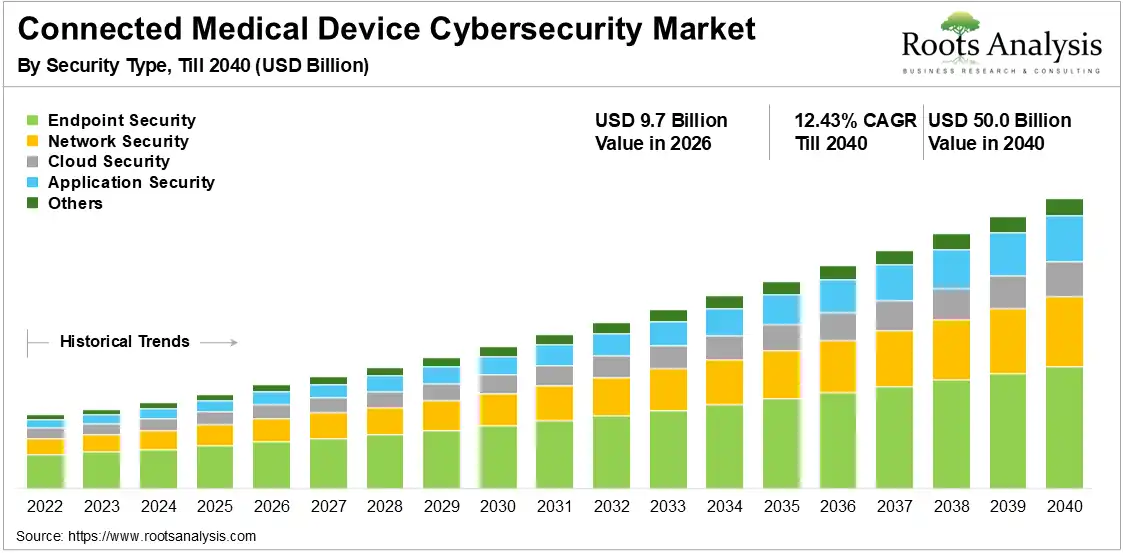
The global connected medical device cybersecurity market reached USD 9.7 billion in 2026 and is projected to reach USD 50.0 billion by 2040, growing at a CAGR of 12.43% over the forecast period 2026 to 2040, driven by rising IoMT exposure, FDA cybersecurity requirements, and hospital network risk.
See What’s in the Full Report – Request Your Complimentary Insights!
Market Report: Key Takeaways
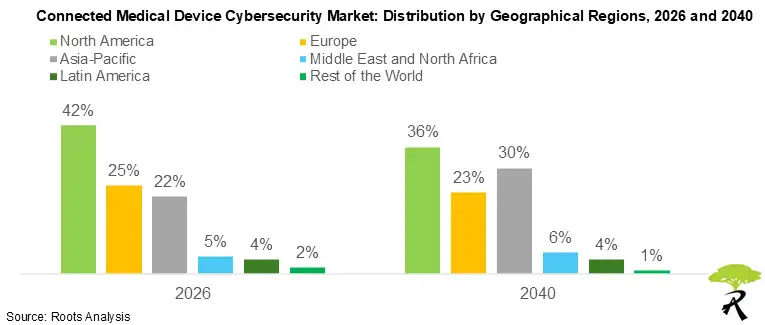
- Based on geography, North America captures 42.0% market share in 2026, whereas Asia-Pacific registers a 14.9% CAGR through 2040, driven by hospital digitization and regulatory catch-up.
- Based on component, the Solutions category captures 68.0% market share in 2026, whereas Services registers a 14.0% CAGR through 2040, driven by specialist talent shortages.
- Based on security type, Network Security captures 31.0% market share in 2026, whereas Cloud Security registers a 16.1% CAGR through 2040, driven by remote monitoring expansion.
- Based on device type, Hospital Medical Devices captures 60.0% market share in 2026, whereas Wearable and External Medical Devices registers a 14.9% CAGR through 2040, driven by distributed care.
- Based on application / capability, Asset Discovery and Device Inventory captures 25.0% market share in 2026, whereas SBOM and Software Supply Chain Security registers a 16.4% CAGR through 2040, driven by software transparency mandates.
Connected Medical Device Cybersecurity Market Outlook
Connected medical device security has shifted from point tools toward enterprise risk management, centered on asset discovery, segmentation, and SBOM evidence. The medical device cybersecurity market now reflects hospital exposure across IoMT fleets, manufacturer design-control obligations, and tightening procurement checks. Demand has moved beyond endpoint protection because many regulated devices cannot accept agents without clinical workflow disruption, pushing buyers toward passive monitoring and policy-based controls.
Current medical device cybersecurity market growth comes from FDA premarket expectations, unmanaged hospital devices, and rising cloud-connected care models. FDA issued final medical device cybersecurity guidance in February 2026, covering quality management system considerations and premarket submission content for cyber devices. This regulatory pressure is shifting budgets toward lifecycle vulnerability management, compliance reporting, and manufacturer security evidence across product development, procurement, and renewals.
Through 2040, adoption will remain high-growth but gradually moderate as platforms become embedded in provider and OEM operations. Cloud security, SBOM management, and services will gain share as connected medical device security expands beyond hospitals. CrowdStrike extended Falcon for XIoT into healthcare in March 2026, adding IoMT visibility within its platform. The outlook remains positive, with compliance and patient-safety risk sustaining demand across provider and manufacturer annual budgets.
Connected Medical Device Cybersecurity Market Dynamics
Connected Medical Device Cybersecurity Market Drivers
FDA cyber-device requirements, IoMT exposure, and hospital uptime risk are pulling security spending into regulated device workflows. Healthcare providers hold 62.0% share in 2026 because they manage heterogeneous fleets across monitors, pumps, imaging systems, and lab instruments. Asset discovery remains the largest capability at 25.0% share because unknown devices cannot be segmented, patched, or prioritized during incident response across connected care environments.
Connected Medical Device Cybersecurity Market Restraints
Legacy clinical assets constrain deployment because many hospital medical devices cannot support endpoint agents, frequent patching, or downtime-heavy remediation. On-premises deployment still holds 43.0% share in 2026 because hospitals prefer local traffic visibility and direct network control. Long device replacement cycles keep unmanaged exposure high, while clinical safety validation slows rapid platform standardization across departments and clinical engineering teams. This creates slower sales cycles for new entrants.
Connected Medical Device Cybersecurity Market Opportunities
Medical device manufacturers represent the fastest end-user opportunity as cybersecurity shifts into design control, SBOM evidence, and postmarket monitoring. This segment grows at 14.5% CAGR through 2040, ahead of healthcare providers. Medcrypt expanded its product security intelligence platform in May 2025 for premarket and postmarket cybersecurity teams. That move supports OEM compliance workflows and product-security commercialization. It also differentiates lifecycle platforms from generic scanners.
Connected Medical Device Cybersecurity Market Challenges
SBOM and vulnerability management create execution challenges because manufacturers and providers need component-level evidence across long device lifecycles. SBOM and software supply chain security grows at 16.4% CAGR, yet it starts from only 8.0% share in 2026. Buyers must connect software bills, exploitability context, clinical criticality, and regulatory reporting without overwhelming engineering or biomedical teams during remediation decisions. This raises integration cost and buyer scrutiny.
Connected Medical Device Cybersecurity Market Size Estimation Methodology
- As a starting point, the forecast anchored the medical device cybersecurity market to direct medical-device-security estimates from multiple credible secondary sources. Broader healthcare IoT security and narrow solution-only estimates were treated as scope checks, not as primary sizing anchors. The model retained solutions, services, provider adoption, manufacturer compliance, and payer participation within one normalized taxonomy. This avoided double-counting generic healthcare cybersecurity spending.
- Moving forward, the analysis mapped demand to device type, deployment mode, security type, end user, and application capability. Hospital medical devices received the largest 2026 weighting because providers operate dense fleets across monitors, pumps, imaging, and lab systems. Wearable and external medical devices received higher long-term growth weighting because remote patient monitoring expands security needs outside facilities.
- Building on this, segment shares were calibrated using specific adoption constraints and technology pathways. Network security received a leading near-term share because many medical devices cannot accept endpoint agents. Cloud security, application security, and SBOM software supply chain security received higher CAGRs because telemetry, generative insights, and component-level evidence are scaling across connected care.
- Drawing upon these, the regional model used regulatory submission counts, national digital health regulation, hospital digitization indicators, and connected device manufacturing footprints. North America received the highest 2026 share because FDA cybersecurity compliance, cyber insurance pressure, and mature hospital IT spending support early adoption. Asia-Pacific received the fastest growth because digital health programs and device manufacturing expansion localize demand.
- The projected value was then developed through a consensus curve that links regulatory enforcement, platform adoption, managed services growth, and long-term moderation. The curve accelerates in the early period as hospitals formalize IoMT security solutions. It later moderates as asset discovery becomes standard, while SBOM vulnerability management and incident response remain higher-growth capabilities. Services gained weight where customers lacked specialist biomedical security teams.
- Finally, the forecast was cross-checked against recent developments, vendor positioning, M&A signals, partnerships, product launches, and policy updates after January 2025. ServiceNow’s Armis acquisition, Axonius’s Cynerio acquisition, and Medcrypt’s product-security expansion supported the consolidation and lifecycle-security assumptions. Segment-level outputs were reviewed for internal consistency across share trends, CAGR rankings, and buyer adoption logic.
Connected Medical Device Cybersecurity Market Share Insights
Market Share by Device Type
According to our analysis, Hospital Medical Devices lead because hospitals operate dense fleets of monitors, imaging systems, pumps, and lab instruments. Long replacement cycles create persistent unmanaged-device exposure and demand continuous visibility. Example: Claroty, March 2025, analyzed over 2.25 million IoMT devices across healthcare environments.
Wearable and External Medical Devices will grow fastest as remote monitoring expands outside clinical facilities. These devices generate sensitive longitudinal data and require scalable security across home and mobile settings. Example: Validic, February 2025, launched generative AI-powered insights for remote patient monitoring.
Market Share by End User
Healthcare Providers lead because they own operational uptime, patient safety risk, and clinical network exposure. Providers also manage heterogeneous assets from many OEMs, creating high demand for asset discovery. Example: Axonius, July 2025, acquired Cynerio to target healthcare medical-device security.
Medical Device Manufacturers will grow fastest as cybersecurity shifts into design control, SBOM, and postmarket monitoring. Regulatory submissions increasingly require secure development evidence and vulnerability management plans. Example: Medcrypt, February 2025, launched Helm for SBOM vulnerability management for medical device manufacturers.
Want Information on Specific Region / Segment?
Regional Analysis: North America Leads the Market and Asia-Pacific is Likely to Register Higher CAGR
Presently, North America holds 42.0% share in 2026. Its dominance reflects mature hospital IT budgets, FDA cybersecurity requirements, cyber insurance pressure, and deep vendor ecosystems. The region also benefits from high EHR, telehealth, and connected device penetration.
On the contrary, Asia-Pacific grows at 14.9% CAGR from 2026 to 2040. Growth reflects hospital digitization, digital health regulation, device manufacturing expansion, and rising cyber awareness. South Korea, Japan, China, India, and Australia will localize demand through national digital health programs.
Market Ecosystem Analysis
Within the provided scope, eight Tier 1 leaders anchor commercial activity, followed by ten specialists and eight emerging entrants. Platform convergence dominates consolidation as vendors combine asset discovery, exposure management, segmentation, EDR, SBOM, and compliance workflows. The primary commercial force is regulatory and procurement pressure linking device cybersecurity to patient safety and market access. FDA issued updated medical-device cybersecurity guidance in June 2025, while RunSafe’s June 2025 index tied device attacks to patient-care disruption and purchasing behavior. Competitive advantage is shifting from complete inventory to clinical-context prioritization and software-supply-chain evidence.
- Armis introduced Clinical Impact Score in July 2025 for Armis Centrix Medical Device Security. It adds FDA device class, patient dependence, equipment class, and failure effects to triage. This raises the barrier for inventory-only rivals and strengthens vulnerability and risk management.
- Claroty gained February 2026 Top Performer validation in Healthcare IoT Security from KLAS. The score came from 35 healthcare organizations, giving Claroty stronger customer-proof than many CPS rivals. It supports asset discovery, risk management, and healthcare provider sales.
- Forescout’s IoMT Security solution won March 2025 Cybersecurity Excellence recognition for securing healthcare networks. The result reinforces single-platform visibility and control across IT, OT, IoT, and IoMT. It pressures point tools and strengthens network security, segmentation, and asset inventory.
- CrowdStrike extended Falcon for XIoT to healthcare medical devices in March 2026. The beta adds protocol visibility across DICOM, HL7, clinical devices, and IoT assets. That pressures network-only vendors by bringing IoMT risk into EDR, exposure management, SIEM, and SOAR.
- Forescout and Netskope formed a February 2026 zero-trust partnership for IT, OT, IoT, and IoMT. The integration combines device intelligence with cloud access controls and local east-west traffic protection. It strengthens network segmentation, access control, and cloud security.
- Axonius expanded healthcare cybersecurity with new AI capabilities in October 2025. The move turns clinical asset intelligence into policy and exposure management across medical, IoT, and OT assets. It pressures standalone visibility specialists and strengthens asset discovery for providers.
- Medcrypt debuted a Security Intelligence Platform for medical devices in June 2025. The platform translates cybersecurity gaps into financial impact and supports FDA-readiness workflows. It pressures generic SBOM tools and strengthens compliance reporting and software supply-chain security.
- C2A Security signed a May 2025 multi-year agreement with Elekta for product cybersecurity and global compliance. Elekta uses EVSec for threat modeling, SBOMs, compliance reporting, and vulnerability response from pre-market to post-market. This strengthens the medical device manufacturer segment and raises product-security lifecycle barriers.
- C2A Security also acquired Vigilant Ops in October 2025 to add MedTech SBOM automation. The acquisition strengthens FDA and EU MDR readiness while expanding lifecycle product-security coverage. It pressures services-only consultants and narrows the gap between SBOM management and embedded product security.
Startup Companies and their Key Highlights
- Medcrypt
- Event type: Product launch, Medical Device Product Security Intelligence Platform
- Month and year: May 2025
- Stated purpose: Assess product security posture, identify gaps, quantify cyber risk, and generate cost-aligned remediation plans.
- Market implication: Accelerates SBOM, vulnerability management, and compliance reporting for medical device manufacturers.
- C2A Security
- Event type: Acquisition of Vigilant Ops
- Month and year: October 2025
- Stated purpose: Add MedTech SBOM automation, faster compliance, stronger supply-chain security, and regulatory readiness.
- Market implication: Accelerates product-security lifecycle management for medical device manufacturers and strengthens SBOM workflow automation.
- Finite State
- Event type: Regional expansion
- Month and year: April 2025
- Stated purpose: Expand into EMEA with a dedicated team for software supply-chain security and regulatory compliance.
- Market implication: Accelerates Europe, Middle East, and Africa coverage for product security and compliance-led device cybersecurity.
- RunSafe Security
- Event type: Research report release, 2026 Medical Device Cybersecurity Index
- Month and year: April 2026
- Stated purpose: Quantify medical-device cyberattack impact and show tightening procurement standards.
- Market implication: Accelerates embedded software hardening and runtime protection for hospital and manufacturer-side security programs.
- NetRise
- Event type and funding amount: Series A funding, USD 10 million
- Month and year: April 2025
- Lead investor: DNX Ventures
- Stated purpose: Grow its software supply-chain security platform and expand market reach.
- Market implication: Accelerates firmware and binary software visibility for connected medical-device fleets and legacy embedded systems.
Connected Medical Device Cybersecurity Market Trends / Opportunities
Connected Medical Device Cybersecurity Market Asset Visibility Consolidation Driving Platform-Led Sales
Asset discovery is becoming the control point for medical device risk programs. Larger platforms gain an entry route into hospitals through unified asset intelligence.
Clinical environment visibility is moving from niche device inventories into broader exposure management. Axonius acquired Cynerio in July 2025 to target healthcare medical-device security and clinical asset intelligence. This strengthens competition for vendors that can connect inventory, risk scoring, and remediation workflows. It also raises acquisition value for specialist healthcare device datasets.
Connected Medical Device Cybersecurity Market SBOM Requirements Expanding OEM Product-Security Budgets
Regulatory evidence is shifting cybersecurity upstream into device design and submission workflows. FDA issued final guidance in February 2026 covering cybersecurity quality management and premarket submission content for cyber devices. OEMs now need platforms that link SBOMs, vulnerability handling, and secure development evidence.
Machine-learning enabled devices are adding a specialized compliance layer to embedded medical device security. FDA recognized AAMI CR515:2025 in December 2025 for cybersecurity considerations unique to machine-learning enabled medical devices. Vendors that support AI-enabled device documentation gain a compliance-led differentiation path.
Product security lifecycle platforms are gaining because postmarket monitoring cannot rely on static submission files. Medcrypt expanded its platform in May 2025 for premarket and postmarket cybersecurity teams. This trend favors vendors that serve manufacturers across design, launch, and field support. It turns regulatory readiness into recurring software and services revenue.
Cloud-Connected IoMT Security Shifting Competitive Advantage Toward XIoT and Zero Trust Platforms
Cloud security is outgrowing traditional network controls as remote patient monitoring and device telemetry expand. Cloud security grows at 16.1% CAGR through 2040, while cloud-based deployment reaches 48.0% share. CrowdStrike extended Falcon for XIoT into healthcare in March 2026, adding protection and visibility for IoMT devices. Platform vendors gain share when they connect endpoint, network, and unmanaged-device telemetry.
Distributed care is pushing device security beyond hospital perimeters into home and mobile settings. Validic launched Health IoT and remote patient management solutions in AWS Marketplace in March 2025. Security vendors that support identity, device posture, and managed analytics can access broader digital health channels. Marketplace availability can shorten buying cycles for cloud-connected care programs.
Your Business is Unique – Why Shouldn’t Your Report Be?
Market Access Considerations
FDA Premarket and Quality System Evidence
FDA cybersecurity guidance now shapes access because cyber-device submissions need quality management evidence, security architecture details, and lifecycle risk planning. This raises entry costs for OEM-focused vendors that cannot map controls to submission content. It enables providers with regulatory-ready workflows to win manufacturer budgets earlier. FDA issued final guidance in February 2026 covering quality system considerations and premarket content. Vendors with submission-ready templates shorten buying cycles for regulated manufacturers. This improves pricing power in OEM security programs.
SBOM and Software Supply Chain Traceability
SBOM traceability determines access because manufacturers need component-level evidence before and after product launch. Platforms must connect vulnerability intake, exploitability assessment, and remediation records across long device lifecycles. This favors lifecycle product-security vendors over generic asset scanners. Medcrypt launched an enhanced Helm SBOM vulnerability management tool for medical device manufacturers in February 2025. Strong SBOM workflows also support recalls, supplier reviews, and postmarket reporting. This expands renewal value after initial implementation.
Clinical Network Constraints and Non-Agent Deployment
Clinical network constraints shape commercialization because hospitals cannot disrupt devices that support patient monitoring, imaging, infusion, and laboratory workflows. Vendors need passive discovery, network segmentation, and access-control capabilities that avoid unsafe downtime. This requirement favors platforms proven in healthcare networks. Forescout received a March 2025 healthcare network security recognition for its unified platform to secure healthcare networks. Non-agent deployment becomes a qualification gate for hospital pilots. It also narrows competition against general endpoint vendors.
Procurement Scrutiny and Cyber Risk Benchmarks
Procurement standards increasingly decide which vendors reach shortlists because hospitals and OEMs face higher cyberattack exposure. Buyers want evidence on device hardening, vulnerability processes, and clinical risk reduction before renewal. This benefits firms that package benchmarking, compliance evidence, and executive reporting. RunSafe Security released its 2026 Medical Device Cybersecurity Index in April 2026, highlighting attacks and tighter procurement standards. Benchmark-led selling can separate specialist vendors from general security tools. It supports board-level justification for larger renewals.
How Stakeholders Benefit from the Key Focus Areas of Our Connected Medical Device Cybersecurity Market Report
FDA cybersecurity compliance, unmanaged IoMT fleets, and connected care expansion make this market commercially urgent. The report supports prioritization across platforms, services, SBOM workflows, regional expansion, and partnership targets.
- Unmet Needs and Market Gaps in Connected Medical Device Cybersecurity Market: The report identifies where hospitals still lack healthcare IoT asset discovery, segmentation, and vulnerability prioritization. Security and clinical engineering leaders use this view to decide whether to buy integrated platforms or specialist modules. The analysis supports budget allocation across asset inventory, threat detection, and compliance reporting.
- Funding and Venture Investment Opportunities in Connected Medical Device Cybersecurity Market: The report maps high-growth areas such as services at 14.0% CAGR and SBOM software supply chain security at 16.4% CAGR. Corporate development and investment teams use these signals to compare platform consolidation against product-security specialists. ServiceNow completed its Armis acquisition in April 2026, showing buyer interest in asset visibility platforms.
- Technology Innovation and Adoption Trends: The report tracks adoption across cloud security, application security, XIoT visibility, SBOM vulnerability management, and embedded medical device security. Technology leaders use these findings to select architectures that fit non-agent devices and distributed care models. CrowdStrike extended Falcon for XIoT into healthcare in March 2026, signaling platform expansion into IoMT environments.
- Connected Medical Device Cybersecurity Market Competitive Landscape and Industry Analysis: The report segments Tier 1 leaders, Tier 2 specialists, and emerging providers across platforms, PKI, SBOM, runtime protection, and product security. Business development teams use this structure to identify partners, white spaces, and competitive displacement opportunities. Axonius acquired Cynerio in July 2025, showing how clinical visibility capabilities can reshape positioning.
- Mapping Strategic Partnerships and Ecosystem Synergies: The report links providers, OEMs, product-security vendors, PKI specialists, and embedded runtime providers into actionable ecosystem roles. Alliance teams use this map to target partners that cover lifecycle gaps across design, deployment, and postmarket monitoring. Thirdwayv and Medcrypt partnered in October 2025 to advance cybersecurity and interoperability across connected device lifecycles.
- Connected Medical Device Cybersecurity Market CAGR and Growth Trends: The report explains why the market grows at 12.4% CAGR through 2040 while segment growth varies sharply. Strategy teams use CAGR differences to prioritize cloud security, SBOM, services, wearable devices, and Asia-Pacific expansion. This supports decisions on portfolio investment, regional entry timing, and long-term product roadmap focus.
Connected Medical Device Cybersecurity Market: Scope of the Report
| Key Report Attributes | Details | |
| Forecast Period | Till 2040 | |
| Market Size 2026 | USD 9.7 Billion | |
| Market Size 2040 | USD 50.0 Billion | |
| CAGR (Till 2040) | 12.43% | |
| Segments Covered |
|
|
| Geographical Regions Covered |
|
|
| Key Sections Covered |
|
|
Market Segmentation
The Connected Medical Device Cybersecurity Market report presents an in-depth analysis, highlighting the capabilities of various stakeholders, based on different segments, such as component, security type, device type, deployment mode, end user, application / capability, geographical regions, and leading players.
By Component
- Solutions
- Services
By Security Type
- Endpoint Security
- Network Security
- Cloud Security
- Application Security
- Others
By Device Type
- Hospital Medical Devices
- Wearable and External Medical Devices
- Internally Embedded Medical Devices
By Deployment Mode
- Cloud-Based Deployment
- On-Premises Deployment
- Hybrid Deployment
By End User
- Healthcare Providers
- Medical Device Manufacturers
- Healthcare Payers
- Others
By Application / Capability
- Asset Discovery and Device Inventory
- Vulnerability and Risk Management
- Network Segmentation and Access Control
- Threat Detection and Incident Response
- SBOM and Software Supply Chain Security
- Compliance and Regulatory Reporting
By Geographical Regions
- North America
- US
- Canada
- Mexico
- Rest of North America
- Europe
- Austria
- Belgium
- Denmark
- France
- Germany
- Ireland
- Italy
- Netherlands
- Norway
- Russia
- Spain
- Sweden
- Switzerland
- UK
- Rest of Europe
- Asia-Pacific
- China
- India
- Japan
- Singapore
- South Korea
- Rest of Asia-Pacific
- Latin America
- Argentina
- Brazil
- Chile
- Colombia
- Venezuela
- Rest of Latin America
- Middle East and Africa (MEA)
- Egypt
- Iran
- Iraq
- Israel
- Kuwait
- Saudi Arabia
- UAE
- Rest of MEA
- Rest of the World


