


 Download Free Sample
 Buy Now
Market Size
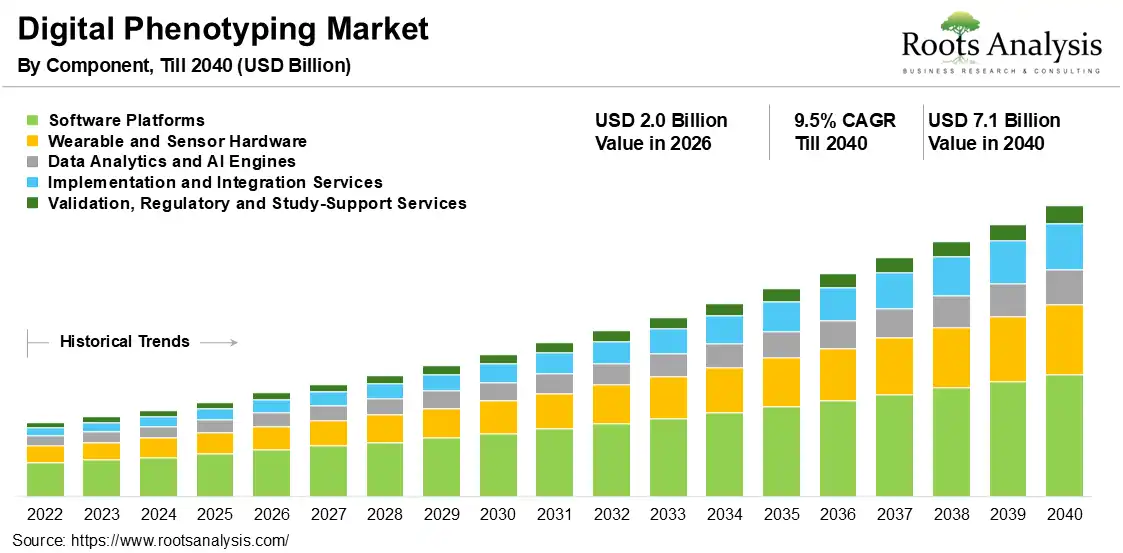
The global digital phenotyping market is expected to rise from USD 2.0 billion in 2026 and is projected to reach USD 7.1 billion by 2040, growing at a CAGR of 9.5% over the forecast period 2026 to 2040, driven by regulated remote digital endpoints and AI-enabled multimodal capacity monitoring.
See What’s in the Full Report – Request Your Complimentary Insights!
Market Report: Key Takeaways
- Based on Geography, North America captures 42.0% market share in 2026, whereas Asia-Pacific registers a 12.4% CAGR through 2040, driven by healthcare digitalization and trial localization.
- Based on Component, Software platforms capture 40.0% market share in 2026, whereas Data analytics and AI engines register a 13.0% CAGR through 2040, driven by algorithmic endpoint scaling.
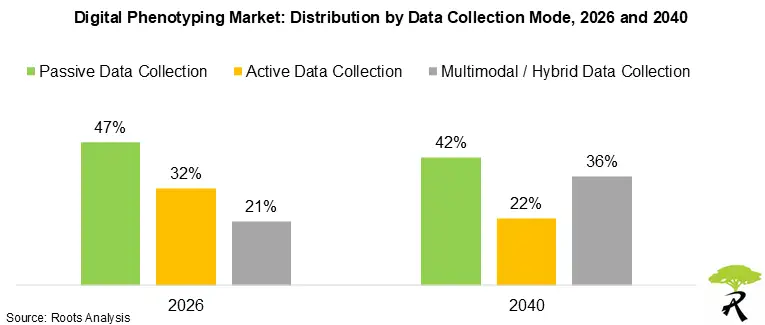
- Based on Data Collection Mode, Passive data collection captures 47.0% market share in 2026, whereas Multimodal / hybrid data collection registers a 13.8% CAGR through 2040, driven by integrated signal fusion.
- Based on Device / Data Source, Smartphones capture 36.0% market share in 2026, whereas Voice and speech interfaces register a 15.0% CAGR through 2040, driven by low-friction ambient screening.
- Based on Application, Mental health monitoring captures 27.0% market share in 2026, whereas Clinical-trial endpoint measurement registers a 12.9% CAGR through 2040, driven by validated digital endpoints.
- Based on End User, Healthcare providers capture 31.0% market share in 2026, whereas Pharmaceutical and biopharmaceutical companies register an 11.7% CAGR through 2040, driven by decentralized trial adoption.
Digital Phenotyping Market Outlook
Digital phenotyping is moving from smartphone symptom tracking into regulated multimodal evidence infrastructure for trials and care programs. Software platforms still anchor adoption because they combine consent, data capture, dashboards, and compliance workflows. Demand now shifts toward AI engines, voice biomarkers, and validation services as sponsors need endpoint automation, lower participant burden, and evidence-grade real-world patient data across remote settings and hybrid study designs globally.
Current growth reflects decentralized clinical trials, remote patient monitoring, and regulatory acceptance of digital health technologies for drug development. FDA’s June 2026 DHT program recognizes electronic sensors, computing platforms, and IT for remote clinical-trial data collection from patients. WHOOP expanded continuous wearable insight into targeted biomarker testing in April 2026 through Specialized Panels powered by Quest Diagnostics, linking wearables with laboratory data longitudinally across programs.
Through 2040, the digital phenotyping market will remain high-growth as passive sensing, multimodal data fusion, and clinical-trial endpoint measurement gain share. Voice interfaces will grow fastest among data sources, while pharmaceutical and biopharmaceutical companies will outpace provider adoption. Empatica acquired PKG Health in October 2025 to add Parkinson’s algorithms and digital endpoints to wearable monitoring. The outlook remains positive, but validation requirements will separate scalable platforms from research tools.
Digital Phenotyping Market Dynamics
Digital Phenotyping Market Drivers
Regulated remote evidence collection now drives digital phenotyping market growth because sponsors need continuous endpoint data beyond trial sites. Passive data collection holds 47.0% share in 2026, while multimodal and hybrid collection grows at 13.8% CAGR through 2040. FDA’s June 2026 DHT program supports remote clinical-trial data collection through electronic sensors, computing platforms, and IT, giving sponsors a clearer operating path.
Digital Phenotyping Market Restraints
Clinical validation and regulatory clearance remain the main adoption restraints for voice biomarkers, AI engines, and endpoint algorithms. Kintsugi shut down in April 2026 after failing to secure FDA clearance for its depression-detecting voice AI, showing that technical promise alone cannot support commercialization. Buyers now prefer platforms with validated measures, audit trails, trial-grade evidence workflows, and clear regulatory documentation.
Digital Phenotyping Market Opportunities
Clinical-trial endpoint measurement creates the clearest opportunity because it grows at 12.9% CAGR through 2040. Pharmaceutical and biopharmaceutical companies grow at 11.7% CAGR as sponsors use digital endpoints for recruitment, adherence, endpoint sensitivity, and post-market evidence. Thermo Fisher completed acquisition of Clario in March 2026, strengthening clinical-trial data and endpoint capabilities at scale.
Digital Phenotyping Market Challenges
Interoperability, data governance, and patient adherence challenge scaling across smartphones, wearables, eCOA apps, and connected medical sensors. Smartphones lead device share at 36.0% in 2026, but bring-your-own-device models complicate data quality, support, and protocol consistency across regions and study populations. Medable highlighted web, mobile, and bring-your-own-device capture in September 2025, underscoring the need for standardized workflows across decentralized studies.
Digital Phenotyping Market Size Estimation Methodology
- As a starting point, the digital phenotyping market forecast used multiple credible secondary sources to frame a 2022 historical series, 2026 base year, and 2040 endpoint. The model excluded outlier growth readings when scope signals conflicted with smartphone, wearable, sensor, mobile app, and clinical endpoint definitions. This preserved a core digital biomarkers and passive sensing boundary for comparable forecasting.
- Moving forward, the baseline was reconciled against component-level demand for software platforms, wearable and sensor hardware, data analytics and AI engines, implementation services, and validation support. Software platforms retained the largest 2026 share because they bundle consent, capture, dashboards, and compliance workflows. AI engines received higher growth weight because endpoint automation and multimodal training data expand algorithm demand.
- Building on this, application shares were tested against clinical trial databases, decentralized study adoption, remote patient monitoring programs, and disease-area endpoint needs. Mental health monitoring received the largest 2026 allocation because behavior signals fit high-frequency psychiatric assessment. Clinical-trial endpoint measurement received the fastest growth curve because sponsors need continuous, regulator-ready evidence outside trial sites and during hybrid follow-up.
- Drawing upon these, device and data-source assumptions were mapped across smartphones, wearables, connected medical sensors, voice interfaces, ePRO apps, and ambient sensors. Smartphone adoption received the largest near-term share because bring-your-own-device models reduce deployment friction. Voice and speech interfaces received the fastest growth rate because cognitive, respiratory, and mental-health screening can occur with low participant burden.
- The projected value was then stress-tested by region using regulatory submission counts, clinical sponsor density, digital-health capital availability, and local trial infrastructure. North America received the largest 2026 share because FDA digital-health engagement, trial sponsor density, and remote evidence programs support early commercialization. Asia-Pacific received the fastest growth path because China, India, Japan, and Southeast Asia are localizing digital trials.
- Finally, the model converted segment shares into annual growth curves, then checked them against funding signals, partnership activity, acquisition moves, and technology launches from 2025 onward. The final digital phenotyping market forecast kept higher growth for AI engines, multimodal collection, voice interfaces, clinical-trial endpoints, and pharmaceutical users. Segments with hardware dependency or manual validation requirements received more moderate growth assumptions.
Digital Phenotyping Market Share Insights
Market Share by Component
According to our analysis, software platforms lead because they combine data capture, consent, analytics, dashboards and compliance workflows. Their lower marginal deployment cost supports broader use across studies and care programs. ActiGraph, January 2025, acquired Biofourmis Connect to combine digital-trial software and data ecosystems.
Data analytics and AI engines will expand fastest as sponsors need validated algorithms and endpoint automation. The category benefits from multimodal training data and regulatory-facing evidence workflows. Ametris, August 2025, partnered with Luca Healthcare to accelerate AI-enabled DHT deployment in US and Chinese trials.
Market Share by Data Collection Mode
Passive data collection leads because it reduces recall bias and participant burden. It fits continuous monitoring across sleep, activity, cough, cardiac and medication-response endpoints. ActiGraph, January 2025, introduced its Hyfe cough-monitoring solution using LEAP for passive day and night collection.
Multimodal / hybrid data collection will grow fastest as sponsors combine physiology, behavior and patient-reported context. These datasets support stronger endpoint validation and richer longitudinal interpretation. Empatica, December 2025, outlined eCOA data integrated with wearable biomarkers in a unified pipeline.
Want Information on Specific Region / Segment?
Regional Analysis: North America Leads the Market and Asia-Pacific is Likely to Register Higher CAGR
Presently, North America holds a 42.0% share in 2026. North America leads because it combines trial sponsor density, digital-health capital, AI infrastructure and regulatory engagement. FDA, June 2026, maintained a DHT drug-development program covering remote data collection and decentralized evidence generation.
On the contrary, Asia-Pacific registers a 12.4% CAGR from 2026 to 2040. The growth will accelerate as China, India, Japan and Southeast Asia localize digital trials and remote-monitoring infrastructure. Ametris, August 2025, partnered with Luca Healthcare to expand AI-enabled digital-health solutions across China and Asian clinical trials.
Market Ecosystem Analysis
Commercial activity concentrates around 11 Tier 1 leaders, with seven specialists and seven emerging entrants filling modality-specific gaps. Acquisition-driven consolidation now dominates, as larger endpoint and care platforms absorb respiratory monitoring, wearable capture, eCOA oversight, and disease-specific analytics. The primary commercial force is pharma demand for protocol-ready digital endpoints that link passive signals with active assessments. Competitive advantage is shifting toward validated multimodal stacks, because sponsors now buy analyzable longitudinal data, compliance workflows, and regulatory evidence.
- Clario’s October 2025 acquisition agreement with Thermo Fisher lifts digital endpoint capture into a scaled clinical-research services stack. The deal pressures standalone wearable vendors by raising enterprise procurement expectations around imaging, eCOA, cardiac, respiratory, and wearable data integration. It strengthens clinical-trial endpoint measurement, validation services, and connected medical sensor workflows.
- Ametris acquired Biofourmis Connect in January 2025, adding device-agnostic software and proprietary AI-driven algorithms to its digital health ecosystem. This expands its position beyond actigraphy into ECG, pulse oximetry, spirometry, blood pressure, pain, and cytokine release syndrome measures. The move strengthens software platforms, AI engines, connected sensors, and validation support for pharma trials (https://blog.ametris.com/news/actigraph-acquires-biofourmis-life-science-business).
- Huma partnered with Eckuity Capital and acquired Aluna in May 2025, expanding respiratory remote monitoring through Aluna’s U.S. network. The acquisition strengthens Huma’s cloud platform in asthma, COPD, sleep apnea, and respiratory patient monitoring. This pressures narrow RPM vendors and supports chronic disease management, remote patient monitoring, and provider-facing deployment.
- Clario and Oxford’s NeuroMetrology Lab enrolled the first participant in October 2025 for Parkinson’s research using the Opal wearable system. The collaboration advances gait, balance, home task, and passive mobility measurement in remote settings. It strengthens neurodegenerative disorder monitoring and clinical-trial endpoint measurement.
- Ametris partnered with Modality.AI in July 2025 to combine audiovisual biomarkers with physical function, sleep, and vital-sign measures. The partnership gives sponsors a broader multimodal endpoint stack for ALS, Parkinson’s disease, and neuropsychiatric studies. It raises barriers for single-modality tools in speech, cognition, and passive wearable monitoring.
- Rune Labs and the Parkinson’s Foundation launched a June 2025 clinical program linking genetics with StrivePD’s wearable-derived symptom data. Participants use iPhones and Apple Watches to capture tremor, dyskinesia, routines, and treatment use. The program strengthens Parkinson’s stratification, neurodegenerative monitoring, and real-world digital biomarker validation.
- Sonde Health integrated voice-based mental and cognitive fitness monitoring into Qualcomm’s Snapdragon S7 sound platform in January 2025. The integration lowers adoption barriers for voice biomarkers across hearables and connected devices. It strengthens voice interfaces, mental health monitoring, cognitive tracking, and passive population-scale screening.
- Canary Speech partnered with JubileeTV in February 2026 to embed AI speech analysis into video calls for home care. The deployment extends voice biomarkers beyond clinical and research environments into passive domestic monitoring. It strengthens cognitive, mood, stress, energy, and wellness screening for remote care settings.
- Oura opened its Blood Pressure Profile Study in December 2025, using ring data and questionnaires to study hidden hypertension risk. WHOOP launched Specialized Panels in April 2026, combining Quest-powered blood biomarkers with continuous wearable data. These moves pressure research-only device vendors and strengthen chronic disease, sleep, movement, and population health applications.
Startup Companies and their Key Highlights
- Ksana Health
- Event type and funding amount: ARPA-H contract, up to USD 17.9 million
- Month and year: May 2026
- Lead investor or strategic partner name: ARPA-H, Providence, MedStar Health, University of Washington
- Stated purpose of the event: Build a behavioral health foundation model for mental health and substance-use prediction, prevention, and management.
- Market implication: This accelerates mental health monitoring through smartphone and wearable behavioral signals in U.S. research and care settings.
- Altoida
- Event type and funding amount: Research collaboration
- Month and year: January 2026
- Lead investor or strategic partner name: Mindspan
- Stated purpose of the event: Evaluate Altoida’s AI/AR-powered NeuroMarker platform inside Mindspan’s cognitive care delivery model.
- Market implication: This accelerates neurodegenerative disorder monitoring through scalable cognitive, motor, and functional digital biomarkers.
- Sahha
- Event type and funding amount: Funding round, USD 1.2 million
- Month and year: July 2025
- Lead investor or strategic partner name: Supermoon Capital, Aura Ventures, Antler, Gandel Invest, Func Ventures, Cutri Family Office
- Stated purpose of the event: Scale commercialization for APIs capturing and analyzing wearable, smartphone, and lifestyle data.
- Market implication: This accelerates passive data collection and analytics infrastructure for digital health, wellness, insurance, and DTx users.
- Neurocast
- Event type and funding amount: FDA device registration
- Month and year: May 2025
- Stated purpose of the event: Enable U.S. launch of its passive smartphone-based brain health monitoring platform, starting with multiple sclerosis.
- Market implication: This strengthens passive smartphone phenotyping for neurological monitoring without wearables or active patient input.
- emteq labs
- Event type and funding amount: Product technology update
- Month and year: August 2025
- Stated purpose of the event: Describe OCOsense smart glasses for real-time emotion sensing through contactless facial muscle monitoring.
- Market implication: This expands digital phenotyping into facial expression, emotion analytics, behavioral research, and ambient real-world sensing.
Digital Phenotyping Market Trends / Opportunities
Digital Phenotyping Market Moving into Regulated Trial Endpoints and Raising the Validation Bar
Regulated endpoint use is shifting demand from research tools toward audit-ready digital health technology platforms. FDA updated its DHT drug-development page in June 2026, recognizing remote clinical-trial data collection through sensors, computing platforms, and IT. This favors vendors that can support validation, documentation, and sponsor-facing evidence workflows.
Clinical-trial endpoint measurement is gaining share as sponsors seek continuous treatment-response data outside sites. Empatica unveiled EmbraceMini in June 2025 for clinical trials, using continuous sensor data to feed biomarker analytics. This moves competition toward platforms that combine devices, algorithms, and study support.
Voice and Speech Biomarkers Creating Low-Burden Screening Differentiation
Voice interfaces are becoming a faster-growth data source because they reduce assessment burden in cognitive and mental-health monitoring. Sonde Health integrated voice-based monitoring with Qualcomm’s Snapdragon S7+ Sound Platform in January 2025. This gives device ecosystems a pathway to ambient screening and differentiated wellness features.
Commercial risk remains high when voice AI lacks regulatory evidence for clinical claims. Kintsugi shut down in April 2026 after failing to secure FDA clearance for its depression-detecting voice AI. This raises the premium on validated algorithms, conservative claims, and regulated commercialization strategies.
Wearable and Multimodal Platforms Consolidating Digital Phenotyping Market Advantage
Wearable platforms are moving beyond raw signals into combined physiology, biomarkers, and patient-reported context. WHOOP launched clinician-reviewed Advanced Labs in September 2025, combining blood-test results with continuous wearable data. This expands commercial positioning from fitness tracking into longitudinal health intelligence.
Clinical-data consolidation is reshaping competitive positioning around endpoint scale and sponsor relationships. Thermo Fisher agreed in October 2025 to acquire Clario for up to USD 9.4 billion, strengthening clinical-trial data and endpoint capabilities. This signals that validated endpoint infrastructure can command strategic value.
Research collaborations are improving evidence depth for wearable data streams across large digital health cohorts. Garmin announced a September 2025 collaboration with King’s College London using Garmin Health technology in large-scale research. This strengthens competitive credibility for wearable API ecosystems.
Asia-Pacific Trial Localization Expanding Sponsor Access and Regional Partnerships
Regional trial localization is accelerating demand for platforms that support China and broader Asian study operations. Ametris partnered with Luca Healthcare in August 2025 to expand AI-enabled digital-health solutions across China and Asian clinical trials. This creates commercial openings for vendors with local deployment partners.
Patient-centric trial models are reinforcing demand for remote real-time data capture through devices and apps. AstraZeneca described remote real-time data collection in May 2026 within patient-centric trials. This supports sponsor demand for scalable phenotyping workflows across decentralized and hybrid protocols.
Your Business is Unique – Why Shouldn’t Your Report Be?
Market Access Considerations
Regulatory Evidence and Digital Endpoint Validation
FDA’s DHT drug-development program makes regulatory evidence a core access requirement for digital phenotyping vendors. Platforms must document sensor validity, algorithm performance, patient data flows, and remote collection reliability before sponsors use outputs as endpoints. FDA updated its DHT page in June 2026, reinforcing remote data-collection expectations for drug development. Vendors with validation support and study documentation can access sponsor budgets faster than research-only tools, avoid late-stage clearance setbacks, defend premium pricing, and reduce buyer risk.
Interoperability Across Smartphones, Wearables, Sensors, and eCOA Apps
Device fragmentation shapes market access because studies combine smartphones, wearables, connected sensors, eCOA apps, and ambient data streams. Medable’s September 2025 emphasis on web, mobile, and bring-your-own-device eCOA capture reflects a common market behavior in decentralized trials. Vendors must normalize data quality across participant-owned devices and clinical-grade sensors. Strong integration capability improves scaling speed, reduces support burden, and strengthens procurement appeal for global studies, multi-country protocols, and recurring sponsor work at lower marginal cost.
Sponsor Workflow Fit and Clinical-Trial Data Infrastructure
Pharmaceutical and biopharmaceutical companies require workflows that fit recruitment, adherence tracking, endpoint sensitivity, and post-market evidence. Thermo Fisher’s October 2025 agreement to acquire Clario highlights the strategic value of clinical-trial data and endpoint infrastructure. New entrants must prove they can integrate with sponsor operating models, not only collect signals. Platforms with CRO, sponsor, and endpoint relationships gain stronger competitive positioning, shorten enterprise sales cycles, reduce switching friction, and expand repeat deployments across therapeutic areas.
Patient Trust, Consent, and Longitudinal Engagement
Passive sensing depends on sustained participant trust because smartphones and wearables collect behavioral, sleep, movement, and physiology signals continuously. WHOOP’s September 2025 Advanced Labs combined blood-test results with continuous wearable data, showing how longitudinal data depth can expand insight value. The same depth increases consent, transparency, and data-governance expectations. Vendors that explain data use clearly can reduce dropout risk, support adherence, improve commercialization outcomes, preserve long-term user engagement, and improve dataset continuity.
How Stakeholders Benefit from the Key Focus Areas of Our Digital Phenotyping Market Report
Remote clinical-trial evidence, AI-enabled multimodal monitoring, and passive sensing now make digital phenotyping commercially urgent. Regulatory scrutiny and sponsor demand for real-world patient data are increasing at the same time. The report links segment forecasts, company positioning, and access constraints to decisions on product strategy, investment timing, partnerships, and regulatory readiness.
- Unmet Needs and Market Gaps in Digital Phenotyping Market: The report identifies where endpoint validation, consent workflows, and multimodal data integration remain underdeveloped. Product owners can use this view to decide whether to prioritize AI engines, voice interfaces, or study-support services. Commercial teams can target buyers that need lower-burden monitoring but lack validated deployment infrastructure, especially in hybrid trial models.
- Funding and Venture Investment Opportunities in Digital Phenotyping Market: The report separates durable funding signals from speculative adoption by comparing growth segments and recent capital activity. Investment teams can assess why data analytics and AI engines grow at 13.0% CAGR, while voice interfaces grow at 15.0% CAGR. This supports decisions on platform bets, exit timing, and risk exposure after regulatory setbacks.
- Technology Innovation and Adoption Trends: The report tracks which technologies are gaining share across smartphones, wearables, connected sensors, voice interfaces, and eCOA apps. Technology leaders can compare passive sensing, multimodal collection, and clinical endpoint workflows before allocating engineering budgets. This supports roadmap choices between horizontal platforms, disease-specific algorithms, and trial-grade integrations for regulated sponsor environments.
- Digital Phenotyping Market Competitive Landscape and Industry Analysis: The report profiles Tier 1 leaders, Tier 2 specialists, and emerging companies across wearable monitoring, digital biomarkers, voice analytics, and remote patient data. Corporate planning teams can assess where Empatica, Clario, Ametris, Koneksa, Medable, Huma, Evidation, Verily, Oura, Garmin Health, and WHOOP compete. This supports make, buy, partner, or monitor decisions.
- Mapping Strategic Partnerships and Ecosystem Synergies: The report maps collaborations, acquisitions, and research partnerships that shape endpoint capability and market access. Business development teams can evaluate moves such as Clario with Oxford’s NeuroMetrology Lab, Garmin with King’s College London, and Ametris with Luca Healthcare. This supports partner screening, geographic expansion, and sponsor-access decisions.
- Digital Phenotyping Market CAGR and Growth Trends: The report explains why the market grows at 9.5% CAGR through 2040, with faster growth in AI engines, multimodal collection, voice interfaces, and trial endpoints. Planning teams can compare segment trajectories against internal product capacity and sales-cycle expectations. This supports prioritization of high-growth applications without overlooking validation costs and access barriers.
Digital Phenotyping Market: Scope of the Report
| Key Report Attributes | Details | |
| Forecast Period | Till 2040 | |
| Market Size 2026 | USD 2.00 Billion | |
| Market Size 2040 | USD 7.10 Billion | |
| CAGR (Till 2040) | 9.5% | |
| Segments Covered |
|
|
| Geographical Regions Covered |
|
|
| Key Sections Covered |
|
|
Market Segmentation
The Digital Phenotyping Market report presents an in-depth analysis, highlighting the capabilities of various stakeholders, based on different segments, such as component, data collection mode, device / data source, application, end user, geographical regions, and leading players.
By Component
- Software Platforms
- Wearable and Sensor Hardware
- Data Analytics and AI Engines
- Implementation and Integration Services
- Validation, Regulatory and Study-Support Services
By Data Collection Mode
- Passive Data Collection
- Active Data Collection
- Multimodal / Hybrid Data Collection
By Device / Data Source
- Smartphones
- Wearables
- Connected Medical Sensors
- Voice and Speech Interfaces
- Electronic Patient-Reported Outcome Apps
- Environmental / Ambient Sensors
By Application
- Mental Health Monitoring
- Chronic Disease Management
- Behavioral Research
- Sleep and Movement Analysis
- Neurodegenerative Disorder Monitoring
- Clinical-Trial Endpoint Measurement
- Remote Patient Monitoring
By End User
- Healthcare Providers
- Pharmaceutical and Biopharmaceutical Companies
- Clinical Research Organizations
- Academic and Research Institute
- Insurance Payers
- Digital Health and Life-Science Laboratories
By Geographical Regions
- North America
- US
- Canada
- Mexico
- Rest of North America
- Europe
- Austria
- Belgium
- Denmark
- France
- Germany
- Ireland
- Italy
- Netherlands
- Norway
- Russia
- Spain
- Sweden
- Switzerland
- UK
- Rest of Europe
- Asia-Pacific
- China
- India
- Japan
- Singapore
- South Korea
- Rest of Asia-Pacific
- Latin America
- Argentina
- Brazil
- Chile
- Colombia
- Venezuela
- Rest of Latin America
- Middle East and Africa (MEA)
- Egypt
- Iran
- Iraq
- Israel
- Kuwait
- Saudi Arabia
- UAE
- Rest of MEA
- Rest of the World


