
Lowest Price Guaranteed
Slides
237
Last Updated
August 2026
View Count
13042
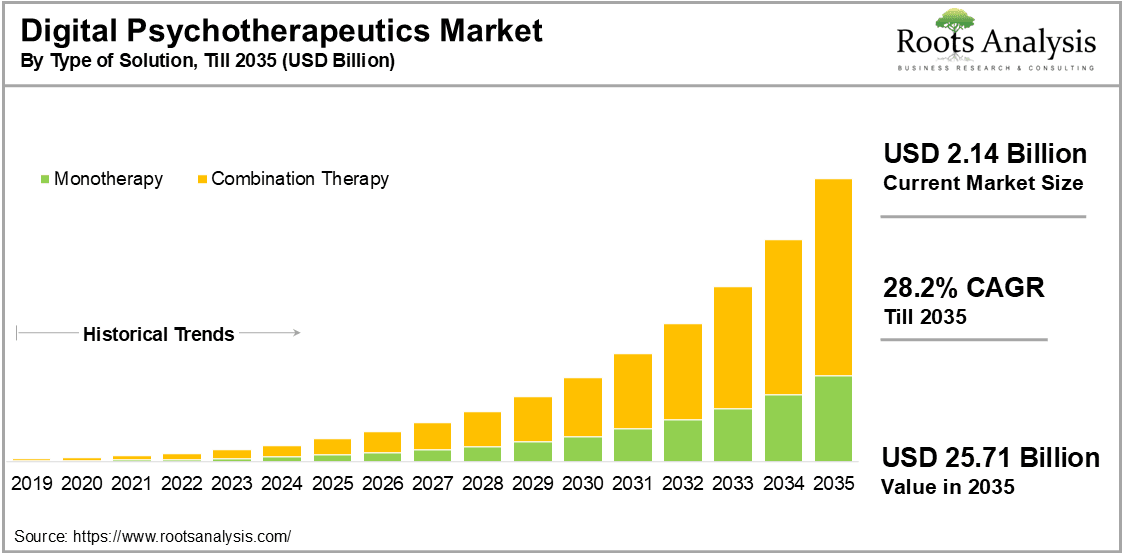
Digital psychotherapeutics market is estimated to be USD 2.14 billion in 2025 and is poised to reach USD 25.71 billion by 2035, representing a CAGR of 28.2% during the forecast period.
 |
To learn more about this report, request a free sample copy
Digital psychotherapeutics are evidence-based therapy treatments and services given through digital technology and software applications. These treatments are intended to test, cure, or aid people suffering from a variety of psychological conditions, such as depression, anxiety, stress, and mood disorders. Mobile applications, smart wearable devices, web-based platforms and virtual reality-based software are some of the medium through which patients can access digital psychotherapies to improve mental health. Currently, the market for digital psychotherapeutics is experiencing a rapid surge driven by the growing burden of mental health disorders and chronic conditions that may disturb the neurological health of patients.
According to a recent report published by the American Psychiatric Association, in 2024, nearly 43% of the adult population is suffering from anxiety. Moreover, the World Health Organization reported that around 280 million people across the globe have depression and over 700,000 people annually die due to severe depression. Considering the burgeoning incidence of mental illness, clinicians are adopting digital psychotherapeutics to treat patients with mental health disorders, such as anxiety, depression and psychotic disorders. Additionally, the rising shift towards digital healthcare technologies and wearable devices for disease management, has further contributed to the growth of the digital psychotherapeutics industry.
In order to increase the adoption of digital psychotherapeutics, industrial players and government organizations are taking strategic initiatives to raise awareness among the population about the latest technologies and applications to manage stress, anxiety and depression. Digital therapeutics encompass technologies like e-Health, m-Health, and artificial intelligence (AI). Application of AI in mental health is a fairly emerging area. The market players are aiming to integrate AI-driven tools and develop applications for digital psychotherapeutics to deliver personalized treatment with a real time analysis approach. This technological integration helps to enhance patient engagement, allowing continuous monitoring and collection of data, which is essential for healthcare providers in delivering optimal care.
It is important to highlight here that in April 2024, the USFDA has cleared Rejoyn™, prescription smartphone app-based digital therapeutics developed by Otsuka and Click Therapeutics. Rejoyn™ has been designed to treat major depressive disorder (MDD) among adult patients (22-years or older). Notably, Rejoyn is the first-of-its kind digital therapeutics approved by the USFDA for the treatment of MDD. Later, in September 2024, American Psychological Association reported that the USFDA cleared two consecutive research-backed mental health digital therapeutics to be used by psychologists. Moreover, Centers for Medicare & Medicaid Services (CMS) also proposed three new reimbursement codes that offer evidence-based therapeutic treatment to combat mental health concerns through websites and mobile devices. Driven by the increasing USFDA support, several industrial players are focusing on strategic innovations in this field, which is anticipated to drive the digital psychotherapeutics market at steady pace during the forecast period.
The market report provides in-depth information about leading industrial players who are presently active across various segments of the digital psychotherapeutics industry as mentioned in the table below.
| Key Report Attributes | Details | |
| Historical Trend | Since 2019 | |
| Forecast Period | Till 2035 | |
| Market Size in 2035 | USD 25.71 billion | |
| CAGR | 28.2% | |
| Type of Solution |
|
|
| Type of Application |
|
|
| Type of Indication |
|
|
| Type of Business Model |
|
|
| Key Geographical Regions |
|
|
| Key Companies Profiled |
|
|
| PowerPoint Presentation (Complimentary) |
Available | |
| Customization Scope | 15% Free Customization | |
| Excel Data Packs (Complimentary) |
Available | |
One of the key objectives of the digital psychotherapeutics market report was to estimate the current market size, opportunity and the market growth potential, over the forecast period, till 2035. We have provided informed estimates on the likely evolution of the market for the forecast period.
Additionally, the market report features the likely distribution of the current and forecasted opportunity within the market distributed across various segments such as type of solution (monotherapy, and combination therapy), type of application (prevention, management, and treatment), type of indication (phobias and anxiety,y and psychotic disorders), type of business model (direct-to-patients and B2B), geographical regions (North America, Europe, Asia-Pacific, Middle East and North Africa, and Latin America), and leading players.
To account for the uncertainties associated with the development of dental tourism and to add robustness to our model, we have provided three market forecast scenarios, portraying the conservative, base and optimistic tracks of the market’s evolution. All actual figures have been sourced and analyzed from publicly available information forums and primary research discussions. Financial figures mentioned in this market research report are in USD, unless otherwise specified.
Based on the type of solution, the global digital psychotherapeutics market is segmented into monotherapy and combination therapy. Currently, combination therapies account for the highest share (nearly 70%) of the market and the trend is likely to remain unchanged during the forecast period. Combination therapies have shown significant potential in treating mental health conditions with personalized approaches. Moreover, the combinational approach includes teletherapy, mobile application and therapeutic intervention to enhance treatment efficacy. Driven by the growing preferences of combination therapies, this segment will continue to grow at a higher CAGR during the forecast period.
The global market is categorized on the basis of application into prevention, management and treatment. According to our analysis, the treatment segment accounts for the highest digital psychotherapeutics market share (nearly 60%). This highest share is primarily due to the adoption of digital psychotherapeutics applications and software to treat patients with mental health conditions. Moreover, digital psychotherapeutics also encourages people with mental disorders to take appropriate treatment remotely by mobile applications and software. Additionally, the increasing awareness about the significance of digital therapeutics in treating mental health disorders is likely to grow this segment at a higher CAGR during the forecast period.
This segment highlights the distribution of the digital psychotherapeutics market across different disease indications, such as phobias and anxiety, depression, post-traumatic stress disorder (PTSD), substance use disorder, psychotic disorders and other disease indications. It is worth mentioning here that phobias and anxiety disorders currently occupy the highest share (42%) of the market. This can be attributed to the rising prevalence of anxiety across the globe and rising adoption of digital psychotherapeutic solutions to treat patients with anxiety conditions. Moreover, online platforms and mobile applications offer convenience to seek medical assistance for managing anxiety, contributing to the growth of this segment.
Other indications that are gaining the attention of stakeholders in the market digital mental health solutions for depression treatment. Rejoyn, which was launched in August 2024 in the US, was the first digital therapeutic that received FDA approval as an adjunctive treatment for major depressive disorder. Additionally, NHS Talking Therapies, a program run by the NHS in the UK which offers NICE recommended digital therapeutics for mental disorders, witnessed a rise in the service for anxiety and depression.
Based on the type of business model, the global market for digital psychotherapeutics is segmented into direct to consumer / patients and B2B business models. According to our projection, direct to customer / patients exhibit the highest share (nearly 75%) of the market. This can be predicted due to the ease of purchasing access and high demand of digital psychotherapeutics applications / software and technologies by patients to receive treatment in their homes. Moreover, the growing demand for personalized therapies and treatment programs has contributed to the growth of this segment. However, it is important to highlight here that B2B business models will grow at a higher CAGR during the forecast period.
The digital psychotherapeutics market value is distributed across different geographical regions, such as North America, Europe, Asia-Pacific, Middle East and North Africa, and Latin America. Currently, North America accounts for the highest share ( nearly 60% ) of the market driven by the growing adoption of digital therapeutics to improve mental well-being and growing focus towards patient-centric treatment approaches with stress, anxiety and depression. Additionally, the high incidence rate of mental health disorders in the North American region has further contributed to the growth of this region. Moreover, a strong base for technological advances and raising research on digital therapeutics in this region is bolstering the market. Year 2024 saw the approval of several digital psychotherapeutics including DaylightRx for Generalized Anxiety Disorder, SleepioRx for chronic insomnia, MamaLift Plus for mild to moderate postpartum depression and Rejoyn for major depressive disorder. Within this workflow, psychedelic drugs are being evaluated within supervised treatment pathways for psychiatric and neurological conditions.
However, it is important to highlight here that the market for digital psychotherapeutics in Asia-Pacific is likely to expand at a steady rate during the forecast period. Asian countries, such as China, Japan and India are increasingly adapting to digital solutions to enhance healthcare services and growing initiatives by the government to increase awareness about mental health.
The “Digital Psychotherapeutics Market: Industry Trends and Global Forecast, till 2035” market report features an extensive study of the focus on competitive landscape of strategic initiatives, emerging mega trends, big pharma initiatives, company profiles and key drivers and restraints. Key takeaways of the market report are briefly discussed below.
The market landscape of digital psychotherapeutics is witnessing the presence of several well-established and new entrants who are aiming for technological innovations in this field. However, the primary focus on the industrial players is one integrating cord-cutting technologies such as AI, mobile applications, VR technologies for real-time monitoring and treatment planning to improve patient outcomes. Some of the top players in the market who are engaged in this industry to develop advanced digital psychotherapeutics solutions and platforms are Pear Therapeutics, Woebot Health and Starling Minds. Furthermore, a number of startups have emerged in this market in the past decade, several of which have also raised venture funding to advance their products through the development stages. Overall, the market seems highly competitive, featuring several small, mid-sized and large industrial players who are aiming to provide AI-driven mental health solutions for evidence-based treatment.
Some of the major market drivers that are propelling the industry include high incidence of mental health disorders and rising demand for digital therapeutics to offer remote care to the patients. According to World Health Organization, in 2024, nearly 1 out of 3 people are currently affected with neurological conditions, the most prominent cause of disability and mental illness. Digital psychotherapeutics in this instance are playing a significant role in managing stress, depression and other mental health issues, anticipated to be a key reason for widespread adoption of digital therapies.
Some of the potential challenges that limit the adoption of digital psychotherapeutics are data security concerns and lack of awareness among the population. It is worth noting that the integration of digital psychotherapeutics with healthcare systems requires third party sources for data transmission which poses a significant risk of data breaching. Moreover, the lack of awareness among population, specifically geriatric population, may restrict the widespread adoption of digital psychotherapeutics on a large scale.
Owing to the increased focus on data privacy, several countries have strengthened their data privacy laws such as the General Data Protection Regulation (GDPR) in the EU. The digital therapeutics collecting patient data have to comply with these laws. Additionally, the approval process differs across various geographies, posing challenge to the companies looking for geographical expansions.
Despite challenges, the market for digital psychotherapeutics is experiencing tremendous growth. Some of the notable trends that are likely to shape the future of this industry include increasing preferences for teletherapy, virtual reality therapy and mental health apps. Furthermore, healthcare professionals are adopting personalized mental health care and integrating AI-powered chatbot with mHealth applications, software and platforms to enhance treatment advisory and intervention delivery. In addition, the growing demand for wearable medical devices, such as smartwatches and smart wearables for monitoring mental health has further contributed to the growth of the market.
Digital Psychotherapeutics Market is currently valued at USD 2.14 billion. With increasing incidence of neurological conditions, the market players are focusing on digital therapeutics that aid in managing mental health illnesses such as depression and bringing stress levels down. Driven by widespread adoption, this market is poised to reach USD 25.71 billion by 2035, expecting a higher CAGR of 28.2% during the forecast period. Some of the potential trends that are bolstering market growth includes rising focus on integrating virtual reality, integration of AI for personalized therapy experience, chatbots and mobile applications for managing mental health conditions.
This market report also covers the digital psychotherapeutics adoption trends in North America, Europe and other key geographies.
Examples of the key players (which have also been profiled in this report) involved in digital psychotherapeutics industry include (in alphabetic order) 2MORROW, Canary Health, Dthera Sciences, Fitbit Health Solutions, Livongo Health, Medtronic, Mango Health, Noom, Omada Health, Pear Therapeutics, Resmed (Propeller Health), Voluntis and Welldoc. This market report includes an easily searchable excel database of all the companies focusing on the development of digital psychotherapeutics.
Several recent developments have taken place in the field of digital psychotherapeutics. We have outlined some of these recent initiatives below.