
Lowest Price Guaranteed
Pages
198
Last Updated
July 2025
View Count
11082
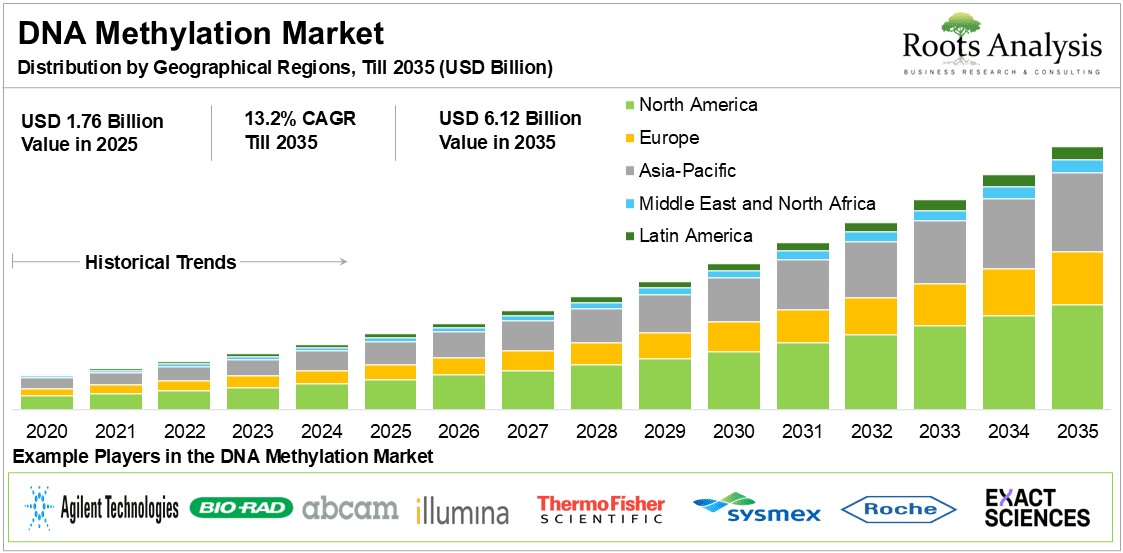
The global DNA methylation market size, valued at USD 1.52 billion in 2024, is projected to reach USD 1.76 billion in 2025 and USD 6.12 billion by 2035, representing a CAGR of 13.2% during the forecast period.
 |
To learn more about this report, request a free sample copy
DNA methylation is gaining rapid momentum due to its increasing applications, such as disease diagnosis, drug development, genomic research, and epigenetic research. Some of the reasons for instrumental growth include key role of DNA methylation in cancer detection, genetic disorders detection and increasing research on genomics for treating rare or un-diagnosed diseases.
DNA methylation represents an epigenetic mechanism in which a methyl group is added to the cytosine base specifically at CpG dinucleotides of DNA molecules. This methylation pattern can modulate gene expression without altering its base sequence, resulting in overexpression or suppression of gene function. DNA methylation plays a crucial role in genomic imprinting, gene regulation, and X-chromosome inactivation. Notably, DNA methylation analysis also helps in early disease diagnosis which is helpful to minimize the risk of complications and improve clinical outcomes.
It is worth noting that cancer and genetic disorders remain a significant burden on the healthcare industry. As stated in the National Cancer Institute report, in 2025, around 2,041,910 new cases of cancer will be diagnosed in the US and approximately 618,120 people will die from the disease. Some of the significant concerns associated with cancer are late diagnosis, and one-size treatment approach.
In order to mitigate the challenges, researchers are broadly adopting DNA methylation technologies, such as polymerase chain reaction, microarrays, and sequencing systems to understand the disease mechanism on genomic level and design tailored treatment to meet patient’s requirements.
Interestingly, the widespread adoption of DNA methylation technologies and broad emphasis on genome research have become crucial growth factors for this industry. It is worth noting that industrial players, such as Pfizer, Roche, QIAGEN are finding key opportunities in this field and focusing on technological innovations to make them more advanced and affordable. For instance, in April 2025, EpiCypher® (a global leader in epigenomic innovation) launched CUTANA® meCUT&RUN and Multiomic CUT&RUN (affordable methylation sequencing technologies) for drug discovery and genomic research.
Owing to the keen interest of industrial players, we believe that DNA methylation industry will remain competitive for a long term, offering plenty of opportunities for investments.
| Key Report Attributes | Details | |
| Historical Trend | Since 2020 | |
| Forecast Period | Till 2035 | |
| Market Size 2025 | USD 1.76 Billion | |
| Market Size 2035 | USD 6.12 Billion | |
| CAGR (Till 2035) | 13.2% | |
One of the key objectives of the DNA methylation market report was to estimate the current size, opportunity, and the market growth potential, over the forecast period, till 2035. We have provided informed estimates on the likely evolution of the market for the forecast period.
The global market analysis report also features the likely distribution of the current and forecasted opportunity within the market across various segments, such as type of technology, application area, end users, geographical regions, and leading players.
In order to account for future uncertainties associated with some of the key parameters and to add robustness to our model, we have provided three DNA methylation market forecast scenarios, namely conservative, base, and optimistic scenarios, representing different tracks of industry’s evolution.
Increasing adoption of technologies for early disease diagnosis has spurred the demand for DNA methylation analysis, which is expected to be a major driver for the market. Additionally, the expanding applications of DNA methylation beyond cancer diagnosis, and genomic analysis has offered a broad scope of innovation in this field to industrial players.
Several recent developments have taken place in the field of DNA methylation, and we outline some of these below.
The market report provides comprehensive information on DNA methylation technology developers who are currently active across various segments of the industry as mentioned in the table below.
| Market Segmentations | Details | |
| Type of Technology |
|
|
| Type of Product |
|
|
| Application Area |
|
|
| End User |
|
|
| Geographical Regions |
|
|
| Market in North America |
|
|
| Market in Europe |
|
|
| Market in Asia-Pacific |
|
|
| Market in Middle East and North Africa |
|
|
| Market in Latin America |
|
|
DNA methylation editing tools and technologies holds great promise for advancing knowledge of gene regulation, disease detection and developing innovative drugs for addressing genetic and epigenetic disorders.
PacBio's President and CEO, Christian Henry, believes the DNA methylation market is key for advancement, especially with HiFi sequencing. “I am delighted to see this technology now being deployed more broadly through PacBio’s global customer base,” said Professor Dennis Lo, Scientific Director of Centre for Novostics, CUHK. “Accurate detection of DNA methylation—particularly 5mC and 5hmC—on native molecules is important for advancing research in cancer, human development, and beyond. With the improvements enabled by HK2, methylation calling with PacBio HiFi sequencing is poised to set a new standard for accuracy in the industry, surpassing other available technologies.”
| Report Deliverables | Details | |
| Excel Data Packs (Complimentary) |
Available | |
| Key DNA Methylation Companies Profiled |
|
|
| PowerPoint Presentation (Complimentary) |
Available | |
| Customization Scope | 15% Free Customization | |
The “DNA Methylation Market: Industry Trends and Global Forecasts, till 2035” market report features an extensive study of the current market landscape, market size, market share, market growth, market trends, market value, market forecast, market outlook, statistics, and future opportunities for DNA methylation industrial players. The market research report lays emphasis on the DNA methylation technologies that are being developed. Key takeaways of the market report are briefly discussed below.
With a broad focus on technological innovations for disease diagnosis and research, several industrial players are showing keen interest in this market. Overall, the market seems highly competitive, featuring the presence of several small, mid-sized and large industrial players.
Companies such as Abcam, Agilent Technologies, Bio-Rad, and Zymo Research are continually emphasizing the expansion of product portfolios, effective technologies innovations and investing heavily to develop cost-effective DNA methylation kits and instruments. Some of the notable products that are developed by industrial players for DNA methylation and are broadly accepted by the pharmaceutical companies, clinical research organizations and hospitals are mentioned below:
| Leading Companies | Focus Area | Latest Technologies | Top Products | |||
| Abcam | Antibody And Assay Solutions | Methylation-Specific Antibodies | Anti-5-Methylcytosine Antibody | |||
| Active Motif | Epigenetics Research Tools | Antibody-Based Methylation Detection | Medip Kit | |||
| Illumina | NGS-Based Methylation Analysis | Infinium Methylation Arrays, NGS | Infinium Methylationepic Beadchip | |||
| New England Biolabs | Enzyme Solutions | Methylation-Sensitive Restriction Enzymes | EpiMark Methylated DNA Enrichment Kit | |||
| Thermo Fisher Scientific | PCR and Sequencing Solutions | Bisulfite Conversion, qPCR | Methylcode Bisulfite Conversion Kit | |||
| Qiagen | Sample Preparation and Analysis | Pyrosequencing, Bisulfite Conversion | EpiTect Bisulfite Kit | |||
| Zymo Research | Epigenetics Toolbox Provider | Bisulfite Conversion, Methylation-Specific PCR | EZ Dna Methylation Kit | |||
The global market for DNA methylation is estimated to grow from USD 1.76 billion in 2025 to USD 6.12 billion by 2035, representing a CAGR of 13.2%. Large companies like New England Biolabs offer a range of reagents and consumables such as magnetic beads and primers for DNA methylation analysis. In addition, a number of epigenetic service providers provide DNA methylation analysis as part of their portfolios. The market for DNA methylation will continue to grow with the growing application of epigenetics.
The market for DNA methylation is propelled by several factors. Some of the notable factors are the rising prevalence of chronic diseases and genetic disorders across the globe. DNA methylation serves as an important biomarker for identifying epigenetic changes associated with these conditions, enabling early disease detection and improving patient outcomes.
Furthermore, the growing focus of industrial players to develop advanced high-throughput methods including microarrays and next-generation sequencing (NGS) has significantly facilitated genome-wide methylation profiling research. Additionally, the high demand for precision medicine has underscored the demand for DNA methylation analysis for the identification of biomarkers, early disease detection, risk assessment, and personalized treatment strategies, particularly in oncology and neurodegenerative diseases.
Despite promising growth prospects, the DNA methylation industry players face several significant challenges. Some of the noticeable challenges are technical complexities, data interpretation hurdles and lack of skilled personnel. It is worth mentioning that the uneven distribution of methylation target sequences may complicate the DNA methylation analysis process.
Furthermore, the complex nature of interpreting DNA methylation data presents substantial challenges, requiring multidisciplinary collaboration and continuous research efforts. In addition, the lack of qualified professionals for handling DNA methylation technologies may limit the adoption of new technologies across various industrial verticals.
Despite significant challenges, the continuous adoption of DNA methylation analysis across research areas and healthcare industry is offering enormous opportunities to industrial players. Some of the notable trends of this industry includes expanding application beyond oncology, robust regulatory pathway, and cost reduction of genome sequencing.
While cancer applications have historically dominated the market, DNA methylation analysis is increasingly being applied to other areas including neurodegenerative disorders, cardiovascular diseases, metabolic disorders, and even aging research. The identification of age-associated CpG sites across diverse populations demonstrates the versatility of this technology.
Furthermore, the growing focus on cost reduction has made DNA methylation technologies more accessible to a broader range of research institutions, and healthcare providers. In addition, technological convergence like DNA methylation analysis with other omics technologies (genomics, proteomics, and transcriptomics) is creating more comprehensive biological insights. This multi-omics approach enhances our understanding of disease mechanisms and identifies novel therapeutic targets.
The market report presents an in-depth analysis, highlighting the capabilities of various stakeholders in the DNA methylation industry, across different geographies. Amongst other elements, the market report includes:
The DNA methylation industry trajectory has been characterized by the increasing focus on epigenomics research, heightened demand for disease diagnosis and expanding clinical applications beyond oncology. Additionally, the acceptance of sequencing by regulatory authorities to accelerate the development of targeted therapies has underscored the demand for DNA methylation assay technologies. However, several challenges, such as data interpretation difficulties, and the requirement of skilled personnel remain a significant concern. In order to address these challenges, market players are leveraging partnerships and collaborations to develop affordable and easy to access sequencing technologies as well as kits, which further enhance competitiveness in this industry.