
Lowest Price Guaranteed
Slides
207
Last Updated
June 2026
View Count
11508
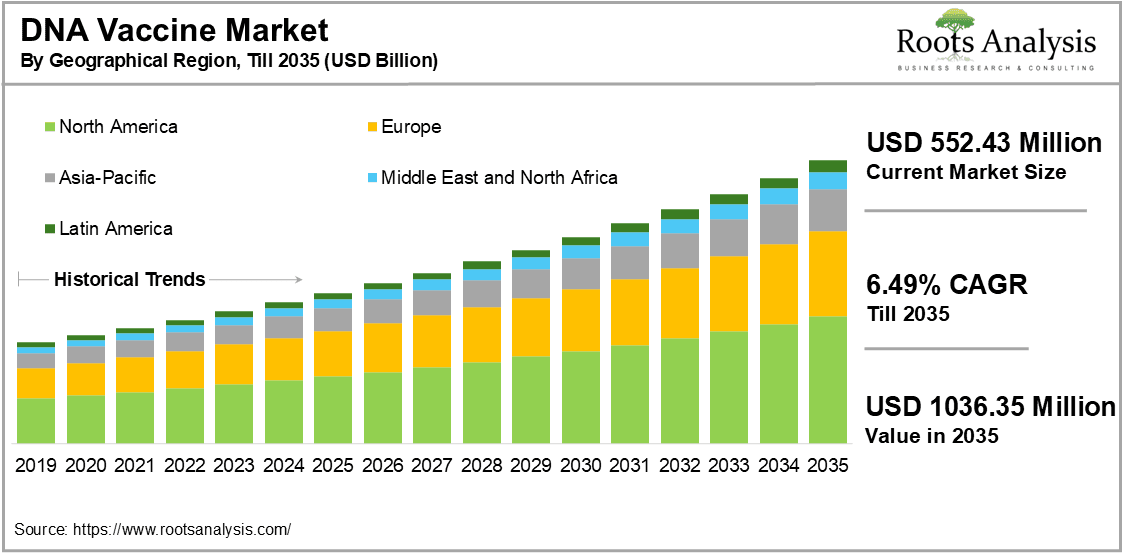
The global DNA vaccine market size is estimated to be USD 552.43 million in 2025 and is poised to reach USD 1,036.35 million by 2035, representing a CAGR of 6.49% during the forecast period.
To learn more about this report, request a free sample copy
DNA vaccine is a next generation approach to target infectious diseases and control the rising risk of antibiotic resistance across the globe. According to the report of Centers for Disease Control and Prevention, antimicrobial resistance is amongst the global health threat, over 2.8 million antimicrobial-resistant infections occur annually in U.S. With growing incidence of antimicrobial resistance, healthcare professionals are witnessing a burden in mitigating the rising risk of infectious diseases among individuals with antimicrobial resistance. In addition to human population, the rising concern of cancer and infectious diseases in canines has raised the demand for advanced therapeutic vaccines.
DNA vaccine has emerged as a promising solution to trigger immune response to fight against various conditions including allergies, infectious diseases, autoimmune disorders and cancer. DNA vaccines comprises of circular plasmid DNA that encodes for protein antigens to stimulate an immune response to specific disease. These DNA based vaccines has been designed to minimize the undesirable characteristics of traditionally available vaccines. It is important to highlight here that ZyCoV-D is the world’s first DNA COVID-19 vaccine developed by Zydus Cadila that has been approved for human use specifically for adults and children (12-year-old).
Driven by the successful approval, several researchers are focusing on taking strategic initiatives to increase their efforts for the development of DNA vaccines. It is important to highlight here that currently several DNA vaccine candidates that are under clinical evaluation have shown positive outcomes. For instance, in November 2024, Immuno Cure BioTech (clinical-stage biotechnology group, Hong Kong) announced the successful completion of phase I clinical trial for ICVAX, first-in human novel therapeutic HIV vaccine with exceptional safety and immunogenicity profiles . This successful completion signifies a key milestone towards achieving antiretroviral therapy free virological control and functional cure of HIV / AIDS. With consistent efforts, breakthrough technological innovations and successful clinical results, we believe DNA vaccine market will continue to grow at a steady rate.
The market research report presents an in-depth analysis of various industrial players that are involved in global DNA vaccine industry, across different segments, as defined in the table below:
| Key Report Attributes | Details | |
| Historical Trend | Since 2019 | |
| Forecast Period | Till 2035 | |
| Market Size 2035 | USD 1,036.35 Million | |
| CAGR | ~6.49% | |
| Type of Product |
|
|
| Type of Vaccine |
|
|
| Type of Therapeutic Indications |
|
|
| Application Area |
|
|
| End User |
|
|
| Key Geographical Region |
|
|
| Key Companies Profiled |
|
|
| PowerPoint Presentation (Complimentary) |
Available | |
| Customization Scope | 15% Free Customization | |
| Excel Data Packs (Complimentary) |
Available | |
One of the key objectives of the DNA vaccine market report was to estimate the current market size, opportunity and the market growth potential, over the forecast period, till 2035. We have provided informed estimates on the likely evolution of the market for the forecast period.
Additionally, the market report features the likely distribution of market based on the type of product (oncept, west nile-innovator and Apex-IHN), type of vaccine (therapeutic vaccines and prophylactic vaccines), type of technology (pDNA vaccine technology and pDNA vaccine delivery technology), type of therapeutic indication (vector borne diseases and cancer), application area (human vaccines and animal vaccines), end user (hospitals, clinics and other end users), geographical region (North America, Europe, Asia-Pacific, Middle East and North Africa, and Latin America) and leading players.
To account for the uncertainties associated with the development of DNA vaccines and to add robustness to our model, we have provided three market forecast scenarios, portraying the conservative, base and optimistic tracks of the market’s evolution. All actual figures have been sourced and analyzed from publicly available information forums and primary research discussions. Financial figures mentioned in this market research report are in USD, unless otherwise specified.
The global DNA vaccine market is distributed across various types of products, such as oncept, west nile-innovator, Apex-IHN and ZyCov-D. The first three DNA vaccines are approved for animal use. According to our projection,, currently oncept holds the largest share of the market driven by the increasing incidence of canine melanoma cancer, particularly in dogs. Additionally, oncept has been widely adopted in aquaculture sector to target viral diseases in fish. However, the Apex-IHN is anticipated to grow at a substantial CAGR owing to the increasing demand in aquaculture industry to mitigate the risk of infectious diseases and enhancement of protein content.
Based on the type of vaccine, the global DNA vaccine market is segmented into therapeutic vaccines and prophylactic vaccines. Currently, prophylactic vaccines accounts for the highest share of the market. This is primarily attributed to the availability of prophylactic vaccines to treat animal diseases such as hematopoietic necrosis virus and West Nile Virus. Driven by the availability of prophylactic vaccines, this segment will continue to grow at a substantial CAGR during the forecast period.
This segment highlights the distribution of global market based on the type of therapeutic intervention into vector borne diseases and cancer. Currently, vector borne diseases accounts for the highest DNA vaccine market share. This can be attributed to the growing clinical trial pipeline for treating vector borne diseases such as dengue, malaria, chikungunya and Zika virus. It is important to highlight here that a group of researchers published results from a first-in-human clinical trial of HPS (Hantavirus Pulmonary Syndrome) vaccine (ANDV DNA vaccine) in the Journal of Infectious Diseases in Jan 2024. The phase I clinical trial demonstrated safe and robust immune response.
However, with growing demand for personalized therapies to treat cancer, this segment is expected to grow at a higher CAGR during the forecast period. In December 2024, NEC Bio Therapeutics presented promising interim results from a phase I clinical trial of its oral DNA vaccine, NECVAX-NEO1, used in combination with immune checkpoint inhibitor in patients with solid tumors. The company also initiated a phase I/II clinical trial of their candidate in patients with triple negative breast cancer in December 2024. Some other companies / academic institutes with DNA vaccine candidates in clinical trials include Newish Technology (Beijing) Co., Ltd., University of Wisconsin and Aston Sci. Inc.
The global DNA vaccine market is distributed across application area including human DNA vaccines and animal DNA vaccines. It is important to highlight here that currently animal DNA vaccines accounts for the highest share of the market. This dominance is due to the widespread availability of DNA vaccines for the treatment of infectious diseases in animals. However, in the long run, human DNA vaccines is expected to grow at a higher CAGR during the forecast period. This is primarily due to the increasing research on DNA based vaccines for targeting infectious diseases in humans. It is important to highlight here that in August 2024, Shan Lu, a scientist at UMass Chan Medical School shared a report on effectiveness of DNA vaccine for the prevention of HIV. DNA / prime-protein boost vaccine, PDPHV, was found to be safe and well tolerated in a phase I clinical trial enrolling 60 participants across the US. This significant milestone has catered the attention of industrial players to drive innovations in this field, which is expected to be key factor for the growth of this segment.
On the basis of end users, the global DNA vaccine market is segmented into hospitals, clinics and other end users. Among these, hospitals occupy the highest share of the market for DNA vaccine and trend of dominance is likely to remain unchanged during the forecast period. Hospitals are the primary distributors of DNA vaccines and growing focus on the preventive treatment to control the spread of infectious diseases within hospitals contributing the highest share. However, other end users such as academic institutes and research organizations is likely to grow at a significant CAGR during the forecast period. This can be attributed to the rising research and clinical trials on DNA vaccines within academic institutes and research organizations.
The global DNA vaccine market is distributed across different geographical regions, such as North America, Europe, Asia-Pacific, Middle East and North Africa, and Latin America. Currently, North America occupies the largest share (nearly 45%) of the market. This dominance is due to the availability of advanced healthcare infrastructure and increasing research activities for the development of advanced DNA based vaccines. Furthermore, the rapid surge in the cases on pathogen-borne infection and antibiotic resistance pathogens has necessitated the demand for effective immunotherapies and vaccines to treat patients in this region.
In Asia-Pacific, the market for DNA vaccines is expected to pick up pace only in the long term. The only approved human DNA vaccine, ZyCoV-D was launched in India; however, it did not receive positive adoption in the region. This can be attributed to the slowing pace of COVID-19 by the time the vaccine was launched, but also to the inhibition towards adoption of novel products.
The “DNA Vaccine Market: Industry Trends and Global Forecast, till 2035” the market report features a detailed study of the current market landscape, market size, market forecast and future opportunities for the DNA-based vaccine developers. Further, the market research report underlines an in-depth analysis, highlighting the capabilities of stakeholders engaged in the market.
Currently, the competitive landscape of DNA vaccine market has the presence of several small and mid-sized players. These industrial players are emphasizing on DNA based vaccines to treat different type of cancers such as pancreatic cancer, prostate carcinoma, metastatic melanoma and other solid tumors. Furthermore, the increasing adoption of DNA vaccines across healthcare industry for treating wide range of diseases including SARS-CoV-2 has catered the attention of industrial leaders to make strategic initiatives in this field.
Majority research is currently being conducted at academic institutes, even reaching clinical stages of development. For instance, in November 2024, Karolinska Institutet initiated a phase I clinical trial for N-pVAX1 to test its safety and efficacy against Crimean Congo Hemorrhagic Fever. Owing to the ongoing research initiatives and rising interest towards the development of tailored therapies, we believe the market will remain competitive throughout the projected period offering opportunities for collaboration between academia and industry players.
Some of the major drivers that are supposed to propel the DNA vaccines market includes growing demand for cancer immunotherapies and robust response of DNA based vaccines in treating infectious diseases. The ability of DNA vaccines to deploy rapid response to pathogens has caught attention of industrial players to develop more novel vaccines using DNA. Additionally, DNA vaccines are currently being explored for cancer treatment and researchers are aiming to modify the DNA vaccines to target specific tumor antigens. With increasing research initiatives, we believe that this market will continue to grow at a significant pace during the forecast period.
Some of the major challenges in DNA vaccine market are immunological response, stability / storage problems and regulatory challenges. It is important to highlight that in comparison to protein-based vaccines, DNA vaccine may not induce robust immune response against targeted pathogen. Further, DNA vaccines are prone to degradation when exposed to external environment. Thus, these types of vaccines require cold chain logistics for safe transportation and storage. Without cold chain logistics, it can be challenging to maintain viability of DNA vaccines for long term, ultimately impact widespread adoption. Additionally, the complex regulatory guidelines associated with the development of DNA vaccines to ensure safety and efficacy may delay the approval. Moreover, competition from other therapeutic drugs and mRNA vaccines may create challenges in the adoption of these DNA based vaccines.
DNA vaccine is gaining traction due to its targeted design and faster immune response. With increasing popularity, several industrial players and government organizations are making considerable collaborations and partnerships in this field to drive innovations in DNA vaccine technology. It is worth noting here that in August 2024, scientists at the University of Nottingham collaborated with Touchlight to scale up the development of Zika Virus DNA vaccine. Touchlight specializes in enzymatic DNA production and under this collaboration, the company will supply its proprietary dbDNA™ to the University of Nottingham for development of next-generation DNA vaccine targeting Zika virus. Along with infectious diseases, scientists are taking strategic initiatives to expand applications of DNA vaccines for the treatment of cancer as well. Additionally, the growing demand for personalized treatment has supported the growth of this market during the forecast period.
Presently, in North America, the market for DNA vaccine is growing exponentially driven by the growing research initiatives and rising adoption of immunotherapies for the treatment of infectious disease. The market in North America has been further bolstered by the robust healthcare infrastructure and presence of leading players who are consistently implementing advanced technologies for the development of DNA vaccines. However, the primary focus is on the third generation DNA vaccine platforms and delivery systems such as nanomaterial technology. The consistent efforts of the industrial players established in this field is anticipated to drive the market during the forecast period.
Currently, the market for DNA vaccine is valued at USD 552.43 million and is poised to reach USD 1036.35 million by 2035. Driven by the benefits offered such as flexibility in encoding genes, high therapeutic potential and minimum off-target effects, there is likely to be a surge in the demand for DNA vaccines, when they enter the market for human use. Further, with growing demand for targeted therapies, several industrial players are focusing on strategic innovations in this field. For instance, in September 2024, PharmaJet and Scancell signed a strategic partnership agreement to develop and commercialize needle-free DNA vaccine for advanced melanoma. The ongoing strategic initiatives by industrial players will accelerate market growth at a CAGR of 6.49% during the forecast period.
Examples of key players engaged in the field of DNA vaccine (which have also been captured in this report) include Astellas Pharma, AstraZeneca, Bavarian Nordic, Biontech, Dendreon, Eli Lily, Geovax, Invio Biomedical, Moderna, Merck, Noravax, Pfizer, Sanofi and Tekmira Pharmaceuticals. This market report includes an easily searchable excel database of all the companies focusing on the development of DNA vaccines.
Several recent developments have taken place in the field of DNA vaccine. We have outlined some of these recent initiatives below.