Dry Age-Related Macular Degeneration Market by Disease Stage / Clinical Severity (Early Dry AMD, Intermediate Dry AMD, Geographic Atrophy and Late Dry AMD with Foveal Involvement), Therapeutic Modality, Route / Delivery Mode, Product / Technology Type, Care Setting / End User, Diagnostic / Monitoring Technology, Geographical Regions, and Leading Players – Trends and Forecasts, 2026-2040
Market Size
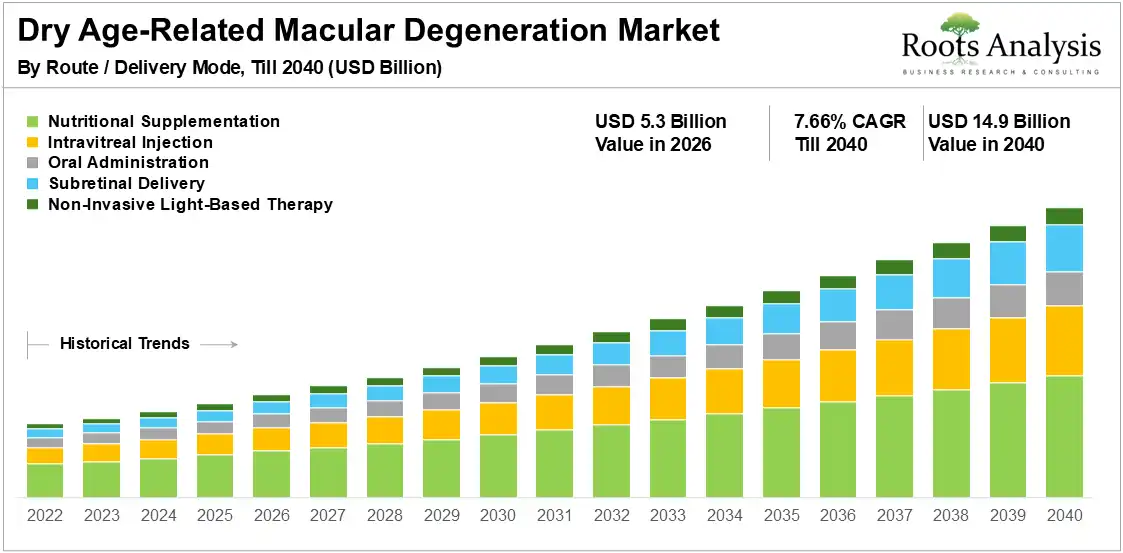
The global Dry Age-Related Macular Degeneration market reached USD 5.3 billion in 2026 and is projected to reach USD 14.9 billion by 2040, growing at a CAGR of 7.66% over the forecast period 2026 to 2040, driven by geographic atrophy therapy uptake, PBM adoption, and AI monitoring.
See What’s in the Full Report – Request Your Complimentary Insights!
Market Report: Key Takeaways
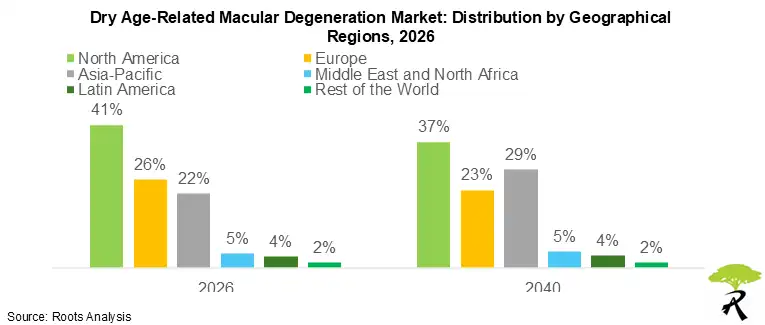
- Based on Geography, North America captures 42.0% market share in 2026, whereas Asia-Pacific registers a 9.8% CAGR through 2040, supported by Japan and China access expansion.
- • Based on Disease Stage / Clinical Severity, Intermediate dry AMD captures 34.0% market share in 2026, whereas Geographic atrophy registers a 10.1% CAGR through 2040, driven by reimbursed GA therapy adoption.
- Based on Therapeutic Modality, Nutritional / AREDS2 supplementation captures 36.0% market share in 2026, whereas Gene therapies register an 18.9% CAGR through 2040, driven by one-time disease-modifying programs.
- Based on Route / Delivery Mode, Nutritional supplementation captures 36.0% market share in 2026, whereas Subretinal delivery registers a 10.8% CAGR through 2040, driven by gene and cell therapy delivery.
- Based on Product / Technology Type, Dietary supplement formulations capture 34.0% market share in 2026, whereas AI-enabled image analysis software registers a 13.1% CAGR through 2040, driven by automated lesion quantification.
Dry Age-Related Macular Degeneration Market Outlook
Geographic atrophy therapies are shifting the dry AMD market from supplement-led prevention toward treated retinal degeneration. Earlier spending centered on AREDS2 formulations, OCT imaging, and monitoring for early or intermediate disease stages. Current demand now concentrates around intravitreal complement inhibitors, photobiomodulation, and quantitative GA lesion tracking. Specialist capacity, injection cadence, imaging workload, and uneven access outside mature retina networks still limit faster conversion. Clinic purchasing is moving toward treatment-enabling infrastructure. Dry AMD is part of the wider group of back-of-the-eye disorders, which also includes other retinal and posterior-segment conditions.
Regulatory expansion now drives treated prevalence more directly than awareness campaigns. FDA label growth, Japan conditional approval, and China priority review point to wider geographic access for GA therapy. Astellas announced in May 2026 that China’s NMPA accepted the IZERVAY NDA for GA secondary to AMD. The agency also granted priority review. This policy path shortens launch planning for Retina networks and payer engagement across cities.
Through 2040, growth will accelerate around GA drugs, AI-based monitoring, home surveillance, and durable retinal technologies. Gene therapies, subretinal delivery, and AI-enabled image analysis expand from smaller bases with higher CAGRs. Alcon completed its LumiThera acquisition in September 2025, adding Valeda photobiomodulation for dry AMD. The outlook remains high-growth, but adoption will favor evidence-backed products with scalable clinic workflows and differentiated national access economics.
Dry Age-Related Macular Degeneration Market Dynamics
Dry Age-Related Macular Degeneration Market Drivers
Approved GA therapies now pull revenue toward retina specialty clinics and intravitreal care pathways. Geographic atrophy grows at 10.1% CAGR through 2040, while complement inhibitors rise from 24.0% share in 2026 to 32.0% in 2040. Astellas secured an expanded FDA label for IZERVAY in February 2025, strengthening commercial clarity for GA secondary to AMD. This shift gives approved brands a pricing and evidence advantage.
Dry Age-Related Macular Degeneration Market Restraints
Procedure burden slows broader adoption because intravitreal injections require specialist capacity, repeated visits, and imaging-linked follow-up. Nutritional supplementation still holds 36.0% share in 2026 because it fits low-cost primary eye-care workflows. Late dry AMD with foveal involvement remains smaller, at 11.0% share in 2026. Advanced vision loss narrows treatable benefit windows and makes payer evidence harder. Commercial scaling therefore depends on capacity, not demand alone.
Dry Age-Related Macular Degeneration Market Opportunities
Durable retinal technologies create the strongest upside beyond current complement inhibition. Gene therapies grow at 18.9% CAGR through 2040, and subretinal delivery grows at 10.8% CAGR from a specialist-led base. Ocugen announced 12-month Phase 2 ArMaDa data for OCU410 in March 2026. The program supports modifier gene therapy opportunity in GA secondary to dry AMD. This creates partnering scope for retina specialists and surgical centers.
Dry Age-Related Macular Degeneration Market Challenges
Clinical endpoint risk remains a decisive barrier for pipeline assets targeting geographic atrophy therapies. Lesion-growth reduction must translate into clear differentiation against SYFOVRE and IZERVAY, not only plausible biology. In December 2025, Aviceda’s AVD-104 missed the primary lesion-growth endpoint against IZERVAY in Phase 2 GA study context. This result raises scrutiny for new mechanisms. Pipeline sponsors must now design cleaner comparator strategies.
Dry Age-Related Macular Degeneration Market Size Estimation Methodology
- As a starting point, multiple credible secondary sources were triangulated to set the dry AMD market baseline and historical growth range. Dry AMD-specific values received priority over broader AMD drug sources because wet AMD revenues would overstate the addressable market. A 7MM-only estimate was used only as a directional check because its geographic scope was narrower than the global forecast. This hierarchy kept the forecast anchored to dry AMD revenue, not total retinal disease spending.
- Moving forward, disease severity was mapped across early dry AMD, intermediate dry AMD, geographic atrophy, and late dry AMD with foveal involvement. Segment shares were aligned with the forecast tables supplied. Intermediate dry AMD holds 34.0% share in 2026, while geographic atrophy grows at 10.1% CAGR through 2040. This step connected patient progression with treatment intensity, monitoring needs, and referral timing.
- Building on this, modality and route shares were assigned using therapy status, delivery burden, and clinical adoption logic. Complement inhibitors, nutritional supplementation, photobiomodulation, oral administration, intravitreal injection, and subretinal delivery were treated separately because they scale through different channels. Product-level splits then separated prescription drugs, medical devices, diagnostic imaging, AI software, home monitoring, and dietary supplements. This prevented low-cost supplements from distorting high-value GA therapy adoption.
- Drawing upon these, clinical trial databases, regulatory submission counts, and drug approval timelines were used to test pipeline-driven growth. The methodology gave higher acceleration to categories with active post-2025 evidence, including gene therapies, AI-based GA quantification, and home-based AMD monitoring. Company disclosures on SYFOVRE, IZERVAY, Valeda, OCU410, and tinlarebant informed competitive timing. Failed endpoint examples were used to moderate pipeline conversion.
- The projected value was then allocated by geography, care setting, technology type, and delivery mode using bottom-up share migration. North America started as the leading region because retina networks and reimbursement pathways matured earlier. Asia-Pacific received the fastest CAGR because Japan and China showed regulatory momentum for IZERVAY and broader urban retina capacity. Care-setting shares reflected physician-office dosing, surgical delivery, and home monitoring adoption.
- Finally, sensitivity checks compared the forecast against clinical endpoint risk, procedure capacity, payer evidence requirements, and technology adoption curves. Higher-risk assets, including oral and glyco-immune programs, received slower conversion until stronger lesion-growth evidence appeared. The final model keeps the dry AMD market high-growth while preserving restraints from specialist capacity and comparative efficacy uncertainty. This produces a forecast suitable for strategy, investment, access, and portfolio prioritization.
Dry Age-Related Macular Degeneration Market Share Insights
Market Share by Disease Stage / Clinical Severity
According to our analysis, intermediate dry AMD leads because diagnosis, supplements, imaging, and follow-up concentrate around drusen management. It carries lower intervention costs than injection-based GA care. Alcon, July 2025, agreed to acquire LumiThera and its PBM device for early and intermediate dry AMD
On the other hand, geographic atrophy will grow fast as approved intravitreal therapies expand treated prevalence. Better imaging and earlier lesion tracking will increase eligible patient identification. In November 2025, Apellis reported five-year GALE data for SYFOVRE in GA secondary to AMD.
Market Share by Route / Delivery Mode
According to our analysis, nutritional supplementation leads because it avoids procedure burden and fits primary eye-care workflows. It also reaches patients before GA referral or injection eligibility. AAO, November 2025, updated patient guidance on vitamins for AMD.
Conversely, subretinal delivery will grow fastest as gene and cell therapies target durable retinal effects. Adoption remains specialist-led, but procedural learning will improve over time. Ocugen announced 12-month Phase 2 ArMaDa data for OCU410.
Want Information on Specific Region / Segment?
Regional Analysis: North America Leads the Market and Asia-Pacific is Likely to Register Higher CAGR
Presently, North America has 42.0% share in 2026. North America leads because it combines retina specialist density, payer infrastructure, and trial ecosystem depth. Earlier FDA approvals also accelerated clinical adoption of GA therapies. Astellas, February 2025, secured an expanded FDA label for IZERVAY in GA secondary to AMD.
Further, Asia-Pacific, 9.8% CAGR from 2026 to 2040. Asia-Pacific will grow fastest as Japan and China expand access to GA therapies. Aging demographics, regulatory momentum, and urban retina-center expansion will localize demand. Astellas, May 2026, received China NMPA NDA acceptance and priority review for IZERVAY.
Market Ecosystem Analysis
Within the scoped roster, seven Tier 1 leaders control most commercialized activity across complement drugs, PBM, supplements, and imaging. Six specialists and 13 emerging entrants contest narrower pipeline, AI-monitoring, and home-monitoring positions around GA progression. Hardware-software bundling and targeted acquisition now dominate consolidation, after Alcon moved to acquire LumiThera’s Valeda PBM platform in July 2025. Treatment burden is reshaping behavior, as Apellis reported Q2 2025 SYFOVRE share above 60% and 95,000 delivered doses. Competitive advantage is shifting toward measurable lesion tracking, lower-burden dosing, and earlier dry AMD intervention.
- Apellis reported July 2025 Q2 SYFOVRE U.S. net revenue of $150.6 million, with GA market share exceeding 60%. This scale pressures emerging intravitreal entrants because clinics already manage reimbursement and injection logistics around SYFOVRE. It strengthens prescription biologics for geographic atrophy and raises the access barrier for complement challengers.
- Astellas announced in October 2025 that AAO 2025 IZERVAY data would cover GATHER2 extension, safety, real-world patterns, and biomarkers. This gives Astellas a counterweight to Apellis by shifting competition toward evidence packages. It strengthens intravitreal prescription therapy and biomarker-linked monitoring in retina specialty clinics.
- Annexon completed enrollment in July 2025 for the pivotal Phase 3 ARCHER II trial of vonaprument in GA. The program pressures C3 and C5 incumbents to defend against function-oriented neuroprotective endpoints. It strengthens complement-pathway pipeline competition within late dry AMD and GA.
- Alcon’s July 2025 LumiThera acquisition positioned Valeda as an office-based PBM platform for early and intermediate dry AMD. The deal pressures standalone PBM developers because distribution shifts into Alcon’s vitreoretinal channel. It strengthens non-invasive light-based therapy and medical-device adoption in retina clinics.
- Bausch + Lomb launched PreserVision AREDS3 in May 2026, adding B vitamins to clinically proven AREDS2 nutrients. This expands supplement competition into earlier macular-health discussions across optometry and retail pharmacy channels. It strengthens nutritional supplementation and dietary supplement formulations for early and intermediate dry AMD.
- RetInSight received August 2025 TGA and Medsafe approvals for GA Monitor and Fluid Monitor in Australia and New Zealand. These approvals pressure imaging vendors to support device-agnostic quantification rather than instrument-only workflows. They strengthen AI-based GA quantification and Asia-Pacific longitudinal monitoring.
- Stealth BioTherapeutics reached 50% Phase 3 ReNEW enrollment in March 2025 for elamipretide in dry AMD. Alkeus presented May 2025 SAGA data for oral gildeuretinol in GA secondary to AMD. Together, they pressure injection-centric care by strengthening subcutaneous mitochondrial therapy and oral visual-cycle modulation.
- Lineage reported June 2025 36-month RG6501 data from its OpRegen RPE cell therapy study. Ocugen released January 2026 preliminary Phase 2 OCU410 data for modifier gene therapy in GA. These programs strengthen subretinal delivery, gene therapy, and RPE replacement while raising surgical and manufacturing barriers.
- Aviceda reported December 2025 Phase 2b SIGLEC results for AVD-104 in geographic atrophy. ONL randomized the first Phase 2 GALAXY patient in October 2025 for xelafaslatide in GA associated with dry AMD. They broaden competition toward glyco-immune and Fas-inhibition mechanisms, pressuring complement leaders on durability, safety, and function
Startup Companies and their Key Highlights
- Character Biosciences
- Event type and funding amount: Series B financing, $93 million.
- Month and year: March 2025.
- Stated purpose: Advance two AMD programs, CTX114 for GA and CTX203 for intermediate AMD.
- Market implication: Accelerates genomics-driven AMD therapy across GA and intermediate dry AMD.
- ADARx Pharmaceuticals
- Event type: Positive interim Phase 1 clinical data for ADX-038, an siRNA targeting complement factor B.
- Month and year: November 2025.
- Stated purpose: Demonstrate sustained alternative pathway suppression and support Phase 2 development, including GA.
- Market implication: Accelerates RNA therapy and CFB siRNA positioning within the GA pipeline.
- Ocugen
- Event type: Positive preliminary Phase 2 data for OCU410 modifier gene therapy.
- Month and year: January 2026
- Stated purpose: Report 12-month lesion-growth and safety data in GA secondary to dry AMD.
- Market implication: Accelerates gene therapy and subretinal delivery as lower-frequency alternatives to chronic injections.
- Aviceda Therapeutics
- Event type: Phase 2b SIGLEC results for AVD-104.
- Month and year: December 2025.
- Stated purpose: Evaluate AVD-104 efficacy and safety in geographic atrophy secondary to AMD.
- Market implication: Accelerates glyco-immune GA therapy and challenges complement-only differentiation.
- ONL Therapeutics
- Event type: First patient randomized in global Phase 2 GALAXY trial.
- Month and year: October 2025.
- Stated purpose: Evaluate xelafaslatide, formerly ONL1204, in GA associated with dry AMD.
- Market implication: Accelerates Fas-inhibition neuroprotection within late dry AMD and GA pipelines.
Dry Age-Related Macular Degeneration Market Trends / Opportunities
Complement Expansion Creating Revenue Concentration in the Dry AMD Market
Approved intravitreal therapy is converting GA from a monitored endpoint into a reimbursed treatment category. Astellas received Japan conditional approval for IZERVAY in September 2025, making regional access a competitive differentiator.
Long-term evidence is raising the bar for geographic atrophy treatment market forecast assumptions. Apellis announced five-year GALE extension data in November 2025, reporting that SYFOVRE delayed GA progression by about 1.5 years. Products with durable evidence gain pricing and formulary leverage.
Strategic consolidation is concentrating commercial control around approved GA assets. Larger portfolios can bundle access, evidence generation, and physician engagement more efficiently.
Photobiomodulation Expanding Early Disease Pathways in the Dry AMD Market
Non-invasive light-based therapy creates an option between supplements and injection-based GA care. In July 2025, Alcon agreed to acquire LumiThera and its PBM device for early and intermediate dry AMD. This expands commercial reach before advanced GA treatment eligibility.
Device ownership is becoming a strategic route into dry AMD treatment workflows. Alcon completed the LumiThera acquisition in September 2025, adding Valeda photobiomodulation technology for dry AMD. Ophthalmic device companies can defend share through installed relationships and service infrastructure.
Intermediate dry AMD remains commercially important because it holds 34.0% share in 2026. Alcon’s July 2025 LumiThera agreement shows how PBM targets early and intermediate dry AMD. The competitive implication is stronger demand for bundled diagnostics, devices, and follow-up programs.
Quantification and Home Monitoring Creating Data Advantage Across GA
Automated lesion measurement is turning imaging from documentation into treatment-decision infrastructure. RetinAI showcased AI analysis with Heidelberg Engineering workflows during ARVO 2025. Vendors that integrate with OCT workflows can gain influence over trials, payer evidence, and clinic protocols.
Home monitoring is shifting progression detection outside specialist clinics. Notal Vision published positive pivotal AI algorithm results for its home OCT system in February 2025. This gives connected platforms a role in referral timing and patient retention.
AI-based GA quantification grows at 13.6% CAGR through 2040, faster than OCT / OCTA infrastructure. RetinAI highlighted real-time image processing and AI analysis at ARVO 2025. Software differentiation can shift value from hardware ownership toward recurring analytics.
Your Business is Unique – Why Shouldn’t Your Report Be?
Market Access Considerations
Country-Specific GA Regulatory Pathways
Regulatory access now determines which competitors can scale beyond mature United States retina networks. Japan conditional approval and China priority review show that country-level pathways shape launches sequence, evidence obligations, and payer planning. Astellas announced in May 2026 that China’s NMPA accepted the IZERVAY NDA for GA secondary to AMD. The agency also granted priority review. Firms with local regulatory depth gain timing advantages in launch sequencing. Access teams must localize evidence packages early.
Retina Specialist Capacity and Injection Workflow
Intravitreal therapy access depends on retina clinic capacity, repeat dosing logistics, and imaging-linked monitoring. Retina specialty clinics hold 38.0% share in 2026 and rise to 41.0% by 2040, confirming the specialist channel’s control. Apellis reported full-year 2025 SYFOVRE revenue and physician-office dose delivery in February 2026. Companies that reduce visit burden can improve commercialization speed. Capacity planning becomes a competitive barrier. Service models must protect physician throughput. ASC use will depend on retinal procedure logistics and payer authorization.
Imaging Evidence and AI Quantification Infrastructure
GA access increasingly requires repeatable lesion measurement, not only diagnostic imaging availability. OCT / OCTA holds 34.0% diagnostic technology share in 2026, while AI-based GA quantification grows at 13.6% CAGR through 2040. RetinAI showcased automated image upload and AI analysis with Heidelberg Engineering workflows in May 2025. Vendors embedded in imaging workflows can influence evidence generation, trial recruitment, and payer confidence. Integration quality shapes competitive lock-in. Validated software can make follow-up intervals more defensible.
Early Disease Pathways Through AREDS2 and PBM
Early and intermediate dry AMD access relies on low-burden interventions before injection eligibility. Nutritional supplementation holds 36.0% route share in 2026, and PBM supports a non-invasive device pathway. AAO updated patient guidance on vitamins for AMD in November 2025. Alcon’s Valeda position adds device-based competition where clinics need scalable pre-GA management options. This channel rewards broad distribution and simple workflows. Patient education directly affects adherence. Device companies can compete before drug eligibility.
How Stakeholders Benefit from the Key Focus Areas of Our Dry Age-Related Macular Degeneration Market Report
Geographic atrophy therapy adoption makes this market commercially urgent because approved intravitreal drugs, PBM, and AI monitoring are changing spend allocation. The report connects segment share, CAGR, pipeline status, and access constraints to decisions on portfolio focus, partnering, and commercialization.
- Unmet Needs and Market Gaps in Dry Age Related Macular Degeneration Market: The report separates early dry AMD, intermediate dry AMD, geographic atrophy, and late foveal involvement because each stage needs different interventions. Clinical and portfolio leaders can compare supplements, PBM, injections, subretinal delivery, and monitoring technologies. This supports decisions on whether to target pre-GA progression, GA lesion growth, or follow-up gaps.
- Funding and Venture Investment Opportunities in Dry Age Related Macular Degeneration Market: Capital allocators can compare gene therapies, cell and RPE replacement, visual-cycle modulators, and AI-enabled software by growth rate and evidence maturity. Gene therapies show the fastest modality CAGR at 18.9% through 2040, while AI-enabled image analysis reaches 13.1%. This supports decisions on asset screening, valuation risk, and partnership timing.
- Technology Innovation and Adoption Trends: Technology teams receive adoption signals across OCT / OCTA, fundus autofluorescence, AI-based GA quantification, home monitoring, PBM, and dark adaptometry. AI-based GA quantification grows at 13.6% CAGR through 2040, while home monitoring settings grow at 10.4%. This supports build, buy, or partner decisions around analytics, devices, and retinal workflow integration.
- Dry Age-Related Macular Degeneration Market Competitive Landscape and Industry Analysis: Commercial leaders can benchmark Apellis, Astellas, Alcon, Bausch + Lomb, ZEISS, and Heidelberg Engineering across core roles. Topcon, Optos, and NIDEK add imaging depth, while Belite Bio, Ocugen, Alkeus, Aviceda, and Lineage show pipeline competition. This supports prioritization of defend, acquire, or partner options.
- Mapping Strategic Partnerships and Ecosystem Synergies: Business development teams can map synergy between drug makers, imaging suppliers, PBM device providers, AI software companies, and home monitoring platforms. Biogen and Apellis show approved-asset consolidation, while Alcon and LumiThera show device-led expansion into early and intermediate disease stages. Heidelberg Engineering and RetinAI show how imaging workflow partnerships can support AI adoption.
- Dry Age-Related Macular Degeneration Market CAGR and Growth Trends: Planning teams can use the 7.7% overall CAGR alongside segment-level growth rates for geography, route, modality, technology, and care setting. Asia-Pacific grows fastest by region at 9.8%, while North America keeps the largest 2026 share at 42.0%. This supports decisions on regional sequencing, sales-resource allocation, and long-term portfolio weighting.
Dry Age-Related Macular Degeneration Market: Scope of the Report
| Key Report Attributes | Details | |
| Forecast Period | Till 2040 | |
| Market Size 2026 | USD 5.3 Billion | |
| Market Size 2040 | USD 14.9 Billion | |
| CAGR (Till 2040) | 7.66% | |
| Segments Covered |
|
|
| Geographical Regions Covered |
|
|
| Key Sections Covered |
|
|
Market Segmentation
The Dry Age-Related Macular Degeneration market report presents an in-depth analysis, highlighting the capabilities of various stakeholders, based on different segments, such as disease stage / clinical severity, therapeutic modality, route / delivery mode, product / technology type, care setting / end user, diagnostic / monitoring technology, geographical regions, and leading players.
By Disease Stage / Clinical Severity
- Early Dry AMD
- Intermediate Dry AMD
- Geographic Atrophy
- Late Dry AMD with Foveal Involvement
By Therapeutic Modality
- Complement Inhibitors
- Visual-Cycle Modulators
- Mitochondrial-Targeted Therapies
- Gene Therapies
- Cell and RPE Replacement Therapies
- Photobiomodulation Therapies
- Nutritional / AREDS2 Supplementation
- Others
By Route / Delivery Mode
- Intravitreal Injection
- Oral Administration
- Subretinal Delivery
- Non-Invasive Light-Based Therapy
- Nutritional Supplementation
By Product / Technology Type
- Prescription Drugs / Biologics
- Medical Devices
- Diagnostic Imaging Systems
- AI-Enabled Image Analysis Software
- Home Monitoring Platforms
- Dietary Supplement Formulations
By Care Setting / End User
- Retina Specialty Clinics
- Ophthalmology Hospitals
- Ambulatory Surgical Centers
- Optometry / Primary Eye-Care Practices
- Research Institutes and Clinical Trial Sites
- Home Monitoring Settings
By Diagnostic / Monitoring Technology
- Optical Coherence Tomography / OCTA
- Fundus Autofluorescence Imaging
- Ultra-Widefield Retinal Imaging
- Dark Adaptometry
- AI-based GA Quantification
- Home-Based AMD Monitoring
By Geographical Regions
- North America
- US
- Canada
- Mexico
- Rest of North America
- Europe
- Austria
- Belgium
- Denmark
- France
- Germany
- Ireland
- Italy
- Netherlands
- Norway
- Russia
- Spain
- Sweden
- Switzerland
- UK
- Rest of Europe
- Asia-Pacific
- Australia
- China
- India
- Japan
- New-Zealand
- Singapore
- South Korea
- Rest of Asia-Pacific
- Latin America
- Argentina
- Brazil
- Chile
- Colombia
- Venezuela
- Rest of Latin America
- Middle East and Africa (MEA)
- Egypt
- Iran
- Iraq
- Israel
- Kuwait
- Saudi Arabia
- UAE
- Rest of MEA
- Rest of the World


