
Lowest Price Guaranteed
Slides
344
Last Updated
September 2026
View Count
30783
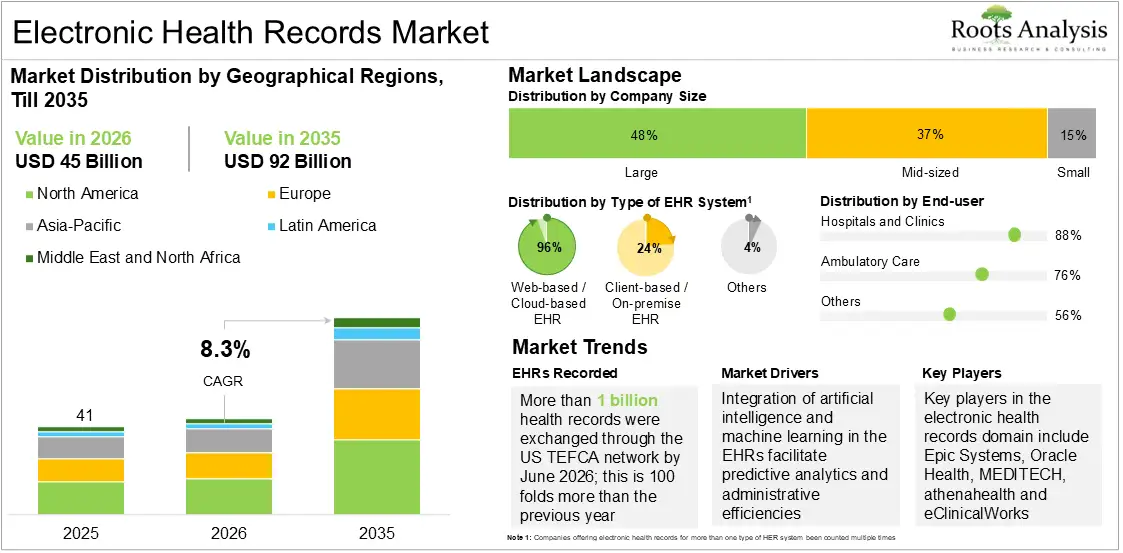
The global electronic health records market, valued at USD 41 billion in 2025, is projected to reach USD 45 billion in 2026 and USD 92 billion by 2035, representing a CAGR of 8.3% during the forecast period from 2026 to 2035.
To learn more about this report, request a free sample copy
Healthcare delivery is becoming increasingly data-driven, and electronic health records (EHR) have emerged as the digital backbone of this transformation. Modern EHR platforms are no longer limited to replacing paper charts; they serve as centralized clinical information systems that connect patient history, diagnoses, medications, allergies, laboratory findings, imaging records, treatment plans, and care notes across healthcare settings. In fact, EHRs have evolved from digital repositories into the core operating layer of modern healthcare delivery. This transition is driven by the increasing burden of chronic diseases, an aging population with multiple comorbidities, and the growing need for coordinated, timely, and evidence-based care.
Today, EHR platforms help hospitals, clinics, physicians, payers, laboratories, and patients access and exchange clinical information more efficiently across the care continuum. This role has become even more important as healthcare systems manage growing patient volumes, chronic disease burden, remote care models, and the need for coordinated decision-making. In June 2026, HHS announced that the TEFCA network had expanded rapidly, with the number of health records exchanged through TEFCA growing from 10 million to more than 1 billion in less than one year, reflecting the accelerating adoption of nationwide health data exchange. As interoperability expands, blockchain in healthcare is being explored for auditable data-sharing and consent workflows alongside existing EHR infrastructure.
Alongside this expansion in data connectivity, federal policy is creating a more structured framework for the timely and secure movement of health information. These measures are expected to increase the integration of EHR platforms with payer and provider systems, streamline prior authorization workflows, improve patient access to health information, and reduce delays in care delivery. Further, ONC's HTI-2 Final Rule, updated in 2026, reinforces this policy direction by advancing TEFCA-related provisions governing the access, exchange, and use of electronic health information.
At the same time, EHR vendors are moving toward AI-enabled and workflow-focused platforms. For instance, in August 2025, Oracle launched its modern Oracle Health EHR for ambulatory providers in the US, describing it as an AI-driven system that allows clinicians to use voice commands to access information such as recent lab results and current medications. Similarly, in February 2026, Epic released AI Charting, a built-in feature that listens during patient visits, drafts clinician notes, and queues up orders based on the conversation. These developments show that the EHR market is moving beyond digitization toward intelligent systems that reduce documentation burden, improve clinical productivity, and support more patient-centered care.
Going forward, the electronic health records market is expected to be driven by the convergence of interoperability, artificial intelligence, automation, cloud-based deployment, patient access tools, and value-based care requirements. As health systems continue to modernize their digital infrastructure, EHR platforms are likely to play an increasingly strategic role in clinical decision support, care coordination, quality reporting, population health management, and real-world data generation. These factors are expected to create sustained opportunities for EHR vendors, healthcare IT providers, cloud companies, and digital health stakeholders during the forecast period.
| Company | Headquarters (State, Country) | Flagship EHR / Platform | Core Market Positioning |
| Epic Systems | Wisconsin, US | Epic EHR | Enterprise EHR for large hospitals and health systems |
| Oracle Health | Missouri, US | Oracle Health EHR / next-generation Oracle Health EHR | AI-enabled enterprise EHR and clinical workflows |
| MEDITECH | Massachusetts, US | Expanse EHR | Cloud-ready hospital and health system EHR |
| athenahealth | Massachusetts, US | athenaOne / athenahealth EHR | Cloud-based ambulatory EHR, practice management and billing |
| eClinicalWorks | Massachusetts, US | eClinicalWorks EHR | Cloud-based ambulatory EHR and practice management |
| NextGen Healthcare | Georgia, US | NextGen Enterprise EHR | Cloud EHR for specialty and ambulatory practices |
| Veradigm | Illinois, US | Veradigm EHR | Ambulatory EHR, clinical data and life sciences insights |
| InterSystems | Massachusetts, US | TrakCare / IntelliCare | Global enterprise EHR and unified healthcare information systems |
Based on the research, we have segmented the electronic health records market into the type of EHR, type of EHR system, application, therapeutic area, end-user, and geographical regions.
By Type of EHR
By Type of EHR System
By Application
By Therapeutic Area
By End-User
By Key Geographical Regions
Driven by generative AI integration and context-aware clinical decision support, the electronic health records market is increasingly placing data quality, clinical validation, and workflow trust at the center of platform value.
Highlighting the operational and usability challenges associated with EHR implementation, Jonathan Teich (Clinical / Health IT expert, InterSystems) stated, "EHRs benefit all stakeholders tremendously because the information you need is in that one computer in front of you, and a lot of it is structured. The biggest challenge is getting that information in there. Especially because of regulation and payment requirements in the US and other countries, you have to enter data in different fields, different screens, different formats, often in an unnatural way that doesn't match the flow of thought that evolves in a typical clinical encounter."
Discussions with multiple stakeholders in this domain have influenced the opinions and insights presented in this study. The market report includes transcripts of the following third-party discussions:
Based on type of EHR, the electronic health records market is segmented into acute electronic health records, ambulatory electronic health records and post-acute electronic health records.
The acute electronic health records segment currently holds the largest share, accounting for ~50% of the electronic health records market. This can be attributed to their extensive deployment across hospitals and large healthcare systems, where patient care involves multiple departments, high patient volumes, and complex clinical workflows. Acute care hospitals require comprehensive EHR platforms capable of managing inpatient admissions, emergency care, surgical procedures, intensive care, medication administration, laboratory and imaging data, and interoperability with other hospital information systems, resulting in significantly higher implementation and maintenance expenditures than other care settings. Furthermore, government initiatives promoting digital health and interoperable healthcare records have accelerated acute electronic health records adoption.
For example, in the United States, the Centers for Medicare & Medicaid Services Promoting Interoperability Program (formerly the Medicare and Medicaid EHR Incentive Programs) and provisions under the 21st Century Cures Act have encouraged hospitals to adopt certified interoperable EHR systems and facilitate secure health information exchange. Leading vendors such as Epic Systems, Oracle Health (formerly Cerner), MEDITECH, and Altera Digital Health have established a strong presence in acute care hospitals, further reinforcing the segment's dominant market position.
The ambulatory electronic health records (EHR) segment is expected to grow at a significant pace during the forecast period owing to the increasing shift toward outpatient care, value-based healthcare delivery, and decentralized healthcare services. Rising patient preference for same-day procedures, specialty clinics, physician practices, and ambulatory surgery centers is driving demand for cloud-based, scalable, and interoperable EHR platforms that support efficient clinical documentation, e-prescribing, telehealth, and remote patient monitoring. In addition, regulatory initiatives promoting health information exchange and interoperability continue to accelerate adoption among outpatient providers.
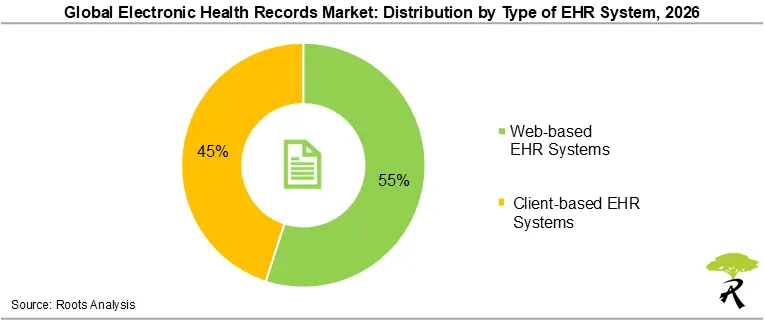
Based on type of EHR system, the electronic health records market is segmented into web-based EHR systems and client-based EHR systems.
Currently, the web-based EHR systems segment holds the largest share (~55%) of the electronic health records market. Web-based architecture reduces dependence on locally installed servers and allows vendors to centralize software maintenance, upgrades, backups, security updates, and feature deployment. These characteristics are particularly relevant for multisite practices, remote users, and organizations that lack large internal IT teams. Commercial platforms such as athenaOne, eClinicalWorks, Tebra, AdvancedMD, and CareCloud combine EHR functionality with practice management, billing, and patient-engagement tools through cloud delivery. The breadth of available products across both enterprise and independent-practice settings supports the segment's current leadership.
The web-based EHR systems segment is also likely to register the highest growth during the forecast period. Cloud delivery enables faster updates, standardized API access, scalable storage, mobile connectivity, remote support, and subscription-based purchasing. These factors make it easier for providers to adopt new interoperability and AI capabilities without replacing local hardware or conducting separate upgrades at every facility.
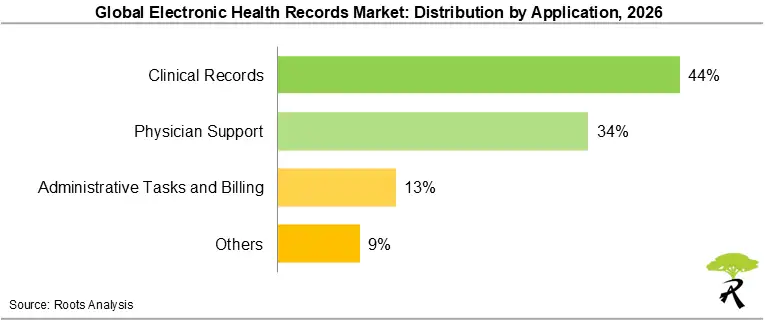
The electronic health records market is segmented into administrative task and billing, clinical records, physician support and others, based on applications.
The clinical records segment currently holds the largest share (~45%) of the electronic health records market. Clinical documentation is the foundational function around which other EHR applications operate. Patient histories, diagnoses, allergies, medications, laboratory findings, imaging results, clinical notes, clinical orders, care plans, and discharge information must be captured in a longitudinal record before systems can support billing, analytics, quality reporting, or decision support. Clinical records are used by nearly every professional involved in a patient's care and must remain available through repeated encounters. Their central role in care delivery, compliance, communication, and medico-legal documentation makes clinical functionality a primary consideration in procurement, implementation, configuration and renewal decisions.
Further, the clinical records segment is likely to register the highest growth during the forecast period. This is because the integration of artificial intelligence (AI) into EHR systems enables the conversion of unstructured clinical notes and longitudinal patient data into actionable summaries, risk indicators, suggested documentation, and workflow prompts.
Based on therapeutic area, the electronic health records market is segmented into cardiological disorders, oncological disorders, inflammatory disorders, metabolic disorders, neurological disorders, respiratory disorders, and others.
Currently, cardiological disorders hold the largest share of the electronic health records market owing to the high global burden of cardiovascular diseases and the need for continuous management of patients across multiple care settings. Cardiology departments generate large volumes of complex clinical data, including electrocardiograms (ECGs), echocardiograms, cardiac catheterization reports, imaging studies, laboratory results, medication histories, and long-term follow-up records, making comprehensive EHR systems indispensable for care coordination. Furthermore, the increasing adoption of value-based care and remote cardiac monitoring has intensified the demand for interoperable EHR platforms capable of integrating data from wearable devices, implantable cardiac monitors, and telecardiology solutions.
Regulatory initiatives promoting healthcare data interoperability, such as the 21st Century Cures Act in the US and the European Health Data Space (EHDS) initiative in Europe, have accelerated the adoption of interoperable EHR systems, supporting more efficient management of cardiovascular care through improved data sharing and care coordination. Leading EHR vendors including Epic Systems, Oracle Health, MEDITECH, and Philips offer integrated cardiology information systems that support imaging, structured reporting, and longitudinal patient management, reinforcing the dominance of the cardiological disorders segment.
The oncological disorders segment is expected to grow at a significant pace during the forecast period owing to the rapid expansion of precision oncology, increasing cancer incidence, and the growing complexity of cancer care delivery. Oncology patients require longitudinal management involving multidisciplinary teams, genomic reports, pathology results, chemotherapy protocols, immunotherapy records, radiation treatment plans, and survivorship monitoring, creating strong demand for advanced EHR platforms capable of integrating diverse clinical datasets. In addition, the increasing adoption of molecular diagnostics, companion diagnostics, and AI-assisted clinical decision support is driving healthcare providers to modernize oncology information systems.
In terms of geographical regions, the global electronic health records market is segmented into North America, Europe, Asia-Pacific, Latin America, and the Middle East and North Africa.
Currently, North America holds the largest share of the electronic health records market owing to its highly digitalized healthcare infrastructure, favorable regulatory framework, and early adoption of interoperable health information technologies. The United States has one of the highest EHR adoption rates globally, driven by federal initiatives such as the Health Information Technology for Economic and Clinical Health (HITECH) Act, which provided financial incentives for EHR implementation, and the Centers for Medicare & Medicaid Services Promoting Interoperability Program, which encourages healthcare providers to use certified EHR systems and exchange patient information electronically.
Furthermore, the implementation of the 21st Century Cures Act and interoperability standards based on FHIR (Fast Healthcare Interoperability Resources) have accelerated seamless health data exchange across healthcare organizations. The presence of leading EHR vendors such as Epic Systems, Oracle Health (formerly Cerner), MEDITECH, Veradigm, and athenahealth has significantly reinforced North America's leadership in the global EHR market. Additionally, increasing investments in artificial intelligence, cloud-based healthcare platforms, and digital health transformation continue to strengthen the region's market position.
The Asia-Pacific electronic health records market is expected to grow at a significant pace during the forecast period owing to rapid healthcare digitalization, expanding healthcare infrastructure, and strong government initiatives promoting electronic health information systems. Countries such as India, China, Japan, South Korea, and Australia are making significant investments in nationwide digital health ecosystems to improve healthcare accessibility and interoperability.
For example, India's Ayushman Bharat Digital Mission (ABDM) is creating a unified digital health infrastructure through unique health IDs and interoperable electronic health records, while China's Healthy China 2030 strategy and hospital digital transformation programs are accelerating EHR deployment across public and private healthcare facilities. Similarly, Japan's initiatives to establish a nationwide electronic medical information-sharing network and Australia's My Health Record are expanding the use of interoperable patient records.
The report profiles AdvancedMD, Athenahealth, Bizmatics, CareCloud, ChipSoft, CompuGroup Medical, CureMD, DrChrono, eClinicalWorks, Epic Systems, Greenway Health, InterSystems, MEDITECH, Microwize Technology, Netsmart, NextGen Healthcare, Oracle Health, Practice Fusion, PracticeSuite, Royal Philips, RXNT, Tebra, TruBridge, Veradigm, and WRS Health.
Alongside the core market report, clients receive complimentary Excel data packs covering the electronic health records market landscape, company competitiveness analysis, and market sizing and opportunity analysis. A complimentary PowerPoint presentation summarizing the full report is also included, and 15% free customization scope is available on request.
Roots Analysis is an independent market research and consulting firm. This report draws on publicly available information, primary interviews, and proprietary analysis. Roots Analysis is not affiliated with, endorsed by, or a representative of the USFDA, the European Medicines Agency, or any of the pharmaceutical companies, branded therapeutics, or individuals named in this report. All company and product names are used for identification purposes only and remain the property of their respective owners.
Roots Analysis maintains its own proprietary primary research process, and does not receive compensation from any company profiled within the report, in exchange for inclusion or favorable characterization.
Clients evaluating this report alongside competing market studies should weigh two factors in particular: whether the segmentation depth matches their specific decision, and whether the publisher discloses its own independence from the companies and regulatory bodies it covers.