Lowest Price Guaranteed
Pages
176
Last Updated
July 2026
View Count
16793
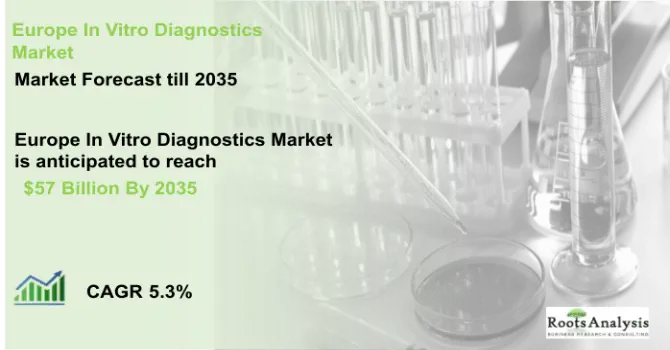
Europe in vitro diagnostics market, valued at USD 32 billion in 2024, is estimated to reach USD 34 billion in 2025 and USD 57 billion by 2035, representing a CAGR of 5.4% during the forecast period.
|
|
To learn more about this report, request a free sample copy
The new market research study report covers an in-depth analysis of industry trends, market size, patent analysis, competitive landscape, emerging trends, and future forecast.
In Europe, the growing incidence of chronic diseases and infectious diseases has surged the requirement of advanced in vitro diagnostic medical devices, instruments, and reagents. These in vitro diagnostics procedures have been employed to analyze samples such as blood, tissue, urine, and body fluids for disease diagnosis. Early diagnosis of disease at the molecular level has always been beneficial in managing disease conditions and preventing fatality. With technological advancements, the latest in vitro diagnostic instruments that work on various techniques, such as hematology, immunodiagnostics, molecular diagnostics, and tissue diagnostics, enable early diagnosis at the molecular level. Presently, in vitro diagnostics devices, instruments, and reagents have been employed to diagnose a wide range of medical conditions, such as cardiac disorders, cancer, infectious diseases, and nephrological disorders.
Europe has always been an epicenter for medical advancements, offering lucrative opportunities for industrial leaders to drive growth in the in vitro diagnostics market. Technological innovations such as next-generation sequencing and in vitro diagnostics home testing kits have become the key catalysts of the European in vitro diagnostic market. Next-generation sequencing techniques enable quick scanning of DNA to detect diseases at the genomic level. It is worth highlighting here that the European IVD industry witnessed funding and investments from various industrial and non-industrial leaders to develop advanced technologies that will be intertwined with early diagnosis. For instance, the European Investment Bank provides €20 million of investment to advance diagnostic developer Numares Health AG. This Regensburg-based company has utilized this investment for the development of the AXINON® system (fully automated in-vitro diagnostics platform). AXINON® improves the diagnostic quality of various chronic diseases such as heart, kidney, liver, and even multiple sclerosis. Moreover, the shift towards advanced technology has been demonstrated by the increasing demand for home-based in vitro diagnostic kits. The growth trajectory in the European in vitro diagnostics market is commendable and offers enormous opportunities for key developers to drive innovations in the field.
The market study report, covers the in-depth analysis of capabilities of future industrial growth across various segments mentioned below:
| Key Report Attribute | Details | |
| Historical Trend | Since 2018 | |
| Forecast Period | Till 2035 | |
| Market Size 2025 | USD 34 billion | |
| Market Size 2035 | USD 57 billion | |
| CAGR (Till 2035) | 5.4% | |
| Test Types |
|
|
| Distribution by Products |
|
|
| Distribution by Technology |
|
|
| Distribution by Application Areas |
|
|
| End-users |
|
|
Key Countries Covered in Europe In Vitro Diagnostics Market |
|
|
| Key Companies Profiled |
|
|
| Customization Scope | 15% Free Customization Option | |
| Excel Data Packs (Complimentary) |
|
|
The primary objective of the Europe in vitro diagnostics market report is to provide a comprehensive analysis of the current market size, competitive landscape, market opportunities, and growth potential for the vendors active in this domain. We have a well-informed estimation of market evolution and emerging trends on the basis of several parameters, such as competitive scenarios, primary validations, and adoption trends during the forecast period 2024-2035. Our year-wise analysis of current trends and future forecasts across various segments such as test type, type of offering, therapeutic area, end-user, and European countries provide insight into investment opportunities for the industrial stakeholders active in this field. In order to add strength and account for future uncertainties to our study model, we have included three market scenarios, namely conservative, base, and optimistic models, signifying different growth tracks in this domain.
All actual figures have been sourced and analyzed from publicly available information forums and primary research discussions. Financial figures mentioned in this regional market report are in USD unless otherwise specified. The opinions and insights presented in the market report were influenced by discussions held with stakeholders in the industry.
Europe IVD market value has been distributed across reagents, instruments, and services. Among these segments, reagents are likely to hold the highest share of the market and are expected to witness steady growth during the forecast period.
The Europe in vitro diagnostics market opportunity is segmented across laboratory testing and point of care diagnostics. Driven by the increasing incidence of chronic diseases, laboratory testing is likely to grow during the forecast period. Presently, laboratory testing accounts for the highest share of the European IVD market and is anticipated to dominate the market from 2024-2035. However, in the long run, the point-of-care testing segment is estimated to grow at a higher CAGR driven by the ability to generate results faster and convenience of use.
The Europe in vitro diagnostics market has been distributed into clinical chemistry, hematology, immunoassay, molecular diagnostics, and others. According to our projection, immunoassay holds the largest market share in 2024 and is anticipated to grow substantially over the forecast period. Clinical chemistry market segment is likely to hold the second-largest share of the Europe market.
Based on the type of end users, the market has been distributed into hospitals, laboratories, and others. According to our market research report, hospitals are expected to hold the largest share in 2024, and the trend is likely to continue from 2024-2035. This can be attributed to the growing number of laboratories that target diagnostics across a wide range of disease indications.
Europe In Vitro Diagnostics Market (Distribution by Products (Instruments, Reagents, and Other Products), by Technology (Immunoassay, Hematology, Clinical Chemistry, Molecular Diagnostics, Coagulation Microbiology, and Other Technologies), by Application (Infectious Disease, Diabetes, Oncology, Cardiology, Nephrology, Autoimmune Disease, Drug Testing, and Other Applications), by End User (Hospitals, Laboratories, and Other End Users) and Key European Countries (Austria, Belgium, France, Germany, Italy, Netherlands, Poland, Spain, Switzerland, UK and Rest of the Europe): Industrial Trends and Regional Forecast, 2024-2035; the market research report covers in-depth analysis on market size, trends, competitive landscape, growth opportunities, future investment opportunities for industrial stakeholders in the European market. Furthermore, the market report also features a detailed analysis of the ongoing efforts of key industrial leaders active in this industry for overall growth and innovations. Key takeaways of the market report are briefly discussed below.
Europe In vitro diagnostics market is estimated to be driven by growing cases of chronic and infectious diseases in Europe. According to the recently published report of the World Health Organization, the European region is experiencing a surge in measles cases. As per the report, from January to October 2023, more than 30,000 measles cases have been reported by 40 out of the 53 member states. In 2022, the number of cases was around 941, representing an over 30-fold increase. The current focus of the industrial leaders is on the development of diagnostics techniques such as molecular diagnostics and immunodiagnostics that help in early diagnosis and tracking disease indications at the molecular level.
In countries like the UK, the NHS now operates more than 155 community diagnostic centers (CDCs) that conduct tests, checks and scans. The government has pledged more funding to take the number of diagnostic tests delivered through CDCs from 7 million to 17 million by March 2025.
Driven by the ongoing efforts of industrial leaders in developing advanced in vitro diagnostic techniques, the European in vitro diagnostics market is projected to grow at a substantial rate.
European players are required to follow stringent guidelines to ensure that in vitro diagnosis instruments, reagents, and techniques are safe to use for disease diagnosis. In May 2017, the EU published In Vitro Diagnostic Regulation (IVDR) to replace the e In Vitro Medical Devices Directive (IVDD). The IVD tests have been divided into high risk and low risk IVDs, although the approval process in the EU stays the same, which is getting CE-mark for IVD devices to be sold in European markets. Even before the compliance date, a further amendment was proposed in January 2024. Although the new compliance dates are set at December 2027 for high-risk IVDs and December 2028 for low-risk IVDs, the stakeholders are still not clear of the impact of the new regulations. Further, adapting to regulatory guidelines and significant changes in the documentation, processes, and clinical evidence may consume time and be costly. Reimbursement issues also create challenges for the European healthcare system to adopt advanced technologies for disease diagnosis and treatment, as the majority of European countries have government funded health systems. Additionally, variability in the reimbursement policy across different countries in Europe further adds complexity for the manufacturers, which hinders its progress.
European healthcare is witnessing the shift towards personalized medicines to target patient's requirements. Considering the ongoing trend of personalized medicine, pharmaceutical companies and healthcare sectors are implementing in vitro diagnostic techniques such as immunoassay, next-generation sequencing, and molecular techniques to customize treatment plans based on individual patient molecular characteristics. It is worth highlighting here that several players active in this domain are entering into a collaboration to develop point-of-care testing techniques and home-based diagnostic kits, which are anticipated to provide enormous opportunities for industrial stakeholders engaged in this field.
Although the amendments proposed by EU will be challenging for the IVD developers from the point of view of understanding the requirements and managing the resources for implementation, it also provides long-term opportunities. The initiatives have been taken by the European Council for the prevention of regional test shortages.
Examples of European in vitro diagnostics companies engaged in this domain (also profiled in this report; the complete list of companies is available in the full report) include bioMérieux, Gold Standard Diagnostics, Grifols, Qiagen, Roche, Siemens Healthineers, and Werfen. This regional IVD market report includes an easily searchable excel database of the leading companies that offer in vitro diagnostic solutions in Europe.
Some of the recent developments in the Vitro Diagnostics market in Europe are mentioned below.