


 Download Free Sample
 Buy Now
Fat Cavitation Market Overview
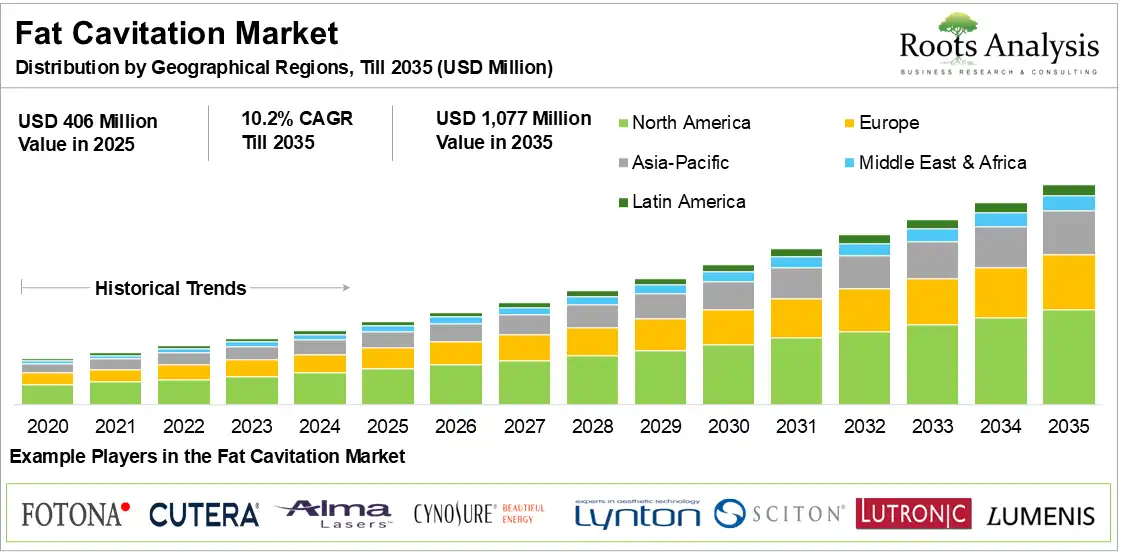
The global fat cavitation market size, valued at USD 361 million in 2024, is projected to reach USD 406 million in 2025 and USD 1,077 million by 2035, representing a CAGR of 10.2% during the forecast period.
See What’s in the Full Report - Request Your Complimentary Insights!
Fat Cavitation Industry: In Summary
- The global fat cavitation market is experiencing significant growth, driven by increasing demand for non-invasive fat reduction and body contouring solutions.
- This fat cavitation market is projected to reach USD 1,077 million by 2035, exhibiting a compelling CAGR of 10.2% during the forecast period. The pervasive influence of social media has amplified aesthetic goals and rising incidence of obesity, leading to a surge in demand for procedures that offer a toned and lean body.
- Continuous innovation in technologies like radiofrequency, ultrasonic waves, advanced cooling, and High-Intensity Focused Ultrasound (HIFU) are enhancing the efficacy and appeal of fat cavitation.
- Ultrasound cavitation (especially high-frequency ultrasound) currently dominates the market share due to its widespread use in fat removal and body contouring. However, combined technologies are expected to grow at a higher CAGR as healthcare professionals increasingly prefer integrated approaches to address multiple concerns simultaneously.
- Handheld devices hold the largest market share, favored for their ease of operation and ergonomic design, making them suitable for both professional and home-based use. Portable devices are anticipated to witness the highest CAGR, reflecting a growing shift towards technologies usable beyond clinical settings.
- North America region dominates the market with nearly 45% of the share, acting as a technology hotspot. This leadership is driven by high obesity rates, strong demand for medical aesthetic treatments, and continuous technological innovations, supported by high disposable incomes and social media influence.
- The fat cavitation market is highly competitive, featuring both established players and new entrants. Key players like Cutera (US), and Fotona (US) are actively leveraging strategic initiatives, including product approvals, collaborations, and partnerships. For instance, Apyx® Medical received 510(k) clearance for its AYON Body Contouring System™ in May 2025.
- Ongoing investments in improving ultrasound and deep-acting radiofrequency technologies are expected to deliver faster and superior results. The focus will also shift towards developing at-home and wearable medical devices for greater convenience and affordability.
Fat Cavitation Market Introduction
Fat cavitation refers to a non-invasive fat reduction procedure designed to reduce fat and cellulite from the body. With social media hype on aesthetic goals and rising incidence of obesity, there is surge in the demand for fat cavitation technology. Notably, this non-invasive aesthetic technology utilizes low-frequency ultrasound waves to break fat cells, which are then expelled from the body naturally. It is non-invasive, require minimal downtime and is safer than traditional liposuction procedures.
Technologies, such as radiofrequency, ultrasonic waves, and advanced cooling technologies have been adopted on a large scale for fat cavitation. Additionally, the growing trend of body contouring to get a lean and toned body is likely to propel the demand for fat cavitation procedures. Owing to the ongoing demand, several market players are finding enormous opportunities for technological innovation in this field.
Your Business is Unique – Why Shouldn’t Your Report Be?
However, the primary aim of the industrial players will be to develop cost-effective, safe and convenient fat removal technologies. Market players, such as Cutera, Fotona, and InMode are leveraging strategic initiatives, followed by latest product approval, collaborations and partnerships. For instance, in May 2025, Apyx® Medical announced that its AYON Body Contouring System™ has received 510(k) clearance from the USFDA for fat reduction and body contouring. As more market players continue to explore new technologies, we believe that fat cavitation market will remain progressive in the future.
Fat Cavitation Market: Report Attributes
| Key Report Attribute | Details | |
| Historical Trend | Since 2020 | |
| Forecast Period | Till 2035 | |
| Market Size 2025 | USD 406 Million | |
| Market Size 2035 | USD 1,077 Million | |
| CAGR (Till 2035) | 10.2% | |
One of the key objectives of the fat cavitation market report was to estimate the current size, opportunity, and the market growth potential, over the forecast period, till 2035. We have provided informed estimates on the likely evolution of the market for the forecast period.
The global fat cavitation market analysis also features the likely distribution of the current and forecasted opportunity within the market across various segments, such as type of treatment, type of product, type of gender, application area, end user, geographical regions, and leading players.
In order to account for future uncertainties associated with some of the key parameters and to add robustness to our model, we have provided three market forecast scenarios, namely conservative, base, and optimistic scenarios, representing different tracks of industry’s evolution.
Recent Developments in Fat Cavitation Market
Several recent developments in the field of fat cavitation industry have occurred, and we outlined some of these below.
- In June 2025, Kaya (India) launched Artiqa next-generation aesthetic device designed to reduce stubborn fat and address body contouring problem. This newly launched device combines thermal hot and cold therapy along with electro muscle stimulation (EMS) to reduce fat, tone muscles, inches and rejuvenate skin non-invasively.
- In May 2025, The Laser Lounge Spa launched medical-grade non-surgical technologies for fat reduction, and body contouring aiming to provide customized approach for aesthetic goals.
- In April 2025, Cure Medical attended “The Dubai World Dermatology & Laser Conference & Exhibition (Dubai Derma) 2025.” During this exhibition, Cure Medical’s CEO Adam Bashir showcase their latest advancements in medical aesthetics, including AgeJet Plasma Skin Rejuventation, Ultraformer III & MPT HIFU for fat reduction, and CLATUU Alpha Cryolipolysis.
Fat Cavitation Market Segmentation Insights
The market report provides comprehensive information on fat cavitation industry players who are currently active across various segments of the industry as mentioned in the table below.
Fat Cavitation Market: Market Segmentation
| Market Segmentations | Details | |
| Type of Treatment |
|
|
| Type of Product |
|
|
| Type of Gender |
|
|
| Application Area |
|
|
| Type of Technology |
|
|
| End User |
|
|
| Geographical Regions |
|
|
| Market in North America |
|
|
| Market in Europe |
|
|
| Market in Asia-Pacific |
|
|
| Market in Middle East and Africa |
|
|
| Market in Latin America |
|
|
Industry Experts on Fat Cavitation Market
The global non-invasive fat reduction market is gaining traction due to the growing demand for advanced aesthetic solutions for weight loss. During South Beach Symposium 2025, David Goldberg, (MD, JD) shared his insights on the growing role of non-invasive treatments in medical aesthetic industry.
“Goldberg (MD, JD) highlighted that ultrasound-based body contouring is gaining traction due to ease of use and cost-effectiveness. He also concluded that the increasing adoption of non-invasive and combination treatments, aesthetic practitioners must stay informed about the latest developments to optimize patient outcomes. Goldberg, further added in his statement that, we have a lot of young doctors joining the practice, and we want them to learn things that are safe and easy to use.”
Fat Cavitation Market Share Insights
Market Share by Type of Treatment: Is Ultrasound Cavitation Expected to Maintain its Market Leadership?
- Based on the type of treatment, the global market is segmented into ultrasound cavitation (low-frequency ultrasound, and high-frequency ultrasound), radiofrequency cavitation (monopolar RF, bipolar RF, and multipolar RF), combined technologies. According to the fat cavitation market forecast, the ultrasound cavitation segment is dominating by holding maximum share of the market. This dominance stems from the growing usage of high-frequency ultrasound for fat removal and body contouring to achieve aesthetic appearance goals.
- In the future, combined technologies segment is likely to gain momentum at a higher CAGR during the forecast period. This can be attributed to the healthcare professionals preferences for combined approach, such as cryolipolysis, and radiofrequency to address multiple concerns (cellulite, fat, and skin laxity) simultaneously.
Market Share by Type of Product: Why Handheld Cavitation Devices Adoption is Increasing?
- The global market is categorized across different type of product, such as handheld devices (wireless devices, and wired devices), tabletop devices (professional-grade machines, and compact devices), portable devices (battery-operated devices, and plug-in devices). Among these, the handheld devices segment accounts for the highest fat cavitation market share. Handheld devices are easy to operate and have ergonomic design, which makes it highly suitable for body contouring, and home-based fat reduction practices.
- It is important to highlight here that the portable devices segment is likely to grow at a higher CAGR during the forecast period. This can be ascribed due to the rising shift towards portable fat cavitation technologies that can be operated beyond clinical settings.
Market Share by Type of Gender: Why Fat Cavitation Technology is Gaining Popularity Among Women?
- This segment is distributed across different type of gender, such as male and female. Presently, the women segment holds the highest share of the fat cavitation market size. This highest share reflects the high adoption of non-invasive body contouring solutions to get a toned body.
- It is worth noting that men segment is likely to grow to show a robust growth, anticipated to register higher CAGR in the future. The rising incidence of men obesity and rising interest towards aesthetic clinic fat reduction treatments to achieve youthful appearance is likely to drive this segment growth in the future.
Market Share by Application Area: Why is Beauty Salon Fat Reduction Equipment Holding Highest Share?
- Based on the application area, the global market is segmented into abdomen, hip, thigh and others. According to the fat cavitation industry analysis, the abdomen segment is dominating the market by securing nearly 30% of the market share. This dominance is due to the rising adoption of beauty salon fat reduction equipment to get rid of stubborn abdomen fat which is difficult to reduce with traditionally available approach.
- It is important to highlight here that the hip segment is likely to grow at a higher CAGR in the future. This growth reflects the rising demand for medical aesthetic procedures to get desirable shape of the buttocks.
Market Share by End User: Does Medspas Segment Maintain Its Dominance in the Future?
- Based on the end user, the global market is segmented into hospitals, wellness centers, medspas and individuals consumers. According to our projection, the medspas segment is dominating by holding 50% of the fat cavitation market share. This growth can be attributed to the fact that medspas holds specialized non-invasive aesthetic procedures and these clinic offer personalized attention which seems appealing to the consumers.
- In the future, wellness centers segment is likely to grow at the highest CAGR during the forecast period. This can be ascribed due to the fact that wellness centers are investing in fat cavitation equipment, such as ultrasound cavitation, machine, laser systems, and radiofrequency devices. The availability of advanced technologies helps to offer precise and effective fat reduction.
Regional Analysis: Why North America is Dominating the Market?
The global fat cavitation market is distributed across North America, Europe, Asia-Pacific, Middle East and Africa, and Latin America. This regional analysis indicate the rising opportunities for technological innovations. The major growing regions are listed below:
North America: Technology Hot Spot for the Market Players
According to our projection, the North America region currently dominate by holding nearly 45% of the market share. This dominance is due to the rising incidence of obesity, strong demand for medical aesthetic treatment for body sculpting and technological innovations. It is worth noting that the rising social media hype for body goals, and disposable income to spend on medical aesthetic procedures is encouraging the market growth in this region.
Europe: Well-Established Cosmetic and Wellness Industry
Europe region also holds the substantial share of the market driven by the well-established wellness industry and willing to spend on beauty regimes for aesthetic goals. Notably, countries like UK, Germany, and France have a strong emphasis on physical appearance which drives the demand for advanced aesthetic procedures for body contouring. Moreover, the favorable regulatory guidelines has further supported the growth of market in this region.
Asia-Pacific: Fastest Growth Region of the Market
In Asia-Pacific, the market for fat cavitation is growing rapidly, anticipating registering a higher CAGR in the future. The growing social media influencers marketing for aesthetic goals, rising obesity among younger demographic, and economic growth is accelerating the adoption of body contouring treatment in this region. Notably, the rising awareness about fitness and consequences associated with overweight conditions has further bolstered the demand for advanced fat cavitation technologies in this region.
Want Information on Specific Region / Segment?
Fat Cavitation Market: Report Deliverables
| Report Deliverables | Details | |
| Excel Data Packs (Complimentary) |
Available | |
| Key Fat Cavitation Companies Profiled |
|
|
| PowerPoint Presentation (Complimentary) |
Available | |
| Customization Scope | 15% Free Customization | |
Fat Cavitation Market Key Takeaways
The "Fat Cavitation Market Report: Industry Trends and Global Forecasts, till 2035" market report features an extensive study of the current market landscape, market size, market share, market growth, market trends, market value, market forecast, market outlook, statistics, and future opportunities for fat cavitation technologies providers. The market research report lays emphasis on the fat cavitation technologies that are being developed for parents and daycare providers. Key takeaways of the market report are briefly discussed below.
What's The Competitive Landscape Like For Fat Cavitation Equipment Manufacturers?
The non-invasive fat reduction market is highly competitive, featuring the presence of several well-established and new entrants. With increasing demand for fat cavitation techniques, industrial players are focusing on advancing the ultrasound and radiofrequency techniques to enhance outcomes of the treatment. However, the primary focus will be on the development of portable and AI-integrated fat cavitation techniques, such as portable ultrasonic cavitation machines to enhance precision and efficiency. As more industrial player show active interest in this field, the market will remain competitive in the future.
Market Size Analysis: Market Outlook For Fat Cavitation Treatments in Medical Spas and Wellness Centers
In 2025, the global fat cavitation market is valued at USD 406 million and poised to reach USD 1,077 million by 2035. This unprecedented growth is driven by the rising focus on beauty and wellness to maintain aesthetic appearance. Notably, the medical spas and wellness centers are focusing on body sculpting and body contouring procedures to help consumers get visibly toned body. Moreover, the increasing spending on medical spas by tourists across different regions are likely to bolster the fat cavitation treatment in medical spas and wellness centers.
Market Drivers: What are the Main Drivers Behind Increasing Demand for Fat Cavitation Treatments?
The medical spa cavitation treatments are gaining traction across millennial and population above 30 years age due to the hype of social media, creating an immense demand for these procedures. Some other factors that are propelling the market are listed below:
Increasing Incidence of Obesity: How is Rising Obesity Affecting the Fat Cavitation Market Outlook?
It is worth noting that the rising incidence of obesity across the globe has necessitated the demand for portable fat cavitation machines to reduce excessive cellulite and fat. Notably, radiofrequency cavitation devices helps to are highly effective in reducing stubborn fat in obese people without causing side-effects, making it a potential alternative of anti-obesity drugs. Beyond obesity, these fat cavitation machines can help to get rid of loose skin, and cellulite in person who have done weight loss using liposuction and drugs treatments.
Pay Only for What You Need – The Best Way to Optimize
Rising Demand for Non-Invasive Fat Reduction Treatment: How is Consumer Preference for Non-Invasive Procedures Influencing Market Trends?
Consumers are increasingly seeking safe and effective non-invasive fat reduction treatment to reduce fat from the body without undergoing expensive surgeries. It is worth mentioning that non-surgical treatments does cause scars and cause minimal discomfort to the individuals seeking fat reduction treatment. Owing to the increasing awareness about non-invasive procedures, the demand for fat cavitation is likely to increase in the future.
Market Challenges: What Challenges Do Beauty Clinics Face When Investing in Cavitation Equipment?
Despite increasing demand, several factors may hinder the market growth. Some of the potential challenges are listed below:
High Cost of Procedures and Equipment: Are High Equipment Costs Still Limiting Market Expansion for Smaller Clinics?
It is important to highlight here that the average cost of fat cavitation solutions can range from USD 750 to USD 4000 per area of the body. The full treatment may often exceed USD 10,000 and even higher if an individual require multiple sittings. This high cost of treatment may limit its adoption across low-to-middle income countries. In addition, lack of reimbursement policies, and high equipment cost may along limit its adoption across global population.
Competition from the Alternative Solutions
Although consumers prefer non-invasive fat reduction treatments, however, the availability of alternative solutions may hinder the market progress. For instance, the availability of GLP-1 weight loss drugs for faster weight loss and traditional weight reduction regime may limit its adoption across the global population.
Market Trends: What are the Top Fat Cavitation Market Trends?
With rising adoption of fat cavitation procedures, several market players are leveraging technological innovations. Some of the potential trends are listed below:
Advancement in Fat Cavitation Technology: Investment Opportunities in Portable and Home-Use Fat Cavitation Devices
The future of the fat cavitation industry is technological innovations to enhance efficacy and precision in fat reduction. Notably, several industrial players are focusing to improve ultrasound and deep-acting RD technologies for faster and superior results. In addition, the market players, such as Erchonia (US) are advancing their low-level laser therapy (LLLT) devices that helps to create minute temporary pores within fat cells so lipids can seep out. Moreover, the future focus will also be on the development of at-home and wearable devices for convenience and affordability.
Integration of AI And Radiofrequency In Advanced Fat Cavitation Systems
The medical aesthetic industry specifically fat cavitation is leveraging AI technology to collect anthropometric data from the body to recommend precise session and applicator placement. The AI-powered body sculpting technology enhance patient safety, increasing optimal results. Moreover, with integration of AI-powered skin analysis systems, clinicians can accurately modulate the procedure for maximum fat cavitation, while minimizing human errors.
Emerging Trends In Combination Therapies Using Fat Cavitation and Body Contouring
The industrial players are increasingly focusing on combination therapies, such as pairing of fact cavitation procedures and invasive surgical procedures to enhance fat reduction. In addition, these industrial players are aiming for multi-modality devices development that combines ultrasonic cavitation and radiofrequency technology to simultaneously reduce fat, tighten skin, tone muscles, and reduce cellulite. The strategic packaging of multiple devices into curated "transformation journeys" is also reported to yield higher average revenue per client.
Get an Instant Quote in 10 Minutes. Lowest Price Guaranteed!
Fat Cavitation Market Report Coverage
The market report presents an in-depth analysis, highlighting the capabilities of various stakeholders in the fat cavitation industry, across different geographies. Amongst other elements, the market report includes:
- An Infographic Executive Summary
- Regulatory Scenario
- Comprehensive Database of Leading Players
- Competitive Landscape
- Porter’s Five Forces Analysis
- Company Competitiveness Analysis
- Startup Ecosystem in the Fat Cavitation Market
- Company Profiles
- Partnerships and Collaborations
- Market Forecast and Future Opportunity Analysis
- Adjacent Market Analysis
- Key Winning Strategies
- Value Chain Analysis
Glossary
- Body Contouring: A set of procedures that reshape and improve the appearance of the body, often after significant weight loss.
- Cryolipolysis: A non-invasive fat reduction method that uses controlled cooling to freeze and eliminate fat cells, commonly known as fat freezing.
- GLP-1 (Glucagon-Like Peptide-1) Agonists:A class of medications used to treat type 2 diabetes and obesity by mimicking a natural hormone that helps regulate blood sugar and appetite.
- High-Intensity Focused Ultrasound (HIFU): A non-invasive technology that uses focused ultrasound energy to generate heat and destroy fat cells, also used for skin tightening.
- Low-Level Laser Therapy (LLLT): A non-invasive treatment that uses low-power laser light to stimulate cellular function and promote healing, also applied in fat reduction.
From the Author’s Desk
Author’s View on Fat Cavitation Market
The fat cavitation market presents a compelling narrative of innovation and adaptation within the broader aesthetic and wellness industries. Notably, the future of fat cavitation lies in multi-modality approaches and AI integration. The trend of combining ultrasonic and radiofrequency technologies, often with other modalities like LLLT or HIFEM, reflects a market demand for comprehensive solutions that address multiple aesthetic concerns simultaneously. AI-driven personalized treatment planning and robotic assistance will further enhance precision, efficacy, and patient experience. Companies that invest in these integrated, technologically advanced systems, coupled with robust training and support for their professional partners, are best positioned to capture market share.
Customization Opportunities
At Roots Analysis, we genuinely care about your success and understand that your business requirements are unique. While our market research reports provide valuable insights, we recognize that they might not cover every aspect you need to make well-informed strategic decisions. To account for that, we offer 15% free report customization tailored to your specific needs. Whether you require additional quantitative analysis, qualitative insights, or any other information related to the electric vehicles market, reach out to us today at support@rootsanalysis.com


