


 Download Free Sample
 Buy Now
Market Size
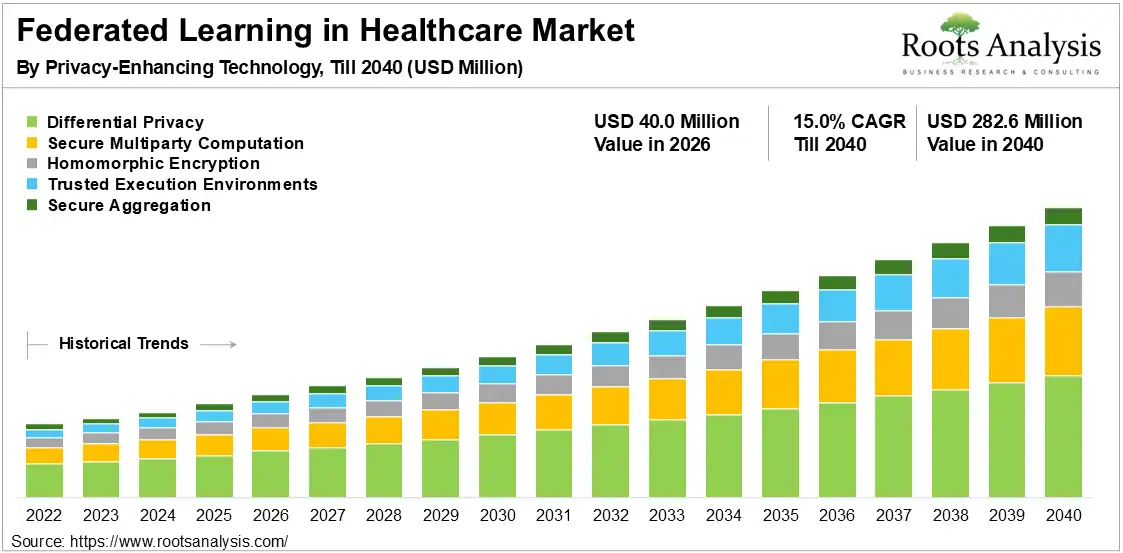
The global federated learning in healthcare market is expected to rise from USD 40.0 million in 2026 to reach USD 282.6 million by 2040, growing at a CAGR of 15.0% over the forecast period 2026 to 2040, driven by privacy-preserving collaboration across fragmented clinical datasets.
See What’s in the Full Report – Request Your Complimentary Insights!
Market Report: Key Takeaways
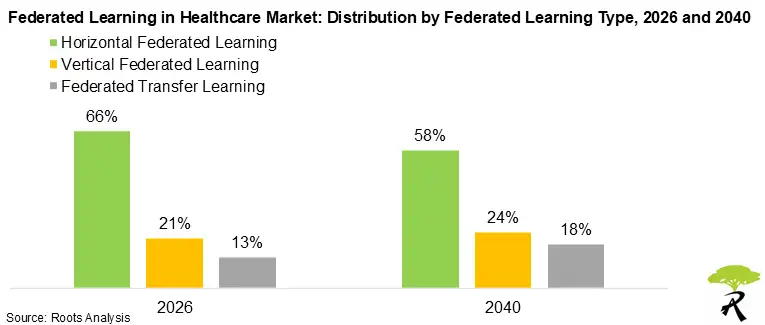
- Based on federated learning type, horizontal federated learning captures 66.0% market share in 2026, whereas federated transfer learning registers a 17.9% CAGR through 2040, supported by reusable foundation models.
- Based on application, drug discovery and development captures 34.5% market share in 2026, whereas precision medicine and genomics registers an 18.0% CAGR through 2040, supported by distributed multi-omics collaboration.
- Based on healthcare data modality, medical images capture 27.0% market share in 2026, whereas genomic and other omics data registers a 17.6% CAGR through 2040, supported by expanding rare-disease cohorts.
- Based on end user, hospitals and healthcare providers capture 40.0% market share in 2026, whereas pharmaceutical and biotechnology companies register a 16.9% CAGR through 2040, supported by privacy-safe drug discovery partnerships.
- Based on geography, North America captures 34.5% market share in 2026, whereas Asia-Pacific registers a 17.1% CAGR through 2040, supported by national digital-health investments.
Federated Learning in Healthcare Market Outlook
The federated learning healthcare market has moved from research-led hospital pilots toward commercial platforms connecting clinical, molecular, and imaging data. Drug discovery now leads application demand with 34.5% market share in 2026. Hospitals remain the largest end users at 40.0%, yet pharmaceutical companies are gaining share faster. Secure aggregation currently anchors deployments, while transfer learning and encrypted computation increasingly address smaller datasets, specialized models, and cross-border privacy constraints.
Growth comes from expensive proprietary datasets, stronger artificial intelligence investment, and policies supporting decentralized health-data use. India’s National Federated Learning Platform extends validation across ecosystem partners within the Ayushman Bharat Digital Mission. In September 2025, Eli Lilly launched TuneLab for biotechnology companies seeking privacy-preserving access to drug-discovery models. These developments reduce data-transfer barriers while widening commercial participation across fragmented partner ecosystems.
Through 2040, the market will remain high-growth as precision medicine expands at 18.0% CAGR and federated transfer learning grows 17.9%. Homomorphic encryption will gain as hardware acceleration lowers computation penalties. In May 2025, Flower Labs introduced Photon for federated foundation-model pretraining. Competitive advantage will increasingly depend on reusable models, protected aggregation, and trusted multi-institution networks. Standalone software will carry less weight across clinical and research settings.
Federated Learning in Healthcare Market Dynamics
Federated Learning in Healthcare Market Drivers
Privacy-preserving collaboration is the strongest driver in the federated learning healthcare market. Hospitals and pharmaceutical companies cannot freely pool identifiable or proprietary data. Drug discovery already holds 34.5% application share, while hospitals control 40.0% of end-user demand. Secure aggregation supports 31.0% of privacy-technology spending by protecting individual model updates. In November 2025, Johns Hopkins launched federated Cancer AI Alliance projects spanning electronic health records and brain-cancer research.
Federated Learning in Healthcare Market Restraints
Complex orchestration restrains adoption because participating institutions use different infrastructure, governance rules, model-validation processes, and data quality standards. Horizontal federated learning still holds 66.0% share because comparable feature structures simplify deployment. Vertical learning requires harder entity matching across organizations with different variables. Homomorphic encryption adds further computing cost, even though its 17.5% CAGR signals improving performance and stronger buyer demand for protected aggregation.
Federated Learning in Healthcare Market Opportunities
Federated drug discovery platforms create the clearest commercial opportunity by opening high-value molecular, assay, and compound datasets without centralizing them. Pharmaceutical and biotechnology companies will expand at 16.9% CAGR, outpacing hospitals. In February 2026, Apheris introduced the ADMET Network for training and evaluating models across proprietary pharmaceutical datasets. Vendors that combine secure computation, model benchmarking, and workflow integration can capture premium enterprise demand.
Federated Learning in Healthcare Market Challenges
Clinical validation remains the hardest scaling challenge because federated models must perform consistently across hospitals, populations, devices, and data modalities. Medical images lead modality demand at 27.0%, supported by standardized archives and defined diagnostic endpoints. Genomic data grows faster at 17.6%, but rare-disease cohorts remain smaller and more geographically fragmented. Providers must therefore balance model generalization, privacy controls, local computing limits, and institution-specific approval requirements.
Federated Learning in Healthcare Market Size Estimation Methodology
- As a starting point, the analysis defined the federated learning healthcare market around software, platforms, and infrastructure supporting decentralized model training. It separated horizontal, vertical, and transfer learning from adjacent data-clean-room or centralized analytics offerings. The scope then mapped six applications, six healthcare data modalities, five privacy technologies, four end-user groups, and six geographic categories. This boundary prevented double counting of adjacent privacy services.
- Moving forward, researchers reviewed 18 credible secondary and industry sources to establish historical revenue patterns and comparable growth ranges. Estimates clustering around similar 2024 baselines and mid-teen growth received greater weight. Broader estimates with materially different market scope or unusually aggressive assumptions were excluded before the consensus forecast was constructed. Source weighting favored consistent definitions and transparent forecast periods.
- Building on this, the model tested demand indicators specific to healthcare adoption. These included hospital deployment records, pharmaceutical artificial intelligence partnerships, clinical trial databases, federated platform launches, and privacy-technology integration. Company disclosures and public program announcements helped distinguish research activity from commercial deployment, while dated developments established the pace of market conversion. This distinction reduced reliance on pilot announcements alone.
- Drawing upon these inputs, segment shares were allocated using deployment maturity, data availability, workflow standardization, and buyer spending capacity. Medical imaging received higher current weight because PACS infrastructure and defined diagnostic endpoints simplify validation. Drug discovery gained application leadership because proprietary molecular and assay datasets support premium collaboration spending without requiring raw-data transfers. End-user weights reflected data control and procurement authority.
- The projected value was then extended through 2040 using a 15.0% compound annual growth rate and segment-specific adoption curves. Faster trajectories were assigned to precision medicine, genomics, federated transfer learning, homomorphic encryption, pharmaceutical users, and Asia-Pacific. Slower trajectories reflected mature hospital workflows, established imaging use cases, and share dilution as newer applications scaled. Regional curves also reflected infrastructure maturity and government support.
- Finally, the forecast was cross-checked against platform launches, partnership frequency, regional digital-health programs, and privacy-computing adoption. Sensitivity tests assessed changes in institutional onboarding speed, computing costs, model-validation requirements, and cross-border data restrictions. The final shares were normalized to 100.0% within each segmentation layer, and annual values were reconciled with the overall market growth path. No segment assumption was allowed to override the consolidated total.
Federated Learning in Healthcare Market Share Insights
Market Share by Federated Learning Type
According to our analysis, horizontal federated learning leads because hospitals usually hold comparable feature structures across separate patient populations. Its tooling maturity and simpler orchestration reduce deployment costs and clinical validation requirements. In February 2025, Flower Labs detailed a University of Maryland medical-imaging federation.
Federated transfer learning grows fastest as pretrained models reduce data and computing requirements for smaller institutions. Foundation-model reuse also supports rare diseases, specialized diagnostics, and regions with limited labeled data.
Market Share by Privacy-Enhancing Technology
Secure aggregation leads because it protects individual model updates while preserving familiar federated training workflows. Its relatively lower computational burden supports deployment across heterogeneous hospital infrastructure. In March 2025, Google Research announced confidential federated analytics with protected aggregation.
Homomorphic encryption grows fastest as selective encryption and hardware acceleration reduce previous performance penalties. Healthcare buyers will increasingly require protection during aggregation, not only local data retention. In February 2025, Sherpa.ai detailed federated learning and homomorphic-encryption applications.
Want Information on Specific Region / Segment?
Regional Analysis: North America Leads the Market and Asia-Pacific is Likely to Register Higher CAGR
Presently, North America holds 34.5% market share in 2026. North America maintains structural leadership through advanced healthcare infrastructure, extensive cloud capacity, and mature clinical-data governance. Strong capital access also connects technology vendors, academic medical centers, pharmaceutical companies, and specialized artificial-intelligence developers. Comparable industry estimates place the region near one-third of global revenue during the current market-development stage. In September 2025, Eli Lilly launched TuneLab for privacy-preserving collaboration with biotechnology companies. The platform uses federated learning without directly exposing participating companies' proprietary datasets.
On the contrary, Asia-Pacific grows at a 17.1% CAGR from 2026 to 2040. Asia-Pacific will grow fastest as governments connect hospitals, expand health-data systems, and invest in locally trained clinical models. Large distributed populations create demand for collaboration without moving sensitive information between institutions and jurisdictions. In February 2026, India's health ministry detailed a national platform for validating AI models across ecosystem partners. The initiative operates within the Ayushman Bharat Digital Mission's expanding health-data infrastructure.
Market Ecosystem Analysis
Within the 20-company scope, nine Tier 1 leaders control most activity, alongside six specialists and five emerging entrants. Platform convergence dominates, combining federated runtimes, confidential computing, GPU infrastructure, clean rooms, and healthcare workflow software. Proprietary pharmaceutical data is reshaping competition, with model access increasingly exchanged for partner data contributions. Advantage is shifting toward governed network orchestration and protected compute because algorithms alone cannot unlock institutional healthcare data.
- In September 2025, Eli Lilly launched TuneLab, providing selected biotechs access to models trained on proprietary research data.
- In October 2025, Eli Lilly and NVIDIA announced a DGX SuperPOD collaboration supporting TuneLab's federated models.
- In January 2026, Schrödinger announced TuneLab integration into LiveDesign, extending Lilly's models to biotechnology customers.
- In October 2025, Apheris expanded OpenFold3 with three additional pharmaceutical contributors supplying proprietary structural datasets.
- In July 2025, Elix commercialized federated models trained on data from 16 pharmaceutical companies through Elix Discovery.
- In February 2025, Rhino and Flower integrated Flower's framework ecosystem with Rhino's enterprise federated-computing platform.
- In October 2025, Flower deployed within an NHS secure research environment supporting a multi-institutional blood-diagnostics consortium.
- In October 2025, Fortanix and NVIDIA announced an on-premises Confidential AI platform for regulated healthcare workloads.
Startup Companies and their Key Highlights
- Rhino Federated Computing
- Event type and funding amount: Series A financing, USD 15 million
- Month and year: May 2025
- Lead investor: AlleyCorp
- Stated purpose: Expand Rhino's enterprise-grade federated AI platform across healthcare, biopharma, finance, and other regulated industries.
- Market implication: Accelerates hospital and biopharma federations by funding compliance, enterprise deployment, and cross-jurisdiction orchestration.
- Flower Labs GmbH
- Company name: Flower Labs GmbH
- Event type: Strategic platform-integration partnership
- Month and year: February 2025
- Strategic partner: Rhino Federated Computing
- Stated purpose: Make Flower workloads deployable through Rhino's secure, production-grade federated-computing platform.
- Market implication: Accelerates horizontal federated learning, privacy-enhancing technologies, and hybrid deployment across hospitals and pharmaceutical networks.
- Apheris
- Company name: Apheris
- Event type: Federated structural-biology consortium expansion
- Month and year: October 2025
- Stated purpose: Improve OpenFold3 using additional proprietary protein and small-molecule structures without centralizing participating companies' datasets.
- Market implication: Accelerates molecular-data collaboration and small-molecule discovery by increasing proprietary structural-data diversity.
- Decentriq AG
- Company name: Decentriq AG
- Event type: Healthcare-data partnership and commercial solution launch
- Month and year: March 2026
- Strategic partner: PurpleLab
- Stated purpose: Connect social-media exposure with prescriptions, claims, and patient outcomes inside confidential data clean rooms.
- Market implication: Accelerates claims analytics and real-world evidence through confidential computing and protected multiparty data collaboration.
- Elix, Inc.
- Company name: Elix, Inc.
- Event type: Commercial federated AI drug-discovery platform launch
- Month and year: July 2025
- Strategic partner: Life Intelligence Consortium
- Stated purpose: Commercialize multiple federated models trained using confidential data from 16 pharmaceutical companies.
- Market implication: Accelerates Japan's drug-discovery segment through federated molecular, ADMET, and compound-generation models.
Federated Learning in Healthcare Market Trends / Opportunities
Federated Drug Discovery Networks Reshaping Competition in the Federated Learning Healthcare Market
Federated drug discovery is shifting competition from standalone software toward protected data networks and integrated workflows. Eli Lilly launched TuneLab in September 2025 for biotechnology access to privacy-preserving discovery models. Platform value will increasingly depend on model quality, partner reach, and secure access to proprietary datasets.
Cross-company model improvement is becoming commercially viable without raw-data pooling. Bristol Myers Squibb, Takeda, and Astex joined an October 2025 consortium using federated learning to improve OpenFold3. This structure favors vendors that can govern multiparty participation while protecting each contributor’s competitive information.
Workflow integration is lowering adoption friction for smaller biotechnology users. Schrödinger and Eli Lilly agreed in January 2026 to connect TuneLab with LiveDesign. Embedded access can expand usage faster than separate platform deployments and strengthen ecosystem lock-in.
Foundation Models Expanding Participation in the Federated Learning Healthcare Market
Federated transfer learning is widening participation because pretrained models reduce local data and computing requirements. Flower Labs introduced Photon in May 2025 for federated foundation-model pretraining. Vendors supporting reusable models can address smaller hospitals, rare diseases, and regions with limited labeled datasets.
Precision medicine is gaining commercial weight as distributed cohorts improve variant interpretation and disease-specific generalization. Flower Labs profiled Eye2Gene’s federated genetic-disease diagnostic model in March 2025. Providers combining genomics, imaging, and protected collaboration can compete for the market’s fastest-growing application segment.
Local model execution is becoming essential for pharmaceutical intellectual-property protection. Apheris launched ApherisFold in October 2025 for secure benchmarking and fine-tuning of OpenFold3 and Boltz-2. Flexible local and federated deployment can differentiate vendors during enterprise security reviews.
Confidential Computing and Encryption Raising the Enterprise Security Threshold
Protected aggregation is becoming a baseline requirement because decentralized training can still expose sensitive model updates. Google Research announced confidential federated analytics with protected aggregation in March 2025. Platforms combining secure aggregation with trusted infrastructure can shorten buyer security assessments and improve enterprise credibility.
Homomorphic encryption is moving toward broader use as selective encryption and hardware acceleration reduce performance penalties. Sherpa.ai detailed federated learning and homomorphic-encryption applications in February 2025. Vendors that manage encryption overhead without slowing training can command stronger positions in regulated deployments.
Secure research environments are connecting privacy controls with operational healthcare workflows. Flower Labs deployed federated artificial intelligence within NHS secure research environments in October 2025. Compatibility with institutional governance systems can become a stronger purchasing factor than algorithm performance alone.
Your Business is Unique – Why Shouldn’t Your Report Be?
Market Access Considerations
Health-Data Governance and Institutional Trust
Institutional governance determines whether vendors can access hospital, genomic, and pharmaceutical datasets without moving identifiable information. India’s National Federated Learning Platform, operating within the Ayushman Bharat Digital Mission, shows how public infrastructure can coordinate validation across ecosystem partners. Vendors must support local control, auditable participation, and institution-specific approvals. Strong governance capabilities shorten onboarding, while weak controls can delay multicenter scaling and exclude suppliers from public-health collaborations. These requirements also raise compliance staffing and integration costs.
Hospital Infrastructure and Workflow Compatibility
Hospital access depends on compatibility with existing imaging archives, electronic health record environments, and local computing capacity. PACS infrastructure supports medical imaging leadership because standardized workflows and defined diagnostic endpoints simplify federated validation. NHS secure research environments illustrate the need to operate inside controlled institutional systems. Vendors that integrate deployment, monitoring, and model updates into established workflows gain an advantage over platforms requiring major infrastructure replacement. Proven interoperability reduces implementation risk for hospital procurement teams.
Privacy-Computing Performance and Cost
Security architecture directly shapes commercialization costs because privacy controls add different computing, integration, and validation burdens. Secure aggregation leads with 31.0% share because it protects model updates with lower overhead than heavier encryption approaches. Homomorphic encryption grows at 17.5% CAGR as hardware acceleration improves feasibility. Suppliers that balance protection with training speed can enter regulated projects faster and defend premium pricing during enterprise procurement. Poor optimization can erase savings from decentralized data handling for buyers.
How Stakeholders Benefit from the Key Focus Areas of Our Federated Learning in Healthcare Market Report
Fragmented clinical data and rising privacy requirements make federated learning commercially urgent across hospitals, biotechnology companies, and research networks. The report connects quantified segment growth, privacy-technology adoption, regional programs, and partnership activity to support capital allocation, platform selection, and market-entry decisions.
- Unmet Needs and Market Gaps in Federated Learning in Healthcare Market: The analysis identifies gaps in cross-hospital learning, genomics collaboration, clinical-text use, and smaller-institution participation. Hospital executives can compare current demand against faster-growing precision medicine and transfer-learning segments. Product teams can decide whether to prioritize imaging integration, omics support, or reusable foundation models. This evidence clarifies where unmet workflow needs can support differentiated platform development.
- Funding and Venture Investment Opportunities in Federated Learning in Healthcare Market: The funding view highlights segments with expanding commercial headroom, including precision medicine at 18.0% CAGR and homomorphic encryption at 17.5%. Investment committees can compare growth with adoption barriers, computing costs, and partnership dependency. Corporate development teams can screen Apheris, Flower Labs, Rhino Federated Computing, and other specialists by role and maturity. The analysis supports investment sizing and due-diligence priorities.
- Technology Innovation and Adoption Trends: The technology assessment tracks secure aggregation, homomorphic encryption, trusted execution environments, differential privacy, and secure multiparty computation. Technology leaders can compare current share with future adoption speed before setting architecture roadmaps. The report also links transfer learning, foundation models, and local execution to smaller datasets and intellectual-property protection. These findings guide build, buy, and integration decisions.
- Federated Learning in Healthcare Market Competitive Landscape and Industry Analysis: The competitive analysis separates infrastructure leaders, healthcare specialists, and emerging federated platform providers. Strategy teams can assess how NVIDIA, Intel, Google, IBM, Oracle, Snowflake, Owkin, and specialist vendors compete across orchestration, security, and healthcare workflows. Role-based positioning shows where broad technology scale outweighs domain depth. This structure supports partner selection, competitor benchmarking, and product-positioning decisions.
- Mapping Strategic Partnerships and Ecosystem Synergies: The partnership map shows how pharmaceutical companies, software providers, hospitals, and research institutions combine models, data, and validation capacity. Business development leaders can examine TuneLab integrations, OpenFold3 consortia, and Cancer AI Alliance deployments. Each structure reveals who controls the workflow, intellectual property, and participant network. The findings support alliance targeting, negotiation strategy, and ecosystem-entry sequencing.
- Federated Learning in Healthcare Market CAGR and Growth Trends: The growth analysis compares the overall 15.0% CAGR with faster segments across applications, technologies, users, and regions. Planning teams can identify precision medicine, transfer learning, genomics, pharmaceutical users, and Asia-Pacific as priority growth pools. Operations leaders can test whether staffing, compliance, and infrastructure plans match adoption speed. Investors can use the annual forecast path to assess timing, risk, and expected market maturation.
Federated Learning in Healthcare Market: Scope of the Report
| Key Report Attributes | Details | |
| Forecast Period | Till 2040 | |
| Market Size 2026 | USD 40.0 Million | |
| Market Size 2040 | USD 282.6 Million | |
| CAGR (Till 2040) | 15.0% | |
| Segments Covered |
|
|
| Geographical Regions Covered |
|
|
| Key Sections Covered |
|
|
Market Segmentation
The Federated Learning in Healthcare Market report presents an in-depth analysis, highlighting the capabilities of various stakeholders, based on different segments, such as federated learning type, application, healthcare data modality, privacy-enhancing technology, end user, geographical regions, and leading players.
By Federated Learning Type
- Horizontal Federated Learning
- Vertical Federated Learning
- Federated Transfer Learning
By Application
- Medical Imaging and Diagnostics
- Drug Discovery and Development
- Electronic Health Record and Clinical-Data Analytics
- Remote Patient Monitoring and Connected Health
- Clinical Trials and Real-World Evidence
- Precision Medicine and Genomics
By Healthcare Data Modality
- Medical Images
- Structured Electronic Health Record and Claims Data
- Clinical Text and Documents
- Genomic and Other Omics Data
- Physiological Signals and Wearable Data
- Molecular, Assay and Compound Data
By Privacy-Enhancing Technology
- Differential Privacy
- Secure Multiparty Computation
- Homomorphic Encryption
- Trusted Execution Environments
- Secure Aggregation
By End User
- Hospitals and Healthcare Providers
- Pharmaceutical and Biotechnology Companies
- Academic and Clinical Research Institutions
- Government Agencies and Public-Health Bodies
By Geographical Regions
- North America
- US
- Canada
- Mexico
- Rest of North America
- Europe
- Austria
- Belgium
- Denmark
- France
- Germany
- Ireland
- Italy
- Netherlands
- Norway
- Russia
- Spain
- Sweden
- Switzerland
- UK
- Rest of Europe
- Asia-Pacific
- China
- India
- Japan
- Singapore
- South Korea
- Rest of Asia-Pacific
- Latin America
- Argentina
- Brazil
- Chile
- Colombia
- Venezuela
- Rest of Latin America
- Middle East and Africa (MEA)
- Egypt
- Iran
- Iraq
- Israel
- Kuwait
- Saudi Arabia
- UAE
- Rest of MEA
- Rest of the World


