


 Download Free Sample
 Buy Now
Market Size
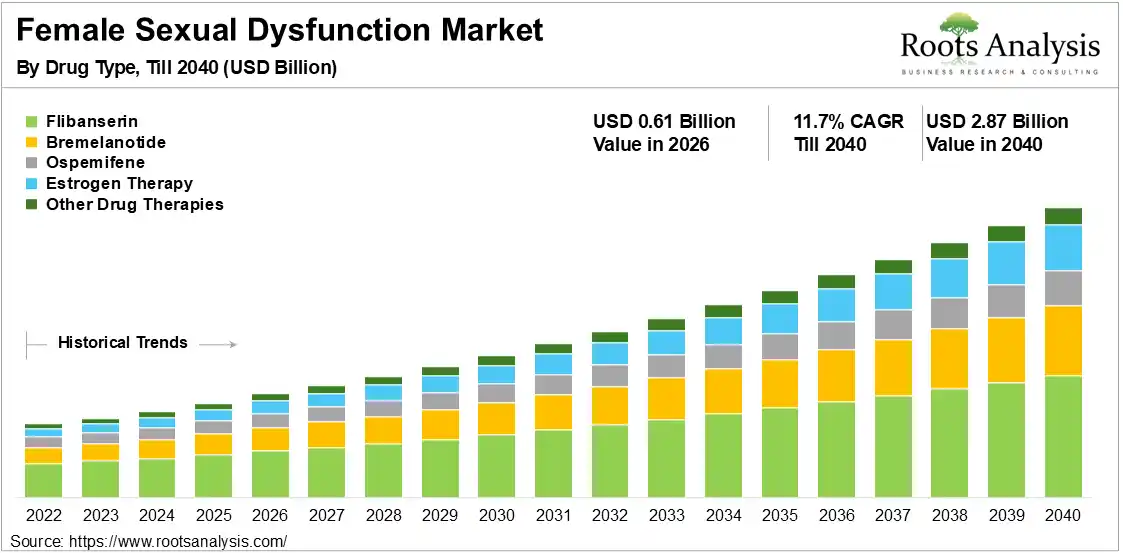
The global female sexual dysfunction market reached USD 0.61 billion in 2026 and is projected to reach USD 2.87 billion by 2040, growing at a CAGR of 11.7% over the forecast period 2026 to 2040, driven by broader treatment eligibility and delivery innovation.
See What’s in the Full Report – Request Your Complimentary Insights!
Market Report: Key Takeaways
- Based on drug type, estrogen therapy captures 41.0% market share in 2026, whereas other drug therapies register a 17.7% CAGR through 2040, supported by localized formulations and emerging mechanisms.
- Based on disease or indication, dyspareunia captures 62.0% market share in 2026, whereas other female sexual dysfunctions register a 17.4% CAGR through 2040, driven by expanding arousal and orgasmic-disorder treatments.
- Based on route of administration, oral therapies capture 58.0% market share in 2026, whereas topical therapies register a 13.7% CAGR through 2040, supported by localized action and convenient use.
- Based on distribution channel, drug stores and retail pharmacies capture 46.0% market share in 2026, whereas online pharmacies register a 16.4% CAGR through 2040, driven by telehealth and discreet fulfillment.
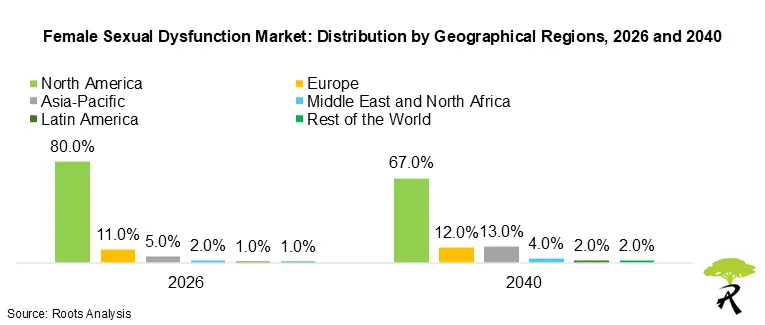
- Based on geography, North America captures 80.0% market share in 2026, whereas Asia-Pacific registers a 19.6% CAGR through 2040, supported by improving awareness, access, and women’s health investment.
Female Sexual Dysfunction Market Outlook
Treatment demand is shifting from menopause-centered symptom management toward broader desire, arousal, pain, and orgasm-focused care. Estrogen therapy still leads drug demand with 41.0% share in 2026, while oral therapies hold 58.0% across administration routes. Topical therapies, digital interventions, and virtual prescribing now challenge that structure through localized action, greater privacy, and easier access. These changes are expanding the female sexual dysfunction market beyond established gynecology-led pathways.
Current growth reflects wider treatment eligibility, stronger awareness, and improved access across pharmacies, telehealth, and specialist channels. The FDA expanded Addyi approval in December 2025 to postmenopausal women under 65 with acquired, generalized hypoactive sexual desire disorder. That decision widened the addressable treatment population and strengthened oral therapy demand among an underserved patient group. It also reinforced regulatory recognition of unmet needs across menopause-related sexual dysfunction.
Through 2040, the market will remain high-growth as other drug therapies expand to 17.7% CAGR and topical treatments advance at 13.7%. Online pharmacies will grow to 16.4%, while Asia-Pacific will expand at 19.6% through better awareness and digital access. In February 2026, GAIA’s mylovia intervention improved desire, satisfaction, sexual function, and pain outcomes. The outlook favors diversified, evidence-based, discreet care models with broader treatment coverage.
Female Sexual Dysfunction Market Dynamics
Female Sexual Dysfunction Market Drivers
Broader treatment eligibility and channel expansion are accelerating demand across established and emerging therapies. Dyspareunia represents 62.0% of indication demand in 2026, supporting estrogen, ospemifene, and localized treatments. Oral therapies retain 58.0% share through familiar prescribing and pharmacy workflows. The December 2025 Addyi label expansion added postmenopausal women under 65. It widened the treated population and reinforced hypoactive sexual desire disorder treatment demand.
Female Sexual Dysfunction Market Restraints
Clinical heterogeneity, stigma, and promotional compliance risks slow diagnosis and commercial conversion. Desire, arousal, orgasmic, and pain disorders require different endpoints, formulations, and care pathways. The FDA’s May 2025 warning letter to Sprout Pharmaceuticals highlighted risks from incomplete safety communication in social-media promotion. Companies must therefore fund evidence generation, careful patient education, and compliant promotion before scaling direct-to-consumer demand.
Female Sexual Dysfunction Market Opportunities
Localized treatment and digital fulfillment create the clearest near-term commercial opportunity. Topical therapies will grow at 13.7% CAGR through 2040, while online pharmacies will expand at 16.4%. These channels can reduce systemic exposure, travel barriers, and privacy concerns. In February 2026, Daré Bioscience activated nationwide telehealth consultations for DARE to PLAY Sildenafil Cream, linking clinical access with home fulfillment.
Female Sexual Dysfunction Market Challenges.
Competitive differentiation increasingly depends on indication-specific evidence rather than broad sexual-health positioning. Other female sexual dysfunctions will grow at 17.4% CAGR, attracting arousal, orgasmic, and mixed-function programs. Futura Medical reported positive WSD4000 study data in June 2026 across sexual satisfaction and several functional measures. Developers still face uncertain reimbursement, variable clinical adoption, and pressure to show meaningful advantages over established oral and hormonal options.
Female Sexual Dysfunction Market Size Estimation Methodology
- As a starting point, the analysis fixed the female sexual dysfunction market scope around commercial treatments, devices, digital interventions, and prescribing infrastructure. It separated drug type, indication, administration route, distribution channel, and geography into non-overlapping categories. Credible published market estimates were then compared across multiple secondary sources. Broader sexual-wellness definitions were excluded because they conflicted with the pharmaceutical treatment taxonomy and distorted revenue comparability.
- Moving forward, the base-year structure was allocated across flibanserin, bremelanotide, ospemifene, estrogen therapy, and other drug therapies. Revenue weights also reflected dyspareunia, hypoactive sexual desire disorder, and other female sexual dysfunctions. Approved product availability, pharmacy presence, route-specific use, and company commercialization status calibrated the starting shares. This step also separated mature menopausal treatments from newer arousal-focused and mixed-function therapies.
- Building on this, regulatory approval timelines, Priority Review decisions, warning letters, clinical trial milestones, and commercial rollouts were reviewed. These indicators captured changes in treatment eligibility, compliance costs, and launch readiness. The Addyi expansion and DARE to PLAY rollout provided commercialization checks. WSD4000 study results and Lybrido Phase II progress clarified development momentum and competitive timing.
- Drawing upon these, segment forecasts applied different growth assumptions to mature and emerging categories. Estrogen therapy and oral administration received lower growth profiles because both already hold large shares. Topical therapies, online pharmacies, other drug therapies, and Asia-Pacific received higher assumptions. Localized delivery, telehealth, awareness, improved access, and women’s health investment support faster adoption across these categories.
- The projected value was then calculated through annual compounding across the 2026 to 2040 forecast period. The model used an 11.7% overall CAGR and generated yearly values rather than only endpoint estimates. Each annual result was cross-checked against the credible CAGR range of 8.8% to 13.6%. Segment-level trajectories were also reconciled against changing shares through 2040.
- Finally, every drug, indication, route, channel, and regional share was checked to ensure each category totaled 100.0%. Sensitivity tests examined slower regulatory expansion, weaker telehealth conversion, delayed topical adoption, and uneven regional access. The final female sexual dysfunction market forecast retained only supported company examples, visible dates, and verified URLs. This control prevented unsupported assumptions from influencing the published outlook.
Female Sexual Dysfunction Market Share Insights
Market Share by Disease / Indication
According to our analysis, dyspareunia leads because menopause-related tissue changes create recurring demand for estrogen, ospemifene, and other localized treatments. Established diagnostic pathways and gynecology prescribing support broad treatment penetration. In February 2025, Mayne Pharma reported growing sales across a women’s health portfolio containing IMVEXXY.
Other female sexual dysfunctions will grow fastest as development expands beyond desire and pain into arousal and orgasmic symptoms. Broader screening and localized therapies will convert previously unmanaged demand into treated cases. Daré Bioscience activated nationwide telehealth consultations for its topical female arousal cream in February 2026.
Market Share by Distribution Channel
Drug stores and retail pharmacies lead through national coverage, immediate fulfillment, pharmacist support, and established payer processing. Their scale remains decisive for recurring oral prescriptions and repeat dispensing. In January 2026, Sprout Pharmaceuticals reported Addyi availability across more than 70,000 United States retail pharmacies.
Online pharmacies will grow fastest as telehealth reduces stigma, travel, and appointment barriers for sensitive conditions. Integrated prescribing and home delivery will improve privacy, convenience, and treatment conversion. Daré Bioscience launched nationwide telehealth consultations through a pharmacy-powered health hub in February 2026.
Want Information on Specific Region / Segment?
Regional Analysis: North America Leads the Market and Asia-Pacific is Likely to Register Higher CAGR
Presently, North America holds 80.0% in 2026, supported by approved therapies, specialist networks, reimbursement capacity, and deep commercialization infrastructure. Capital access and direct-to-patient channels accelerate product launches and treatment uptake.
On the contrary, Asia-Pacific will grow at 19.6%, driven by rising diagnosis, digital access, localized education, and expanding women’s health investment. Large untreated populations create substantial headroom as stigma declines and provider capacity improves.
Market Ecosystem Analysis
The ecosystem contains five Tier 1 leaders, ten specialists, and ten emerging entrants, with leaders controlling approved prescription categories. Consolidation follows platform convergence, illustrated by Wisp’s January 2026 acquisition of TBD Health’s hybrid diagnostics and enterprise capabilities.
Direct prescribing and clinical validation now reshape competition across desire, arousal, dyspareunia, pelvic care, and digital therapy. Competitive advantage is shifting toward operators integrating validated products, prescribing, education, fulfillment, and longitudinal patient support.
- Sprout Pharmaceuticals: Sprout gained FDA approval in December 2025 to extend Addyi to postmenopausal women younger than 65. This widens the oral HSDD segment and pressures Cosette’s on-demand injectable positioning among eligible premenopausal patients.
- Pfizer: November 2025 FDA action reduced warning-related friction around low-dose vaginal estrogen and introduced generic competition for Pfizer’s Premarin franchise. The policy strengthens estrogen therapy acceptance while increasing access and pricing pressure on Pfizer’s branded menopause portfolio.
- Daré Bioscience and Rosy Wellness: In June 2025, both companies launched a collaboration covering education, clinician engagement, consumer outreach, and companion digital support. Rosy expands Daré’s audience reach, raising the education barrier for compounded creams and strengthening the topical arousal segment.
- Daré Bioscience: In February 2026, Daré activated nationwide telehealth consultations and pre-fulfillment prescriptions through its DARE Health Hub. This shortens prescription initiation and strengthens topical sildenafil distribution through online pharmacy and telehealth channels.
- Arletta Pharma Solutions: Arletta initiated a Phase II dose-response study in August 2025 for testosterone and sildenafil combinations in premenopausal FSIAD. Objective clitoral blood-flow measurement raises the development threshold for investigational therapies targeting female arousal and desire.
- eSense Health: eSense published pivotal randomized-trial findings in April 2025, showing improved desire, distress, satisfaction, and sustained six-month benefits.This raises the evidence threshold for wellness applications and strengthens digital treatment for sexual interest and arousal disorder.
- GAIA AG: GAIA-linked researchers published the mylovia randomized trial in February 2026, covering 252 women with sexual dysfunction or sexual pain. Positive functional, desire, satisfaction, and pain-cognition outcomes strengthen digital therapy across dyspareunia and other female sexual dysfunctions.
- Evaro: Evaro closed a $25 million Series A in January 2026, led by AlbionVC, to expand APIs and clinical services. Embedded consultations, prescribing, dispensing, and aftercare lower infrastructure barriers for sexual-wellness brands entering regulated online care.
Startup Companies and their Key Highlights
- Allo Health
- Event type and funding amount: Pre-Series A funding of INR 16 crore, approximately USD 1.9 million
- Month and year: March 2025
- Lead investor: Rainmatter
- Other participating investor: Nexus Venture Partners
- Stated purpose: Expand clinics, diagnostics, digital therapeutics solutions, and technology-supported patient care
- Market implication: Accelerates Asia-Pacific hybrid sexual-health access through clinics, diagnostics, standardized protocols, and digital treatment pathways
- Evaro
- Event type and funding amount: Series A funding of $25 million
- Month and year: January 2026
- Lead investor: AlbionVC
- Other participating investors: Exceptional Ventures, Simplyhealth Ventures, Cornerstone VC, and BBI
- Stated purpose: Enhance Evaro’s integration API and expand consultations, diagnostics, prescribing, dispensing, and aftercare capabilities
- Market implication: Strengthens European online prescribing infrastructure for women’s health platforms and sexual-wellness brands requiring regulated clinical services
- Wisp
- Event type: Acquisition of TBD Health
- Month and year: January 2026
- Strategic partner: TBD Health
- Stated purpose: Expand Wisp’s enterprise strategy, hybrid-care delivery, diagnostics, and integrated sexual-health services
- Market implication: Strengthens North American virtual care and diagnostics while raising integration barriers for stand-alone telehealth providers
- Arletta Pharma Solutions
- Event type: Phase II clinical dose-response study initiation
- Month and year: August 2025
- Stated purpose: Evaluate two testosterone and sildenafil combinations using objective clitoral blood-flow measurements in premenopausal women with FSIAD
- Market implication: Advances the other-drug-therapies segment and differentiates dual-action treatment through physiological arousal biomarkers
- eSense Health
- Event type: Publication of pivotal randomized clinical-trial results
- Month and year: April 2025
- Stated purpose: Validate digital cognitive behavioral therapy and mindfulness-based therapy for female sexual interest and arousal disorder
- Market implication: Expands North American digital treatment access by addressing stigma, provider shortages, waitlists, and affordability barriers
- Joylux
- Event type: Launch of the Juicy Like a Peach vaginal dryness gel
- Month and year: July 2026
- Strategic partner: Halle Berry
- Stated purpose: Relieve menopause-related vaginal dryness, discomfort, and painful intercourse using FDA-cleared HPMC-5 technology
- Market implication: Expands North American dyspareunia and intimate-comfort distribution through direct sales and national beauty retail channels
Female Sexual Dysfunction Market Trends / Opportunities
Localized Topical Therapies Expanding the Female Sexual Dysfunction Market Beyond Oral Treatment
Topical therapies will increase from 31.0% market share in 2026 to 40.0% by 2040, growing at 13.7% CAGR. Localized action supports convenient, as-needed use and reduces dependence on daily oral treatment. Daré Bioscience began DARE to PLAY’s regulated commercial rollout in December 2025 through a Section 503B outsourcing facility. The shift expands competition around formulation speed, evidence quality, and direct patient access.
Pipeline activity is widening the commercial field beyond approved desire and menopause therapies. Futura Medical reported positive WSD4000 study data in June 2026 across sexual satisfaction and several aspects of sexual function. Successful differentiation could give topical developers access to arousal-focused patients underserved by current oral and hormonal options.
Digital Care Pathways Accelerating Female Sexual Dysfunction Market Access and Online Fulfillment
Online pharmacies will expand from 22.0% market share in 2026 to 39.0% by 2040, growing at 16.4% CAGR. Telehealth can reduce stigma, travel, and appointment barriers for sensitive conditions. Daré Bioscience launched nationwide telehealth consultations for DARE to PLAY in February 2026. Integrated prescribing and fulfillment will strengthen platforms that combine clinical review, privacy, and rapid delivery.
Regulated digital pathways are also reshaping how patients enter treatment. Evaro launched the United Kingdom’s first regulated digital prescription pathway for female sexual dysfunction treatment in December 2025. Providers with compliant prescribing infrastructure can convert previously unmanaged demand while reducing dependence on specialist clinic capacity.
Broader Regulatory Eligibility Strengthening Oral HSDD Competition
Oral therapies retain 58.0% market share in 2026 because prescribers understand dosing, reimbursement, and retail fulfillment. The FDA expanded Addyi approval in December 2025 to postmenopausal women under 65 with acquired, generalized hypoactive sexual desire disorder. Wider eligibility strengthens flibanserin demand and raises competitive pressure across the hypoactive sexual desire disorder treatment market.
Regulatory expansion also increases scrutiny of promotional conduct and risk communication. The FDA issued Sprout Pharmaceuticals a warning letter in May 2025 concerning promotional claims and omitted risk information. Competitors must balance consumer education with compliant messaging, increasing commercialization costs for direct-to-patient campaigns.
Indication Expansion Shifting Growth Toward Arousal and Mixed-Function Therapies
Other female sexual dysfunctions will grow at 17.4% CAGR through 2040, outpacing dyspareunia and hypoactive sexual desire disorder. Freya Pharma Solutions initiated a Phase II dose-response study of Lybrido in August 2025. Programs addressing combined psychological and physiological mechanisms can capture demand beyond single-symptom treatment categories.
Clinical evidence is becoming more indication-specific as developers target arousal, satisfaction, and functional outcomes. Arletta Pharma Solutions announced positive Phase II clitoral Doppler ultrasound results for Lybrido in March 2026. Strong endpoint differentiation will determine which emerging therapies secure partnerships, regulatory progress, and specialist adoption.
Your Business is Unique – Why Shouldn’t Your Report Be?
Market Access Considerations
Indication-Specific Regulatory Approval and Promotional Compliance
Regulatory scope determines which patients companies can address and how quickly brands can expand. The December 2025 Addyi approval extension opened access to postmenopausal women under 65. The FDA’s May 2025 warning letter to Sprout Pharmaceuticals also showed that promotional claims require complete risk communication. Strong regulatory execution can widen eligible populations, protect marketing continuity, and strengthen prescriber confidence. Compliance failures can increase review costs and delay patient-acquisition campaigns. This discipline matters across regulated commercial channels.
Clinical Evidence Across Distinct Sexual-Function Endpoints
Market entry requires evidence matched to desire, arousal, pain, satisfaction, or mixed-function outcomes. Futura Medical reported positive WSD4000 data in June 2026 across sexual satisfaction and several functional measures. Arletta Pharma Solutions reported positive Phase II clitoral Doppler ultrasound results for Lybrido in March 2026. Developers with differentiated endpoints can support regulatory discussions, specialist adoption, reimbursement arguments, and partnership negotiations. Weak evidence limits positioning against established hormonal and oral options. This matters during commercial expansion.
Retail Pharmacy Reach and Digital Prescribing Infrastructure
Distribution scale shapes treatment conversion because privacy, convenience, and repeat fulfillment directly influence patient follow-through. Sprout Pharmaceuticals reported Addyi availability across more than 70,000 United States retail pharmacies in January 2026. Evaro launched a regulated digital prescription pathway in December 2025. Companies combining compliant prescribing, payer processing, pharmacy fulfillment, and discreet delivery can scale faster than clinic-dependent competitors. These capabilities also improve geographic reach without building specialist networks. This expands access across underserved patient populations.
Formulation Manufacturing and Section 503B Commercialization
Topical products require reliable compounding, prescription controls, and consistent formulation quality before national scaling. Daré Bioscience began DARE to PLAY’s commercial rollout in December 2025 through a Section 503B outsourcing facility. This pathway enabled regulated market entry before broader conventional commercialization. Competitors must secure suitable manufacturing capacity, evidence-backed formulations, pharmacy integration, and quality oversight. Operational readiness therefore influences launch speed, supply continuity, expansion costs, and confidence among prescribing partners. These controls remain critical during geographic expansion.
How Stakeholders Benefit from the Key Focus Areas of Our Female Sexual Dysfunction Market Report
Commercial urgency is rising as treatment eligibility broadens, topical formulations advance, and digital prescribing reduces privacy and access barriers. The report connects segment economics, regulatory activity, technology adoption, and competitive positioning to support portfolio, investment, development, and market-entry decisions.
- Unmet Needs and Market Gaps in Female Sexual Dysfunction Market: The report separates unmet demand across desire, arousal, orgasmic, pain, and menopause-related conditions. Commercial teams can identify where established estrogen and oral therapies leave patients underserved. R&D and portfolio leaders can use the 17.4% CAGR for other female sexual dysfunctions to prioritize differentiated endpoints, formulations, and patient groups. This supports indication selection and product-positioning decisions.
- Funding and Venture Investment Opportunities in Female Sexual Dysfunction Market: The report highlights growth pockets with stronger expansion than mature hormonal categories. Investment committees can compare the 17.7% CAGR for other drug therapies, 16.4% for online pharmacies, and 19.6% for Asia-Pacific. Pipeline activity across Daré Bioscience, Futura Medical, Arletta Pharma Solutions, and GAIA shows where capital is supporting new mechanisms and care models. This evidence supports funding allocation and diligence priorities.
- Technology Innovation and Adoption Trends: The analysis tracks topical vasodilators, digital interventions, virtual prescribing, intimate-health devices, and localized menopausal treatments. Product and technology leaders can compare adoption curves across oral, parenteral, and topical routes. Topical therapies will increase from 31.0% share in 2026 to 40.0% by 2040. This supports platform selection, development sequencing, and channel integration decisions.
- Female Sexual Dysfunction Market Competitive Landscape and Industry Analysis: The report maps approved drug suppliers, clinical-stage developers, device companies, digital-therapeutic providers, and prescribing platforms. Corporate development teams can distinguish Tier 1 leaders from specialists and emerging companies using regulatory maturity and commercialization presence. Segment shares show where estrogen therapy, flibanserin, ospemifene, and newer treatments compete. This supports benchmarking, entry positioning, and competitor-response planning.
- Mapping Strategic Partnerships and Ecosystem Synergies: The ecosystem analysis shows how developers combine clinical evidence, education, telehealth, pharmacy fulfillment, and symptom-directed products. Business development teams can examine collaboration logic across Daré Bioscience, Rosy Wellness, Evaro, GAIA, and other validated participants. The mapping clarifies where partnerships can improve patient acquisition, prescribing access, evidence communication, or distribution reach. This supports partner screening and alliance design.
- Female Sexual Dysfunction Market CAGR and Growth Trends: The report explains how the 11.7% overall CAGR differs across drugs, indications, routes, channels, and regions. Planning teams can compare mature segments with faster categories such as topical therapies, online pharmacies, and Asia-Pacific. Share shifts through 2040 show where leadership positions may weaken despite continued revenue growth. This supports forecast calibration, regional prioritization, capacity planning, and long-term portfolio allocation.
Female Sexual Dysfunction Market: Scope of the Report
| Key Report Attributes | Details | |
| Forecast Period | Till 2040 | |
| Market Size 2026 | USD 0.61 Billion | |
| Market Size 2040 | USD 2.87 Billion | |
| CAGR (Till 2040) | 11.7% | |
| Segments Covered |
|
|
| Geographical Regions Covered |
|
|
| Key Sections Covered |
|
|
Market Segmentation
The Female Sexual Dysfunction Market report presents an in-depth analysis, highlighting the capabilities of various stakeholders, based on different segments, such as drug type, disease or indication, route of administration, distribution channel, geographical regions, and leading players.
By Drug Type
- Flibanserin
- Bremelanotide
- Ospemifene
- Estrogen Therapy
- Other Drug Therapies
By Disease or Indication
- Hypoactive Sexual Desire Disorder
- Dyspareunia
- Other Female Sexual Dysfunctions
By Route of Administration
- Oral
- Parenteral
- Topical
By Distribution Channel
- Hospital Pharmacies
- Drug Stores and Retail Pharmacies
- Online Pharmacies
By Geographical Regions
- North America
- US
- Canada
- Mexico
- Rest of North America
- Europe
- Austria
- Belgium
- Denmark
- France
- Germany
- Ireland
- Italy
- Netherlands
- Norway
- Russia
- Spain
- Sweden
- Switzerland
- UK
- Rest of Europe
- Asia-Pacific
- China
- India
- Japan
- Singapore
- South Korea
- Rest of Asia-Pacific
- Latin America
- Argentina
- Brazil
- Chile
- Colombia
- Venezuela
- Rest of Latin America
- Middle East and Africa (MEA)
- Egypt
- Iran
- Iraq
- Israel
- Kuwait
- Saudi Arabia
- UAE
- Rest of MEA
- Rest of the World


