Glycated Haemoglobin Testing Market
Glycated Haemoglobin Testing Market: Industry Trends and Global Forecast, Till 2035 – Distribution by Type of Testing (Laboratory-Based Testing and Point-of-Care (POC) Testing), Type of Test Method (Immunoassays, Enzymatic Assays, Boronate Affinity Chromatography, High-Performance Liquid Chromatography, Capillary Electrophoresis and Others), Application Area, Distribution Channel, End User, Geographical Regions and Leading Players
-
Lowest Price Guaranteed
-
Pages
159 -
Last Updated
October 2026 -
View Count
13812 -
Market Size
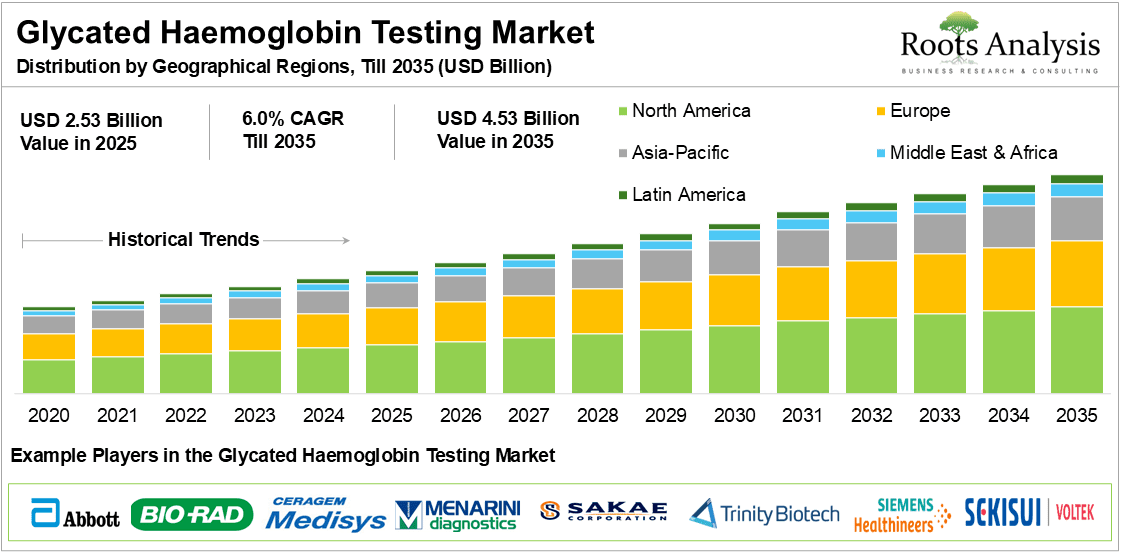
The global glycate haemoglobin testing market, valued at USD 2.35 billion in 2024, is projected to reach USD 2.53 billion in 2025 and USD 4.53 billion by 2035, with a CAGR of 6.0% during the forecast period 2025 to 2035. This market is growing remarkably, driven by the increasing number of people with diabetes who require regular monitoring for management.
To learn more about this report, request a free sample copy
Market Report: Key Takeaways
- The rising prevalence of diabetes and increasing demand for at-home testing kits to manage and monitor diabetes is driving the glycated haemoglobin market growth.
- In terms of test, the point-of-care (POC) testing segment is securing 60% of the overall revenue share due to the high demand for remote diagnostic solutions.
- In terms of test method, the immunoassays segment is dominating the market, accounting for more than 35% of the market share. This growth is due to the widespread usage of immunoassays test due to its convenience and high accuracy rate.
- In terms of geographical regions, North America is dominating the market by holding 40% of the overall revenue share. Several factors, such as high prevalence of diabetes, favorable government policies and technological innovations, are fueling the market growth in this region.
Market Overview
Glycated hemoglobin test is used to measure the hemoglobin A1c (HbA1c), which provides information about the average blood glucose level of an individual over the past three months. This testing is essential for the diagnosis and management of diabetes. As a laboratory or point-of-care blood test, HbA1c measurement forms part of in vitro diagnostics.
With sedentary lifestyle and bad eating habits, there will be a surge in the incidence of diabetes globally. As per the stats published in International Diabetes Federation, by 2050, nearly 853 million (1 in 8 adults) will be living with diabetes. It is worth noting that poorly managed or irregular medication can increase the risk of diabetes wounds, dizziness and confusion, which can potentially impact an individual life.
To effectively manage diabetes, glycated haemoglobin testing kits and devices emerged as a potential solution. Some of the significances of this testing includes no requirement of fasting before testing, low day-to-day variation, and high sample stability. Considering the significances, industry player are focusing on the development of at-home HbA1c test kits for self-monitoring glycemic control so patients can effectively monitor and manage diabetes independently. As the industry players emphasis on rapid testing solutions, the glycated haemoglobin testing market will grow at an unprecedented rate in the upcoming years.
Recent Developments in Glycated Haemoglobin Market
- In September 2025, Awanui Labs unveiled a new method for HbA1c testing used in monitoring and diagnosis of diabetes.
- In July 2025, A recent independent study conducted by the Lenters-Westra, et al., revealed that 19 POC HbA1c device Afinion™ 2 analyzer delivers lab-quality HBA1c result at the point-of-care.
- In May 2025, Tosoh Bioscience – Diagnostics EMEA has launched a highly compact and high performance GR01 HbA1c analyzer for glycated haemoglobin testing on the basis of ion-exchange HPLC methodology.
- In August 2025, PocDoc (UK) has successfully launched a smartphone-based HbA1c blood test for Type 2 diabetes. Currently, this test is being piloted in the Northeast and North Cumbria as a part of a project commissioned by Health Innovation Northeast and North Cumbria.
Market Trends
- Digital Health Integration in HbA1c Test Result Management: With increasing shift toward digital healthcare solutions, the industrial players are focusing on the development of smartphone-based HbA1c testing solutions, which allow diabetic patients to get instant results at home using a smartphone app and finger-prick sample.
- Telemedicine Deployment of Remote Hba1c Monitoring Solutions: It is worth noting that the growing acceptance of continuous glucose monitoring devices and automated analyzers for high-throughput HbA1c diagnostics is likely to encourage the deployment of telemedicine with HbA1c. This integration provide a holistic approach to the patients, allowing them to consult with healthcare professionals virtually for proactive diabetes management.
- Regulatory Approval Trends in HbA1c Testing Products: Driven by the growing focus on point-of-care diagnostics devices, the regulatory agencies are heavily focused on offering standard guidelines to ensure higher accuracy, standardization, and greater accessibility of diagnostic devices across the globe. For instance, the necessity of the USFDA 510(k) clearance and CE mark for the approval of diagnostic devices is encouraging market players to develop highly standardized diagnostic devices, which positively influencing the market growth.
Industry Experts on Glycated Haemoglobin Testing Market
Experts believe that the future of the HbA1c seems promising with growing emphasis on point-of-care HbA1c testing for diabetes management.
Heidi Cassaletto (Senior Vice President Portfolio Strategy and Global Marketing For Ortho Clinical Diagnostics), stated that, ‘These tests all paint a picture of where the disease is at,’ notes. And with more home testing products coming to market and most primary care physicians using A1C as their go-to testing control, it wouldn’t be a stretch to think that diabetes testing has reached a sort of end point; what we have now is enough.
Market Drivers
- Increasing Prevalence of Diabetes: The growing incidence of diabetes across the globe and rising shift towards gestational diabetes management has necessitated the demand for HbA1c home testing kits.
- HbA1c Testing for Pediatric and Gestational Diabetes Care: The increasing shift towards gestational diabetes care is further bolstering the requirement for advanced HbA1c testing solution. These glucose monitoring devices helps in early detection of type 1 diabetes in pregnant women, which allow healthcare professionals in offering precise treatment to prevent the risk of diabetic ketoacidosis. Notably, the future focus lies in pediatric diabetes care. The lab-based HbA1c assays in combination with autoantibody testing will be used to identify at-risk children in the pre-symptomatic stages of the diabetes.
- Innovations in Non-Invasive HbA1c Measurement Technologies: It is worth noting that the market players are undertaking various research and development initiatives to produce user-friendly and accurate non-invasive glycemic control monitoring products. In addition to non-invasive glycated haemoglobin testing solutions, the industry players are focusing on the development of HbA1c home testing kits that aid in monitoring and managing diabetes at home.
Market Segmentation Analysis
Point-of-Care HbA1c Testing Devices for Diabetes Management Demand is likely to Grow in the Future
- Based on the type of testing, the global market is segmented into laboratory-based testing and point-of-care (POC) testing. According to the glycated haemoglobin testing market forecast, the point-of-care (POC) testing segment dominates the market by holding 60% of the market share. This dominance stems from the rising preferences for POCT for HbA1c due to its convenience of usage outside the laboratory settings independently by patients for monitoring diabetes.
- It is important to mention here that the point-of-care testing segment will continue to grow at a higher CAGR during the forecast period. The rising technological innovation to improve the accuracy of HbA1c testing devices and heightened demand for at-home testing kits are the key reasons for the lucrative growth in the upcoming years.
Type of Test Method Market Segment is Currently Dominating the Market
- This segment highlights the distribution of global market across different type of technology, such as immunoassays, chromatography, enzymatic assays, boronate affinity chromatography, high-performance liquid chromatography, capillary electrophoresis, and others. Presently, the immunoassays segment is accounting for over 35% of the glycated haemoglobin testing market share. This can be attributed to the heightened demand for immunoassay technologies for HbA1c testing due to its higher accuracy in measuring glycated haemoglobin.
- It is important to note that this segment will continue to gain momentum at the fastest CAGR during the forecast period. The growing need for immune-assay-based point-of-care devices to monitor and manage diabetes without the requirement for advanced laboratory infrastructure is the key driver for the market.
Market Regional Insights
North America Continue to Dominate in the Future
According to our glycated hemoglobin market report, North America is dominating the market by securing 40% of the overall revenue share. This highest share stems from the rising prevalence of diabetes and growing technological innovation to development advanced automated analyzers for high-throughput HbA1c diagnostics.
US Glycated Haemoglobin Testing Market
The growing incidence of diabetes, obesity and availability of supportive regulatory framework for technological innovations is likely to propel the market in the US. It is important to highlight here that well-established market players, such as Abbott Laboratories, and Pfizer (US) are presently accelerating their efforts for the development of rapid HbA1c testing solutions, which is likely to contribute to the overall growth of the market in this region.
Europe holds a substantial share of the overall glycated haemoglobin market growth and will continue to grow in the future. The favorable research policies, increasing research funding, advanced healthcare infrastructure, and high disposable income are likely to drive the market in this region.
UK Glycated Haemoglobin Testing Market
The increasing awareness about early diabetes diagnosis during gestational period, high disposable income and increase diabetes incidence are several factors that are propelling the market in the UK. In addition, the consistent focus on the development of innovation diabetes diagnostics devices for instant monitoring is driving the growth of the market in this country.
The growing incidence of diabetes and increasing government initiatives to raise awareness about the gestational and pediatric diabetes is likely to grow the market at a higher CAGR in this region. It is important to note here that several government organizations are actively encouraging the development of point-of-care diagnostic solutions to manage and monitor diabetes across Asian population, contributing to the growth of this market in Asian countries.
India Glycated Haemoglobin Testing Market
In India, the increasing concern of diabetes has catered the attention of industrial players, healthcare professionals, and MedTech startup companies to develop advanced diagnostic solutions. In order to combat the concern of diabetes epidemic, Dr. Mohan Diabetes Center (India) has established a holistic diabetes care center for diabetes diagnosis and management. Dr. Mohan is currently organizing regular screening programs with cutting-edge technologies to help patients manage their diabetes.
Additionally, the Ministry of Health & Family Welfare (India) is initiating a “National Programme For Prevention And Control of Non-Communicable Diseases” to help people in managing diabetes with regular screening and drugs.
Market Growth in China and Japan
Countries, such as China and Japan have well-established healthcare infrastructure, which forms the backbone for the adoption of advanced diagnostic solutions and therapeutic drugs for diabetes management. In addition, the government organizations continually encourage the regular hbA1c testing for effective diagnosis and management of the diabetes.
Glycated Haemoglobin Testing Market: Scope of the Report
| Key Report Attributes | Details | |
| Historical Trend | Since 2020 | |
| Forecast Period | Till 2035 | |
| Market Size 2025 | USD 2.53 Billion | |
| Market Size 2035 | USD 4.53 Billion | |
| CAGR (Till 2035) | 6.0% | |
| Key Players Profiled |
|
|
| Segments Covered |
|
|
| Excel Data Packs (Complimentary) |
|
|
| PowerPoint Presentation (Complimentary) |
Available | |
| Customization Scope | 15% Free Customization | |
Market Segments
Based on the research, we have segmented the glycated haemoglobin testing market into type of test, type of test method, application area, distribution channel, end user, geographical regions, and leading players.
Glycated Haemoglobin Testing Market, by Type of Testing
- Laboratory-Based Testing
- Point-of-Care (POC) Testing
Glycated Haemoglobin Testing Market, by Type of Test Method
- Immunoassays
- Enzymatic Assays
- Boronate Affinity Chromatography
- High-Performance Liquid Chromatography
- Capillary Electrophoresis
- Others
Glycated Haemoglobin Testing Market, by Application Area
- Diabetes Monitoring
- Gestational Diabetes Management
- Chronic Conditions Management
Glycated Haemoglobin Testing Market, by Distribution Channel
- Direct Sales
- Distributors and Third-Party Vendors
- Online Retailers
- Pharmacies and Drug Stores
Glycated Haemoglobin Testing Market, by End User
- Hospitals & Clinics
- Diagnostic Laboratories
- Homecare Settings
Glycated Haemoglobin Testing Market, by Geographical Regions
- North America
- US
- Canada
- Mexico
- Europe
- France
- Germany
- Italy
- Spain
- UK
- Rest of Europe
- Asia-Pacific
- China
- India
- Japan
- South Korea
- New Zealand
- Rest of the Asia-Pacific
- Middle East & Africa
- Egypt
- Iran
- Iraq
- Israel
- Saudi Arabia
- South Africa
- United Arab Emirates
- Latin America
- Argentina
- Brazil